 Add to Chrome
 Add to Firefox
 Add to Edge
Seedance 2.0: Advancing Video Generation for World Complexity
Apr 15, 2026
Seedance 2.0 is a new native multi-modal audio-video generation model, officially released in China in early February 2026. Compared with its predecessors, Seedance 1.0 and 1.5 Pro, Seedance 2.0 adopts a unified, highly efficient, and large-scale architecture for multi-modal audio-video joint generation. This allows it to support four input modalities: text, image, audio, and video, by integrating one of the most comprehensive suites of multi-modal content reference and editing capabilities available in the industry to date. It delivers substantial, well-rounded improvements across all key sub-dimensions of video and audio generation. In both expert evaluations and public user tests, the model has demonstrated performance on par with the leading levels in the field. Seedance 2.0 supports direct generation of audio-video content with durations ranging from 4 to 15 seconds, with native output resolutions of 480p and 720p. For multi-modal inputs as reference, its current open platform supports up to 3 video clips, 9 images, and 3 audio clips. In addition, we provide Seedance 2.0 Fast version, an accelerated variant of Seedance 2.0 designed to boost generation speed for low-latency scenarios. Seedance 2.0 has delivered significant improvements to its foundational generation capabilities and multi-modal generation performance, bringing an enhanced creative experience for end users.

Mixture-of-Depths Attention
Mar 16, 2026Scaling depth is a key driver for large language models (LLMs). Yet, as LLMs become deeper, they often suffer from signal degradation: informative features formed in shallow layers are gradually diluted by repeated residual updates, making them harder to recover in deeper layers. We introduce mixture-of-depths attention (MoDA), a mechanism that allows each attention head to attend to sequence KV pairs at the current layer and depth KV pairs from preceding layers. We further describe a hardware-efficient algorithm for MoDA that resolves non-contiguous memory-access patterns, achieving 97.3% of FlashAttention-2's efficiency at a sequence length of 64K. Experiments on 1.5B-parameter models demonstrate that MoDA consistently outperforms strong baselines. Notably, it improves average perplexity by 0.2 across 10 validation benchmarks and increases average performance by 2.11% on 10 downstream tasks, with a negligible 3.7% FLOPs computational overhead. We also find that combining MoDA with post-norm yields better performance than using it with pre-norm. These results suggest that MoDA is a promising primitive for depth scaling. Code is released at https://github.com/hustvl/MoDA .
Cross-Layer Attentive Feature Upsampling for Low-latency Semantic Segmentation
Jan 03, 2026Semantic segmentation is a fundamental problem in computer vision and it requires high-resolution feature maps for dense prediction. Current coordinate-guided low-resolution feature interpolation methods, e.g., bilinear interpolation, produce coarse high-resolution features which suffer from feature misalignment and insufficient context information. Moreover, enriching semantics to high-resolution features requires a high computation burden, so that it is challenging to meet the requirement of lowlatency inference. We propose a novel Guided Attentive Interpolation (GAI) method to adaptively interpolate fine-grained high-resolution features with semantic features to tackle these issues. Guided Attentive Interpolation determines both spatial and semantic relations of pixels from features of different resolutions and then leverages these relations to interpolate high-resolution features with rich semantics. GAI can be integrated with any deep convolutional network for efficient semantic segmentation. In experiments, the GAI-based semantic segmentation networks, i.e., GAIN, can achieve78.8 mIoU with 22.3 FPS on Cityscapes and 80.6 mIoU with 64.5 on CamVid using an NVIDIA 1080Ti GPU, which are the new state-of-the-art results of low-latency semantic segmentation. Code and models are available at: https://github.com/hustvl/simpleseg.
Seedance 1.5 pro: A Native Audio-Visual Joint Generation Foundation Model
Dec 23, 2025Recent strides in video generation have paved the way for unified audio-visual generation. In this work, we present Seedance 1.5 pro, a foundational model engineered specifically for native, joint audio-video generation. Leveraging a dual-branch Diffusion Transformer architecture, the model integrates a cross-modal joint module with a specialized multi-stage data pipeline, achieving exceptional audio-visual synchronization and superior generation quality. To ensure practical utility, we implement meticulous post-training optimizations, including Supervised Fine-Tuning (SFT) on high-quality datasets and Reinforcement Learning from Human Feedback (RLHF) with multi-dimensional reward models. Furthermore, we introduce an acceleration framework that boosts inference speed by over 10X. Seedance 1.5 pro distinguishes itself through precise multilingual and dialect lip-syncing, dynamic cinematic camera control, and enhanced narrative coherence, positioning it as a robust engine for professional-grade content creation. Seedance 1.5 pro is now accessible on Volcano Engine at https://console.volcengine.com/ark/region:ark+cn-beijing/experience/vision?type=GenVideo.
LENS: Learning to Segment Anything with Unified Reinforced Reasoning
Aug 19, 2025Text-prompted image segmentation enables fine-grained visual understanding and is critical for applications such as human-computer interaction and robotics. However, existing supervised fine-tuning methods typically ignore explicit chain-of-thought (CoT) reasoning at test time, which limits their ability to generalize to unseen prompts and domains. To address this issue, we introduce LENS, a scalable reinforcement-learning framework that jointly optimizes the reasoning process and segmentation in an end-to-end manner. We propose unified reinforcement-learning rewards that span sentence-, box-, and segment-level cues, encouraging the model to generate informative CoT rationales while refining mask quality. Using a publicly available 3-billion-parameter vision-language model, i.e., Qwen2.5-VL-3B-Instruct, LENS achieves an average cIoU of 81.2% on the RefCOCO, RefCOCO+, and RefCOCOg benchmarks, outperforming the strong fine-tuned method, i.e., GLaMM, by up to 5.6%. These results demonstrate that RL-driven CoT reasoning serves as a robust prior for text-prompted segmentation and offers a practical path toward more generalizable Segment Anything models. Code is available at https://github.com/hustvl/LENS.
Seed1.5-VL Technical Report
May 11, 2025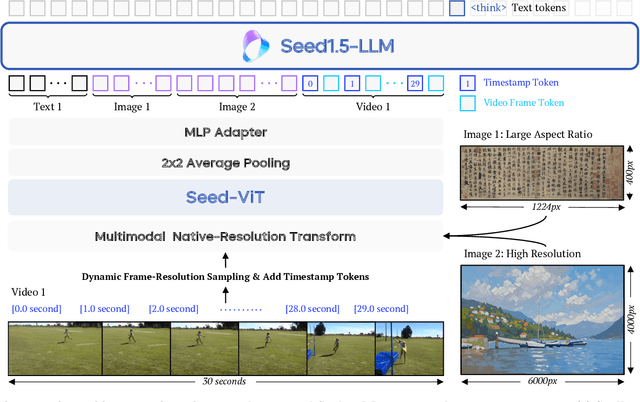

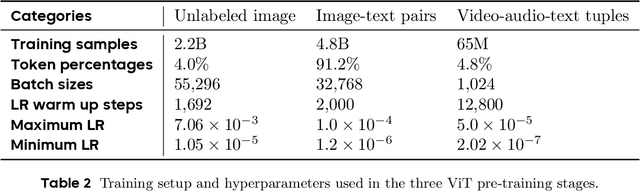
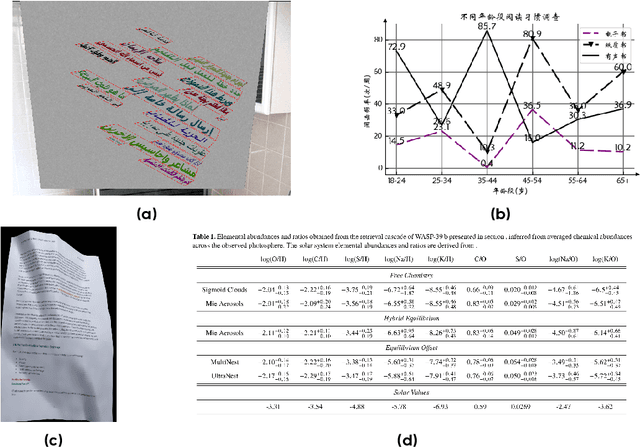
We present Seed1.5-VL, a vision-language foundation model designed to advance general-purpose multimodal understanding and reasoning. Seed1.5-VL is composed with a 532M-parameter vision encoder and a Mixture-of-Experts (MoE) LLM of 20B active parameters. Despite its relatively compact architecture, it delivers strong performance across a wide spectrum of public VLM benchmarks and internal evaluation suites, achieving the state-of-the-art performance on 38 out of 60 public benchmarks. Moreover, in agent-centric tasks such as GUI control and gameplay, Seed1.5-VL outperforms leading multimodal systems, including OpenAI CUA and Claude 3.7. Beyond visual and video understanding, it also demonstrates strong reasoning abilities, making it particularly effective for multimodal reasoning challenges such as visual puzzles. We believe these capabilities will empower broader applications across diverse tasks. In this report, we mainly provide a comprehensive review of our experiences in building Seed1.5-VL across model design, data construction, and training at various stages, hoping that this report can inspire further research. Seed1.5-VL is now accessible at https://www.volcengine.com/ (Volcano Engine Model ID: doubao-1-5-thinking-vision-pro-250428)
GroundingSuite: Measuring Complex Multi-Granular Pixel Grounding
Mar 13, 2025Pixel grounding, encompassing tasks such as Referring Expression Segmentation (RES), has garnered considerable attention due to its immense potential for bridging the gap between vision and language modalities. However, advancements in this domain are currently constrained by limitations inherent in existing datasets, including limited object categories, insufficient textual diversity, and a scarcity of high-quality annotations. To mitigate these limitations, we introduce GroundingSuite, which comprises: (1) an automated data annotation framework leveraging multiple Vision-Language Model (VLM) agents; (2) a large-scale training dataset encompassing 9.56 million diverse referring expressions and their corresponding segmentations; and (3) a meticulously curated evaluation benchmark consisting of 3,800 images. The GroundingSuite training dataset facilitates substantial performance improvements, enabling models trained on it to achieve state-of-the-art results. Specifically, a cIoU of 68.9 on gRefCOCO and a gIoU of 55.3 on RefCOCOm. Moreover, the GroundingSuite annotation framework demonstrates superior efficiency compared to the current leading data annotation method, i.e., $4.5 \times$ faster than the GLaMM.
Multimodal Mamba: Decoder-only Multimodal State Space Model via Quadratic to Linear Distillation
Feb 18, 2025Recent Multimodal Large Language Models (MLLMs) have achieved remarkable performance but face deployment challenges due to their quadratic computational complexity, growing Key-Value cache requirements, and reliance on separate vision encoders. We propose mmMamba, a framework for developing linear-complexity native multimodal state space models through progressive distillation from existing MLLMs using moderate academic computational resources. Our approach enables the direct conversion of trained decoder-only MLLMs to linear-complexity architectures without requiring pre-trained RNN-based LLM or vision encoders. We propose an seeding strategy to carve Mamba from trained Transformer and a three-stage distillation recipe, which can effectively transfer the knowledge from Transformer to Mamba while preserving multimodal capabilities. Our method also supports flexible hybrid architectures that combine Transformer and Mamba layers for customizable efficiency-performance trade-offs. Distilled from the Transformer-based decoder-only HoVLE, mmMamba-linear achieves competitive performance against existing linear and quadratic-complexity VLMs, while mmMamba-hybrid further improves performance significantly, approaching HoVLE's capabilities. At 103K tokens, mmMamba-linear demonstrates 20.6$\times$ speedup and 75.8% GPU memory reduction compared to HoVLE, while mmMamba-hybrid achieves 13.5$\times$ speedup and 60.2% memory savings. Code and models are released at https://github.com/hustvl/mmMamba
GaussTR: Foundation Model-Aligned Gaussian Transformer for Self-Supervised 3D Spatial Understanding
Dec 17, 20243D Semantic Occupancy Prediction is fundamental for spatial understanding as it provides a comprehensive semantic cognition of surrounding environments. However, prevalent approaches primarily rely on extensive labeled data and computationally intensive voxel-based modeling, restricting the scalability and generalizability of 3D representation learning. In this paper, we introduce GaussTR, a novel Gaussian Transformer that leverages alignment with foundation models to advance self-supervised 3D spatial understanding. GaussTR adopts a Transformer architecture to predict sparse sets of 3D Gaussians that represent scenes in a feed-forward manner. Through aligning rendered Gaussian features with diverse knowledge from pre-trained foundation models, GaussTR facilitates the learning of versatile 3D representations and enables open-vocabulary occupancy prediction without explicit annotations. Empirical evaluations on the Occ3D-nuScenes dataset showcase GaussTR's state-of-the-art zero-shot performance, achieving 11.70 mIoU while reducing training duration by approximately 50%. These experimental results highlight the significant potential of GaussTR for scalable and holistic 3D spatial understanding, with promising implications for autonomous driving and embodied agents. Code is available at https://github.com/hustvl/GaussTR.
Mask-Adapter: The Devil is in the Masks for Open-Vocabulary Segmentation
Dec 05, 2024Recent open-vocabulary segmentation methods adopt mask generators to predict segmentation masks and leverage pre-trained vision-language models, e.g., CLIP, to classify these masks via mask pooling. Although these approaches show promising results, it is counterintuitive that accurate masks often fail to yield accurate classification results through pooling CLIP image embeddings within the mask regions. In this paper, we reveal the performance limitations of mask pooling and introduce Mask-Adapter, a simple yet effective method to address these challenges in open-vocabulary segmentation. Compared to directly using proposal masks, our proposed Mask-Adapter extracts semantic activation maps from proposal masks, providing richer contextual information and ensuring alignment between masks and CLIP. Additionally, we propose a mask consistency loss that encourages proposal masks with similar IoUs to obtain similar CLIP embeddings to enhance models' robustness to varying predicted masks. Mask-Adapter integrates seamlessly into open-vocabulary segmentation methods based on mask pooling in a plug-and-play manner, delivering more accurate classification results. Extensive experiments across several zero-shot benchmarks demonstrate significant performance gains for the proposed Mask-Adapter on several well-established methods. Notably, Mask-Adapter also extends effectively to SAM and achieves impressive results on several open-vocabulary segmentation datasets. Code and models are available at \url{https://github.com/hustvl/MaskAdapter}.