 Add to Chrome
 Add to Firefox
 Add to Edge
Safe-Sora: Safe Text-to-Video Generation via Graphical Watermarking
May 19, 2025
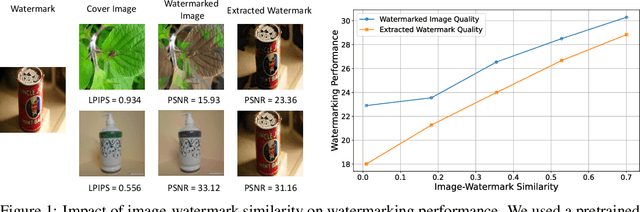
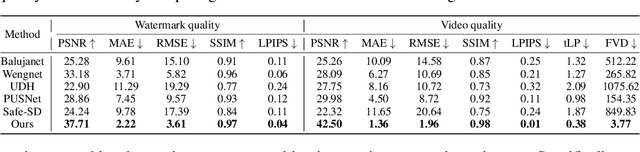
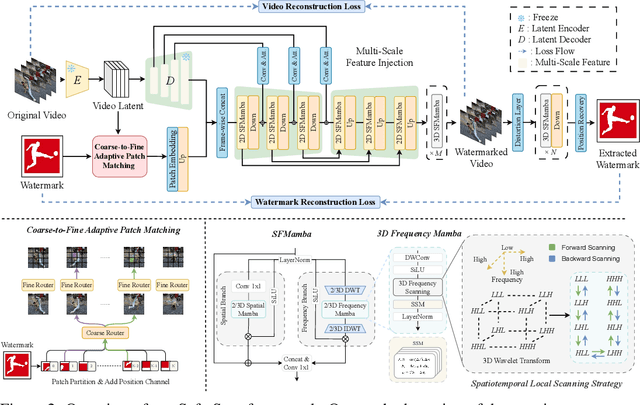
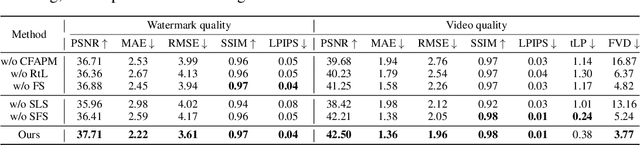
The explosive growth of generative video models has amplified the demand for reliable copyright preservation of AI-generated content. Despite its popularity in image synthesis, invisible generative watermarking remains largely underexplored in video generation. To address this gap, we propose Safe-Sora, the first framework to embed graphical watermarks directly into the video generation process. Motivated by the observation that watermarking performance is closely tied to the visual similarity between the watermark and cover content, we introduce a hierarchical coarse-to-fine adaptive matching mechanism. Specifically, the watermark image is divided into patches, each assigned to the most visually similar video frame, and further localized to the optimal spatial region for seamless embedding. To enable spatiotemporal fusion of watermark patches across video frames, we develop a 3D wavelet transform-enhanced Mamba architecture with a novel spatiotemporal local scanning strategy, effectively modeling long-range dependencies during watermark embedding and retrieval. To the best of our knowledge, this is the first attempt to apply state space models to watermarking, opening new avenues for efficient and robust watermark protection. Extensive experiments demonstrate that Safe-Sora achieves state-of-the-art performance in terms of video quality, watermark fidelity, and robustness, which is largely attributed to our proposals. We will release our code upon publication.

Preference Optimization for Combinatorial Optimization Problems
May 13, 2025Reinforcement Learning (RL) has emerged as a powerful tool for neural combinatorial optimization, enabling models to learn heuristics that solve complex problems without requiring expert knowledge. Despite significant progress, existing RL approaches face challenges such as diminishing reward signals and inefficient exploration in vast combinatorial action spaces, leading to inefficiency. In this paper, we propose Preference Optimization, a novel method that transforms quantitative reward signals into qualitative preference signals via statistical comparison modeling, emphasizing the superiority among sampled solutions. Methodologically, by reparameterizing the reward function in terms of policy and utilizing preference models, we formulate an entropy-regularized RL objective that aligns the policy directly with preferences while avoiding intractable computations. Furthermore, we integrate local search techniques into the fine-tuning rather than post-processing to generate high-quality preference pairs, helping the policy escape local optima. Empirical results on various benchmarks, such as the Traveling Salesman Problem (TSP), the Capacitated Vehicle Routing Problem (CVRP) and the Flexible Flow Shop Problem (FFSP), demonstrate that our method significantly outperforms existing RL algorithms, achieving superior convergence efficiency and solution quality.
Boosting Neural Language Inference via Cascaded Interactive Reasoning
May 10, 2025Natural Language Inference (NLI) focuses on ascertaining the logical relationship (entailment, contradiction, or neutral) between a given premise and hypothesis. This task presents significant challenges due to inherent linguistic features such as diverse phrasing, semantic complexity, and contextual nuances. While Pre-trained Language Models (PLMs) built upon the Transformer architecture have yielded substantial advancements in NLI, prevailing methods predominantly utilize representations from the terminal layer. This reliance on final-layer outputs may overlook valuable information encoded in intermediate layers, potentially limiting the capacity to model intricate semantic interactions effectively. Addressing this gap, we introduce the Cascaded Interactive Reasoning Network (CIRN), a novel architecture designed for deeper semantic comprehension in NLI. CIRN implements a hierarchical feature extraction strategy across multiple network depths, operating within an interactive space where cross-sentence information is continuously integrated. This mechanism aims to mimic a process of progressive reasoning, transitioning from surface-level feature matching to uncovering more profound logical and semantic connections between the premise and hypothesis. By systematically mining latent semantic relationships at various representational levels, CIRN facilitates a more thorough understanding of the input pair. Comprehensive evaluations conducted on several standard NLI benchmark datasets reveal consistent performance gains achieved by CIRN over competitive baseline approaches, demonstrating the efficacy of leveraging multi-level interactive features for complex relational reasoning.
Using External knowledge to Enhanced PLM for Semantic Matching
May 10, 2025Modeling semantic relevance has always been a challenging and critical task in natural language processing. In recent years, with the emergence of massive amounts of annotated data, it has become feasible to train complex models, such as neural network-based reasoning models. These models have shown excellent performance in practical applications and have achieved the current state-ofthe-art performance. However, even with such large-scale annotated data, we still need to think: Can machines learn all the knowledge necessary to perform semantic relevance detection tasks based on this data alone? If not, how can neural network-based models incorporate external knowledge into themselves, and how can relevance detection models be constructed to make full use of external knowledge? In this paper, we use external knowledge to enhance the pre-trained semantic relevance discrimination model. Experimental results on 10 public datasets show that our method achieves consistent improvements in performance compared to the baseline model.
Cobra: Efficient Line Art COlorization with BRoAder References
Apr 16, 2025The comic production industry requires reference-based line art colorization with high accuracy, efficiency, contextual consistency, and flexible control. A comic page often involves diverse characters, objects, and backgrounds, which complicates the coloring process. Despite advancements in diffusion models for image generation, their application in line art colorization remains limited, facing challenges related to handling extensive reference images, time-consuming inference, and flexible control. We investigate the necessity of extensive contextual image guidance on the quality of line art colorization. To address these challenges, we introduce Cobra, an efficient and versatile method that supports color hints and utilizes over 200 reference images while maintaining low latency. Central to Cobra is a Causal Sparse DiT architecture, which leverages specially designed positional encodings, causal sparse attention, and Key-Value Cache to effectively manage long-context references and ensure color identity consistency. Results demonstrate that Cobra achieves accurate line art colorization through extensive contextual reference, significantly enhancing inference speed and interactivity, thereby meeting critical industrial demands. We release our codes and models on our project page: https://zhuang2002.github.io/Cobra/.
InstructEngine: Instruction-driven Text-to-Image Alignment
Apr 14, 2025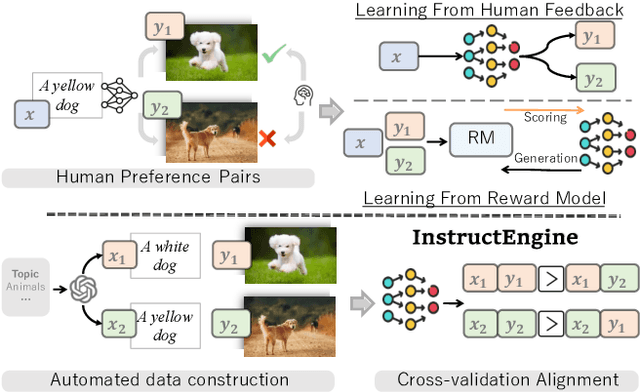
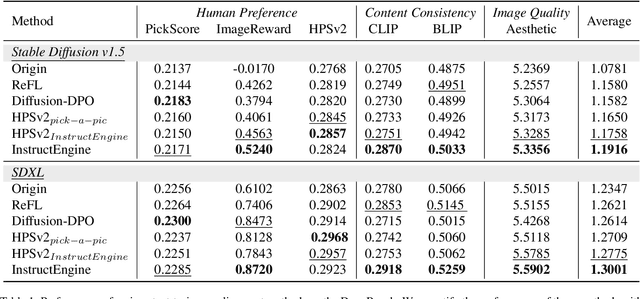

Reinforcement Learning from Human/AI Feedback (RLHF/RLAIF) has been extensively utilized for preference alignment of text-to-image models. Existing methods face certain limitations in terms of both data and algorithm. For training data, most approaches rely on manual annotated preference data, either by directly fine-tuning the generators or by training reward models to provide training signals. However, the high annotation cost makes them difficult to scale up, the reward model consumes extra computation and cannot guarantee accuracy. From an algorithmic perspective, most methods neglect the value of text and only take the image feedback as a comparative signal, which is inefficient and sparse. To alleviate these drawbacks, we propose the InstructEngine framework. Regarding annotation cost, we first construct a taxonomy for text-to-image generation, then develop an automated data construction pipeline based on it. Leveraging advanced large multimodal models and human-defined rules, we generate 25K text-image preference pairs. Finally, we introduce cross-validation alignment method, which refines data efficiency by organizing semantically analogous samples into mutually comparable pairs. Evaluations on DrawBench demonstrate that InstructEngine improves SD v1.5 and SDXL's performance by 10.53% and 5.30%, outperforming state-of-the-art baselines, with ablation study confirming the benefits of InstructEngine's all components. A win rate of over 50% in human reviews also proves that InstructEngine better aligns with human preferences.
Quantization Hurts Reasoning? An Empirical Study on Quantized Reasoning Models
Apr 07, 2025Recent advancements in reasoning language models have demonstrated remarkable performance in complex tasks, but their extended chain-of-thought reasoning process increases inference overhead. While quantization has been widely adopted to reduce the inference cost of large language models, its impact on reasoning models remains understudied. In this study, we conduct the first systematic study on quantized reasoning models, evaluating the open-sourced DeepSeek-R1-Distilled Qwen and LLaMA families ranging from 1.5B to 70B parameters, and QwQ-32B. Our investigation covers weight, KV cache, and activation quantization using state-of-the-art algorithms at varying bit-widths, with extensive evaluation across mathematical (AIME, MATH-500), scientific (GPQA), and programming (LiveCodeBench) reasoning benchmarks. Our findings reveal that while lossless quantization can be achieved with W8A8 or W4A16 quantization, lower bit-widths introduce significant accuracy risks. We further identify model size, model origin, and task difficulty as critical determinants of performance. Contrary to expectations, quantized models do not exhibit increased output lengths. In addition, strategically scaling the model sizes or reasoning steps can effectively enhance the performance. All quantized models and codes will be open-sourced in https://github.com/ruikangliu/Quantized-Reasoning-Models.
MeshCraft: Exploring Efficient and Controllable Mesh Generation with Flow-based DiTs
Mar 29, 2025In the domain of 3D content creation, achieving optimal mesh topology through AI models has long been a pursuit for 3D artists. Previous methods, such as MeshGPT, have explored the generation of ready-to-use 3D objects via mesh auto-regressive techniques. While these methods produce visually impressive results, their reliance on token-by-token predictions in the auto-regressive process leads to several significant limitations. These include extremely slow generation speeds and an uncontrollable number of mesh faces. In this paper, we introduce MeshCraft, a novel framework for efficient and controllable mesh generation, which leverages continuous spatial diffusion to generate discrete triangle faces. Specifically, MeshCraft consists of two core components: 1) a transformer-based VAE that encodes raw meshes into continuous face-level tokens and decodes them back to the original meshes, and 2) a flow-based diffusion transformer conditioned on the number of faces, enabling the generation of high-quality 3D meshes with a predefined number of faces. By utilizing the diffusion model for the simultaneous generation of the entire mesh topology, MeshCraft achieves high-fidelity mesh generation at significantly faster speeds compared to auto-regressive methods. Specifically, MeshCraft can generate an 800-face mesh in just 3.2 seconds (35$\times$ faster than existing baselines). Extensive experiments demonstrate that MeshCraft outperforms state-of-the-art techniques in both qualitative and quantitative evaluations on ShapeNet dataset and demonstrates superior performance on Objaverse dataset. Moreover, it integrates seamlessly with existing conditional guidance strategies, showcasing its potential to relieve artists from the time-consuming manual work involved in mesh creation.
SparseFlex: High-Resolution and Arbitrary-Topology 3D Shape Modeling
Mar 27, 2025Creating high-fidelity 3D meshes with arbitrary topology, including open surfaces and complex interiors, remains a significant challenge. Existing implicit field methods often require costly and detail-degrading watertight conversion, while other approaches struggle with high resolutions. This paper introduces SparseFlex, a novel sparse-structured isosurface representation that enables differentiable mesh reconstruction at resolutions up to $1024^3$ directly from rendering losses. SparseFlex combines the accuracy of Flexicubes with a sparse voxel structure, focusing computation on surface-adjacent regions and efficiently handling open surfaces. Crucially, we introduce a frustum-aware sectional voxel training strategy that activates only relevant voxels during rendering, dramatically reducing memory consumption and enabling high-resolution training. This also allows, for the first time, the reconstruction of mesh interiors using only rendering supervision. Building upon this, we demonstrate a complete shape modeling pipeline by training a variational autoencoder (VAE) and a rectified flow transformer for high-quality 3D shape generation. Our experiments show state-of-the-art reconstruction accuracy, with a ~82% reduction in Chamfer Distance and a ~88% increase in F-score compared to previous methods, and demonstrate the generation of high-resolution, detailed 3D shapes with arbitrary topology. By enabling high-resolution, differentiable mesh reconstruction and generation with rendering losses, SparseFlex significantly advances the state-of-the-art in 3D shape representation and modeling.
Perceive, Understand and Restore: Real-World Image Super-Resolution with Autoregressive Multimodal Generative Models
Mar 14, 2025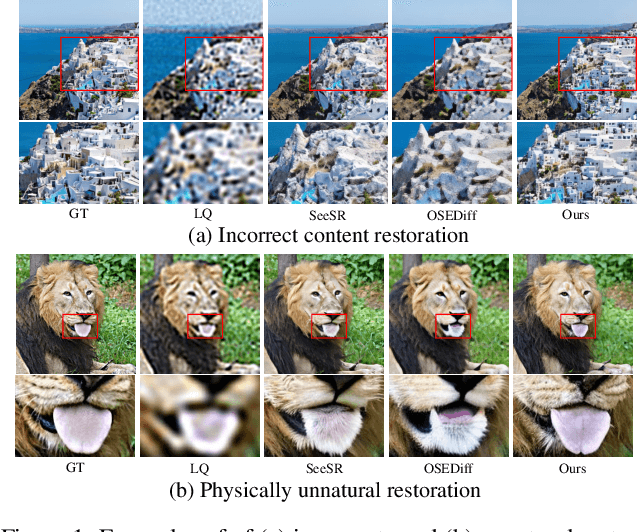
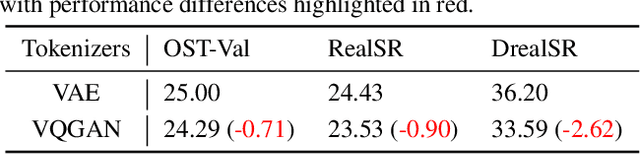
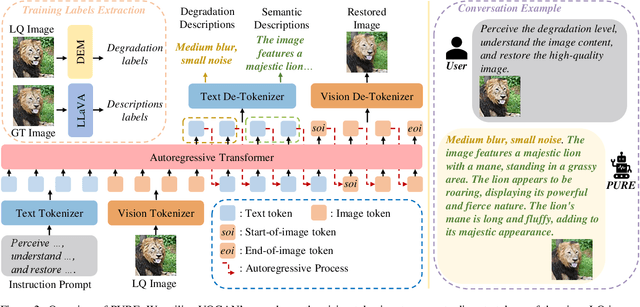
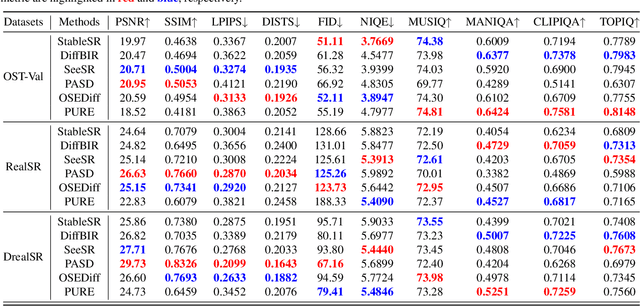
By leveraging the generative priors from pre-trained text-to-image diffusion models, significant progress has been made in real-world image super-resolution (Real-ISR). However, these methods tend to generate inaccurate and unnatural reconstructions in complex and/or heavily degraded scenes, primarily due to their limited perception and understanding capability of the input low-quality image. To address these limitations, we propose, for the first time to our knowledge, to adapt the pre-trained autoregressive multimodal model such as Lumina-mGPT into a robust Real-ISR model, namely PURE, which Perceives and Understands the input low-quality image, then REstores its high-quality counterpart. Specifically, we implement instruction tuning on Lumina-mGPT to perceive the image degradation level and the relationships between previously generated image tokens and the next token, understand the image content by generating image semantic descriptions, and consequently restore the image by generating high-quality image tokens autoregressively with the collected information. In addition, we reveal that the image token entropy reflects the image structure and present a entropy-based Top-k sampling strategy to optimize the local structure of the image during inference. Experimental results demonstrate that PURE preserves image content while generating realistic details, especially in complex scenes with multiple objects, showcasing the potential of autoregressive multimodal generative models for robust Real-ISR. The model and code will be available at https://github.com/nonwhy/PURE.