 Add to Chrome
 Add to Firefox
 Add to Edge
Qwen-Video-Edit: Instruction-Based Video Editing by Repurposing an Image Editing Model
Aug 18, 2026
Instruction-based video editing is commonly built on video-pretrained generative backbones: a video diffusion transformer is adapted, at considerable cost, to condition on a source video and an editing instruction. In this report we explore a different route and show that a strong instruction-based image editing model can edit videos by operating directly on video-VAE latents. Starting from Qwen-Image-Edit, we arrange the latent frames of a Wan~2.1 video VAE as tiles of one large virtual image, reuse the editor's image positional encoding for every tile, and bridge the two latent spaces with a pair of lightweight input/output projections warm-started from the editor's own patchify and unpatchify layers, so that at initialization a (static) video is embedded exactly as an image the model already understands. The whole system is then fine-tuned on the public Ditto-1M editing triplets, and a few denoising steps of Wan~2.2 serve as an optional temporal enhancer. We motivate the design with a chain of zero-training observations: the stock image editor already edits a video presented as a contact sheet; it is indifferent to whether the sheet's tokens come from one joint encode or from per-frame encodes stitched in latent space; and it even edits genuine video latents zero-shot to a clearly recognizable degree, leaving fine-tuning only a fidelity gap to close. Our results suggest that, despite the large investment in training video latent spaces, per-frame video latents remain close enough to the image domain that mature image editing priors transfer with minimal adaptation. Project Page: https://yunpeng1998.github.io/Qwen-Video-Edit-Page Code: https://github.com/yunpeng1998/Qwen-Video-Edit Model: https://huggingface.co/yunpeng1998/Qwen-Video-Edit

DuSPiT: Dual-Branch Sub-Patch Pixel Diffusion Transformer
Jul 20, 2026Diffusion Transformers achieve strong image generation performance, but most operate in compressed latent spaces. Pixel-space diffusion avoids this information loss, yet existing approaches map each raw image patch to a single token, forcing one representation to handle both global communication and fine-grained details. We address this issue by proposing a new architecture, \textbf{DuSPiT}, a \textbf{Du}al-branch \textbf{S}ub\textbf{P}atch \textbf{Pi}xel \textbf{T}ransformer. This model separates global structural reasoning from local appearance modeling. DuSPiT uses a compact base branch for efficient global reasoning and a parallel, high-capacity pixel branch, organized into subpatch groups, to preserve detailed appearance, with the two branches interacting through cross-attention. Our results show that DuSPiT generates images with richer details and stronger fine-grained structures, while also achieving a better quality--efficiency trade-off than prior pixel-space diffusion transformers.
PE-Field 4D: Video Generation Models as Canvas
Jul 17, 2026Diffusion Transformers have recently achieved strong performance in video generation, yet controlling scene geometry under viewpoint changes and camera motion remains challenging. In this work, we revisit the role of positional encoding in video diffusion transformers and show that it provides a useful spatial bias for geometry-aware control. Specifically, if reference tokens are encoded according to their projected locations in the target view, the denoising model is encouraged to retrieve content from position aligned regions of the input video. Building on this observation, we introduce a geometry-aware cross-attention mechanism that enables target video latent tokens to attend to structured context tokens derived from reference images or frames. To establish correspondence between the reference content and the target camera trajectory, we equip the context tokens with a projected positional encoding scheme that combines target-view 2D reprojection with depth-aware disambiguation. At the same time, we preserve the original spatiotemporal positional encoding of the generated video latent, allowing geometric guidance to be injected while maintaining consistency with the video model's native latent structure. The resulting framework provides a simple and effective approach for controllable video generation. It improves spatial controllability in viewpoint-dependent editing tasks, including camera re-trajectory, novel-view video synthesis, and geometry-aware video editing, while preserving the generative prior of the underlying video diffusion model. The code is available at: https://github.com/MTLab/PE-Field.
Modeling Trial-and-Error Navigation With a Sequential Decision Model of Information Scent
Mar 12, 2026Users often struggle to locate an item within an information architecture, particularly when links are ambiguous or deeply nested in hierarchies. Information scent has been used to explain why users select incorrect links, but this concept assumes that users see all available links before deciding. In practice, users frequently select a link too quickly, overlook relevant cues, and then rely on backtracking when errors occur. We extend the concept of information scent by framing navigation as a sequential decision-making problem under memory constraints. Specifically, we assume that users do not scan entire pages but instead inspect strategically, looking "just enough" to find the target given their time budget. To choose which item to inspect next, they consider both local (this page) and global (site) scent; however, both are constrained by memory. Trying to avoid wasting time, they occasionally choose the wrong links without inspecting everything on a page. Comparisons with empirical data show that our model replicates key navigation behaviors: premature selections, wrong turns, and recovery from backtracking. We conclude that trial-and-error behavior is well explained by information scent when accounting for the sequential and bounded characteristics of the navigation problem.
A Resource-Rational Principle for Modeling Visual Attention Control
Mar 02, 2026Understanding how people allocate visual attention is central to Human-Computer Interaction (HCI), yet existing computational models of attention are often either descriptive, task-specific, or difficult to interpret. My dissertation develops a resource-rational, simulation-based framework for modeling visual attention as a sequential decision-making process under perceptual, memory, and time constraints. I formalize visual tasks, such as reading and multitasking, as bounded-optimal control problems using Partially Observable Markov Decision Processes, enabling eye-movement behaviors such as fixation and attention switching to emerge from rational adaptation rather than being hand-coded or purely data-driven. These models are instantiated in simulation environments spanning traditional text reading and reading-while-walking with smart glasses, where they reproduce classic empirical effects, explain observed trade-offs between comprehension and safety, and generate novel predictions under time pressure and interface variation. Collectively, this work contributes a unified computational account of visual attention, offering new tools for theory-driven and resource-efficient HCI design.
Simulation-based Optimization for Augmented Reading
Feb 26, 2026Augmented reading systems aim to adapt text presentation to improve comprehension and task performance, yet existing approaches rely heavily on heuristics, opaque data-driven models, or repeated human involvement in the design loop. We propose framing augmented reading as a simulation-based optimization problem grounded in resource-rational models of human reading. These models instantiate a simulated reader that allocates limited cognitive resources, such as attention, memory, and time under task demands, enabling systematic evaluation of text user interfaces. We introduce two complementary optimization pipelines: an offline approach that explores design alternatives using simulated readers, and an online approach that personalizes reading interfaces in real time using ongoing interaction data. Together, this perspective enables adaptive, explainable, and scalable augmented reading design without relying solely on human testing.
AutoRegressive Generation with B-rep Holistic Token Sequence Representation
Jan 23, 2026Previous representation and generation approaches for the B-rep relied on graph-based representations that disentangle geometric and topological features through decoupled computational pipelines, thereby precluding the application of sequence-based generative frameworks, such as transformer architectures that have demonstrated remarkable performance. In this paper, we propose BrepARG, the first attempt to encode B-rep's geometry and topology into a holistic token sequence representation, enabling sequence-based B-rep generation with an autoregressive architecture. Specifically, BrepARG encodes B-rep into 3 types of tokens: geometry and position tokens representing geometric features, and face index tokens representing topology. Then the holistic token sequence is constructed hierarchically, starting with constructing the geometry blocks (i.e., faces and edges) using the above tokens, followed by geometry block sequencing. Finally, we assemble the holistic sequence representation for the entire B-rep. We also construct a transformer-based autoregressive model that learns the distribution over holistic token sequences via next-token prediction, using a multi-layer decoder-only architecture with causal masking. Experiments demonstrate that BrepARG achieves state-of-the-art (SOTA) performance. BrepARG validates the feasibility of representing B-rep as holistic token sequences, opening new directions for B-rep generation.
BrepLLM: Native Boundary Representation Understanding with Large Language Models
Dec 18, 2025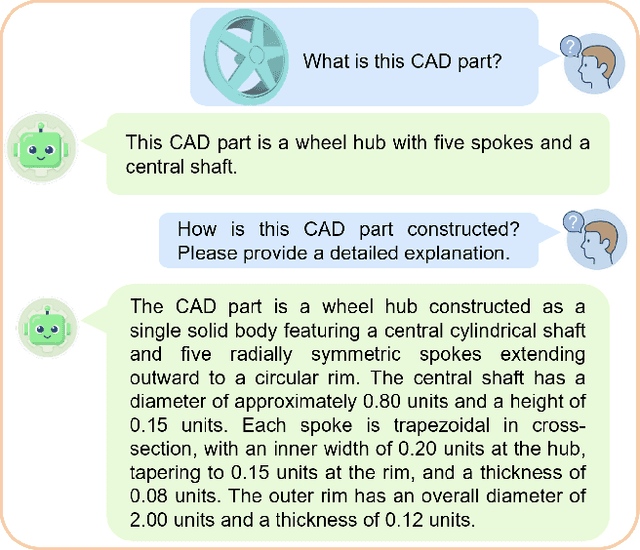


Current token-sequence-based Large Language Models (LLMs) are not well-suited for directly processing 3D Boundary Representation (Brep) models that contain complex geometric and topological information. We propose BrepLLM, the first framework that enables LLMs to parse and reason over raw Brep data, bridging the modality gap between structured 3D geometry and natural language. BrepLLM employs a two-stage training pipeline: Cross-modal Alignment Pre-training and Multi-stage LLM Fine-tuning. In the first stage, an adaptive UV sampling strategy converts Breps into graphs representation with geometric and topological information. We then design a hierarchical BrepEncoder to extract features from geometry (i.e., faces and edges) and topology, producing both a single global token and a sequence of node tokens. Then we align the global token with text embeddings from a frozen CLIP text encoder (ViT-L/14) via contrastive learning. In the second stage, we integrate the pretrained BrepEncoder into an LLM. We then align its sequence of node tokens using a three-stage progressive training strategy: (1) training an MLP-based semantic mapping from Brep representation to 2D with 2D-LLM priors. (2) performing fine-tuning of the LLM. (3) designing a Mixture-of-Query Experts (MQE) to enhance geometric diversity modeling. We also construct Brep2Text, a dataset comprising 269,444 Brep-text question-answer pairs. Experiments show that BrepLLM achieves state-of-the-art (SOTA) results on 3D object classification and captioning tasks.
WorldReel: 4D Video Generation with Consistent Geometry and Motion Modeling
Dec 08, 2025Recent video generators achieve striking photorealism, yet remain fundamentally inconsistent in 3D. We present WorldReel, a 4D video generator that is natively spatio-temporally consistent. WorldReel jointly produces RGB frames together with 4D scene representations, including pointmaps, camera trajectory, and dense flow mapping, enabling coherent geometry and appearance modeling over time. Our explicit 4D representation enforces a single underlying scene that persists across viewpoints and dynamic content, yielding videos that remain consistent even under large non-rigid motion and significant camera movement. We train WorldReel by carefully combining synthetic and real data: synthetic data providing precise 4D supervision (geometry, motion, and camera), while real videos contribute visual diversity and realism. This blend allows WorldReel to generalize to in-the-wild footage while preserving strong geometric fidelity. Extensive experiments demonstrate that WorldReel sets a new state-of-the-art for consistent video generation with dynamic scenes and moving cameras, improving metrics of geometric consistency, motion coherence, and reducing view-time artifacts over competing methods. We believe that WorldReel brings video generation closer to 4D-consistent world modeling, where agents can render, interact, and reason about scenes through a single and stable spatiotemporal representation.
Positional Encoding Field
Oct 23, 2025Diffusion Transformers (DiTs) have emerged as the dominant architecture for visual generation, powering state-of-the-art image and video models. By representing images as patch tokens with positional encodings (PEs), DiTs combine Transformer scalability with spatial and temporal inductive biases. In this work, we revisit how DiTs organize visual content and discover that patch tokens exhibit a surprising degree of independence: even when PEs are perturbed, DiTs still produce globally coherent outputs, indicating that spatial coherence is primarily governed by PEs. Motivated by this finding, we introduce the Positional Encoding Field (PE-Field), which extends positional encodings from the 2D plane to a structured 3D field. PE-Field incorporates depth-aware encodings for volumetric reasoning and hierarchical encodings for fine-grained sub-patch control, enabling DiTs to model geometry directly in 3D space. Our PE-Field-augmented DiT achieves state-of-the-art performance on single-image novel view synthesis and generalizes to controllable spatial image editing.