 Add to Chrome
 Add to Firefox
 Add to Edge
GRASP: Guided Region-Aware Sparse Prompting for Adapting MLLMs to Remote Sensing
Jan 23, 2026
In recent years, Multimodal Large Language Models (MLLMs) have made significant progress in visual question answering tasks. However, directly applying existing fine-tuning methods to remote sensing (RS) images often leads to issues such as overfitting on background noise or neglecting target details. This is primarily due to the large-scale variations, sparse target distributions, and complex regional semantic features inherent in RS images. These challenges limit the effectiveness of MLLMs in RS tasks. To address these challenges, we propose a parameter-efficient fine-tuning (PEFT) strategy called Guided Region-Aware Sparse Prompting (GRASP). GRASP introduces spatially structured soft prompts associated with spatial blocks extracted from a frozen visual token grid. Through a question-guided sparse fusion mechanism, GRASP dynamically aggregates task-specific context into a compact global prompt, enabling the model to focus on relevant regions while filtering out background noise. Extensive experiments on multiple RSVQA benchmarks show that GRASP achieves competitive performance compared to existing fine-tuning and prompt-based methods while maintaining high parameter efficiency.

Overcoming Joint Intractability with Lossless Hierarchical Speculative Decoding
Jan 09, 2026Verification is a key bottleneck in improving inference speed while maintaining distribution fidelity in Speculative Decoding. Recent work has shown that sequence-level verification leads to a higher number of accepted tokens compared to token-wise verification. However, existing solutions often rely on surrogate approximations or are constrained by partial information, struggling with joint intractability. In this work, we propose Hierarchical Speculative Decoding (HSD), a provably lossless verification method that significantly boosts the expected number of accepted tokens and overcomes joint intractability by balancing excess and deficient probability mass across accessible branches. Our extensive large-scale experiments demonstrate that HSD yields consistent improvements in acceptance rates across diverse model families and benchmarks. Moreover, its strong explainability and generality make it readily integrable into a wide range of speculative decoding frameworks. Notably, integrating HSD into EAGLE-3 yields over a 12% performance gain, establishing state-of-the-art decoding efficiency without compromising distribution fidelity. Code is available at https://github.com/ZhouYuxuanYX/Hierarchical-Speculative-Decoding.
VLCache: Computing 2% Vision Tokens and Reusing 98% for Vision-Language Inference
Dec 18, 2025This paper presents VLCache, a cache reuse framework that exploits both Key-Value (KV) cache and encoder cache from prior multimodal inputs to eliminate costly recomputation when the same multimodal inputs recur. Unlike previous heuristic approaches, we formally identify the cumulative reuse error effect and demonstrate how to minimize the non-prefix cache reuse error effectively. We further analyze the varying importance of model layers and propose a dynamic, layer-aware recomputation strategy to balance accuracy and efficiency. Experimental results show that VLCache achieves an accuracy on par with full recomputation, while requiring only 2-5% of the tokens to compute, yielding 1.2x-16x TTFT speedups. We develop an experimental implementation of the proposed VLCache pipeline based on SGLang, enabling significantly faster inference in practical deployments.
Awakening Facial Emotional Expressions in Human-Robot
Oct 27, 2025The facial expression generation capability of humanoid social robots is critical for achieving natural and human-like interactions, playing a vital role in enhancing the fluidity of human-robot interactions and the accuracy of emotional expression. Currently, facial expression generation in humanoid social robots still relies on pre-programmed behavioral patterns, which are manually coded at high human and time costs. To enable humanoid robots to autonomously acquire generalized expressive capabilities, they need to develop the ability to learn human-like expressions through self-training. To address this challenge, we have designed a highly biomimetic robotic face with physical-electronic animated facial units and developed an end-to-end learning framework based on KAN (Kolmogorov-Arnold Network) and attention mechanisms. Unlike previous humanoid social robots, we have also meticulously designed an automated data collection system based on expert strategies of facial motion primitives to construct the dataset. Notably, to the best of our knowledge, this is the first open-source facial dataset for humanoid social robots. Comprehensive evaluations indicate that our approach achieves accurate and diverse facial mimicry across different test subjects.
Estimating Continuum Robot Shape under External Loading using Spatiotemporal Neural Networks
Oct 25, 2025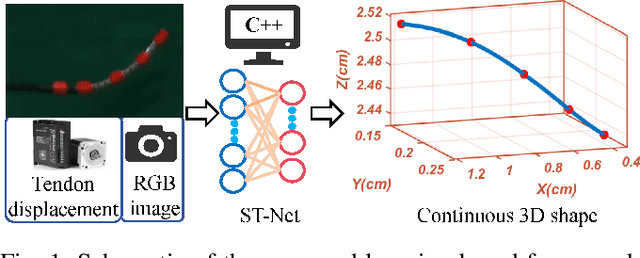
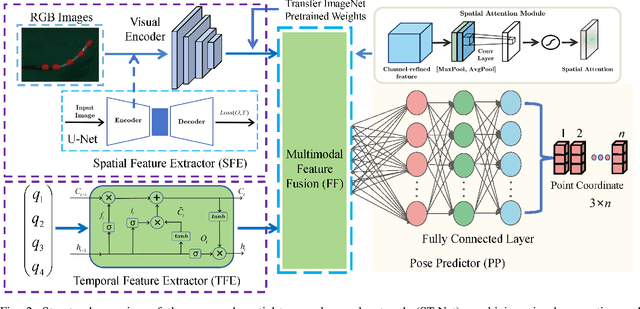
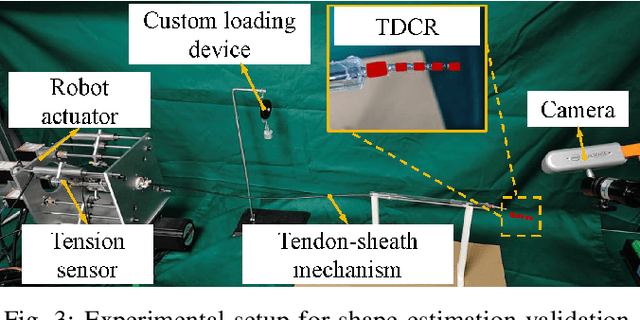
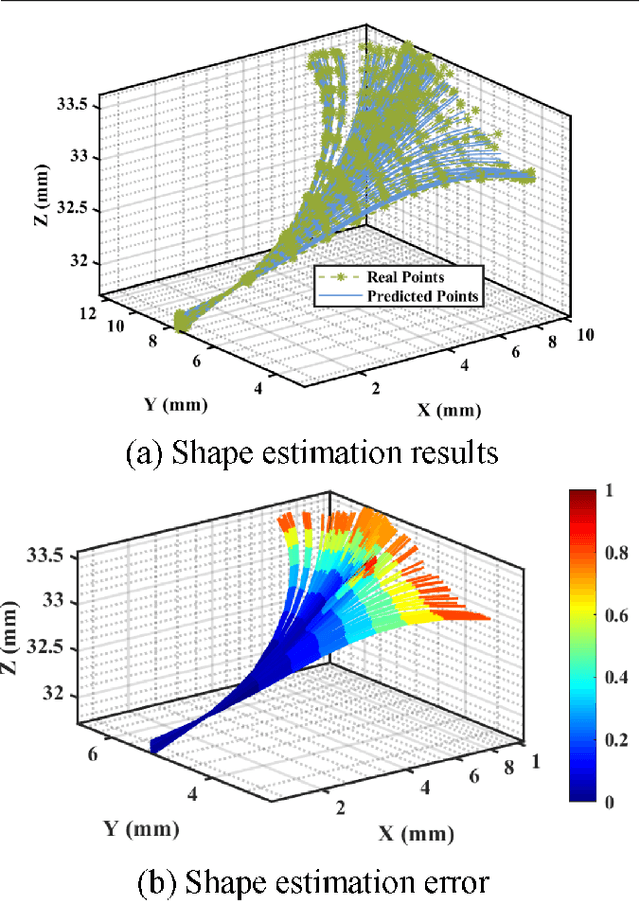
This paper presents a learning-based approach for accurately estimating the 3D shape of flexible continuum robots subjected to external loads. The proposed method introduces a spatiotemporal neural network architecture that fuses multi-modal inputs, including current and historical tendon displacement data and RGB images, to generate point clouds representing the robot's deformed configuration. The network integrates a recurrent neural module for temporal feature extraction, an encoding module for spatial feature extraction, and a multi-modal fusion module to combine spatial features extracted from visual data with temporal dependencies from historical actuator inputs. Continuous 3D shape reconstruction is achieved by fitting B\'ezier curves to the predicted point clouds. Experimental validation demonstrates that our approach achieves high precision, with mean shape estimation errors of 0.08 mm (unloaded) and 0.22 mm (loaded), outperforming state-of-the-art methods in shape sensing for TDCRs. The results validate the efficacy of deep learning-based spatiotemporal data fusion for precise shape estimation under loading conditions.
Qwen3Guard Technical Report
Oct 16, 2025As large language models (LLMs) become more capable and widely used, ensuring the safety of their outputs is increasingly critical. Existing guardrail models, though useful in static evaluation settings, face two major limitations in real-world applications: (1) they typically output only binary "safe/unsafe" labels, which can be interpreted inconsistently across diverse safety policies, rendering them incapable of accommodating varying safety tolerances across domains; and (2) they require complete model outputs before performing safety checks, making them fundamentally incompatible with streaming LLM inference, thereby preventing timely intervention during generation and increasing exposure to harmful partial outputs. To address these challenges, we present Qwen3Guard, a series of multilingual safety guardrail models with two specialized variants: Generative Qwen3Guard, which casts safety classification as an instruction-following task to enable fine-grained tri-class judgments (safe, controversial, unsafe); and Stream Qwen3Guard, which introduces a token-level classification head for real-time safety monitoring during incremental text generation. Both variants are available in three sizes (0.6B, 4B, and 8B parameters) and support up to 119 languages and dialects, providing comprehensive, scalable, and low-latency safety moderation for global LLM deployments. Evaluated across English, Chinese, and multilingual benchmarks, Qwen3Guard achieves state-of-the-art performance in both prompt and response safety classification. All models are released under the Apache 2.0 license for public use.
M4Diffuser: Multi-View Diffusion Policy with Manipulability-Aware Control for Robust Mobile Manipulation
Sep 18, 2025Mobile manipulation requires the coordinated control of a mobile base and a robotic arm while simultaneously perceiving both global scene context and fine-grained object details. Existing single-view approaches often fail in unstructured environments due to limited fields of view, exploration, and generalization abilities. Moreover, classical controllers, although stable, struggle with efficiency and manipulability near singularities. To address these challenges, we propose M4Diffuser, a hybrid framework that integrates a Multi-View Diffusion Policy with a novel Reduced and Manipulability-aware QP (ReM-QP) controller for mobile manipulation. The diffusion policy leverages proprioceptive states and complementary camera perspectives with both close-range object details and global scene context to generate task-relevant end-effector goals in the world frame. These high-level goals are then executed by the ReM-QP controller, which eliminates slack variables for computational efficiency and incorporates manipulability-aware preferences for robustness near singularities. Comprehensive experiments in simulation and real-world environments show that M4Diffuser achieves 7 to 56 percent higher success rates and reduces collisions by 3 to 31 percent over baselines. Our approach demonstrates robust performance for smooth whole-body coordination, and strong generalization to unseen tasks, paving the way for reliable mobile manipulation in unstructured environments. Details of the demo and supplemental material are available on our project website https://sites.google.com/view/m4diffuser.
DORA: Object Affordance-Guided Reinforcement Learning for Dexterous Robotic Manipulation
May 20, 2025Dexterous robotic manipulation remains a longstanding challenge in robotics due to the high dimensionality of control spaces and the semantic complexity of object interaction. In this paper, we propose an object affordance-guided reinforcement learning framework that enables a multi-fingered robotic hand to learn human-like manipulation strategies more efficiently. By leveraging object affordance maps, our approach generates semantically meaningful grasp pose candidates that serve as both policy constraints and priors during training. We introduce a voting-based grasp classification mechanism to ensure functional alignment between grasp configurations and object affordance regions. Furthermore, we incorporate these constraints into a generalizable RL pipeline and design a reward function that unifies affordance-awareness with task-specific objectives. Experimental results across three manipulation tasks - cube grasping, jug grasping and lifting, and hammer use - demonstrate that our affordance-guided approach improves task success rates by an average of 15.4% compared to baselines. These findings highlight the critical role of object affordance priors in enhancing sample efficiency and learning generalizable, semantically grounded manipulation policies. For more details, please visit our project website https://sites.google.com/view/dora-manip.
Qwen3 Technical Report
May 14, 2025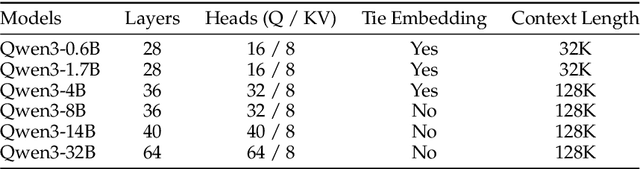
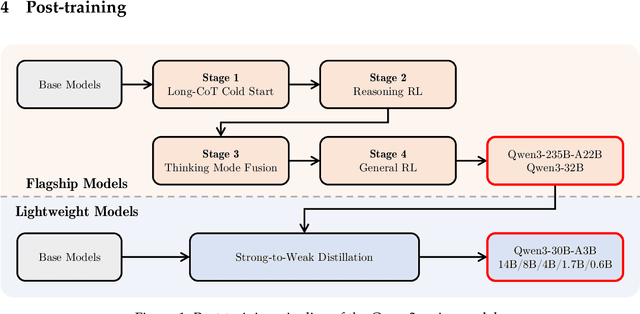

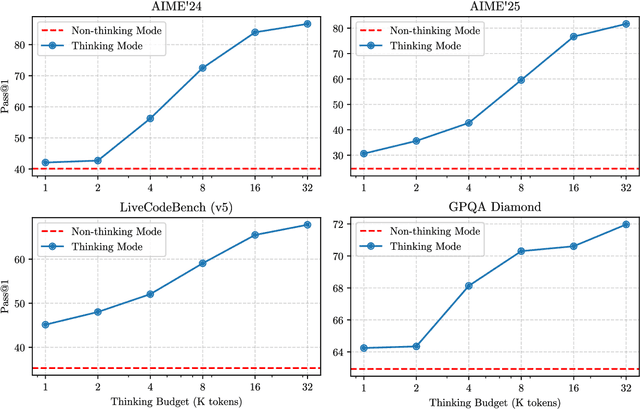
In this work, we present Qwen3, the latest version of the Qwen model family. Qwen3 comprises a series of large language models (LLMs) designed to advance performance, efficiency, and multilingual capabilities. The Qwen3 series includes models of both dense and Mixture-of-Expert (MoE) architectures, with parameter scales ranging from 0.6 to 235 billion. A key innovation in Qwen3 is the integration of thinking mode (for complex, multi-step reasoning) and non-thinking mode (for rapid, context-driven responses) into a unified framework. This eliminates the need to switch between different models--such as chat-optimized models (e.g., GPT-4o) and dedicated reasoning models (e.g., QwQ-32B)--and enables dynamic mode switching based on user queries or chat templates. Meanwhile, Qwen3 introduces a thinking budget mechanism, allowing users to allocate computational resources adaptively during inference, thereby balancing latency and performance based on task complexity. Moreover, by leveraging the knowledge from the flagship models, we significantly reduce the computational resources required to build smaller-scale models, while ensuring their highly competitive performance. Empirical evaluations demonstrate that Qwen3 achieves state-of-the-art results across diverse benchmarks, including tasks in code generation, mathematical reasoning, agent tasks, etc., competitive against larger MoE models and proprietary models. Compared to its predecessor Qwen2.5, Qwen3 expands multilingual support from 29 to 119 languages and dialects, enhancing global accessibility through improved cross-lingual understanding and generation capabilities. To facilitate reproducibility and community-driven research and development, all Qwen3 models are publicly accessible under Apache 2.0.
Multi-segment Soft Robot Control via Deep Koopman-based Model Predictive Control
May 01, 2025Soft robots, compared to regular rigid robots, as their multiple segments with soft materials bring flexibility and compliance, have the advantages of safe interaction and dexterous operation in the environment. However, due to its characteristics of high dimensional, nonlinearity, time-varying nature, and infinite degree of freedom, it has been challenges in achieving precise and dynamic control such as trajectory tracking and position reaching. To address these challenges, we propose a framework of Deep Koopman-based Model Predictive Control (DK-MPC) for handling multi-segment soft robots. We first employ a deep learning approach with sampling data to approximate the Koopman operator, which therefore linearizes the high-dimensional nonlinear dynamics of the soft robots into a finite-dimensional linear representation. Secondly, this linearized model is utilized within a model predictive control framework to compute optimal control inputs that minimize the tracking error between the desired and actual state trajectories. The real-world experiments on the soft robot "Chordata" demonstrate that DK-MPC could achieve high-precision control, showing the potential of DK-MPC for future applications to soft robots.