 Add to Chrome
 Add to Firefox
 Add to Edge
EAGG: Embodiment-Aligned Grasp Generation via Geometry-Aware Graph Conditioning
Jun 16, 2026
Cross-end-effector grasp generation seeks a unified model that generalizes across objects and across embodiments ranging from parallel grippers to dexterous end effectors. Existing grasp generators are typically designed for a fixed embodiment or encode embodiment identity with a static descriptor, which weakens transfer when topology, actuation coupling, and contact geometry differ substantially. We present EAGG, an embodiment-aligned grasp generator that represents each embodiment with a topology-aware end-effector graph and an embodiment-specific low-dimensional end-effector control space. A frozen end-effector-cognition backbone converts the current articulated state into geometry-aware tokens that act as a reusable morphology prior, and iterative geometry injection refreshes these tokens throughout sampling so that conditioning remains synchronized with the evolving end-effector geometry. On the MultiGripperGrasp benchmark, EAGG reaches 56.17% average success across six training end effectors, remaining within 1.10 percentage points of specialized training while preserving transfer to finetuning and zero-shot end effectors. Iterative geometry injection further reduces the pooled median contact distance from 0.239 cm to 0.189 cm. These results show that cross-end-effector grasp generation is strengthened by aligning embodiment structure inside a shared generator rather than suppressing embodiment differences. Code is available at https://github.com/wanhaoniu/EAGG.

Knowledge Reutilization in Meta-Reinforcement Learning
Jun 16, 2026Meta-reinforcement learning enables fast adaptation by extracting shared structure from related tasks, but existing end-to-end methods often couple task inference with embodiment-specific control. This coupling can obscure non-parametric task semantics, reduce sample efficiency, and limit cross-agent reuse. We propose a meta-knowledge reutilization framework that learns task-level knowledge on a dynamics-simplified agent and transfers it to heterogeneous agents. The framework uses a Bayesian non-parametric prior to organize latent task modes and a high-level policy to generate task-level magnitude guidance. To bridge reusable task knowledge with different embodiments, we introduce a semantic-magnitude interface and a lightweight temporal adaptor, which convert frozen meta-knowledge into temporally aligned subgoals for embodiment-specific low-level controllers. Experiments on multiple locomotion agents show that our framework reduces final-step tracking error by 94.75% -- 99.79% compared with recent state-of-the-art baselines and achieves comparable deployment performance with about 23.8% of their interaction data.
Generalizing Graph Foundation Models via Hyperbolic Retrieval-Augmented Generation
Jun 03, 2026Graph foundation models (GFMs) emerged as a dominant paradigm in graph representation learning by leveraging large-scale pre-training for cross-domain inference. However, the parameterized knowledge encoded within these models is insufficient to cope with distribution shifts, limiting their generalization ability. To mitigate this issue, retrieval-augmented generation (RAG) has been introduced to incorporate external knowledge at inference time. Nevertheless, existing RAG frameworks operating in Euclidean space suffer from a fundamental geometric limitation: the polynomial volume growth of Euclidean space is inherently mismatched with the tree-structured external knowledge bases. This mismatch leads to the loss of semantic granularity in retrieval and gives rise to the hubness phenomenon.To address this limitation, we propose a Hyperbolic Retrieval-Augmented Generation (HyRAG) framework designed to enhance the generalization capabilities of GFMs. Specifically, the introduced Hyperbolic Knowledge Indexing module retains the tree-like hierarchies of the external knowledge base by modeling them within hyperbolic space. The Multi-granularity Retrieval module then provides GFMs with the global semantic anchors and local semantic nuances through coarse-grained and fine-grained knowledge retrieval, respectively. Finally, the Dual-path Fusion module achieves effective knowledge integration for graph tasks at both the feature and structural levels. Experiments on multiple graph benchmarks demonstrate significant improvements in the zero-shot setting, highlighting the generalization of our method for robust GFMs inference.
Test-Time Perturbation Learning with Delayed Feedback for Vision-Language-Action Models
Apr 20, 2026Vision-Language-Action models (VLAs) achieve remarkable performance in sequential decision-making but remain fragile to subtle environmental shifts, such as small changes in object pose. We attribute this brittleness to trajectory overfitting, where VLAs over-attend to the spurious correlation between actions and entities, then reproduce memorized action patterns. We propose Perturbation learning with Delayed Feedback (PDF), a verifier-free test-time adaptation framework that improves decision performance without fine-tuning the base model. PDF mitigates the spurious correlation through uncertainty-based data augmentation and action voting, while an adaptive scheduler allocates augmentation budgets to balance performance and efficiency. To further improve stability, PDF learns a lightweight perturbation module that retrospectively adjusts action logits guided by delayed feedback, correcting overconfidence issue. Experiments on LIBERO (+7.4\% success rate) and Atari (+10.3 human normalized score) demonstrate consistent gains of PDF in task success over vanilla VLA and VLA with test-time adaptation, establishing a practical path toward reliable test-time adaptation in multimodal decision-making agents. The code is available at \href{https://github.com/zhoujiahuan1991/CVPR2026-PDF}{https://github.com/zhoujiahuan1991/CVPR2026-PDF}.
* 12 pages, 7 figures, 5 tables
Periodic Steady-State Control of a Handkerchief-Spinning Task Using a Parallel Anti-Parallelogram Tendon-driven Wrist
Apr 20, 2026Spinning flexible objects, exemplified by traditional Chinese handkerchief performances, demands periodic steady-state motions under nonlinear dynamics with frictional contacts and boundary constraints. To address these challenges, we first design an intuitive dexterous wrist based on a parallel anti-parallelogram tendon-driven structure, which achieves 90 degrees omnidirectional rotation with low inertia and decoupled roll-pitch sensing, and implement a high-low level hierarchical control scheme. We then develop a particle-spring model of the handkerchief for control-oriented abstraction and strategy evaluation. Hardware experiments validate this framework, achieving an unfolding ratio of approximately 99% and fingertip tracking error of RMSE = 2.88 mm in high-dynamic spinning. These results demonstrate that integrating control-oriented modeling with a task-tailored dexterous wrist enables robust rest-to-steady-state transitions and precise periodic manipulation of highly flexible objects. More visualizations: https://slowly1113.github.io/icra2026-handkerchief/
Evolving the Complete Muscle: Efficient Morphology-Control Co-design for Musculoskeletal Locomotion
Apr 14, 2026Musculoskeletal robots offer intrinsic compliance and flexibility, providing a promising paradigm for versatile locomotion. However, existing research typically relies on models with fixed muscle physiological parameters. This static physical setting fails to accommodate the diverse dynamic demands of complex tasks, inherently limiting the robot's performance upper bound. In this work, we focus on the morphology and control co-design of musculoskeletal systems. Unlike previous studies that optimize single physiological attributes such as stiffness, we introduce a Complete Musculoskeletal Morphological Evolution Space that simultaneously evolves muscle strength, velocity, and stiffness. To overcome the exponential expansion of the exploration space caused by this comprehensive evolution, we propose Spectral Design Evolution (SDE), a high-efficiency co-optimization framework. By integrating a bilateral symmetry prior with Principal Component Analysis (PCA), SDE projects complex muscle parameters onto a low-dimensional spectral manifold, enabling efficient morphological exploration. Evaluated on the MyoSuite framework across four tasks (Walk, Stair, Hilly, and Rough terrains), our method demonstrates superior learning efficiency and locomotion stability compared to fixed-morphology and standard evolutionary baselines.
All-in-One Image Restoration via Causal-Deconfounding Wavelet-Disentangled Prompt Network
Mar 04, 2026Image restoration represents a promising approach for addressing the inherent defects of image content distortion. Standard image restoration approaches suffer from high storage cost and the requirement towards the known degradation pattern, including type and degree, which can barely be satisfied in dynamic practical scenarios. In contrast, all-in-one image restoration (AiOIR) eliminates multiple degradations within a unified model to circumvent the aforementioned issues. However, according to our causal analysis, we disclose that two significant defects still exacerbate the effectiveness and generalization of AiOIR models: 1) the spurious correlation between non-degradation semantic features and degradation patterns; 2) the biased estimation of degradation patterns. To obtain the true causation between degraded images and restored images, we propose Causal-deconfounding Wavelet-disentangled Prompt Network (CWP-Net) to perform effective AiOIR. CWP-Net introduces two modules for decoupling, i.e., wavelet attention module of encoder and wavelet attention module of decoder. These modules explicitly disentangle the degradation and semantic features to tackle the issue of spurious correlation. To address the issue stemming from the biased estimation of degradation patterns, CWP-Net leverages a wavelet prompt block to generate the alternative variable for causal deconfounding. Extensive experiments on two all-in-one settings prove the effectiveness and superior performance of our proposed CWP-Net over the state-of-the-art AiOIR methods.
SceneTransporter: Optimal Transport-Guided Compositional Latent Diffusion for Single-Image Structured 3D Scene Generation
Feb 26, 2026We introduce SceneTransporter, an end-to-end framework for structured 3D scene generation from a single image. While existing methods generate part-level 3D objects, they often fail to organize these parts into distinct instances in open-world scenes. Through a debiased clustering probe, we reveal a critical insight: this failure stems from the lack of structural constraints within the model's internal assignment mechanism. Based on this finding, we reframe the task of structured 3D scene generation as a global correlation assignment problem. To solve this, SceneTransporter formulates and solves an entropic Optimal Transport (OT) objective within the denoising loop of the compositional DiT model. This formulation imposes two powerful structural constraints. First, the resulting transport plan gates cross-attention to enforce an exclusive, one-to-one routing of image patches to part-level 3D latents, preventing entanglement. Second, the competitive nature of the transport encourages the grouping of similar patches, a process that is further regularized by an edge-based cost, to form coherent objects and prevent fragmentation. Extensive experiments show that SceneTransporter outperforms existing methods on open-world scene generation, significantly improving instance-level coherence and geometric fidelity. Code and models will be publicly available at https://2019epwl.github.io/SceneTransporter/.
FLAC: Maximum Entropy RL via Kinetic Energy Regularized Bridge Matching
Feb 13, 2026Iterative generative policies, such as diffusion models and flow matching, offer superior expressivity for continuous control but complicate Maximum Entropy Reinforcement Learning because their action log-densities are not directly accessible. To address this, we propose Field Least-Energy Actor-Critic (FLAC), a likelihood-free framework that regulates policy stochasticity by penalizing the kinetic energy of the velocity field. Our key insight is to formulate policy optimization as a Generalized Schrödinger Bridge (GSB) problem relative to a high-entropy reference process (e.g., uniform). Under this view, the maximum-entropy principle emerges naturally as staying close to a high-entropy reference while optimizing return, without requiring explicit action densities. In this framework, kinetic energy serves as a physically grounded proxy for divergence from the reference: minimizing path-space energy bounds the deviation of the induced terminal action distribution. Building on this view, we derive an energy-regularized policy iteration scheme and a practical off-policy algorithm that automatically tunes the kinetic energy via a Lagrangian dual mechanism. Empirically, FLAC achieves superior or comparable performance on high-dimensional benchmarks relative to strong baselines, while avoiding explicit density estimation.
Flow-Based Policy for Online Reinforcement Learning
Jun 15, 2025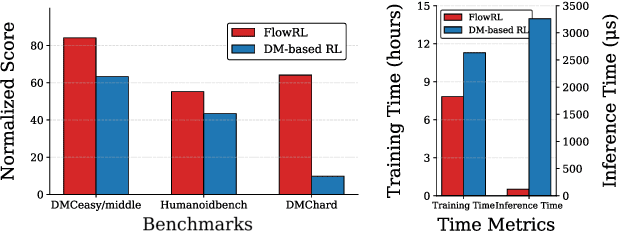
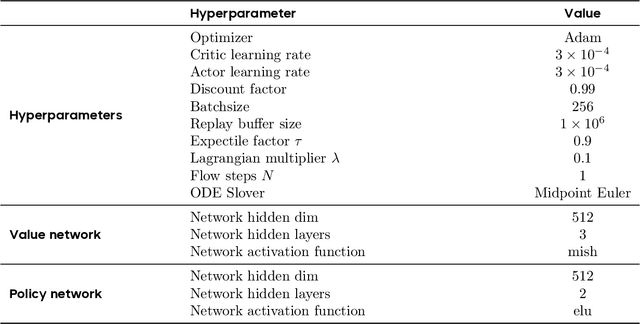
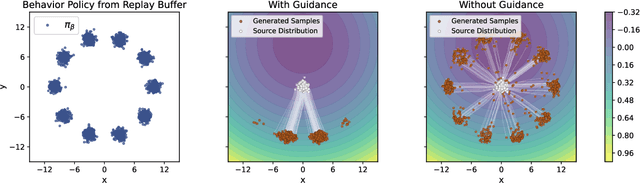
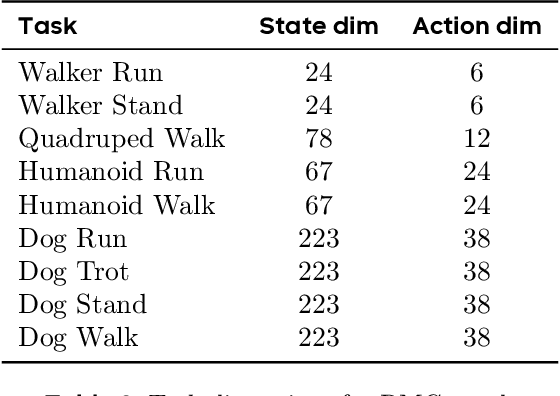
We present \textbf{FlowRL}, a novel framework for online reinforcement learning that integrates flow-based policy representation with Wasserstein-2-regularized optimization. We argue that in addition to training signals, enhancing the expressiveness of the policy class is crucial for the performance gains in RL. Flow-based generative models offer such potential, excelling at capturing complex, multimodal action distributions. However, their direct application in online RL is challenging due to a fundamental objective mismatch: standard flow training optimizes for static data imitation, while RL requires value-based policy optimization through a dynamic buffer, leading to difficult optimization landscapes. FlowRL first models policies via a state-dependent velocity field, generating actions through deterministic ODE integration from noise. We derive a constrained policy search objective that jointly maximizes Q through the flow policy while bounding the Wasserstein-2 distance to a behavior-optimal policy implicitly derived from the replay buffer. This formulation effectively aligns the flow optimization with the RL objective, enabling efficient and value-aware policy learning despite the complexity of the policy class. Empirical evaluations on DMControl and Humanoidbench demonstrate that FlowRL achieves competitive performance in online reinforcement learning benchmarks.