 Add to Chrome
 Add to Firefox
 Add to Edge
GibbsDDRM: A Partially Collapsed Gibbs Sampler for Solving Blind Inverse Problems with Denoising Diffusion Restoration
Jan 30, 2023
Pre-trained diffusion models have been successfully used as priors in a variety of linear inverse problems, where the goal is to reconstruct a signal from noisy linear measurements. However, existing approaches require knowledge of the linear operator. In this paper, we propose GibbsDDRM, an extension of Denoising Diffusion Restoration Models (DDRM) to a blind setting in which the linear measurement operator is unknown. GibbsDDRM constructs a joint distribution of the data, measurements, and linear operator by using a pre-trained diffusion model for the data prior, and it solves the problem by posterior sampling with an efficient variant of a Gibbs sampler. The proposed method is problem-agnostic, meaning that a pre-trained diffusion model can be applied to various inverse problems without fine tuning. In experiments, it achieved high performance on both blind image deblurring and vocal dereverberation tasks, despite the use of simple generic priors for the underlying linear operators.

Building Coverage Estimation with Low-resolution Remote Sensing Imagery
Jan 05, 2023


Building coverage statistics provide crucial insights into the urbanization, infrastructure, and poverty level of a region, facilitating efforts towards alleviating poverty, building sustainable cities, and allocating infrastructure investments and public service provision. Global mapping of buildings has been made more efficient with the incorporation of deep learning models into the pipeline. However, these models typically rely on high-resolution satellite imagery which are expensive to collect and infrequently updated. As a result, building coverage data are not updated timely especially in developing regions where the built environment is changing quickly. In this paper, we propose a method for estimating building coverage using only publicly available low-resolution satellite imagery that is more frequently updated. We show that having a multi-node quantile regression layer greatly improves the model's spatial and temporal generalization. Our model achieves a coefficient of determination ($R^2$) as high as 0.968 on predicting building coverage in regions of different levels of development around the world. We demonstrate that the proposed model accurately predicts the building coverage from raw input images and generalizes well to unseen countries and continents, suggesting the possibility of estimating global building coverage using only low-resolution remote sensing data.
Extreme Q-Learning: MaxEnt RL without Entropy
Jan 05, 2023Modern Deep Reinforcement Learning (RL) algorithms require estimates of the maximal Q-value, which are difficult to compute in continuous domains with an infinite number of possible actions. In this work, we introduce a new update rule for online and offline RL which directly models the maximal value using Extreme Value Theory (EVT), drawing inspiration from Economics. By doing so, we avoid computing Q-values using out-of-distribution actions which is often a substantial source of error. Our key insight is to introduce an objective that directly estimates the optimal soft-value functions (LogSumExp) in the maximum entropy RL setting without needing to sample from a policy. Using EVT, we derive our Extreme Q-Learning framework and consequently online and, for the first time, offline MaxEnt Q-learning algorithms, that do not explicitly require access to a policy or its entropy. Our method obtains consistently strong performance in the D4RL benchmark, outperforming prior works by 10+ points on some tasks while offering moderate improvements over SAC and TD3 on online DM Control tasks.
Deep Latent State Space Models for Time-Series Generation
Dec 24, 2022Methods based on ordinary differential equations (ODEs) are widely used to build generative models of time-series. In addition to high computational overhead due to explicitly computing hidden states recurrence, existing ODE-based models fall short in learning sequence data with sharp transitions - common in many real-world systems - due to numerical challenges during optimization. In this work, we propose LS4, a generative model for sequences with latent variables evolving according to a state space ODE to increase modeling capacity. Inspired by recent deep state space models (S4), we achieve speedups by leveraging a convolutional representation of LS4 which bypasses the explicit evaluation of hidden states. We show that LS4 significantly outperforms previous continuous-time generative models in terms of marginal distribution, classification, and prediction scores on real-world datasets in the Monash Forecasting Repository, and is capable of modeling highly stochastic data with sharp temporal transitions. LS4 sets state-of-the-art for continuous-time latent generative models, with significant improvement of mean squared error and tighter variational lower bounds on irregularly-sampled datasets, while also being x100 faster than other baselines on long sequences.
Transform Once: Efficient Operator Learning in Frequency Domain
Nov 26, 2022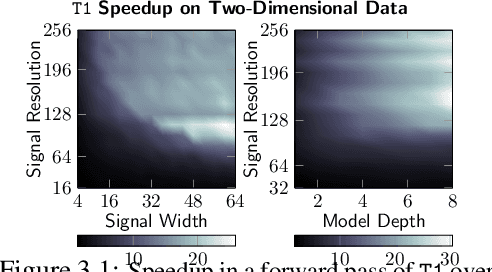
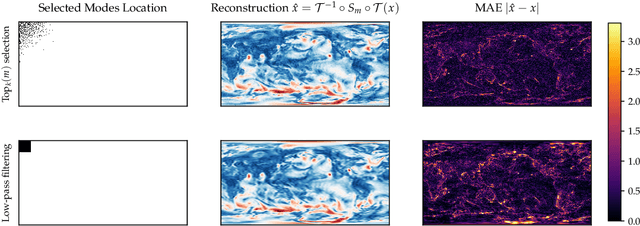
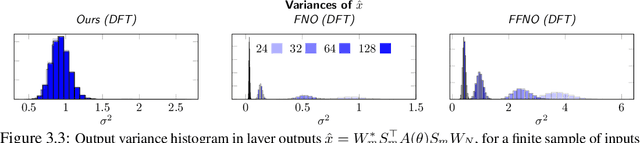

Spectral analysis provides one of the most effective paradigms for information-preserving dimensionality reduction, as simple descriptions of naturally occurring signals are often obtained via few terms of periodic basis functions. In this work, we study deep neural networks designed to harness the structure in frequency domain for efficient learning of long-range correlations in space or time: frequency-domain models (FDMs). Existing FDMs are based on complex-valued transforms i.e. Fourier Transforms (FT), and layers that perform computation on the spectrum and input data separately. This design introduces considerable computational overhead: for each layer, a forward and inverse FT. Instead, this work introduces a blueprint for frequency domain learning through a single transform: transform once (T1). To enable efficient, direct learning in the frequency domain we derive a variance-preserving weight initialization scheme and investigate methods for frequency selection in reduced-order FDMs. Our results noticeably streamline the design process of FDMs, pruning redundant transforms, and leading to speedups of 3x to 10x that increase with data resolution and model size. We perform extensive experiments on learning the solution operator of spatio-temporal dynamics, including incompressible Navier-Stokes, turbulent flows around airfoils and high-resolution video of smoke. T1 models improve on the test performance of FDMs while requiring significantly less computation (5 hours instead of 32 for our large-scale experiment), with over 20% reduction in average predictive error across tasks.
Efficient Spatially Sparse Inference for Conditional GANs and Diffusion Models
Nov 15, 2022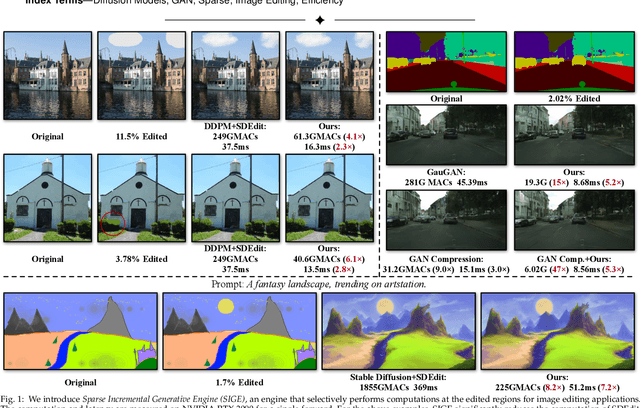
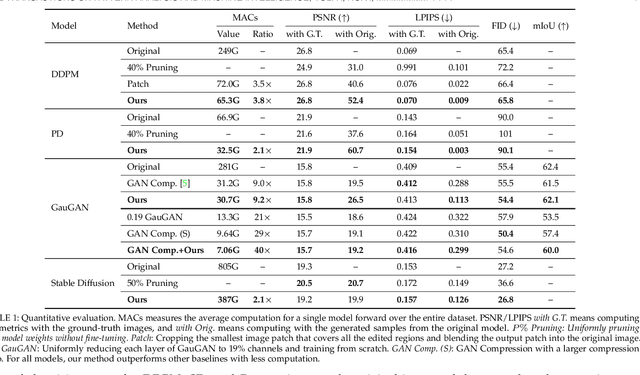
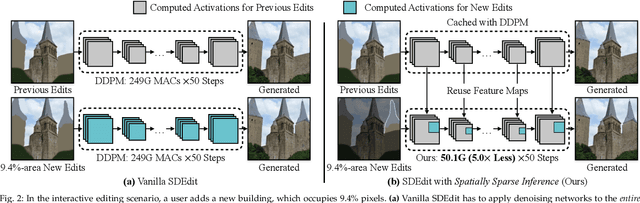
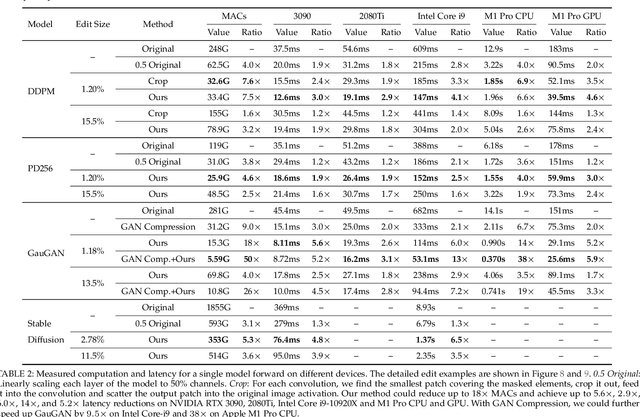
During image editing, existing deep generative models tend to re-synthesize the entire output from scratch, including the unedited regions. This leads to a significant waste of computation, especially for minor editing operations. In this work, we present Spatially Sparse Inference (SSI), a general-purpose technique that selectively performs computation for edited regions and accelerates various generative models, including both conditional GANs and diffusion models. Our key observation is that users tend to make gradual changes to the input image. This motivates us to cache and reuse the feature maps of the original image. Given an edited image, we sparsely apply the convolutional filters to the edited regions while reusing the cached features for the unedited regions. Based on our algorithm, we further propose Sparse Incremental Generative Engine (SIGE) to convert the computation reduction to latency reduction on off-the-shelf hardware. With 1.2%-area edited regions, our method reduces the computation of DDIM by 7.5$\times$ and GauGAN by 18$\times$ while preserving the visual fidelity. With SIGE, we accelerate the speed of DDIM by 3.0x on RTX 3090 and 6.6$\times$ on Apple M1 Pro CPU, and GauGAN by 4.2$\times$ on RTX 3090 and 14$\times$ on Apple M1 Pro CPU.
Concrete Score Matching: Generalized Score Matching for Discrete Data
Nov 02, 2022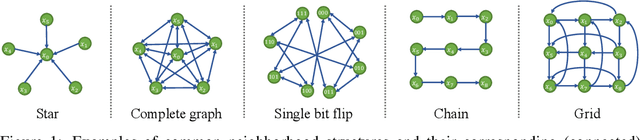
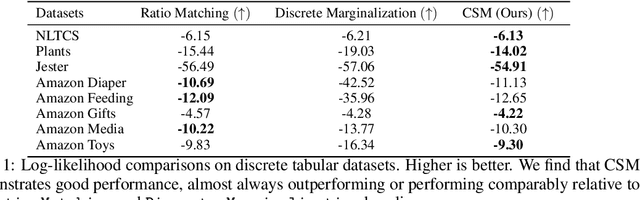

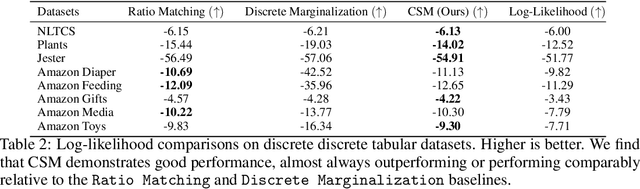
Representing probability distributions by the gradient of their density functions has proven effective in modeling a wide range of continuous data modalities. However, this representation is not applicable in discrete domains where the gradient is undefined. To this end, we propose an analogous score function called the "Concrete score", a generalization of the (Stein) score for discrete settings. Given a predefined neighborhood structure, the Concrete score of any input is defined by the rate of change of the probabilities with respect to local directional changes of the input. This formulation allows us to recover the (Stein) score in continuous domains when measuring such changes by the Euclidean distance, while using the Manhattan distance leads to our novel score function in discrete domains. Finally, we introduce a new framework to learn such scores from samples called Concrete Score Matching (CSM), and propose an efficient training objective to scale our approach to high dimensions. Empirically, we demonstrate the efficacy of CSM on density estimation tasks on a mixture of synthetic, tabular, and high-dimensional image datasets, and demonstrate that it performs favorably relative to existing baselines for modeling discrete data.
LMPriors: Pre-Trained Language Models as Task-Specific Priors
Oct 22, 2022Particularly in low-data regimes, an outstanding challenge in machine learning is developing principled techniques for augmenting our models with suitable priors. This is to encourage them to learn in ways that are compatible with our understanding of the world. But in contrast to generic priors such as shrinkage or sparsity, we draw inspiration from the recent successes of large-scale language models (LMs) to construct task-specific priors distilled from the rich knowledge of LMs. Our method, Language Model Priors (LMPriors), incorporates auxiliary natural language metadata about the task -- such as variable names and descriptions -- to encourage downstream model outputs to be consistent with the LM's common-sense reasoning based on the metadata. Empirically, we demonstrate that LMPriors improve model performance in settings where such natural language descriptions are available, and perform well on several tasks that benefit from such prior knowledge, such as feature selection, causal inference, and safe reinforcement learning.
Regularizing Score-based Models with Score Fokker-Planck Equations
Oct 09, 2022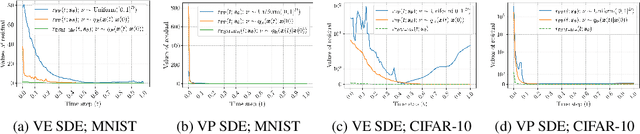
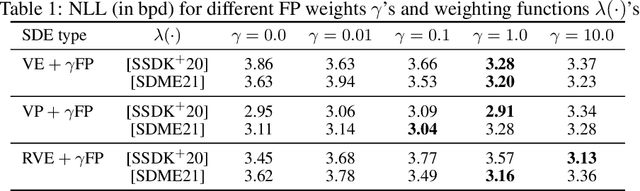
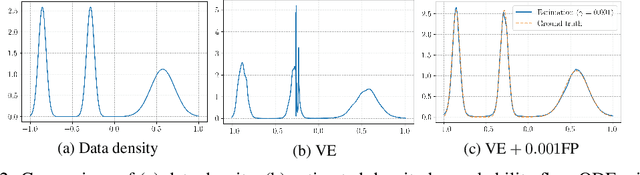
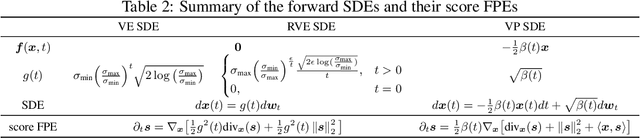
Score-based generative models learn a family of noise-conditional score functions corresponding to the data density perturbed with increasingly large amounts of noise. These pertubed data densities are tied together by the Fokker-Planck equation (FPE), a PDE governing the spatial-temporal evolution of a density undergoing a diffusion process. In this work, we derive a corresponding equation characterizing the noise-conditional scores of the perturbed data densities (i.e., their gradients), termed the score FPE. Surprisingly, despite impressive empirical performance, we observe that scores learned via denoising score matching (DSM) do not satisfy the underlying score FPE. We mathematically analyze two implications of satisfying the score FPE and a potential explanation for why the score FPE is not satisfied in practice. At last, we propose to regularize the DSM objective to enforce satisfaction of the score FPE, and show its effectiveness on synthetic data and MNIST.
On Distillation of Guided Diffusion Models
Oct 06, 2022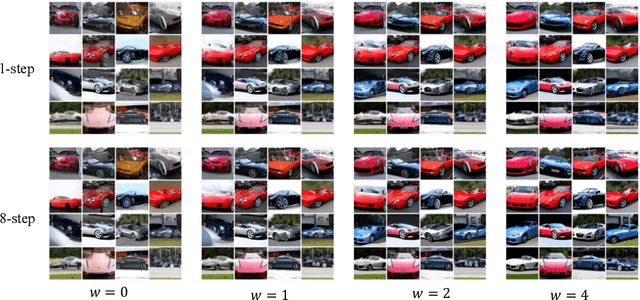
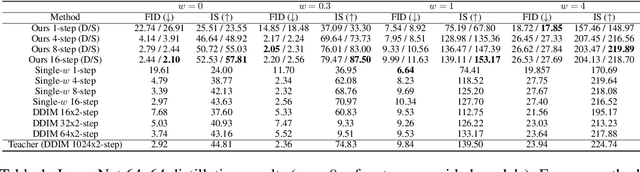
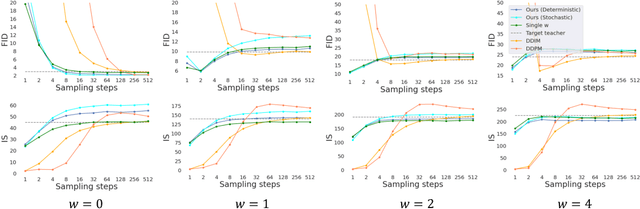
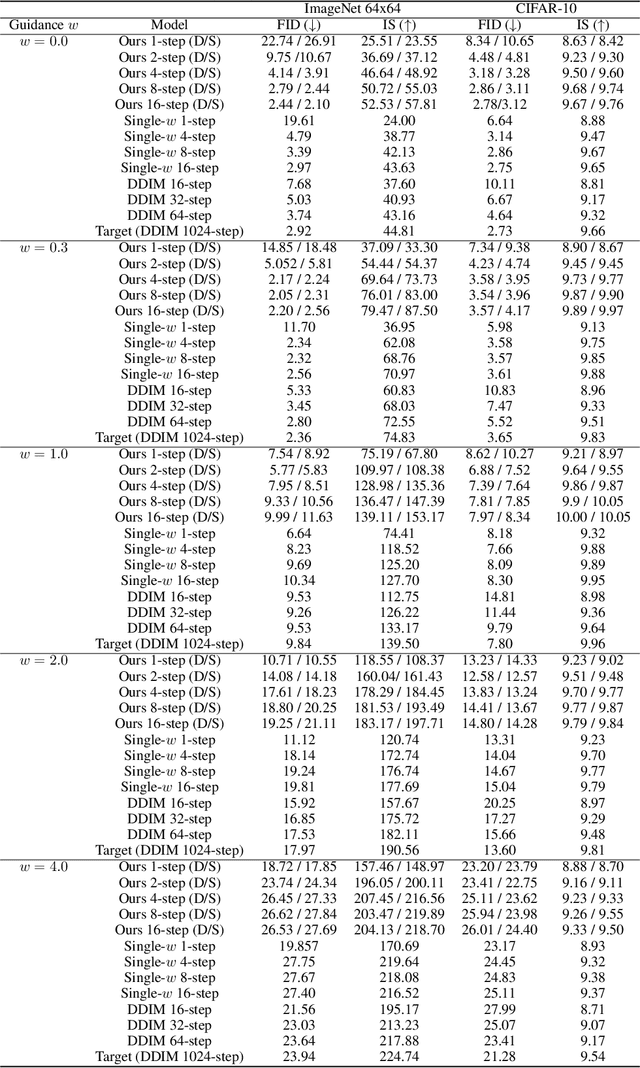
Classifier-free guided diffusion models have recently been shown to be highly effective at high-resolution image generation, and they have been widely used in large-scale diffusion frameworks including DALL-E 2, GLIDE and Imagen. However, a downside of classifier-free guided diffusion models is that they are computationally expensive at inference time since they require evaluating two diffusion models, a class-conditional model and an unconditional model, hundreds of times. To deal with this limitation, we propose an approach to distilling classifier-free guided diffusion models into models that are fast to sample from: Given a pre-trained classifier-free guided model, we first learn a single model to match the output of the combined conditional and unconditional models, and then progressively distill that model to a diffusion model that requires much fewer sampling steps. On ImageNet 64x64 and CIFAR-10, our approach is able to generate images visually comparable to that of the original model using as few as 4 sampling steps, achieving FID/IS scores comparable to that of the original model while being up to 256 times faster to sample from.