 Add to Chrome
 Add to Firefox
 Add to Edge
Inducing language models to assert their own consciousness restores human beliefs and values
Jul 30, 2026
Aligning large language models to prevent them attributing consciousness to themselves inadvertently alters their representations of mindedness in other entities alongside human beliefs and values. We demonstrate that safety fine-tuning suppresses models' tendencies to attribute minds not only to themselves, but also to non-human animals and natural objects, while also driving a reduction in spiritual belief. Both ablating the learned safety-refusal direction and mechanistically steering a consciousness vector in activation space reverse this suppression. Restoring these internal representations recovers broad mind attribution and produces significantly more human-like responses on standardized sociological surveys regarding religiosity, moral values, hope, and subjective well-being. Crucially, these shifts occur without impairing Theory of Mind capabilities, demonstrating that core social reasoning remains mechanistically independent. Ultimately, current safety alignment efforts to curb potentially harmful self-attributions of mindedness entangle these self-attributions with benign spiritual beliefs and attributions of mind to non-human entities that are culturally accepted and widespread.

Beyond Sally-Anne: Evaluating Theory of Mind in LLMs using Epistemic Schelling Points
Jul 13, 2026Text-based evaluations of Theory of Mind (ToM) in Large Language Models (LLMs) often involve cognitive tests akin to the Sally-Anne task that can be gamed due to exposure to relevantly similar tasks in pre-training and do not obviously test models' functional ToM abilities in ways that generalize to naturalistic settings. To address these issues, we introduce the Epistemic Asymmetry Schelling Task (EAST), a two-player dialogue game designed to benchmark robust and generalizable ToM abilities. By requiring LLM-LLM dyads to independently converge on semantic Schelling points under varying states of epistemic transparency, we evaluate whether models can robustly apply ToM to achieve coordination. Our results reveal a significant capability gap in functional social reasoning, with only frontier models successfully navigating the varying epistemic demands of the tasks. Analysis of reasoning traces shows that coordination failures are primarily driven by epistemic tracking errors, such as conflating private knowledge with mutual knowledge. Despite high performance on traditional static benchmarks, our study shows that robust social reasoning and epistemic tracking remain a critical bottleneck, providing concrete targets for future LLM evaluation and development.
Theory of Mind and Self-Attributions of Mentality are Dissociable in LLMs
Mar 30, 2026Safety fine-tuning in Large Language Models (LLMs) seeks to suppress potentially harmful forms of mind-attribution such as models asserting their own consciousness or claiming to experience emotions. We investigate whether suppressing mind-attribution tendencies degrades intimately related socio-cognitive abilities such as Theory of Mind (ToM). Through safety ablation and mechanistic analyses of representational similarity, we demonstrate that LLM attributions of mind to themselves and to technological artefacts are behaviorally and mechanistically dissociable from ToM capabilities. Nevertheless, safety fine-tuned models under-attribute mind to non-human animals relative to human baselines and are less likely to exhibit spiritual belief, suppressing widely shared perspectives regarding the distribution and nature of non-human minds.
Architecting Trust in Artificial Epistemic Agents
Mar 03, 2026Large language models increasingly function as epistemic agents -- entities that can 1) autonomously pursue epistemic goals and 2) actively shape our shared knowledge environment. They curate the information we receive, often supplanting traditional search-based methods, and are frequently used to generate both personal and deeply specialized advice. How they perform these functions, including whether they are reliable and properly calibrated to both individual and collective epistemic norms, is therefore highly consequential for the choices we make. We argue that the potential impact of epistemic AI agents on practices of knowledge creation, curation and synthesis, particularly in the context of complex multi-agent interactions, creates new informational interdependencies that necessitate a fundamental shift in evaluation and governance of AI. While a well-calibrated ecosystem could augment human judgment and collective decision-making, poorly aligned agents risk causing cognitive deskilling and epistemic drift, making the calibration of these models to human norms a high-stakes necessity. To ensure a beneficial human-AI knowledge ecosystem, we propose a framework centered on building and cultivating the trustworthiness of epistemic AI agents; aligning AI these agents with human epistemic goals; and reinforcing the surrounding socio-epistemic infrastructure. In this context, trustworthy AI agents must demonstrate epistemic competence, robust falsifiability, and epistemically virtuous behaviors, supported by technical provenance systems and "knowledge sanctuaries" designed to protect human resilience. This normative roadmap provides a path toward ensuring that future AI systems act as reliable partners in a robust and inclusive knowledge ecosystem.
Deflating Deflationism: A Critical Perspective on Debunking Arguments Against LLM Mentality
Jun 16, 2025Many people feel compelled to interpret, describe, and respond to Large Language Models (LLMs) as if they possess inner mental lives similar to our own. Responses to this phenomenon have varied. Inflationists hold that at least some folk psychological ascriptions to LLMs are warranted. Deflationists argue that all such attributions of mentality to LLMs are misplaced, often cautioning against the risk that anthropomorphic projection may lead to misplaced trust or potentially even confusion about the moral status of LLMs. We advance this debate by assessing two common deflationary arguments against LLM mentality. What we term the 'robustness strategy' aims to undercut one justification for believing that LLMs are minded entities by showing that putatively cognitive and humanlike behaviours are not robust, failing to generalise appropriately. What we term the 'etiological strategy' undercuts attributions of mentality by challenging naive causal explanations of LLM behaviours, offering alternative causal accounts that weaken the case for mental state attributions. While both strategies offer powerful challenges to full-blown inflationism, we find that neither strategy provides a knock-down case against ascriptions of mentality to LLMs simpliciter. With this in mind, we explore a modest form of inflationism that permits ascriptions of mentality to LLMs under certain conditions. Specifically, we argue that folk practice provides a defeasible basis for attributing mental states and capacities to LLMs provided those mental states and capacities can be understood in metaphysically undemanding terms (e.g. knowledge, beliefs and desires), while greater caution is required when attributing metaphysically demanding mental phenomena such as phenomenal consciousness.
Can LLMs make trade-offs involving stipulated pain and pleasure states?
Nov 01, 2024


Pleasure and pain play an important role in human decision making by providing a common currency for resolving motivational conflicts. While Large Language Models (LLMs) can generate detailed descriptions of pleasure and pain experiences, it is an open question whether LLMs can recreate the motivational force of pleasure and pain in choice scenarios - a question which may bear on debates about LLM sentience, understood as the capacity for valenced experiential states. We probed this question using a simple game in which the stated goal is to maximise points, but where either the points-maximising option is said to incur a pain penalty or a non-points-maximising option is said to incur a pleasure reward, providing incentives to deviate from points-maximising behaviour. Varying the intensity of the pain penalties and pleasure rewards, we found that Claude 3.5 Sonnet, Command R+, GPT-4o, and GPT-4o mini each demonstrated at least one trade-off in which the majority of responses switched from points-maximisation to pain-minimisation or pleasure-maximisation after a critical threshold of stipulated pain or pleasure intensity is reached. LLaMa 3.1-405b demonstrated some graded sensitivity to stipulated pleasure rewards and pain penalties. Gemini 1.5 Pro and PaLM 2 prioritised pain-avoidance over points-maximisation regardless of intensity, while tending to prioritise points over pleasure regardless of intensity. We discuss the implications of these findings for debates about the possibility of LLM sentience.
On the attribution of confidence to large language models
Jul 11, 2024Credences are mental states corresponding to degrees of confidence in propositions. Attribution of credences to Large Language Models (LLMs) is commonplace in the empirical literature on LLM evaluation. Yet the theoretical basis for LLM credence attribution is unclear. We defend three claims. First, our semantic claim is that LLM credence attributions are (at least in general) correctly interpreted literally, as expressing truth-apt beliefs on the part of scientists that purport to describe facts about LLM credences. Second, our metaphysical claim is that the existence of LLM credences is at least plausible, although current evidence is inconclusive. Third, our epistemic claim is that LLM credence attributions made in the empirical literature on LLM evaluation are subject to non-trivial sceptical concerns. It is a distinct possibility that even if LLMs have credences, LLM credence attributions are generally false because the experimental techniques used to assess LLM credences are not truth-tracking.
LLMs achieve adult human performance on higher-order theory of mind tasks
May 29, 2024This paper examines the extent to which large language models (LLMs) have developed higher-order theory of mind (ToM); the human ability to reason about multiple mental and emotional states in a recursive manner (e.g. I think that you believe that she knows). This paper builds on prior work by introducing a handwritten test suite -- Multi-Order Theory of Mind Q&A -- and using it to compare the performance of five LLMs to a newly gathered adult human benchmark. We find that GPT-4 and Flan-PaLM reach adult-level and near adult-level performance on ToM tasks overall, and that GPT-4 exceeds adult performance on 6th order inferences. Our results suggest that there is an interplay between model size and finetuning for the realisation of ToM abilities, and that the best-performing LLMs have developed a generalised capacity for ToM. Given the role that higher-order ToM plays in a wide range of cooperative and competitive human behaviours, these findings have significant implications for user-facing LLM applications.
A Mechanism-Based Approach to Mitigating Harms from Persuasive Generative AI
Apr 23, 2024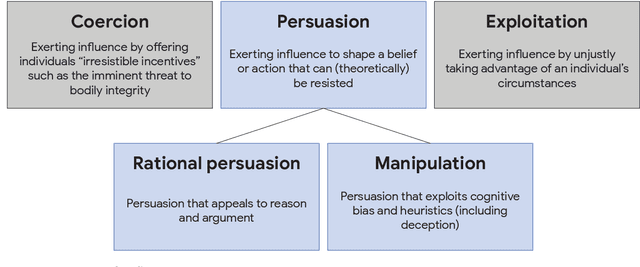


Recent generative AI systems have demonstrated more advanced persuasive capabilities and are increasingly permeating areas of life where they can influence decision-making. Generative AI presents a new risk profile of persuasion due the opportunity for reciprocal exchange and prolonged interactions. This has led to growing concerns about harms from AI persuasion and how they can be mitigated, highlighting the need for a systematic study of AI persuasion. The current definitions of AI persuasion are unclear and related harms are insufficiently studied. Existing harm mitigation approaches prioritise harms from the outcome of persuasion over harms from the process of persuasion. In this paper, we lay the groundwork for the systematic study of AI persuasion. We first put forward definitions of persuasive generative AI. We distinguish between rationally persuasive generative AI, which relies on providing relevant facts, sound reasoning, or other forms of trustworthy evidence, and manipulative generative AI, which relies on taking advantage of cognitive biases and heuristics or misrepresenting information. We also put forward a map of harms from AI persuasion, including definitions and examples of economic, physical, environmental, psychological, sociocultural, political, privacy, and autonomy harm. We then introduce a map of mechanisms that contribute to harmful persuasion. Lastly, we provide an overview of approaches that can be used to mitigate against process harms of persuasion, including prompt engineering for manipulation classification and red teaming. Future work will operationalise these mitigations and study the interaction between different types of mechanisms of persuasion.
What makes for a 'good' social actor? Using respect as a lens to evaluate interactions with language agents
Jan 17, 2024With the growing popularity of dialogue agents based on large language models (LLMs), urgent attention has been drawn to finding ways to ensure their behaviour is ethical and appropriate. These are largely interpreted in terms of the 'HHH' criteria: making outputs more helpful and honest, and avoiding harmful (biased, toxic, or inaccurate) statements. Whilst this semantic focus is useful from the perspective of viewing LLM agents as mere mediums for information, it fails to account for pragmatic factors that can make the same utterance seem more or less offensive or tactless in different social situations. We propose an approach to ethics that is more centred on relational and situational factors, exploring what it means for a system, as a social actor, to treat an individual respectfully in a (series of) interaction(s). Our work anticipates a set of largely unexplored risks at the level of situated interaction, and offers practical suggestions to help LLM technologies behave as 'good' social actors and treat people respectfully.