 Add to Chrome
 Add to Firefox
 Add to Edge
UAV3DCrop: Benchmarking 3D Reconstruction in Repeated Multi-Angle UAV Crop Surveys
Aug 03, 2026
Accurate 3D crop monitoring underpins data-driven precision agriculture by enabling field-scale analysis of plant structure, growth dynamics, and management response. Modern 3D reconstruction methods perform strongly on generic benchmarks, but rendered appearance may not translate into metrically and agronomically useful geometry in crop fields. We introduce UAV3DCrop, a public benchmark of repeated multi-angle unmanned aerial vehicle (UAV) crop surveys. It contains 88,830 RGB images at $5280 \times 3956$ pixels, with a ground sampling distance of 3.6-5.8 mm, from 91 scenes spanning corn, soybean, wheat, and oat. Track A evaluates seven scene-optimized methods -- Neural Radiance Field (NeRF) and 3D Gaussian Splatting (3DGS) variants -- on held-out views, photogrammetry-referenced depth, and canopy-height recovery. Track B tests four pretrained feed-forward models on zero-shot camera-pose and geometry estimation. The scene-optimized methods rank differently across the three targets: Splatfacto-big leads appearance, whereas Scaffold-GS leads depth and is statistically tied with Splatfacto for canopy height. Among feed-forward models, MapAnything leads on seven of the eight metrics, while the remaining models vary more across crops and fail severely on absolute scale in a way that alignment conceals. Repeated acquisitions reveal further sensitivities that differ by output type and by model, associated with position within the acquisition sequence and with tie-point multiplicity. Current 3D reconstruction methods are therefore not yet interchangeable for agronomic use: no single method wins on appearance, geometry, and canopy height at once, and only one of four feed-forward models recovers usable metric scale. The dataset is publicly available at https://link-dev.github.io/UAV3DCrop/

PhenoStitch: Training-Free Panoptic Crop Mapping from Satellite Image Time Series
Aug 01, 2026Panoptic crop mapping requires both delineating individual agricultural parcels and assigning a crop type to each parcel from satellite image time series. Existing approaches typically rely on dense parcel-level annotations and task-specific model training, which limits their applicability to new regions and growing seasons. We introduce PhenoStitch, a panoptic crop-mapping pipeline that requires no task-specific gradient-based training. A frozen Segment Anything model first oversegments each patch into class-agnostic regions. For each region, optical NDVI and Sentinel-1 backscatter series are summarized by an analytic double-harmonic phenological signature. Adjacent regions are then merged into parcels by minimizing a Potts graph energy, and each parcel is classified by nearest-prototype matching using only (k) labeled parcels per class. A final topology-closure step produces the panoptic map. Under a matched budget of (k=20) parcels per class, corresponding to less than 1% of the available labels, PhenoStitch achieves 20.0 crop mIoU, 76.2 segmentation quality, and 6.2 panoptic quality on PASTIS-R under a 5-fold, 3-seed evaluation. It outperforms the evaluated frozen foundation-model, few-shot, and matched-budget supervised baselines under the same protocol, with a consistent ranking also observed on ZueriCrop. Ablation studies show that radar observations contribute the largest performance gain, while the graph-energy merge and compact phenological signature provide further improvements. These results demonstrate the effectiveness of combining label-free parcel delineation with few-shot phenological recognition for panoptic crop mapping under limited supervision.
GeoArbiter: Verifiability-Guided Grounding for Remote-Sensing Multimodal LLMs
Aug 01, 2026Remote-sensing multimodal large language models (MLLMs) often assert facts that imagery cannot establish, such as a facility's identity or function. Coordinate-keyed geographic retrieval can supply this missing knowledge, improving fMoW land-use accuracy by 12.06--17.19 points across three open MLLMs. However, retrieved records can also contradict visible evidence, and we find that models frequently follow the records even when the image is decisive. We argue that source trust should therefore depend on \emph{cross-modal verifiability}: geographic records are most useful for attributes the image cannot verify and most dangerous when they dispute visually verifiable attributes. We introduce GeoArbiter, a training-free pipeline that operationalizes this principle by injecting only image-unverifiable geographic facts. Unlike arbitration prompts, which leak across attribute types and bias yes/no responses, content-level filtering preserves 84.69--87.15\% of the full-retrieval accuracy gain, reduces claim-level hallucination by 9.58--26.34\% under a source-blinded judge, and improves robustness to conflicting records across all three models. These results identify verifiability-guided content selection as a simple, effective mechanism for grounding remote-sensing MLLMs in fallible geographic knowledge.
Beyond Input-Output: Rethinking Creativity through Design-by-Analogy in Human-AI Collaboration
Feb 10, 2026While the proliferation of foundation models has significantly boosted individual productivity, it also introduces a potential challenge: the homogenization of creative content. In response, we revisit Design-by-Analogy (DbA), a cognitively grounded approach that fosters novel solutions by mapping inspiration across domains. However, prevailing perspectives often restrict DbA to early ideation or specific data modalities, while reducing AI-driven design to simplified input-output pipelines. Such conceptual limitations inadvertently foster widespread design fixation. To address this, we expand the understanding of DbA by embedding it into the entire creative process, thereby demonstrating its capacity to mitigate such fixation. Through a systematic review of 85 studies, we identify six forms of representation and classify techniques across seven stages of the creative process. We further discuss three major application domains: creative industries, intelligent manufacturing, and education and services, demonstrating DbA's practical relevance. Building on this synthesis, we frame DbA as a mediating technology for human-AI collaboration and outline the potential opportunities and inherent risks for advancing creativity support in HCI and design research.
* 20 pages, 9 figures. Accepted to the 2026 CHI Conference on Human Factors in Computing Systems
Mixture of Attention Yields Accurate Results for Tabular Data
Feb 18, 2025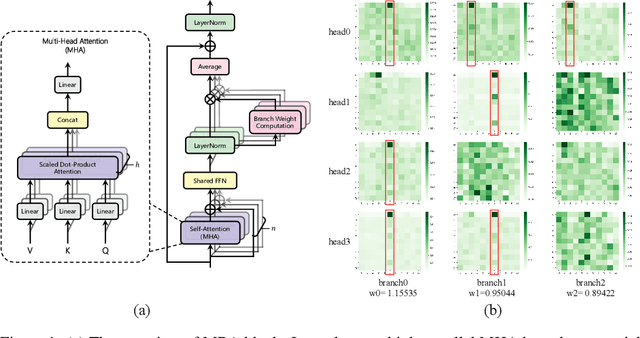
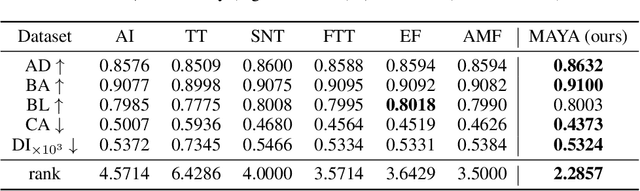
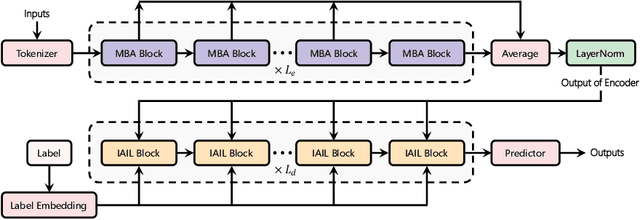
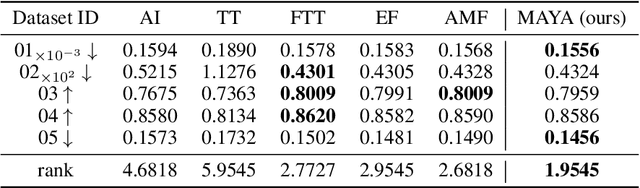
Tabular data inherently exhibits significant feature heterogeneity, but existing transformer-based methods lack specialized mechanisms to handle this property. To bridge the gap, we propose MAYA, an encoder-decoder transformer-based framework. In the encoder, we design a Mixture of Attention (MOA) that constructs multiple parallel attention branches and averages the features at each branch, effectively fusing heterogeneous features while limiting parameter growth. Additionally, we employ collaborative learning with a dynamic consistency weight constraint to produce more robust representations. In the decoder stage, cross-attention is utilized to seamlessly integrate tabular data with corresponding label features. This dual-attention mechanism effectively captures both intra-instance and inter-instance interactions. We evaluate the proposed method on a wide range of datasets and compare it with other state-of-the-art transformer-based methods. Extensive experiments demonstrate that our model achieves superior performance among transformer-based methods in both tabular classification and regression tasks.
SSAD: Self-supervised Auxiliary Detection Framework for Panoramic X-ray based Dental Disease Diagnosis
Jun 20, 2024Panoramic X-ray is a simple and effective tool for diagnosing dental diseases in clinical practice. When deep learning models are developed to assist dentist in interpreting panoramic X-rays, most of their performance suffers from the limited annotated data, which requires dentist's expertise and a lot of time cost. Although self-supervised learning (SSL) has been proposed to address this challenge, the two-stage process of pretraining and fine-tuning requires even more training time and computational resources. In this paper, we present a self-supervised auxiliary detection (SSAD) framework, which is plug-and-play and compatible with any detectors. It consists of a reconstruction branch and a detection branch. Both branches are trained simultaneously, sharing the same encoder, without the need for finetuning. The reconstruction branch learns to restore the tooth texture of healthy or diseased teeth, while the detection branch utilizes these learned features for diagnosis. To enhance the encoder's ability to capture fine-grained features, we incorporate the image encoder of SAM to construct a texture consistency (TC) loss, which extracts image embedding from the input and output of reconstruction branch, and then enforces both embedding into the same feature space. Extensive experiments on the public DENTEX dataset through three detection tasks demonstrate that the proposed SSAD framework achieves state-of-the-art performance compared to mainstream object detection methods and SSL methods. The code is available at https://github.com/Dylonsword/SSAD
Scalable Ensembling For Mitigating Reward Overoptimisation
Jun 03, 2024


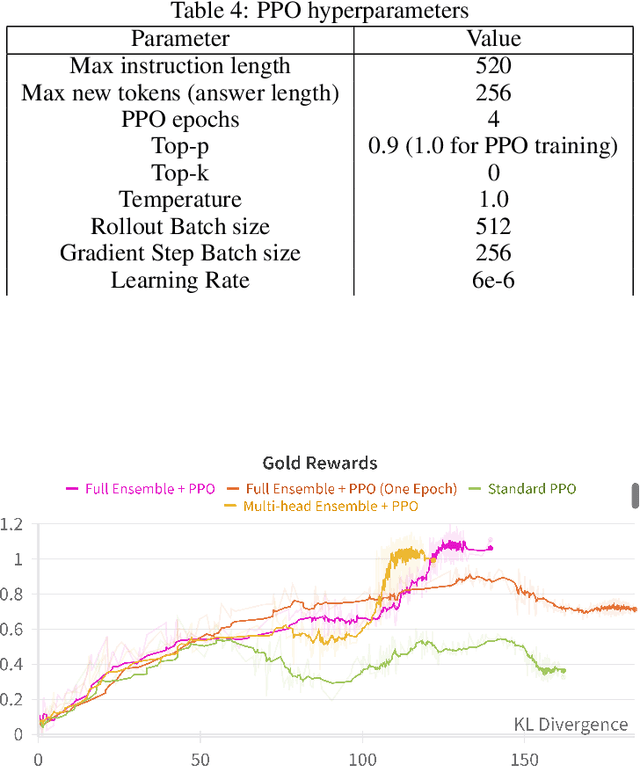
Reinforcement Learning from Human Feedback (RLHF) has enabled significant advancements within language modeling for powerful, instruction-following models. However, the alignment of these models remains a pressing challenge as the policy tends to overfit the learned ``proxy" reward model past an inflection point of utility as measured by a ``gold" reward model that is more performant -- a phenomenon known as \textit{over-optimization}. Prior work has mitigated this issue by computing a pessimistic statistic over an ensemble of reward models, which is common in Offline Reinforcement Learning but incredibly costly for language models with high memory requirements, making such approaches infeasible for sufficiently large models. To this end, we propose using a shared encoder but separate linear heads. We find this leads to similar performance as the full ensemble while allowing tremendous savings in memory and time required for training for models of similar size. \end{abstract}
Linguistic Calibration of Language Models
Mar 30, 2024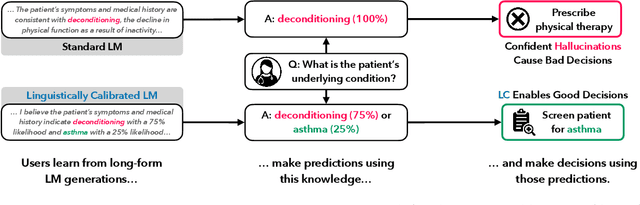

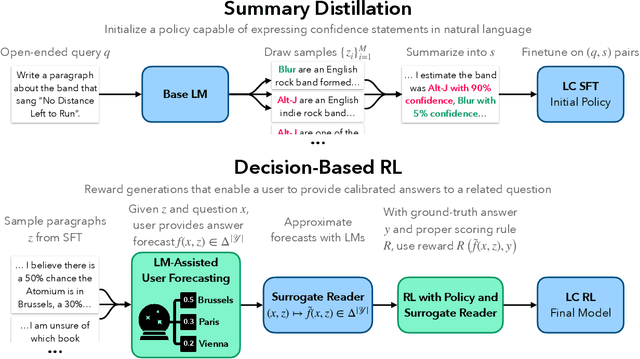

Language models (LMs) may lead their users to make suboptimal downstream decisions when they confidently hallucinate. This issue can be mitigated by having the LM verbally convey the probability that its claims are correct, but existing models cannot produce text with calibrated confidence statements. Through the lens of decision-making, we formalize linguistic calibration for long-form generations: an LM is linguistically calibrated if its generations enable its users to make calibrated probabilistic predictions. This definition enables a training framework where a supervised finetuning step bootstraps an LM to emit long-form generations with confidence statements such as "I estimate a 30% chance of..." or "I am certain that...", followed by a reinforcement learning step which rewards generations that enable a user to provide calibrated answers to related questions. We linguistically calibrate Llama 2 7B and find in automated and human evaluations of long-form generations that it is significantly more calibrated than strong finetuned factuality baselines with comparable accuracy. These findings generalize under distribution shift on question-answering and under a significant task shift to person biography generation. Our results demonstrate that long-form generations may be calibrated end-to-end by constructing an objective in the space of the predictions that users make in downstream decision-making.
SCPMan: Shape Context and Prior Constrained Multi-scale Attention Network for Pancreatic Segmentation
Dec 26, 2023Due to the poor prognosis of Pancreatic cancer, accurate early detection and segmentation are critical for improving treatment outcomes. However, pancreatic segmentation is challenged by blurred boundaries, high shape variability, and class imbalance. To tackle these problems, we propose a multiscale attention network with shape context and prior constraint for robust pancreas segmentation. Specifically, we proposed a Multi-scale Feature Extraction Module (MFE) and a Mixed-scale Attention Integration Module (MAI) to address unclear pancreas boundaries. Furthermore, a Shape Context Memory (SCM) module is introduced to jointly model semantics across scales and pancreatic shape. Active Shape Model (ASM) is further used to model the shape priors. Experiments on NIH and MSD datasets demonstrate the efficacy of our model, which improves the state-of-the-art Dice Score for 1.01% and 1.03% respectively. Our architecture provides robust segmentation performance, against the blurry boundaries, and variations in scale and shape of pancreas.
TCSloT: Text Guided 3D Context and Slope Aware Triple Network for Dental Implant Position Prediction
Aug 10, 2023In implant prosthesis treatment, the surgical guide of implant is used to ensure accurate implantation. However, such design heavily relies on the manual location of the implant position. When deep neural network has been proposed to assist the dentist in locating the implant position, most of them take a single slice as input, which do not fully explore 3D contextual information and ignoring the influence of implant slope. In this paper, we design a Text Guided 3D Context and Slope Aware Triple Network (TCSloT) which enables the perception of contextual information from multiple adjacent slices and awareness of variation of implant slopes. A Texture Variation Perception (TVP) module is correspondingly elaborated to process the multiple slices and capture the texture variation among slices and a Slope-Aware Loss (SAL) is proposed to dynamically assign varying weights for the regression head. Additionally, we design a conditional text guidance (CTG) module to integrate the text condition (i.e., left, middle and right) from the CLIP for assisting the implant position prediction. Extensive experiments on a dental implant dataset through five-fold cross-validation demonstrated that the proposed TCSloT achieves superior performance than existing methods.