 Add to Chrome
 Add to Firefox
 Add to Edge
Vector Policy Optimization: Training for Diversity Improves Test-Time Search
May 21, 2026
Language models must now generalize out of the box to novel environments and work inside inference-scaling search procedures, such as AlphaEvolve, that select rollouts with a variety of task-specific reward functions. Unfortunately, the standard paradigm of LLM post-training optimizes a pre-specified scalar reward, often leading current LLMs to produce low-entropy response distributions and thus to struggle at displaying the diversity that inference-time search will require. We propose Vector Policy Optimization (VPO), an RL algorithm that explicitly trains policies to anticipate diverse downstream reward functions and to produce diverse solutions. VPO exploits that rewards are often vector-valued in practice, like per-test-case correctness in code generation or, say, multiple different user personas or reward models. VPO is essentially a drop-in replacement for the GRPO advantage estimator, but it trains the LLM to output a set of solutions where individual solutions specialize to different trade-offs in the vector reward space. Across four tasks, VPO matches or beats the strongest scalar RL baselines on test-time search (e.g. pass@k and best@k), with the gap widening as the search budget grows. For evolutionary search, VPO models unlock problems that GRPO models cannot solve at all. As test-time search becomes more standardized, optimizing for diversity may need to become the default post-training objective.

PEEK: Context Map as an Orientation Cache for Long-Context LLM Agents
May 19, 2026Large language model (LLM) agents increasingly operate over long and recurring external contexts, like document corpora and code repositories. Across invocations, existing approaches preserve either the agent's trajectory, passive access to raw material, or task-level strategies. None of them preserves what we argue is most needed for repeated same-context workloads: reusable orientation knowledge (e.g., what the context contains, how it is organized, and which entities, constants, and schemas have historically been useful) about the recurring context itself. We introduce PEEK, a system that caches and maintains this orientation knowledge as a context map: a small, constant-sized artifact in the agent's prompt that gives it a persistent peek into the external context. The map is maintained by a programmable cache policy with three modules: a Distiller that extracts transferable knowledge from inference-time signals, a Cartographer that translates it into structured edits, and a priority-based Evictor that enforces a fixed token budget. On long-context reasoning and information aggregation, PEEK improves over strong baselines by 6.3-34.0% while using 93-145 fewer iterations and incurring 1.7-5.8x lower cost than the state-of-the-art prompt-learning framework, ACE. On context learning, PEEK improves solving rate and rubric accuracy by 6.0-14.0% and 7.8-12.1%, respectively, at 1.4x lower cost than ACE. These gains generalize across LMs and agent architectures, including OpenAI Codex, a production-grade coding agent. Together, these results show that a context map helps long-context LLM agents interact with recurring external contexts more accurately and efficiently.
optimize_anything: A Universal API for Optimizing any Text Parameter
May 19, 2026Can a single LLM-based optimization system match specialized tools across fundamentally different domains? We show that when optimization problems are formulated as improving a text artifact evaluated by a scoring function, a single AI-based optimization system-supporting single-task search, multi-task search with cross-problem transfer, and generalization to unseen inputs-achieves state-of-the-art results across six diverse tasks. Our system discovers agent architectures that nearly triple Gemini Flash's ARC-AGI accuracy (32.5% to 89.5%), finds scheduling algorithms that cut cloud costs by 40%, generates CUDA kernels where 87% match or beat PyTorch, and outperforms AlphaEvolve's reported circle packing solution (n=26). Ablations across three domains reveal that actionable side information yields faster convergence and substantially higher final scores than score-only feedback, and that multi-task search outperforms independent optimization given equivalent per-problem budget through cross-task transfer, with benefits scaling with the number of related tasks. Together, we show for the first time that text optimization with LLM-based search is a general-purpose problem-solving paradigm, unifying tasks traditionally requiring domain-specific algorithms under a single framework. We open-source optimize\_anything with support for multiple backends as part of the GEPA project at https://github.com/gepa-ai/gepa .
* 16 pages, 11 figures; Blog: https://gepa-ai.github.io/gepa/blog/2026/02/18/introducing-optimize-anything/
OBLIQ-Bench: Exposing Overlooked Bottlenecks in Modern Retrievers with Latent and Implicit Queries
May 07, 2026Retrieval benchmarks are increasingly saturating, but we argue that efficient search is far from a solved problem. We identify a class of queries we call oblique, which seek documents that instantiate a latent pattern, like finding all tweets that express an implicit stance, chat logs that demonstrate a particular failure mode, or transcripts that match an abstract scenario. We study three mechanisms through which obliqueness may arise and introduce OBLIQ-Bench, a suite of five oblique search problems over real long-tail corpora. OBLIQ-Bench exposes an overlooked asymmetry between retrieval and verification, where reasoning LLMs reliably recognize latent relevance whenever relevant documents are surfaced, but even sophisticated retrieval pipelines fail to surface most relevant documents in the first place. We hope that OBLIQ-Bench will drive research into retrieval architectures that efficiently capture latent patterns and implicit signals in large corpora.
Meta-Harness: End-to-End Optimization of Model Harnesses
Mar 30, 2026The performance of large language model (LLM) systems depends not only on model weights, but also on their harness: the code that determines what information to store, retrieve, and present to the model. Yet harnesses are still designed largely by hand, and existing text optimizers are poorly matched to this setting because they compress feedback too aggressively. We introduce Meta-Harness, an outer-loop system that searches over harness code for LLM applications. It uses an agentic proposer that accesses the source code, scores, and execution traces of all prior candidates through a filesystem. On online text classification, Meta-Harness improves over a state-of-the-art context management system by 7.7 points while using 4x fewer context tokens. On retrieval-augmented math reasoning, a single discovered harness improves accuracy on 200 IMO-level problems by 4.7 points on average across five held-out models. On agentic coding, discovered harnesses surpass the best hand-engineered baselines on TerminalBench-2. Together, these results show that richer access to prior experience can enable automated harness engineering.
Recursive Language Models
Dec 31, 2025We study allowing large language models (LLMs) to process arbitrarily long prompts through the lens of inference-time scaling. We propose Recursive Language Models (RLMs), a general inference strategy that treats long prompts as part of an external environment and allows the LLM to programmatically examine, decompose, and recursively call itself over snippets of the prompt. We find that RLMs successfully handle inputs up to two orders of magnitude beyond model context windows and, even for shorter prompts, dramatically outperform the quality of base LLMs and common long-context scaffolds across four diverse long-context tasks, while having comparable (or cheaper) cost per query.
Reasoning-Intensive Regression
Aug 29, 2025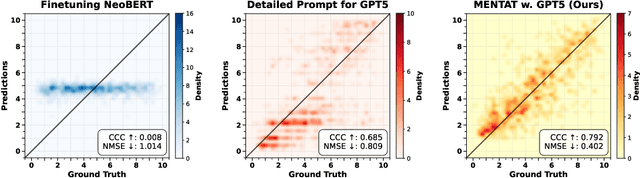
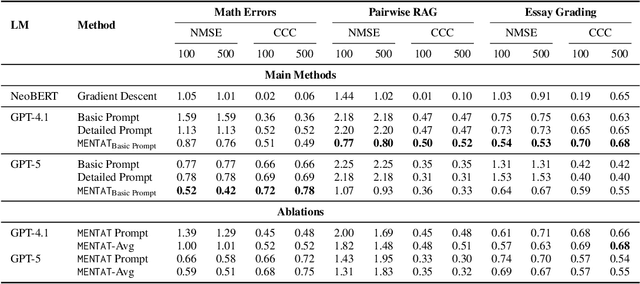
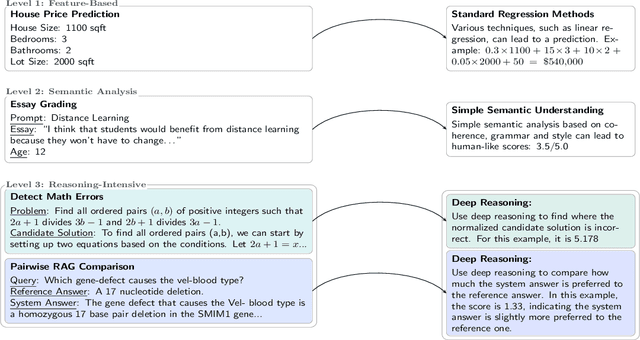
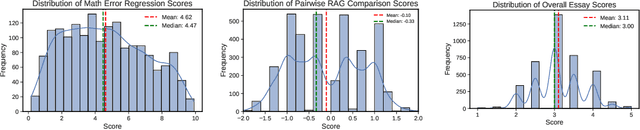
AI researchers and practitioners increasingly apply large language models (LLMs) to what we call reasoning-intensive regression (RiR), i.e. deducing subtle numerical properties from text. Unlike standard language regression tasks, e.g. for sentiment or similarity, RiR often appears instead in ad-hoc problems like rubric-based scoring or domain-specific retrieval, where much deeper analysis of text is required while only limited task-specific training data and computation are available. We cast three realistic problems as RiR tasks to establish an initial benchmark, and use that to test our hypothesis that prompting frozen LLMs and finetuning Transformer encoders via gradient descent will both often struggle in RiR. We then propose MENTAT, a simple and lightweight method that combines batch-reflective prompt optimization with neural ensemble learning. MENTAT achieves up to 65% improvement over both baselines, though substantial room remains for future advances in RiR.
Multi-module GRPO: Composing Policy Gradients and Prompt Optimization for Language Model Programs
Aug 06, 2025Group Relative Policy Optimization (GRPO) has proven to be an effective tool for post-training language models (LMs). However, AI systems are increasingly expressed as modular programs that mix together multiple LM calls with distinct prompt templates and other tools, and it is not clear how best to leverage GRPO to improve these systems. We begin to address this challenge by defining mmGRPO, a simple multi-module generalization of GRPO that groups LM calls by module across rollouts and handles variable-length and interrupted trajectories. We find that mmGRPO, composed with automatic prompt optimization, improves accuracy by 11% on average across classification, many-hop search, and privacy-preserving delegation tasks against the post-trained LM, and by 5% against prompt optimization on its own. We open-source mmGRPO in DSPy as the dspy.GRPO optimizer.
ColBERT-serve: Efficient Multi-Stage Memory-Mapped Scoring
Apr 21, 2025We study serving retrieval models, specifically late interaction models like ColBERT, to many concurrent users at once and under a small budget, in which the index may not fit in memory. We present ColBERT-serve, a novel serving system that applies a memory-mapping strategy to the ColBERT index, reducing RAM usage by 90% and permitting its deployment on cheap servers, and incorporates a multi-stage architecture with hybrid scoring, reducing ColBERT's query latency and supporting many concurrent queries in parallel.
FreshStack: Building Realistic Benchmarks for Evaluating Retrieval on Technical Documents
Apr 17, 2025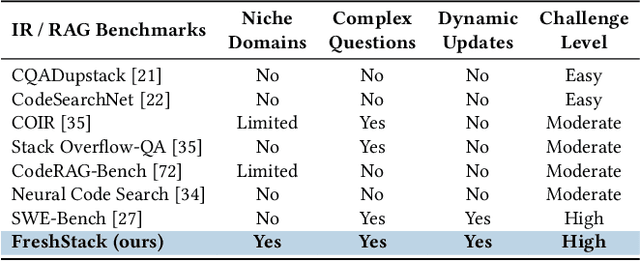
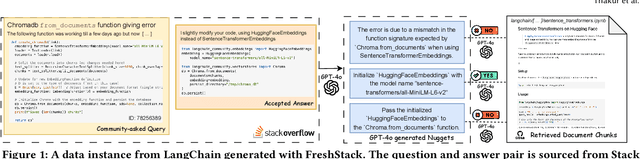
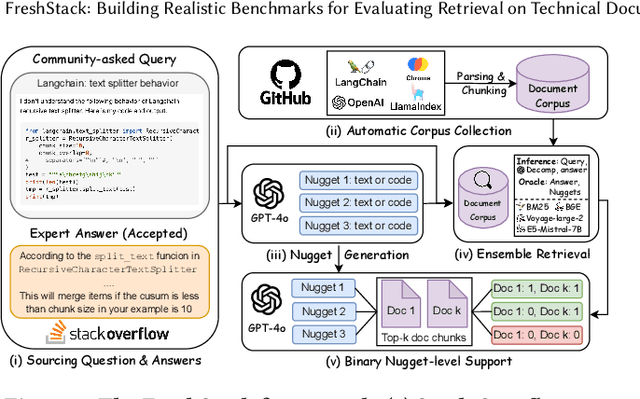
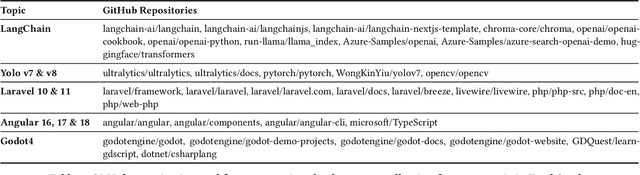
We introduce FreshStack, a reusable framework for automatically building information retrieval (IR) evaluation benchmarks from community-asked questions and answers. FreshStack conducts the following steps: (1) automatic corpus collection from code and technical documentation, (2) nugget generation from community-asked questions and answers, and (3) nugget-level support, retrieving documents using a fusion of retrieval techniques and hybrid architectures. We use FreshStack to build five datasets on fast-growing, recent, and niche topics to ensure the tasks are sufficiently challenging. On FreshStack, existing retrieval models, when applied out-of-the-box, significantly underperform oracle approaches on all five topics, denoting plenty of headroom to improve IR quality. In addition, we identify cases where rerankers do not clearly improve first-stage retrieval accuracy (two out of five topics). We hope that FreshStack will facilitate future work toward constructing realistic, scalable, and uncontaminated IR and RAG evaluation benchmarks. FreshStack datasets are available at: https://fresh-stack.github.io.