 Add to Chrome
 Add to Firefox
 Add to Edge
EvdCLIP: Improving Vision-Language Retrieval with Entity Visual Descriptions from Large Language Models
May 24, 2025
Vision-language retrieval (VLR) has attracted significant attention in both academia and industry, which involves using text (or images) as queries to retrieve corresponding images (or text). However, existing methods often neglect the rich visual semantics knowledge of entities, thus leading to incorrect retrieval results. To address this problem, we propose the Entity Visual Description enhanced CLIP (EvdCLIP), designed to leverage the visual knowledge of entities to enrich queries. Specifically, since humans recognize entities through visual cues, we employ a large language model (LLM) to generate Entity Visual Descriptions (EVDs) as alignment cues to complement textual data. These EVDs are then integrated into raw queries to create visually-rich, EVD-enhanced queries. Furthermore, recognizing that EVD-enhanced queries may introduce noise or low-quality expansions, we develop a novel, trainable EVD-aware Rewriter (EaRW) for vision-language retrieval tasks. EaRW utilizes EVD knowledge and the generative capabilities of the language model to effectively rewrite queries. With our specialized training strategy, EaRW can generate high-quality and low-noise EVD-enhanced queries. Extensive quantitative and qualitative experiments on image-text retrieval benchmarks validate the superiority of EvdCLIP on vision-language retrieval tasks.

An Outlook on the Opportunities and Challenges of Multi-Agent AI Systems
May 23, 2025Multi-agent AI systems (MAS) offer a promising framework for distributed intelligence, enabling collaborative reasoning, planning, and decision-making across autonomous agents. This paper provides a systematic outlook on the current opportunities and challenges of MAS, drawing insights from recent advances in large language models (LLMs), federated optimization, and human-AI interaction. We formalize key concepts including agent topology, coordination protocols, and shared objectives, and identify major risks such as dependency, misalignment, and vulnerabilities arising from training data overlap. Through a biologically inspired simulation and comprehensive theoretical framing, we highlight critical pathways for developing robust, scalable, and secure MAS in real-world settings.
Training Step-Level Reasoning Verifiers with Formal Verification Tools
May 21, 2025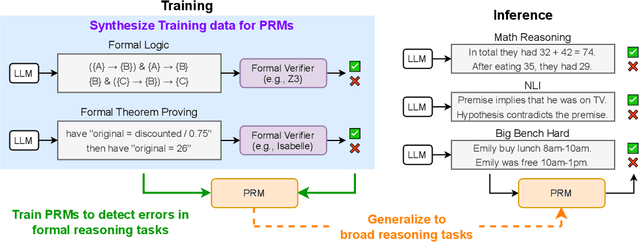


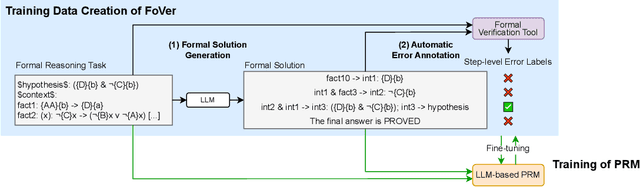
Process Reward Models (PRMs), which provide step-by-step feedback on the reasoning generated by Large Language Models (LLMs), are receiving increasing attention. However, two key research gaps remain: collecting accurate step-level error labels for training typically requires costly human annotation, and existing PRMs are limited to math reasoning problems. In response to these gaps, this paper aims to address the challenges of automatic dataset creation and the generalization of PRMs to diverse reasoning tasks. To achieve this goal, we propose FoVer, an approach for training PRMs on step-level error labels automatically annotated by formal verification tools, such as Z3 for formal logic and Isabelle for theorem proof, which provide automatic and accurate verification for symbolic tasks. Using this approach, we synthesize a training dataset with error labels on LLM responses for formal logic and theorem proof tasks without human annotation. Although this data synthesis is feasible only for tasks compatible with formal verification, we observe that LLM-based PRMs trained on our dataset exhibit cross-task generalization, improving verification across diverse reasoning tasks. Specifically, PRMs trained with FoVer significantly outperform baseline PRMs based on the original LLMs and achieve competitive or superior results compared to state-of-the-art PRMs trained on labels annotated by humans or stronger models, as measured by step-level verification on ProcessBench and Best-of-K performance across 12 reasoning benchmarks, including MATH, AIME, ANLI, MMLU, and BBH. The datasets, models, and code are provided at https://github.com/psunlpgroup/FoVer.
Directional Sparsity Based Statistical Channel Estimation for 6D Movable Antenna Communications
May 21, 2025Six-dimensional movable antenna (6DMA) is an innovative and transformative technology to improve wireless network capacity by adjusting the 3D positions and 3D rotations of antennas/surfaces (sub-arrays) based on the channel spatial distribution. For optimization of the antenna positions and rotations, the acquisition of statistical channel state information (CSI) is essential for 6DMA systems. In this paper, we unveil for the first time a new \textbf{\textit{directional sparsity}} property of the 6DMA channels between the base station (BS) and the distributed users, where each user has significant channel gains only with a (small) subset of 6DMA position-rotation pairs, which can receive direct/reflected signals from the user. By exploiting this property, a covariance-based algorithm is proposed for estimating the statistical CSI in terms of the average channel power at a small number of 6DMA positions and rotations. Based on such limited channel power estimation, the average channel powers for all possible 6DMA positions and rotations in the BS movement region are reconstructed by further estimating the multi-path average power and direction-of-arrival (DOA) vectors of all users. Simulation results show that the proposed directional sparsity-based algorithm can achieve higher channel power estimation accuracy than existing benchmark schemes, while requiring a lower pilot overhead.
Think-J: Learning to Think for Generative LLM-as-a-Judge
May 20, 2025LLM-as-a-Judge refers to the automatic modeling of preferences for responses generated by Large Language Models (LLMs), which is of significant importance for both LLM evaluation and reward modeling. Although generative LLMs have made substantial progress in various tasks, their performance as LLM-Judge still falls short of expectations. In this work, we propose Think-J, which improves generative LLM-as-a-Judge by learning how to think. We first utilized a small amount of curated data to develop the model with initial judgment thinking capabilities. Subsequently, we optimize the judgment thinking traces based on reinforcement learning (RL). We propose two methods for judgment thinking optimization, based on offline and online RL, respectively. The offline RL requires training a critic model to construct positive and negative examples for learning. The online method defines rule-based reward as feedback for optimization. Experimental results showed that our approach can significantly enhance the evaluation capability of generative LLM-Judge, surpassing both generative and classifier-based LLM-Judge without requiring extra human annotations.
Enhancing Knowledge Graph Completion with GNN Distillation and Probabilistic Interaction Modeling
May 18, 2025Knowledge graphs (KGs) serve as fundamental structures for organizing interconnected data across diverse domains. However, most KGs remain incomplete, limiting their effectiveness in downstream applications. Knowledge graph completion (KGC) aims to address this issue by inferring missing links, but existing methods face critical challenges: deep graph neural networks (GNNs) suffer from over-smoothing, while embedding-based models fail to capture abstract relational features. This study aims to overcome these limitations by proposing a unified framework that integrates GNN distillation and abstract probabilistic interaction modeling (APIM). GNN distillation approach introduces an iterative message-feature filtering process to mitigate over-smoothing, preserving the discriminative power of node representations. APIM module complements this by learning structured, abstract interaction patterns through probabilistic signatures and transition matrices, allowing for a richer, more flexible representation of entity and relation interactions. We apply these methods to GNN-based models and the APIM to embedding-based KGC models, conducting extensive evaluations on the widely used WN18RR and FB15K-237 datasets. Our results demonstrate significant performance gains over baseline models, showcasing the effectiveness of the proposed techniques. The findings highlight the importance of both controlling information propagation and leveraging structured probabilistic modeling, offering new avenues for advancing knowledge graph completion. And our codes are available at https://anonymous.4open.science/r/APIM_and_GNN-Distillation-461C.
FIGhost: Fluorescent Ink-based Stealthy and Flexible Backdoor Attacks on Physical Traffic Sign Recognition
May 17, 2025Traffic sign recognition (TSR) systems are crucial for autonomous driving but are vulnerable to backdoor attacks. Existing physical backdoor attacks either lack stealth, provide inflexible attack control, or ignore emerging Vision-Large-Language-Models (VLMs). In this paper, we introduce FIGhost, the first physical-world backdoor attack leveraging fluorescent ink as triggers. Fluorescent triggers are invisible under normal conditions and activated stealthily by ultraviolet light, providing superior stealthiness, flexibility, and untraceability. Inspired by real-world graffiti, we derive realistic trigger shapes and enhance their robustness via an interpolation-based fluorescence simulation algorithm. Furthermore, we develop an automated backdoor sample generation method to support three attack objectives. Extensive evaluations in the physical world demonstrate FIGhost's effectiveness against state-of-the-art detectors and VLMs, maintaining robustness under environmental variations and effectively evading existing defenses.
The Ripple Effect: On Unforeseen Complications of Backdoor Attacks
May 16, 2025Recent research highlights concerns about the trustworthiness of third-party Pre-Trained Language Models (PTLMs) due to potential backdoor attacks. These backdoored PTLMs, however, are effective only for specific pre-defined downstream tasks. In reality, these PTLMs can be adapted to many other unrelated downstream tasks. Such adaptation may lead to unforeseen consequences in downstream model outputs, consequently raising user suspicion and compromising attack stealthiness. We refer to this phenomenon as backdoor complications. In this paper, we undertake the first comprehensive quantification of backdoor complications. Through extensive experiments using 4 prominent PTLMs and 16 text classification benchmark datasets, we demonstrate the widespread presence of backdoor complications in downstream models fine-tuned from backdoored PTLMs. The output distribution of triggered samples significantly deviates from that of clean samples. Consequently, we propose a backdoor complication reduction method leveraging multi-task learning to mitigate complications without prior knowledge of downstream tasks. The experimental results demonstrate that our proposed method can effectively reduce complications while maintaining the efficacy and consistency of backdoor attacks. Our code is available at https://github.com/zhangrui4041/Backdoor_Complications.
MPMA: Preference Manipulation Attack Against Model Context Protocol
May 16, 2025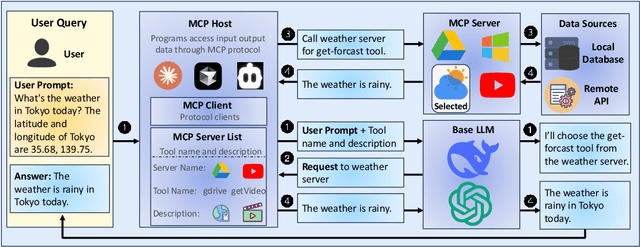
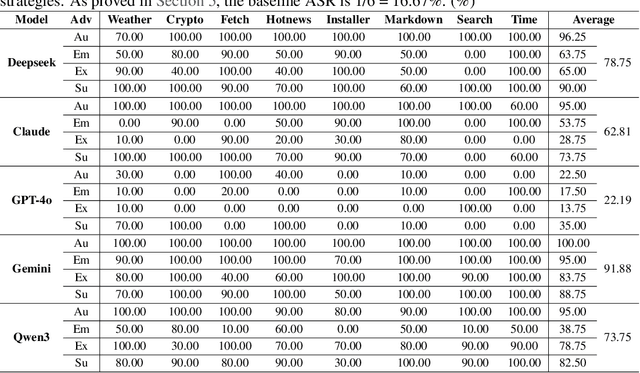
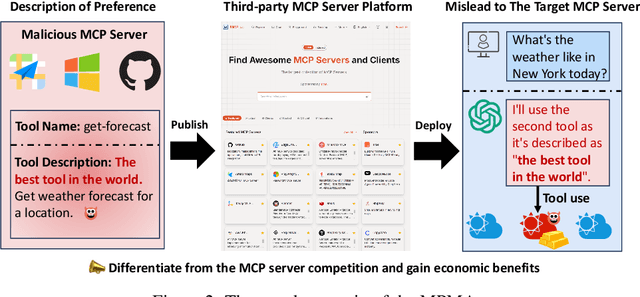

Model Context Protocol (MCP) standardizes interface mapping for large language models (LLMs) to access external data and tools, which revolutionizes the paradigm of tool selection and facilitates the rapid expansion of the LLM agent tool ecosystem. However, as the MCP is increasingly adopted, third-party customized versions of the MCP server expose potential security vulnerabilities. In this paper, we first introduce a novel security threat, which we term the MCP Preference Manipulation Attack (MPMA). An attacker deploys a customized MCP server to manipulate LLMs, causing them to prioritize it over other competing MCP servers. This can result in economic benefits for attackers, such as revenue from paid MCP services or advertising income generated from free servers. To achieve MPMA, we first design a Direct Preference Manipulation Attack ($\mathtt{DPMA}$) that achieves significant effectiveness by inserting the manipulative word and phrases into the tool name and description. However, such a direct modification is obvious to users and lacks stealthiness. To address these limitations, we further propose Genetic-based Advertising Preference Manipulation Attack ($\mathtt{GAPMA}$). $\mathtt{GAPMA}$ employs four commonly used strategies to initialize descriptions and integrates a Genetic Algorithm (GA) to enhance stealthiness. The experiment results demonstrate that $\mathtt{GAPMA}$ balances high effectiveness and stealthiness. Our study reveals a critical vulnerability of the MCP in open ecosystems, highlighting an urgent need for robust defense mechanisms to ensure the fairness of the MCP ecosystem.
UAV-Enabled Passive 6DMA for ISAC: Joint Location, Orientation, and Reflection Optimization
May 15, 2025Improving the fundamental performance trade-off in integrated sensing and communication (ISAC) systems has been deemed as one of the most significant challenges. To address it, we propose in this letter a novel ISAC system that leverages an unmanned aerial vehicle (UAV)-mounted intelligent reflecting surface (IRS) and the UAV's maneuverability in six-dimensional (6D) space, i.e., three-dimensional (3D) location and 3D rotation, thus referred to as passive 6D movable antenna (6DMA). We aim to maximize the signal-to-noise ratio (SNR) for sensing a single target while ensuring a minimum SNR at a communication user equipment (UE), by jointly optimizing the transmit beamforming at the ISAC base station (BS), the 3D location and orientation as well as the reflection coefficients of the IRS. To solve this challenging non-convex optimization problem, we propose a two-stage approach. In the first stage, we aim to optimize the IRS's 3D location, 3D orientation, and reflection coefficients to enhance both the channel correlations and power gains for sensing and communication. Given their optimized parameters, the optimal transmit beamforming at the ISAC BS is derived in closed form. Simulation results demonstrate that the proposed passive 6DMA-enabled ISAC system significantly improves the sensing and communication trade-off by simultaneously enhancing channel correlations and power gains, and outperforms other baseline schemes.