 Add to Chrome
 Add to Firefox
 Add to Edge
OneVision-Encoder: Codec-Aligned Sparsity as a Foundational Principle for Multimodal Intelligence
Feb 09, 2026
Hypothesis. Artificial general intelligence is, at its core, a compression problem. Effective compression demands resonance: deep learning scales best when its architecture aligns with the fundamental structure of the data. These are the fundamental principles. Yet, modern vision architectures have strayed from these truths: visual signals are highly redundant, while discriminative information, the surprise, is sparse. Current models process dense pixel grids uniformly, wasting vast compute on static background rather than focusing on the predictive residuals that define motion and meaning. We argue that to solve visual understanding, we must align our architectures with the information-theoretic principles of video, i.e., Codecs. Method. OneVision-Encoder encodes video by compressing predictive visual structure into semantic meaning. By adopting Codec Patchification, OV-Encoder abandons uniform computation to focus exclusively on the 3.1%-25% of regions rich in signal entropy. To unify spatial and temporal reasoning under irregular token layouts, OneVision-Encoder employs a shared 3D RoPE and is trained with a large-scale cluster discrimination objective over more than one million semantic concepts, jointly capturing object permanence and motion dynamics. Evidence. The results validate our core hypothesis: efficiency and accuracy are not a trade-off; they are positively correlated. When integrated into LLM, it consistently outperforms strong vision backbones such as Qwen3-ViT and SigLIP2 across 16 image, video, and document understanding benchmarks, despite using substantially fewer visual tokens and pretraining data. Notably, on video understanding tasks, OV-Encoder achieves an average improvement of 4.1% over Qwen3-ViT. Codec-aligned, patch-level sparsity is a foundational principle, enabling OV-Encoder as a scalable engine for next-generation visual generalists.

Demo-ICL: In-Context Learning for Procedural Video Knowledge Acquisition
Feb 09, 2026Despite the growing video understanding capabilities of recent Multimodal Large Language Models (MLLMs), existing video benchmarks primarily assess understanding based on models' static, internal knowledge, rather than their ability to learn and adapt from dynamic, novel contexts from few examples. To bridge this gap, we present Demo-driven Video In-Context Learning, a novel task focused on learning from in-context demonstrations to answer questions about the target videos. Alongside this, we propose Demo-ICL-Bench, a challenging benchmark designed to evaluate demo-driven video in-context learning capabilities. Demo-ICL-Bench is constructed from 1200 instructional YouTube videos with associated questions, from which two types of demonstrations are derived: (i) summarizing video subtitles for text demonstration; and (ii) corresponding instructional videos as video demonstrations. To effectively tackle this new challenge, we develop Demo-ICL, an MLLM with a two-stage training strategy: video-supervised fine-tuning and information-assisted direct preference optimization, jointly enhancing the model's ability to learn from in-context examples. Extensive experiments with state-of-the-art MLLMs confirm the difficulty of Demo-ICL-Bench, demonstrate the effectiveness of Demo-ICL, and thereby unveil future research directions.
Continual GUI Agents
Jan 29, 2026As digital environments (data distribution) are in flux, with new GUI data arriving over time-introducing new domains or resolutions-agents trained on static environments deteriorate in performance. In this work, we introduce Continual GUI Agents, a new task that requires GUI agents to perform continual learning under shifted domains and resolutions. We find existing methods fail to maintain stable grounding as GUI distributions shift over time, due to the diversity of UI interaction points and regions in fluxing scenarios. To address this, we introduce GUI-Anchoring in Flux (GUI-AiF), a new reinforcement fine-tuning framework that stabilizes continual learning through two novel rewards: Anchoring Point Reward in Flux (APR-iF) and Anchoring Region Reward in Flux (ARR-iF). These rewards guide the agents to align with shifting interaction points and regions, mitigating the tendency of existing reward strategies to over-adapt to static grounding cues (e.g., fixed coordinates or element scales). Extensive experiments show GUI-AiF surpasses state-of-the-art baselines. Our work establishes the first continual learning framework for GUI agents, revealing the untapped potential of reinforcement fine-tuning for continual GUI Agents.
DynamicVLA: A Vision-Language-Action Model for Dynamic Object Manipulation
Jan 29, 2026Manipulating dynamic objects remains an open challenge for Vision-Language-Action (VLA) models, which, despite strong generalization in static manipulation, struggle in dynamic scenarios requiring rapid perception, temporal anticipation, and continuous control. We present DynamicVLA, a framework for dynamic object manipulation that integrates temporal reasoning and closed-loop adaptation through three key designs: 1) a compact 0.4B VLA using a convolutional vision encoder for spatially efficient, structurally faithful encoding, enabling fast multimodal inference; 2) Continuous Inference, enabling overlapping reasoning and execution for lower latency and timely adaptation to object motion; and 3) Latent-aware Action Streaming, which bridges the perception-execution gap by enforcing temporally aligned action execution. To fill the missing foundation of dynamic manipulation data, we introduce the Dynamic Object Manipulation (DOM) benchmark, built from scratch with an auto data collection pipeline that efficiently gathers 200K synthetic episodes across 2.8K scenes and 206 objects, and enables fast collection of 2K real-world episodes without teleoperation. Extensive evaluations demonstrate remarkable improvements in response speed, perception, and generalization, positioning DynamicVLA as a unified framework for general dynamic object manipulation across embodiments.
OnlineSI: Taming Large Language Model for Online 3D Understanding and Grounding
Jan 23, 2026In recent years, researchers have increasingly been interested in how to enable Multimodal Large Language Models (MLLM) to possess spatial understanding and reasoning capabilities. However, most existing methods overlook the importance of the ability to continuously work in an ever-changing world, and lack the possibility of deployment on embodied systems in real-world environments. In this work, we introduce OnlineSI, a framework that can continuously improve its spatial understanding of its surroundings given a video stream. Our core idea is to maintain a finite spatial memory to retain past observations, ensuring the computation required for each inference does not increase as the input accumulates. We further integrate 3D point cloud information with semantic information, helping MLLM to better locate and identify objects in the scene. To evaluate our method, we introduce the Fuzzy $F_1$-Score to mitigate ambiguity, and test our method on two representative datasets. Experiments demonstrate the effectiveness of our method, paving the way towards real-world embodied systems.
StableWorld: Towards Stable and Consistent Long Interactive Video Generation
Jan 21, 2026In this paper, we explore the overlooked challenge of stability and temporal consistency in interactive video generation, which synthesizes dynamic and controllable video worlds through interactive behaviors such as camera movements and text prompts. Despite remarkable progress in world modeling, current methods still suffer from severe instability and temporal degradation, often leading to spatial drift and scene collapse during long-horizon interactions. To better understand this issue, we initially investigate the underlying causes of instability and identify that the major source of error accumulation originates from the same scene, where generated frames gradually deviate from the initial clean state and propagate errors to subsequent frames. Building upon this observation, we propose a simple yet effective method, \textbf{StableWorld}, a Dynamic Frame Eviction Mechanism. By continuously filtering out degraded frames while retaining geometrically consistent ones, StableWorld effectively prevents cumulative drift at its source, leading to more stable and temporal consistency of interactive generation. Promising results on multiple interactive video models, \eg, Matrix-Game, Open-Oasis, and Hunyuan-GameCraft, demonstrate that StableWorld is model-agnostic and can be applied to different interactive video generation frameworks to substantially improve stability, temporal consistency, and generalization across diverse interactive scenarios.
The RoboSense Challenge: Sense Anything, Navigate Anywhere, Adapt Across Platforms
Jan 08, 2026Autonomous systems are increasingly deployed in open and dynamic environments -- from city streets to aerial and indoor spaces -- where perception models must remain reliable under sensor noise, environmental variation, and platform shifts. However, even state-of-the-art methods often degrade under unseen conditions, highlighting the need for robust and generalizable robot sensing. The RoboSense 2025 Challenge is designed to advance robustness and adaptability in robot perception across diverse sensing scenarios. It unifies five complementary research tracks spanning language-grounded decision making, socially compliant navigation, sensor configuration generalization, cross-view and cross-modal correspondence, and cross-platform 3D perception. Together, these tasks form a comprehensive benchmark for evaluating real-world sensing reliability under domain shifts, sensor failures, and platform discrepancies. RoboSense 2025 provides standardized datasets, baseline models, and unified evaluation protocols, enabling large-scale and reproducible comparison of robust perception methods. The challenge attracted 143 teams from 85 institutions across 16 countries, reflecting broad community engagement. By consolidating insights from 23 winning solutions, this report highlights emerging methodological trends, shared design principles, and open challenges across all tracks, marking a step toward building robots that can sense reliably, act robustly, and adapt across platforms in real-world environments.
HiStream: Efficient High-Resolution Video Generation via Redundancy-Eliminated Streaming
Dec 24, 2025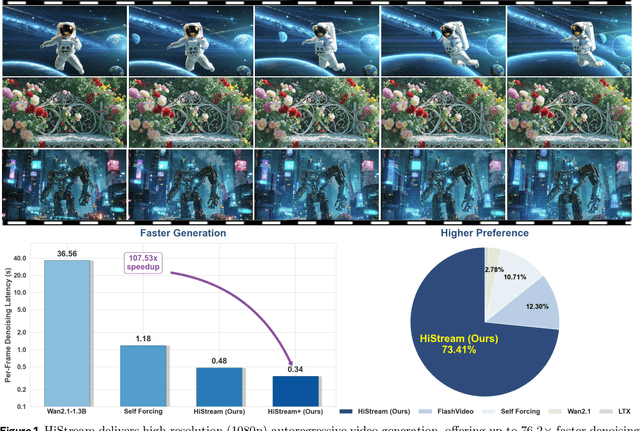
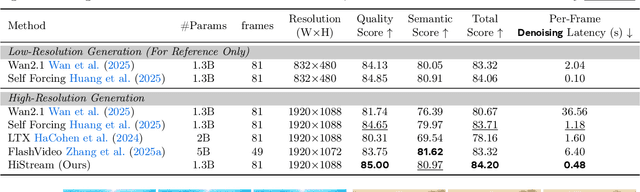
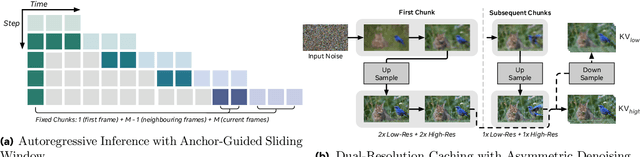
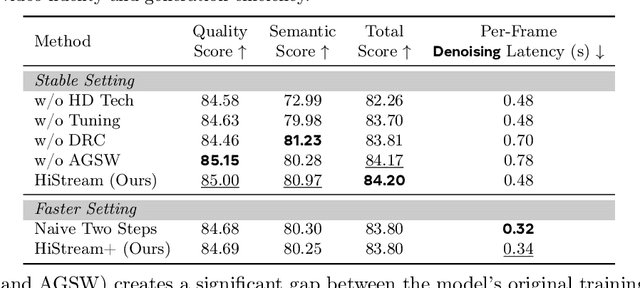
High-resolution video generation, while crucial for digital media and film, is computationally bottlenecked by the quadratic complexity of diffusion models, making practical inference infeasible. To address this, we introduce HiStream, an efficient autoregressive framework that systematically reduces redundancy across three axes: i) Spatial Compression: denoising at low resolution before refining at high resolution with cached features; ii) Temporal Compression: a chunk-by-chunk strategy with a fixed-size anchor cache, ensuring stable inference speed; and iii) Timestep Compression: applying fewer denoising steps to subsequent, cache-conditioned chunks. On 1080p benchmarks, our primary HiStream model (i+ii) achieves state-of-the-art visual quality while demonstrating up to 76.2x faster denoising compared to the Wan2.1 baseline and negligible quality loss. Our faster variant, HiStream+, applies all three optimizations (i+ii+iii), achieving a 107.5x acceleration over the baseline, offering a compelling trade-off between speed and quality, thereby making high-resolution video generation both practical and scalable.
The Prism Hypothesis: Harmonizing Semantic and Pixel Representations via Unified Autoencoding
Dec 22, 2025Deep representations across modalities are inherently intertwined. In this paper, we systematically analyze the spectral characteristics of various semantic and pixel encoders. Interestingly, our study uncovers a highly inspiring and rarely explored correspondence between an encoder's feature spectrum and its functional role: semantic encoders primarily capture low-frequency components that encode abstract meaning, whereas pixel encoders additionally retain high-frequency information that conveys fine-grained detail. This heuristic finding offers a unifying perspective that ties encoder behavior to its underlying spectral structure. We define it as the Prism Hypothesis, where each data modality can be viewed as a projection of the natural world onto a shared feature spectrum, just like the prism. Building on this insight, we propose Unified Autoencoding (UAE), a model that harmonizes semantic structure and pixel details via an innovative frequency-band modulator, enabling their seamless coexistence. Extensive experiments on ImageNet and MS-COCO benchmarks validate that our UAE effectively unifies semantic abstraction and pixel-level fidelity into a single latent space with state-of-the-art performance.
Vision-Language-Action Models for Autonomous Driving: Past, Present, and Future
Dec 18, 2025Autonomous driving has long relied on modular "Perception-Decision-Action" pipelines, where hand-crafted interfaces and rule-based components often break down in complex or long-tailed scenarios. Their cascaded design further propagates perception errors, degrading downstream planning and control. Vision-Action (VA) models address some limitations by learning direct mappings from visual inputs to actions, but they remain opaque, sensitive to distribution shifts, and lack structured reasoning or instruction-following capabilities. Recent progress in Large Language Models (LLMs) and multimodal learning has motivated the emergence of Vision-Language-Action (VLA) frameworks, which integrate perception with language-grounded decision making. By unifying visual understanding, linguistic reasoning, and actionable outputs, VLAs offer a pathway toward more interpretable, generalizable, and human-aligned driving policies. This work provides a structured characterization of the emerging VLA landscape for autonomous driving. We trace the evolution from early VA approaches to modern VLA frameworks and organize existing methods into two principal paradigms: End-to-End VLA, which integrates perception, reasoning, and planning within a single model, and Dual-System VLA, which separates slow deliberation (via VLMs) from fast, safety-critical execution (via planners). Within these paradigms, we further distinguish subclasses such as textual vs. numerical action generators and explicit vs. implicit guidance mechanisms. We also summarize representative datasets and benchmarks for evaluating VLA-based driving systems and highlight key challenges and open directions, including robustness, interpretability, and instruction fidelity. Overall, this work aims to establish a coherent foundation for advancing human-compatible autonomous driving systems.