 Add to Chrome
 Add to Firefox
 Add to Edge
DLWM: Dual Latent World Models enable Holistic Gaussian-centric Pre-training in Autonomous Driving
Apr 01, 2026
Vision-based autonomous driving has gained much attention due to its low costs and excellent performance. Compared with dense BEV (Bird's Eye View) or sparse query models, Gaussian-centric method is a comprehensive yet sparse representation by describing scene with 3D semantic Gaussians. In this paper, we introduce DLWM, a novel paradigm with Dual Latent World Models specifically designed to enable holistic gaussian-centric pre-training in autonomous driving using two stages. In the first stage, DLWM predicts 3D Gaussians from queries by self-supervised reconstructing multi-view semantic and depth images. Equipped with fine-grained contextual features, in the second stage, two latent world models are trained separately for temporal feature learning, including Gaussian-flow-guided latent prediction for downstream occupancy perception and forecasting tasks, and ego-planning-guided latent prediction for motion planning. Extensive experiments in SurroundOcc and nuScenes benchmarks demonstrate that DLWM shows significant performance gains across Gaussian-centric 3D occupancy perception, 4D occupancy forecasting and motion planning tasks.

Vision-Language-Action Models for Autonomous Driving: Past, Present, and Future
Dec 18, 2025Autonomous driving has long relied on modular "Perception-Decision-Action" pipelines, where hand-crafted interfaces and rule-based components often break down in complex or long-tailed scenarios. Their cascaded design further propagates perception errors, degrading downstream planning and control. Vision-Action (VA) models address some limitations by learning direct mappings from visual inputs to actions, but they remain opaque, sensitive to distribution shifts, and lack structured reasoning or instruction-following capabilities. Recent progress in Large Language Models (LLMs) and multimodal learning has motivated the emergence of Vision-Language-Action (VLA) frameworks, which integrate perception with language-grounded decision making. By unifying visual understanding, linguistic reasoning, and actionable outputs, VLAs offer a pathway toward more interpretable, generalizable, and human-aligned driving policies. This work provides a structured characterization of the emerging VLA landscape for autonomous driving. We trace the evolution from early VA approaches to modern VLA frameworks and organize existing methods into two principal paradigms: End-to-End VLA, which integrates perception, reasoning, and planning within a single model, and Dual-System VLA, which separates slow deliberation (via VLMs) from fast, safety-critical execution (via planners). Within these paradigms, we further distinguish subclasses such as textual vs. numerical action generators and explicit vs. implicit guidance mechanisms. We also summarize representative datasets and benchmarks for evaluating VLA-based driving systems and highlight key challenges and open directions, including robustness, interpretability, and instruction fidelity. Overall, this work aims to establish a coherent foundation for advancing human-compatible autonomous driving systems.
VisionPAD: A Vision-Centric Pre-training Paradigm for Autonomous Driving
Nov 22, 2024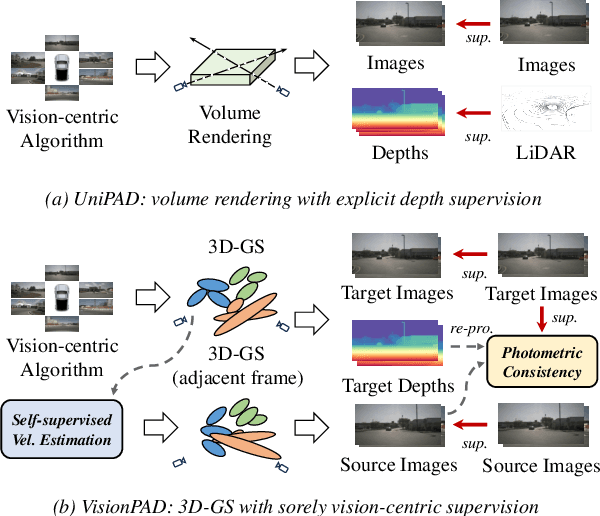
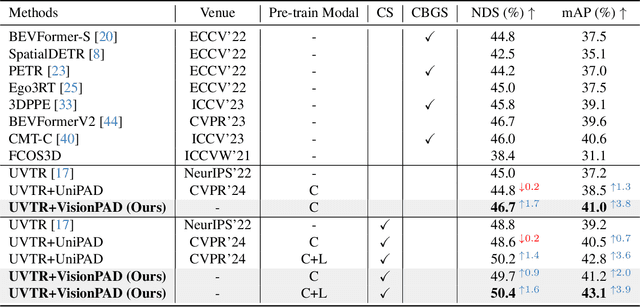
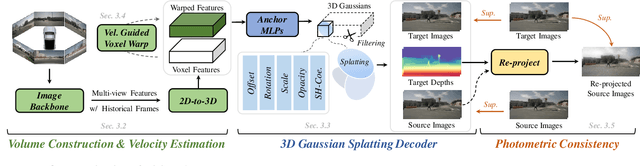
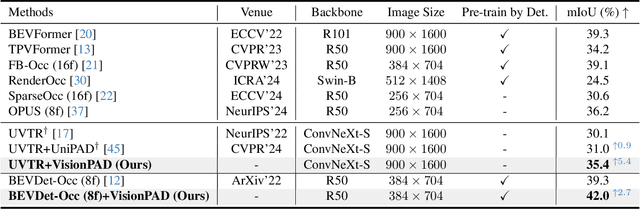
This paper introduces VisionPAD, a novel self-supervised pre-training paradigm designed for vision-centric algorithms in autonomous driving. In contrast to previous approaches that employ neural rendering with explicit depth supervision, VisionPAD utilizes more efficient 3D Gaussian Splatting to reconstruct multi-view representations using only images as supervision. Specifically, we introduce a self-supervised method for voxel velocity estimation. By warping voxels to adjacent frames and supervising the rendered outputs, the model effectively learns motion cues in the sequential data. Furthermore, we adopt a multi-frame photometric consistency approach to enhance geometric perception. It projects adjacent frames to the current frame based on rendered depths and relative poses, boosting the 3D geometric representation through pure image supervision. Extensive experiments on autonomous driving datasets demonstrate that VisionPAD significantly improves performance in 3D object detection, occupancy prediction and map segmentation, surpassing state-of-the-art pre-training strategies by a considerable margin.
BiFF: Bi-level Future Fusion with Polyline-based Coordinate for Interactive Trajectory Prediction
Jun 25, 2023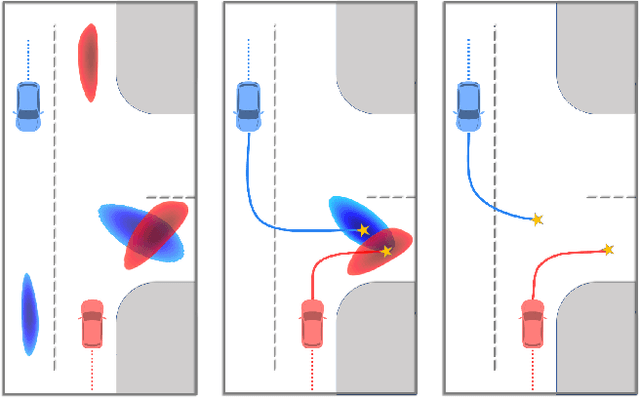
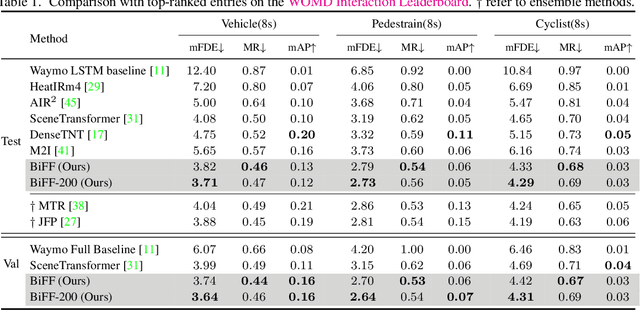
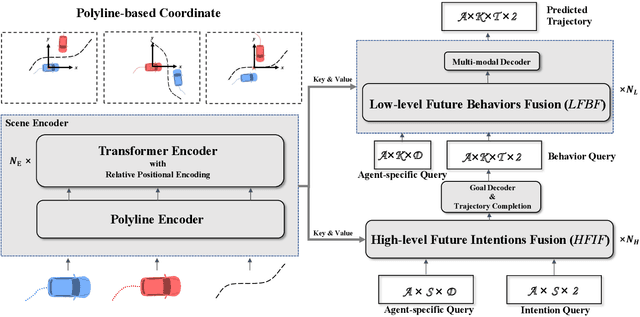
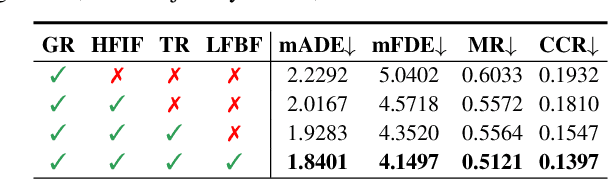
Predicting future trajectories of surrounding agents is essential for safety-critical autonomous driving. Most existing work focuses on predicting marginal trajectories for each agent independently. However, it has rarely been explored in predicting joint trajectories for interactive agents. In this work, we propose Bi-level Future Fusion (BiFF) to explicitly capture future interactions between interactive agents. Concretely, BiFF fuses the high-level future intentions followed by low-level future behaviors. Then the polyline-based coordinate is specifically designed for multi-agent prediction to ensure data efficiency, frame robustness, and prediction accuracy. Experiments show that BiFF achieves state-of-the-art performance on the interactive prediction benchmark of Waymo Open Motion Dataset.