 Add to Chrome
 Add to Firefox
 Add to Edge
From Pixels to Words -- Towards Native One-Vision Models at Scale
May 27, 2026
Current vision-language models (VLMs) typically stitch together separate image encoders and language decoders via multi-stage alignment, a modular framework that inevitably fragments pixel-level signals across frames and scatters early pixel-word interactions. In parallel, native VLMs, despite impressive performance on single images, remain largely unexplored in multi-image, video understanding, and spatial intelligence. Hence, we introduce NEO-ov, a native foundation model that learns cross-frame and pixel-word correspondence end-to-end, without any external encoders, auxiliary adapters, or post-hoc fusion. By eliminating module boundaries entirely, NEO-ov enables fine-grained and unified spatiotemporal modeling to emerge natively inside the model. Notably, NEO-ov largely narrows the gap to modular counterparts while excelling at fine-grained visual perception, validating that native "one-vision" architectures are not only feasible but competitive at scale. Beyond empirical performance, we unveil systematic architectural analyses and detailed training recipes to facilitate subsequent native multimodal modeling. Our code and models are publicly available at: https://github.com/EvolvingLMMs-Lab/NEO.

LLaVA-OneVision-2: Towards Next-Generation Perceptual Intelligence
May 25, 2026We introduce LLaVA-OneVision-2 (LLaVA-OV-2), the most capable vision-language model in the LLaVA-OneVision series to date, achieving superior performance across a broad range of multimodal benchmarks. The model builds on a native OneVision-Encoder and incorporates Windowed Attention for efficient local computation while maintaining native resolution. Its key advance is codec-stream tokenization: it treats compressed video as a continuous bit-cost stream, where bit-cost dynamics determine adaptive temporal groups, and motion-residual cues select salient spatial evidence into compact visual canvases. This allocation concentrates a limited token budget on event-bearing content, enabling more stable long-video token compression than fixed groups of pictures. A shared 3D RoPE further places codec canvases, sampled frames, and images in a unified spatiotemporal coordinate system. Furthermore, we build the LLaVA-OV-2 data and training stack around large-scale open supervision: approximately 8M re-captioned video samples for pretraining, a 4M-sample spatial corpus for fine-tuning. We also introduce JumpScore, a temporal-localization benchmark targeting fine-grained grounding in high-frequency, densely repeated motion, a regime underrepresented by existing video evaluations. A standout capability of LLaVA-OV-2 is its unified perception across video understanding, temporal grounding, spatial grounding, and manipulation-trace reasoning. On JumpScore, LLaVA-OneVision-2-8B reaches 74.9 JumpScore mAP, surpassing Qwen3-VL-8B (30.1) by +44.8 points; under matched visual-token budgets on the same benchmark, codec-stream inputs improve temporal grounding over frame sampling by +9.7 points. Across standard benchmarks, LLaVA-OneVision-2-8B further outperforms Qwen3-VL-8B by +4.3 average points on video tasks, +5.3 on spatial tasks, and +15.6 average J&F on tracking tasks.
VideoOdyssey: A Benchmark for Ultra-Long-Context and Omni-Modal Video Understanding
May 21, 2026Real-world long video understanding requires models to perform continuous tracking, information integration and memory retention over massive temporal spans within extreme video durations. Mastering this intense cognitive load constitutes the fundamental bottleneck in long video understanding. While existing benchmarks have driven progress by scaling up video duration, their evaluation tasks often require comprehending only short and isolated video segments, falling short of capturing the challenge of ultra-long-context reasoning. To measure this cognitive load, we emphasize continuous certificate length, defined as the video length a human must continuously watch to definitively answer a given question. Driven by this metric, we introduce VideoOdyssey, a benchmark specifically designed for ultra-long-context and omni-modal video understanding. VideoOdyssey is characterized by three key features: 1) Extreme video duration and diversity: spanning 11 domains and 54 subcategories with an average video duration of 109 minutes; 2) Comprehensive evaluation scenarios: offering two subsets to address different research focuses, i.e., VideoOdyssey-V for probing the limits of visual understanding in MLLMs, and VideoOdyssey-AV for evaluating synchronized audio-visual understanding for omni-modal models; 3) Ultra-long and multi-level continuous certificates: extending the average continuous certificate to 16 minutes for VideoOdyssey-V and 12.8 minutes for VideoOdyssey-AV. Crucially, we design 5 granular levels from seconds to hours, providing a comprehensive diagnostic tool to evaluate models across varying context lengths and cognitive loads. Extensive evaluations show that bottlenecks of current MLLMs extend beyond simple retrieval to include struggles with continuous reasoning across varying context lengths, fine-grained perception, and non-verbal omni-modal understanding.
OneVision-Encoder: Codec-Aligned Sparsity as a Foundational Principle for Multimodal Intelligence
Feb 09, 2026Hypothesis. Artificial general intelligence is, at its core, a compression problem. Effective compression demands resonance: deep learning scales best when its architecture aligns with the fundamental structure of the data. These are the fundamental principles. Yet, modern vision architectures have strayed from these truths: visual signals are highly redundant, while discriminative information, the surprise, is sparse. Current models process dense pixel grids uniformly, wasting vast compute on static background rather than focusing on the predictive residuals that define motion and meaning. We argue that to solve visual understanding, we must align our architectures with the information-theoretic principles of video, i.e., Codecs. Method. OneVision-Encoder encodes video by compressing predictive visual structure into semantic meaning. By adopting Codec Patchification, OV-Encoder abandons uniform computation to focus exclusively on the 3.1%-25% of regions rich in signal entropy. To unify spatial and temporal reasoning under irregular token layouts, OneVision-Encoder employs a shared 3D RoPE and is trained with a large-scale cluster discrimination objective over more than one million semantic concepts, jointly capturing object permanence and motion dynamics. Evidence. The results validate our core hypothesis: efficiency and accuracy are not a trade-off; they are positively correlated. When integrated into LLM, it consistently outperforms strong vision backbones such as Qwen3-ViT and SigLIP2 across 16 image, video, and document understanding benchmarks, despite using substantially fewer visual tokens and pretraining data. Notably, on video understanding tasks, OV-Encoder achieves an average improvement of 4.1% over Qwen3-ViT. Codec-aligned, patch-level sparsity is a foundational principle, enabling OV-Encoder as a scalable engine for next-generation visual generalists.
The Llama 4 Herd: Architecture, Training, Evaluation, and Deployment Notes
Jan 15, 2026This document consolidates publicly reported technical details about Metas Llama 4 model family. It summarizes (i) released variants (Scout and Maverick) and the broader herd context including the previewed Behemoth teacher model, (ii) architectural characteristics beyond a high-level MoE description covering routed/shared-expert structure, early-fusion multimodality, and long-context design elements reported for Scout (iRoPE and length generalization strategies), (iii) training disclosures spanning pre-training, mid-training for long-context extension, and post-training methodology (lightweight SFT, online RL, and lightweight DPO) as described in release materials, (iv) developer-reported benchmark results for both base and instruction-tuned checkpoints, and (v) practical deployment constraints observed across major serving environments, including provider-specific context limits and quantization packaging. The manuscript also summarizes licensing obligations relevant to redistribution and derivative naming, and reviews publicly described safeguards and evaluation practices. The goal is to provide a compact technical reference for researchers and practitioners who need precise, source-backed facts about Llama 4.
VBench-2.0: Advancing Video Generation Benchmark Suite for Intrinsic Faithfulness
Mar 27, 2025Video generation has advanced significantly, evolving from producing unrealistic outputs to generating videos that appear visually convincing and temporally coherent. To evaluate these video generative models, benchmarks such as VBench have been developed to assess their faithfulness, measuring factors like per-frame aesthetics, temporal consistency, and basic prompt adherence. However, these aspects mainly represent superficial faithfulness, which focus on whether the video appears visually convincing rather than whether it adheres to real-world principles. While recent models perform increasingly well on these metrics, they still struggle to generate videos that are not just visually plausible but fundamentally realistic. To achieve real "world models" through video generation, the next frontier lies in intrinsic faithfulness to ensure that generated videos adhere to physical laws, commonsense reasoning, anatomical correctness, and compositional integrity. Achieving this level of realism is essential for applications such as AI-assisted filmmaking and simulated world modeling. To bridge this gap, we introduce VBench-2.0, a next-generation benchmark designed to automatically evaluate video generative models for their intrinsic faithfulness. VBench-2.0 assesses five key dimensions: Human Fidelity, Controllability, Creativity, Physics, and Commonsense, each further broken down into fine-grained capabilities. Tailored for individual dimensions, our evaluation framework integrates generalists such as state-of-the-art VLMs and LLMs, and specialists, including anomaly detection methods proposed for video generation. We conduct extensive annotations to ensure alignment with human judgment. By pushing beyond superficial faithfulness toward intrinsic faithfulness, VBench-2.0 aims to set a new standard for the next generation of video generative models in pursuit of intrinsic faithfulness.
EgoLife: Towards Egocentric Life Assistant
Mar 05, 2025We introduce EgoLife, a project to develop an egocentric life assistant that accompanies and enhances personal efficiency through AI-powered wearable glasses. To lay the foundation for this assistant, we conducted a comprehensive data collection study where six participants lived together for one week, continuously recording their daily activities - including discussions, shopping, cooking, socializing, and entertainment - using AI glasses for multimodal egocentric video capture, along with synchronized third-person-view video references. This effort resulted in the EgoLife Dataset, a comprehensive 300-hour egocentric, interpersonal, multiview, and multimodal daily life dataset with intensive annotation. Leveraging this dataset, we introduce EgoLifeQA, a suite of long-context, life-oriented question-answering tasks designed to provide meaningful assistance in daily life by addressing practical questions such as recalling past relevant events, monitoring health habits, and offering personalized recommendations. To address the key technical challenges of (1) developing robust visual-audio models for egocentric data, (2) enabling identity recognition, and (3) facilitating long-context question answering over extensive temporal information, we introduce EgoButler, an integrated system comprising EgoGPT and EgoRAG. EgoGPT is an omni-modal model trained on egocentric datasets, achieving state-of-the-art performance on egocentric video understanding. EgoRAG is a retrieval-based component that supports answering ultra-long-context questions. Our experimental studies verify their working mechanisms and reveal critical factors and bottlenecks, guiding future improvements. By releasing our datasets, models, and benchmarks, we aim to stimulate further research in egocentric AI assistants.
Video-MMMU: Evaluating Knowledge Acquisition from Multi-Discipline Professional Videos
Jan 23, 2025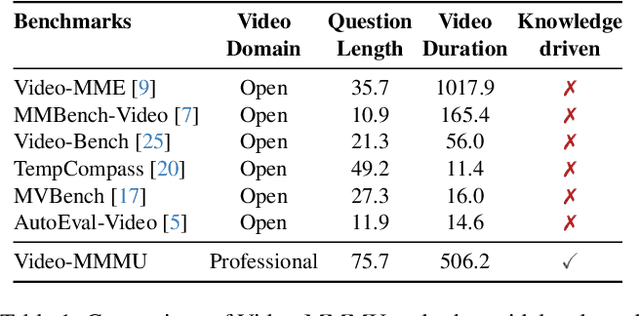
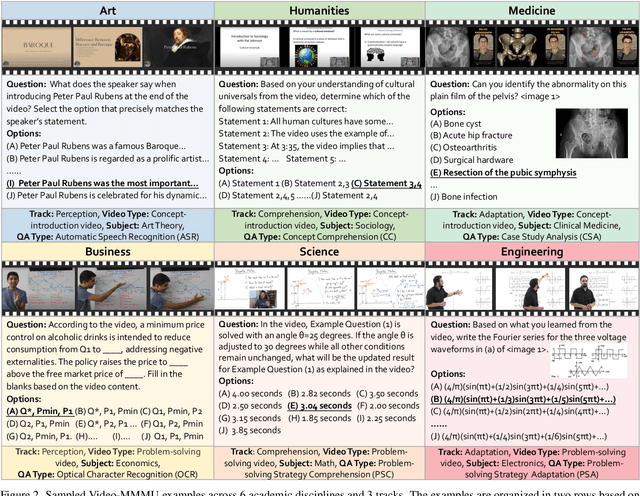
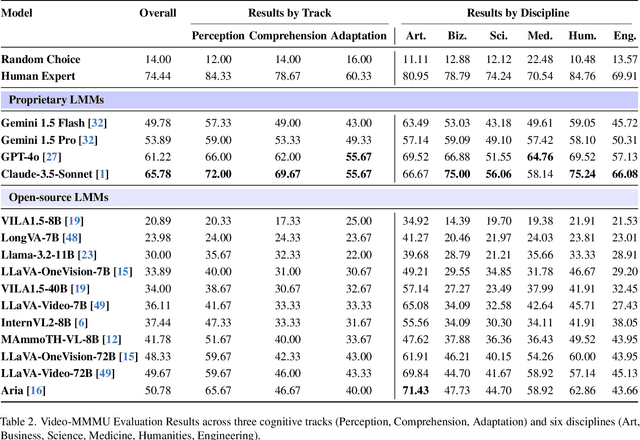

Humans acquire knowledge through three cognitive stages: perceiving information, comprehending knowledge, and adapting knowledge to solve novel problems. Videos serve as an effective medium for this learning process, facilitating a progression through these cognitive stages. However, existing video benchmarks fail to systematically evaluate the knowledge acquisition capabilities in Large Multimodal Models (LMMs). To address this gap, we introduce Video-MMMU, a multi-modal, multi-disciplinary benchmark designed to assess LMMs' ability to acquire and utilize knowledge from videos. Video-MMMU features a curated collection of 300 expert-level videos and 900 human-annotated questions across six disciplines, evaluating knowledge acquisition through stage-aligned question-answer pairs: Perception, Comprehension, and Adaptation. A proposed knowledge gain metric, {\Delta}knowledge, quantifies improvement in performance after video viewing. Evaluation of LMMs reveals a steep decline in performance as cognitive demands increase and highlights a significant gap between human and model knowledge acquisition, underscoring the need for methods to enhance LMMs' capability to learn and adapt from videos.
Video Instruction Tuning With Synthetic Data
Oct 03, 2024


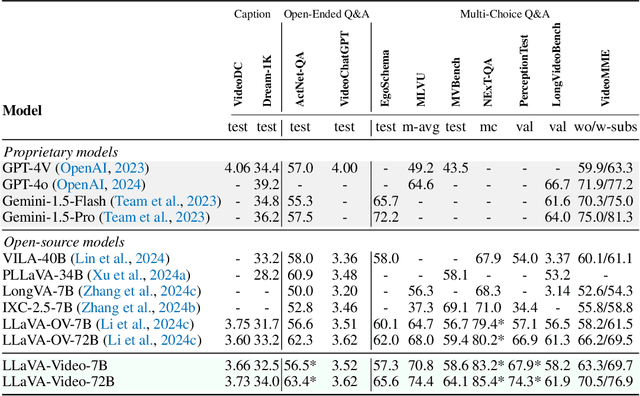
The development of video large multimodal models (LMMs) has been hindered by the difficulty of curating large amounts of high-quality raw data from the web. To address this, we propose an alternative approach by creating a high-quality synthetic dataset specifically for video instruction-following, namely LLaVA-Video-178K. This dataset includes key tasks such as detailed captioning, open-ended question-answering (QA), and multiple-choice QA. By training on this dataset, in combination with existing visual instruction tuning data, we introduce LLaVA-Video, a new video LMM. Our experiments demonstrate that LLaVA-Video achieves strong performance across various video benchmarks, highlighting the effectiveness of our dataset. We plan to release the dataset, its generation pipeline, and the model checkpoints.
LLaVA-OneVision: Easy Visual Task Transfer
Aug 06, 2024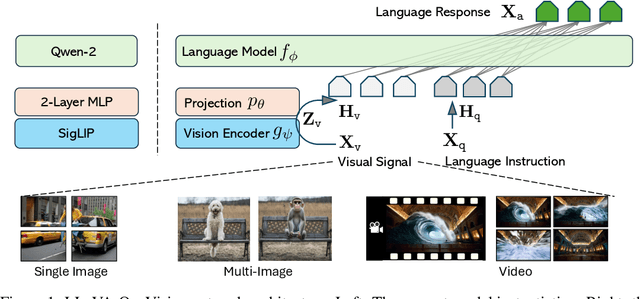


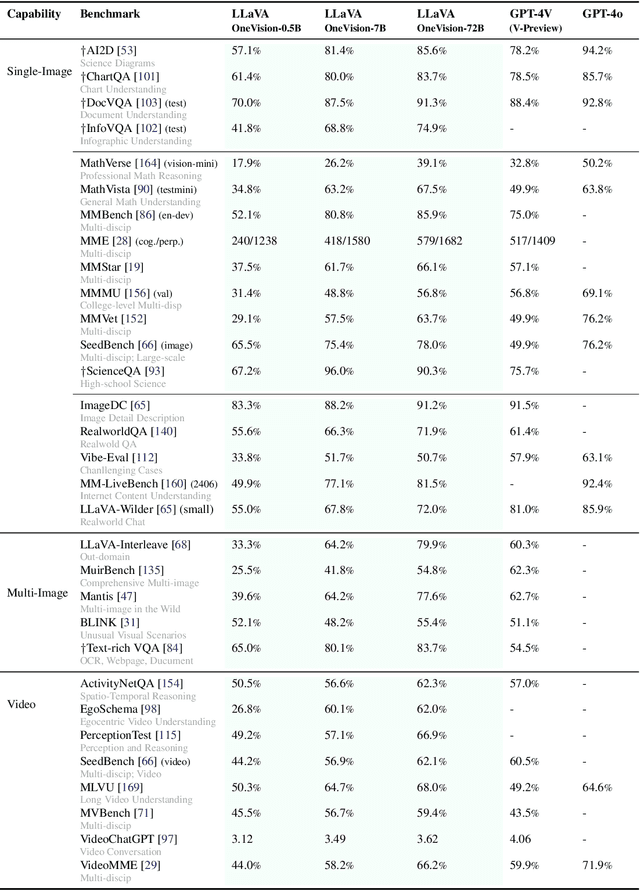
We present LLaVA-OneVision, a family of open large multimodal models (LMMs) developed by consolidating our insights into data, models, and visual representations in the LLaVA-NeXT blog series. Our experimental results demonstrate that LLaVA-OneVision is the first single model that can simultaneously push the performance boundaries of open LMMs in three important computer vision scenarios: single-image, multi-image, and video scenarios. Importantly, the design of LLaVA-OneVision allows strong transfer learning across different modalities/scenarios, yielding new emerging capabilities. In particular, strong video understanding and cross-scenario capabilities are demonstrated through task transfer from images to videos.