 Add to Chrome
 Add to Firefox
 Add to Edge
KVEraser: Learning to Steer KV Cache for Efficient Localized Context Erasing
Jun 15, 2026
Post-hoc context erasing over the KV cache is challenging because a local edit has a global consequence: once a span has been processed, its influence propagates into the cached states of all subsequent tokens. This issue arises naturally in long-context LLM applications, where stale retrieved facts, incorrect tool observations, retracted user preferences, or harmful prompt injections may be identified only after prefill. Exact erasing must then recompute all tokens after the deleted span, making its computational cost depend on suffix length rather than erased-span length. We introduce KVEraser, a learned KV-cache editing method for efficient localized context erasing. Given a processed context and a span to remove, KVEraser replaces only the KV states of the erased interval with learned steering states while reusing the remaining cache unchanged. To learn a transferable erasing mechanism, we build a two-stage training pipeline: generic span-neighbor pre-training teaches the eraser to suppress the influence of the erased span, while task-specific fine-tuning adapts this capability to downstream scenarios. Experiments show that KVEraser nearly matches full recomputation in post-erasure performance on in-domain tasks across 1K--32K context lengths, while its latency increases by only 24% compared with a 17.6x increase for full recomputation. KVEraser also generalizes to unseen long-document QA tasks with harmful factual distractors, achieving the best performance among approximate baselines with a 3--4x speedup over full recomputation.

Towards Direct Latent-Space Synthesis for Parallel Branches in LLM-Agent Workflows
Jun 12, 2026Large language models increasingly serve as execution engines for agentic systems, yet they still consume context through a sequential text interface. This creates a mismatch with modern structured agent workflows, in which independent branches explore subtasks, retrieve evidence, or generate candidate solutions before a final synthesis step. Existing systems typically merge these branches by concatenating their textual outputs, which discards the parallel structure and incurs redundant prefill computation. In this work, we introduce Parallel-Synthesis, a plug-and-play framework that enables a synthesizer to directly consume the KV caches produced by parallel worker agents. Parallel-Synthesis combines a cache mapper that calibrates independently generated branch caches with a fine-tuned synthesizer adapter that enables generation from this non-sequential cache interface. We train Parallel-Synthesis using data that exposes the synthesizer to parallel cache contexts, teaches aggregation across cached branches, and distills reasoning behavior from standard text-concatenation-based synthesis. Across nine downstream datasets spanning math, science QA, code generation, GAIA, and multi-agent database diagnosis, Parallel-Synthesis matches or outperforms text-based synthesis on seven datasets and remains close on the other two. It also reduces time-to-first-token by 2.5x-11x, suggesting that direct cache-based synthesis is a promising interface for more native and efficient synthesis over parallel agent branches.
Rays as Pixels: Learning A Joint Distribution of Videos and Camera Trajectories
Apr 10, 2026Recovering camera parameters from images and rendering scenes from novel viewpoints have long been treated as separate tasks in computer vision and graphics. This separation breaks down when image coverage is sparse or poses are ambiguous, since each task needs what the other produces. We propose Rays as Pixels, a Video Diffusion Model (VDM) that learns a joint distribution over videos and camera trajectories. We represent each camera as dense ray pixels (raxels) and denoise them jointly with video frames through Decoupled Self-Cross Attention mechanism. A single trained model handles three tasks: predicting camera trajectories from video, jointly generating video and camera trajectory from input images, and generating video from input images along a target camera trajectory. Because the model can both predict trajectories from a video and generate views conditioned on its own predictions, we evaluate it through a closed-loop self-consistency test, demonstrating that its forward and inverse predictions agree. Notably, trajectory prediction requires far fewer denoising steps than video generation, even a few denoising steps suffice for self-consistency. We report results on pose estimation and camera-controlled video generation.
EditCtrl: Disentangled Local and Global Control for Real-Time Generative Video Editing
Feb 16, 2026High-fidelity generative video editing has seen significant quality improvements by leveraging pre-trained video foundation models. However, their computational cost is a major bottleneck, as they are often designed to inefficiently process the full video context regardless of the inpainting mask's size, even for sparse, localized edits. In this paper, we introduce EditCtrl, an efficient video inpainting control framework that focuses computation only where it is needed. Our approach features a novel local video context module that operates solely on masked tokens, yielding a computational cost proportional to the edit size. This local-first generation is then guided by a lightweight temporal global context embedder that ensures video-wide context consistency with minimal overhead. Not only is EditCtrl 10 times more compute efficient than state-of-the-art generative editing methods, it even improves editing quality compared to methods designed with full-attention. Finally, we showcase how EditCtrl unlocks new capabilities, including multi-region editing with text prompts and autoregressive content propagation.
HiStream: Efficient High-Resolution Video Generation via Redundancy-Eliminated Streaming
Dec 24, 2025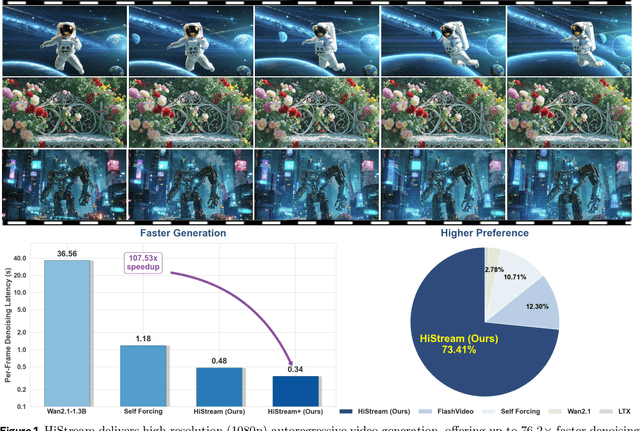
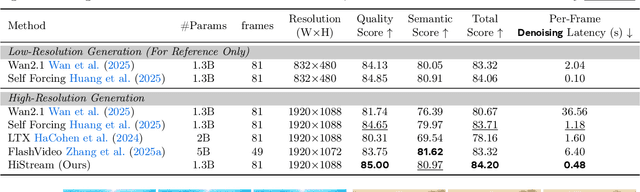
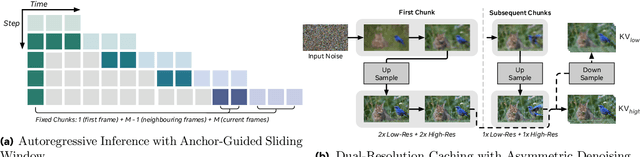
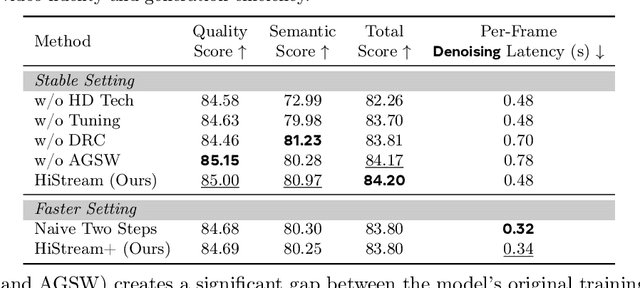
High-resolution video generation, while crucial for digital media and film, is computationally bottlenecked by the quadratic complexity of diffusion models, making practical inference infeasible. To address this, we introduce HiStream, an efficient autoregressive framework that systematically reduces redundancy across three axes: i) Spatial Compression: denoising at low resolution before refining at high resolution with cached features; ii) Temporal Compression: a chunk-by-chunk strategy with a fixed-size anchor cache, ensuring stable inference speed; and iii) Timestep Compression: applying fewer denoising steps to subsequent, cache-conditioned chunks. On 1080p benchmarks, our primary HiStream model (i+ii) achieves state-of-the-art visual quality while demonstrating up to 76.2x faster denoising compared to the Wan2.1 baseline and negligible quality loss. Our faster variant, HiStream+, applies all three optimizations (i+ii+iii), achieving a 107.5x acceleration over the baseline, offering a compelling trade-off between speed and quality, thereby making high-resolution video generation both practical and scalable.
Mixture of States: Routing Token-Level Dynamics for Multimodal Generation
Nov 15, 2025We introduce MoS (Mixture of States), a novel fusion paradigm for multimodal diffusion models that merges modalities using flexible, state-based interactions. The core of MoS is a learnable, token-wise router that creates denoising timestep- and input-dependent interactions between modalities' hidden states, precisely aligning token-level features with the diffusion trajectory. This router sparsely selects the top-$k$ hidden states and is trained with an $ε$-greedy strategy, efficiently selecting contextual features with minimal learnable parameters and negligible computational overhead. We validate our design with text-to-image generation (MoS-Image) and editing (MoS-Editing), which achieve state-of-the-art results. With only 3B to 5B parameters, our models match or surpass counterparts up to $4\times$ larger. These findings establish MoS as a flexible and compute-efficient paradigm for scaling multimodal diffusion models.
Graph-KV: Breaking Sequence via Injecting Structural Biases into Large Language Models
Jun 09, 2025Modern large language models (LLMs) are inherently auto-regressive, requiring input to be serialized into flat sequences regardless of their structural dependencies. This serialization hinders the model's ability to leverage structural inductive biases, especially in tasks such as retrieval-augmented generation (RAG) and reasoning on data with native graph structures, where inter-segment dependencies are crucial. We introduce Graph-KV with the potential to overcome this limitation. Graph-KV leverages the KV-cache of text segments as condensed representations and governs their interaction through structural inductive biases. In this framework, 'target' segments selectively attend only to the KV-caches of their designated 'source' segments, rather than all preceding segments in a serialized sequence. This approach induces a graph-structured block mask, sparsifying attention and enabling a message-passing-like step within the LLM. Furthermore, strategically allocated positional encodings for source and target segments reduce positional bias and context window consumption. We evaluate Graph-KV across three scenarios: (1) seven RAG benchmarks spanning direct inference, multi-hop reasoning, and long-document understanding; (2) Arxiv-QA, a novel academic paper QA task with full-text scientific papers structured as citation ego-graphs; and (3) paper topic classification within a citation network. By effectively reducing positional bias and harnessing structural inductive biases, Graph-KV substantially outperforms baselines, including standard costly sequential encoding, across various settings. Code and the Graph-KV data are publicly available.
Structural Alignment Improves Graph Test-Time Adaptation
Feb 25, 2025Graph-based learning has achieved remarkable success in domains ranging from recommendation to fraud detection and particle physics by effectively capturing underlying interaction patterns. However, it often struggles to generalize when distribution shifts occur, particularly those involving changes in network connectivity or interaction patterns. Existing approaches designed to mitigate such shifts typically require retraining with full access to source data, rendering them infeasible under strict computational or privacy constraints. To address this limitation, we propose a test-time structural alignment (TSA) algorithm for Graph Test-Time Adaptation (GTTA), a novel method that aligns graph structures during inference without revisiting the source domain. Built upon a theoretically grounded treatment of graph data distribution shifts, TSA integrates three key strategies: an uncertainty-aware neighborhood weighting that accommodates structure shifts, an adaptive balancing of self-node and neighborhood-aggregated representations driven by node representations' signal-to-noise ratio, and a decision boundary refinement that corrects remaining label and feature shifts. Extensive experiments on synthetic and real-world datasets demonstrate that TSA can consistently outperform both non-graph TTA methods and state-of-the-art GTTA baselines.
Model Generalization on Text Attribute Graphs: Principles with Large Language Models
Feb 17, 2025Large language models (LLMs) have recently been introduced to graph learning, aiming to extend their zero-shot generalization success to tasks where labeled graph data is scarce. Among these applications, inference over text-attributed graphs (TAGs) presents unique challenges: existing methods struggle with LLMs' limited context length for processing large node neighborhoods and the misalignment between node embeddings and the LLM token space. To address these issues, we establish two key principles for ensuring generalization and derive the framework LLM-BP accordingly: (1) Unifying the attribute space with task-adaptive embeddings, where we leverage LLM-based encoders and task-aware prompting to enhance generalization of the text attribute embeddings; (2) Developing a generalizable graph information aggregation mechanism, for which we adopt belief propagation with LLM-estimated parameters that adapt across graphs. Evaluations on 11 real-world TAG benchmarks demonstrate that LLM-BP significantly outperforms existing approaches, achieving 8.10% improvement with task-conditional embeddings and an additional 1.71% gain from adaptive aggregation.
Learning Flow Fields in Attention for Controllable Person Image Generation
Dec 12, 2024
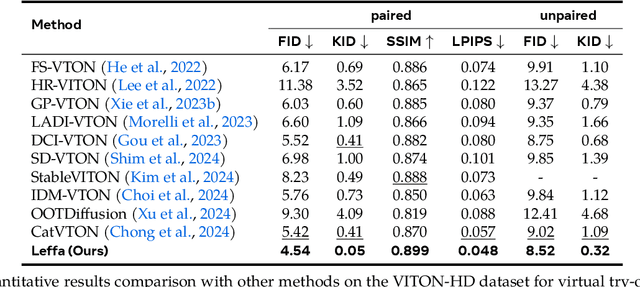

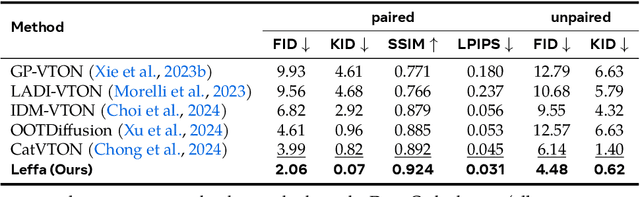
Controllable person image generation aims to generate a person image conditioned on reference images, allowing precise control over the person's appearance or pose. However, prior methods often distort fine-grained textural details from the reference image, despite achieving high overall image quality. We attribute these distortions to inadequate attention to corresponding regions in the reference image. To address this, we thereby propose learning flow fields in attention (Leffa), which explicitly guides the target query to attend to the correct reference key in the attention layer during training. Specifically, it is realized via a regularization loss on top of the attention map within a diffusion-based baseline. Our extensive experiments show that Leffa achieves state-of-the-art performance in controlling appearance (virtual try-on) and pose (pose transfer), significantly reducing fine-grained detail distortion while maintaining high image quality. Additionally, we show that our loss is model-agnostic and can be used to improve the performance of other diffusion models.