 Add to Chrome
 Add to Firefox
 Add to Edge
Token-Wise Latent Streaming from Slow Reasoners to Fast Planners for Dynamic Vision Language Navigation
Jul 18, 2026
Vision-Language Navigation in dynamic, human-centric environments exposes a fundamental tension: linguistic reasoning is slow and deliberative, whereas safe, socially compliant planning should be instant and reactive. The resulting observation staleness is safety-critical: a maneuver chosen during inference can already be unsafe by the time it executes. We observe that, long before a VLM finishes its inference, its intermediate hidden states already encode action-relevant intent. We propose SPARK-VLN, a dual-system framework for dynamic social VLN that streams the slow VLM reasoner's knowledge to a fast flow-matching expert planner throughout token generation, providing fresh and evolving guidance during inference. This design is realized by three modules: a Token-Wise Hidden Streamer that extracts intermediate hidden states along the token generation process, a Sequence-to-Slot Latent Bridge that projects them into fixed-size latent slots, and an Evolving Latent Conditioner that infuses them into the expert planner. We also introduce a human-centric benchmark suite for dynamic social vision-language navigation that keeps pedestrians and the robot active throughout inference and reports navigation success, social compliance, human collisions, and explicit staleness statistics. Across these settings, SPARK-VLN mproves navigation success and social compliance while sustaining inference efficiency. Webpage: https://hutslib.github.io/SPARK-VLN/.

EventDrive: Event Cameras for Vision-Language Driving Intelligence
Jun 16, 2026Event cameras sense the world through asynchronous brightness changes with microsecond latency and high dynamic range, offering motion fidelity far beyond frame-based sensors and capturing temporal structure that conventional exposures often miss. These properties make events a powerful complement to RGB in autonomous driving, especially under blur, glare, and rapid motion, where frame-based perception can become unreliable. However, existing event-aware vision-language models remain limited to generic perception and do not reveal how event sensing contributes to reasoning and decision-making across the full driving loop. We present EventDrive, a large-scale benchmark and model suite that unifies event streams, RGB frames, and language supervision across four core dimensions: Perception, Understanding, Prediction, and Planning, covering captions, structured QA, grounding, motion-state recognition, trajectory forecasting, and planning tasks. Building on this foundation, EventDrive-VLM introduces a multi-horizon event pyramid and a temporal-horizon mixture-of-experts module to adaptively encode and fuse asynchronous and frame-based information for downstream reasoning. Comprehensive evaluation across diverse tasks shows that event streams provide substantial gains in temporal precision, motion awareness, and robustness, bringing event sensing into the center of driving intelligence.
AI for Auto-Research: Roadmap & User Guide
May 18, 2026AI-assisted research is crossing a threshold: fully automated systems can now generate research papers for as little as $15, while long-horizon agents can execute experiments, draft manuscripts, and simulate critique with minimal human input. Yet this productivity frontier exposes a deeper integrity problem: under scientific pressure, even frontier LLMs still fabricate results, miss hidden errors, and fail to judge novelty reliably. Studying developments through April 2026, we present an end-to-end analysis of AI across the complete research lifecycle, organized into four epistemological phases: Creation (idea generation, literature review, coding & experiments, tables & figures), Writing (paper writing), Validation (peer review, rebuttal & revision), and Dissemination (posters, slides, videos, social media, project pages, and interactive agents). We identify a sharp, stage-dependent boundary between reliable assistance and unreliable autonomy: AI excels at structured, retrieval-grounded, and tool-mediated tasks, but remains fragile for genuinely novel ideas, research-level experiments, and scientific judgment. Generated ideas often degrade after implementation, research code lags far behind pattern-matching benchmarks, and end-to-end autonomous systems have not yet consistently reached major-venue acceptance standards. We further show that greater automation can obscure rather than eliminate failure modes, making human-governed collaboration the most credible deployment paradigm. Finally, we provide a structured taxonomy, benchmark suite, and tool inventory, cross-stage design principles, and a practitioner-oriented playbook, with resources maintained at our project page.
NavThinker: Action-Conditioned World Models for Coupled Prediction and Planning in Social Navigation
Mar 16, 2026Social navigation requires robots to act safely in dynamic human environments. Effective behavior demands thinking ahead: reasoning about how the scene and pedestrians evolve under different robot actions rather than reacting to current observations alone. This creates a coupled prediction-planning challenge, where robot actions and human motion mutually influence each other. To address this challenge, we propose NavThinker, a future-aware framework that couples an action-conditioned world model with on-policy reinforcement learning. The world model operates in the Depth Anything V2 patch feature space and performs autoregressive prediction of future scene geometry and human motion; multi-head decoders then produce future depth maps and human trajectories, yielding a future-aware state aligned with traversability and interaction risk. Crucially, we train the policy with DD-PPO while injecting world-model think-ahead signals via: (i) action-conditioned future features fused into the current observation embedding and (ii) social reward shaping from predicted human trajectories. Experiments on single- and multi-robot Social-HM3D show state-of-the-art navigation success, with zero-shot transfer to Social-MP3D and real-world deployment on a Unitree Go2, validating generalization and practical applicability. Webpage: https://github.com/hutslib/NavThinker.
FLUX: Accelerating Cross-Embodiment Generative Navigation Policies via Rectified Flow and Static-to-Dynamic Learning
Mar 13, 2026Autonomous navigation requires a broad spectrum of skills, from static goal-reaching to dynamic social traversal, yet evaluation remains fragmented across disparate protocols. We introduce DynBench, a dynamic navigation benchmark featuring physically valid crowd simulation. Combined with existing static protocols, it supports comprehensive evaluation across six fundamental navigation tasks. Within this framework, we propose FLUX, the first flow-based unified navigation policy. By linearizing probability flow, FLUX replaces iterative denoising with straight-line trajectories, improving per-step inference efficiency by 47% over prior flow-based methods and 29% over diffusion-based ones. Following a static-to-dynamic curriculum, FLUX initially establishes geometric priors and is subsequently refined through reinforcement learning in dynamic social environments. This regime not only strengthens socially-aware navigation but also enhances static task robustness by capturing recovery behaviors through stochastic action distributions. FLUX achieves state-of-the-art performance across all tasks and demonstrates zero-shot sim-to-real transfer on wheeled, quadrupedal, and humanoid platforms without any fine-tuning.
The RoboSense Challenge: Sense Anything, Navigate Anywhere, Adapt Across Platforms
Jan 08, 2026Autonomous systems are increasingly deployed in open and dynamic environments -- from city streets to aerial and indoor spaces -- where perception models must remain reliable under sensor noise, environmental variation, and platform shifts. However, even state-of-the-art methods often degrade under unseen conditions, highlighting the need for robust and generalizable robot sensing. The RoboSense 2025 Challenge is designed to advance robustness and adaptability in robot perception across diverse sensing scenarios. It unifies five complementary research tracks spanning language-grounded decision making, socially compliant navigation, sensor configuration generalization, cross-view and cross-modal correspondence, and cross-platform 3D perception. Together, these tasks form a comprehensive benchmark for evaluating real-world sensing reliability under domain shifts, sensor failures, and platform discrepancies. RoboSense 2025 provides standardized datasets, baseline models, and unified evaluation protocols, enabling large-scale and reproducible comparison of robust perception methods. The challenge attracted 143 teams from 85 institutions across 16 countries, reflecting broad community engagement. By consolidating insights from 23 winning solutions, this report highlights emerging methodological trends, shared design principles, and open challenges across all tracks, marking a step toward building robots that can sense reliably, act robustly, and adapt across platforms in real-world environments.
Visual Grounding from Event Cameras
Sep 11, 2025Event cameras capture changes in brightness with microsecond precision and remain reliable under motion blur and challenging illumination, offering clear advantages for modeling highly dynamic scenes. Yet, their integration with natural language understanding has received little attention, leaving a gap in multimodal perception. To address this, we introduce Talk2Event, the first large-scale benchmark for language-driven object grounding using event data. Built on real-world driving scenarios, Talk2Event comprises 5,567 scenes, 13,458 annotated objects, and more than 30,000 carefully validated referring expressions. Each expression is enriched with four structured attributes -- appearance, status, relation to the viewer, and relation to surrounding objects -- that explicitly capture spatial, temporal, and relational cues. This attribute-centric design supports interpretable and compositional grounding, enabling analysis that moves beyond simple object recognition to contextual reasoning in dynamic environments. We envision Talk2Event as a foundation for advancing multimodal and temporally-aware perception, with applications spanning robotics, human-AI interaction, and so on.
Talk2Event: Grounded Understanding of Dynamic Scenes from Event Cameras
Jul 23, 2025Event cameras offer microsecond-level latency and robustness to motion blur, making them ideal for understanding dynamic environments. Yet, connecting these asynchronous streams to human language remains an open challenge. We introduce Talk2Event, the first large-scale benchmark for language-driven object grounding in event-based perception. Built from real-world driving data, we provide over 30,000 validated referring expressions, each enriched with four grounding attributes -- appearance, status, relation to viewer, and relation to other objects -- bridging spatial, temporal, and relational reasoning. To fully exploit these cues, we propose EventRefer, an attribute-aware grounding framework that dynamically fuses multi-attribute representations through a Mixture of Event-Attribute Experts (MoEE). Our method adapts to different modalities and scene dynamics, achieving consistent gains over state-of-the-art baselines in event-only, frame-only, and event-frame fusion settings. We hope our dataset and approach will establish a foundation for advancing multimodal, temporally-aware, and language-driven perception in real-world robotics and autonomy.
Stairway to Success: Zero-Shot Floor-Aware Object-Goal Navigation via LLM-Driven Coarse-to-Fine Exploration
May 29, 2025Object-Goal Navigation (OGN) remains challenging in real-world, multi-floor environments and under open-vocabulary object descriptions. We observe that most episodes in widely used benchmarks such as HM3D and MP3D involve multi-floor buildings, with many requiring explicit floor transitions. However, existing methods are often limited to single-floor settings or predefined object categories. To address these limitations, we tackle two key challenges: (1) efficient cross-level planning and (2) zero-shot object-goal navigation (ZS-OGN), where agents must interpret novel object descriptions without prior exposure. We propose ASCENT, a framework that combines a Multi-Floor Spatial Abstraction module for hierarchical semantic mapping and a Coarse-to-Fine Frontier Reasoning module leveraging Large Language Models (LLMs) for context-aware exploration, without requiring additional training on new object semantics or locomotion data. Our method outperforms state-of-the-art ZS-OGN approaches on HM3D and MP3D benchmarks while enabling efficient multi-floor navigation. We further validate its practicality through real-world deployment on a quadruped robot, achieving successful object exploration across unseen floors.
Zero-Shot 3D Visual Grounding from Vision-Language Models
May 28, 2025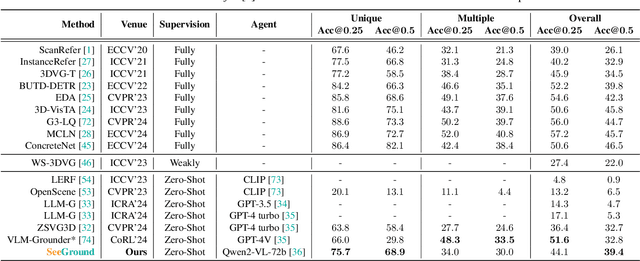
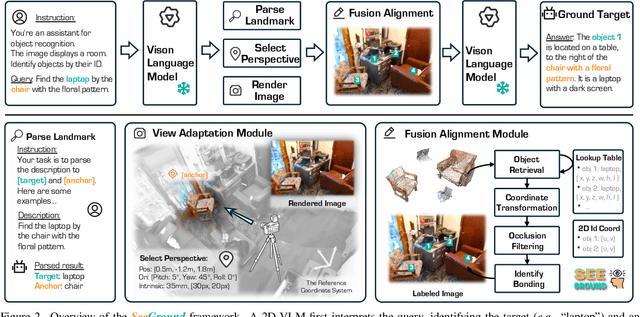
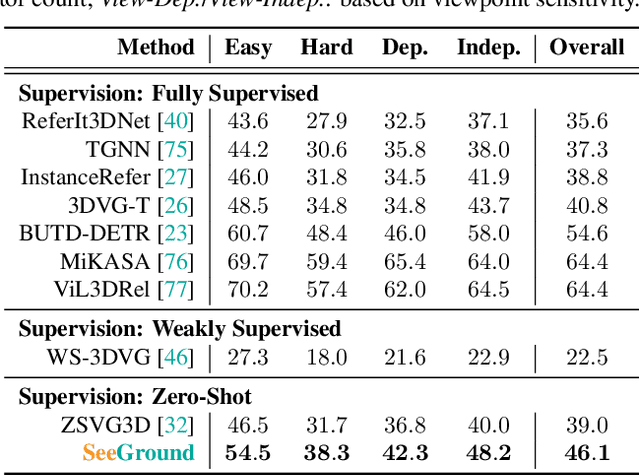
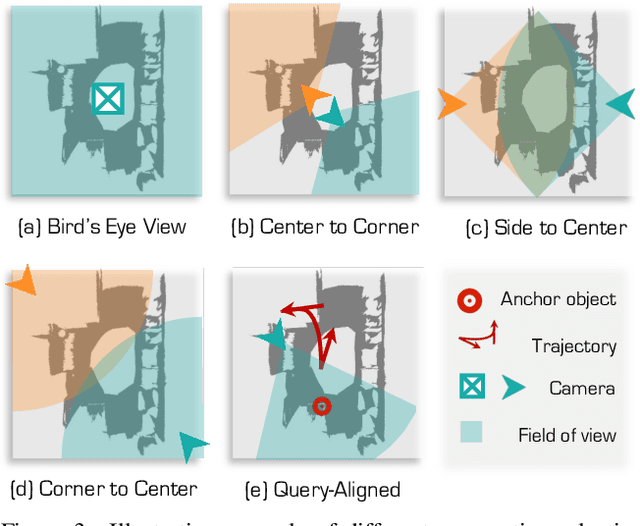
3D Visual Grounding (3DVG) seeks to locate target objects in 3D scenes using natural language descriptions, enabling downstream applications such as augmented reality and robotics. Existing approaches typically rely on labeled 3D data and predefined categories, limiting scalability to open-world settings. We present SeeGround, a zero-shot 3DVG framework that leverages 2D Vision-Language Models (VLMs) to bypass the need for 3D-specific training. To bridge the modality gap, we introduce a hybrid input format that pairs query-aligned rendered views with spatially enriched textual descriptions. Our framework incorporates two core components: a Perspective Adaptation Module that dynamically selects optimal viewpoints based on the query, and a Fusion Alignment Module that integrates visual and spatial signals to enhance localization precision. Extensive evaluations on ScanRefer and Nr3D confirm that SeeGround achieves substantial improvements over existing zero-shot baselines -- outperforming them by 7.7% and 7.1%, respectively -- and even rivals fully supervised alternatives, demonstrating strong generalization under challenging conditions.