 Add to Chrome
 Add to Firefox
 Add to Edge
NormGuard: Reward-Preserving Norm Constraints in Flow-Matching Reinforcement Learning
Jun 26, 2026
Reinforcement learning (RL) post-training improves the reward alignment of flow-based generators, but often degrades perceptual quality in ways that are not captured by the reward proxy. We identify a simple structural signature of this drift: across three post-training methods (NFT, AWM, DPO), RL fine-tuning inflates the per-step velocity norm $\|v_θ\|$ by $5\%$ to $15\%$ relative to the reference. A form of norm inflation has been studied in classifier-free guidance (CFG), where rescaling the velocity back to a reference norm at inference time can mitigate the resulting artifacts. However, this inference-time correction does not transfer cleanly to RL: rescaling $v_θ$ to match $\|v_{\text{ref}}\|$ at inference time neither improves reward nor fixes the quality degradation, because the inflation is co-adapted into the model weights. Furthermore, an adjoint sensitivity analysis shows that velocity magnitude rescaling carries no coherent first-order reward signal at the batch level, indicating that suppressing norm inflation is unlikely to remove a consistently reward-carrying component. Since inference-time renormalization fails while norm suppression carries no reward cost, training-time intervention is the appropriate strategy. Together, these findings motivate \methodname, a hinge penalty that activates only when $\|v_θ\|$ exceeds $\|v_{\text{ref}}\|$ and composes additively with any velocity-local base loss. Across two base models, three post-training methods, and two reward proxies, \methodname consistently improves MLLM-judged image quality and forensic realism while preserving reward, with gains that amplify under few-step inference and are not explained by early stopping.

MaskAlign: Token-Subset Representation Alignment for Efficient Diffusion Training
Jun 07, 2026Representation alignment with pretrained vision models has recently shown strong potential for accelerating diffusion transformer training. By aligning intermediate diffusion features with clean-image representations from self-supervised vision encoders, existing methods improve convergence and generation quality. However, such alignment also introduces a non-trivial constraint: diffusion models operate on noisy inputs whose usable information varies across timesteps, while the reference features are extracted from clean images. In this paper, we revisit this mismatch from a token-level perspective. We find that, under full-token representation alignment, tokens with large alignment-gradient norms exhibit a stable spatial preference, suggesting that the alignment objective does not affect all tokens uniformly and may encourage the model to rely on the complete set of clean-image tokens. To address this issue, we propose MaskAlign, a token-subset representation alignment method that applies alignment to randomly sampled token subsets during training. By exposing the model to different token subsets across iterations, MaskAlign reduces the dependence of representation alignment on the complete token set and encourages alignment behavior that is more stable under token-subset perturbations. To mitigate the information loss caused by directly dropping tokens, we further introduce a lightweight pre-mask token mixing block that shares information across tokens before masking.
NOVA: Sparse Control, Dense Synthesis for Pair-Free Video Editing
Mar 03, 2026Recent video editing models have achieved impressive results, but most still require large-scale paired datasets. Collecting such naturally aligned pairs at scale remains highly challenging and constitutes a critical bottleneck, especially for local video editing data. Existing workarounds transfer image editing to video through global motion control for pair-free video editing, but such designs struggle with background and temporal consistency. In this paper, we propose NOVA: Sparse Control \& Dense Synthesis, a new framework for unpaired video editing. Specifically, the sparse branch provides semantic guidance through user-edited keyframes distributed across the video, and the dense branch continuously incorporates motion and texture information from the original video to maintain high fidelity and coherence. Moreover, we introduce a degradation-simulation training strategy that enables the model to learn motion reconstruction and temporal consistency by training on artificially degraded videos, thus eliminating the need for paired data. Our extensive experiments demonstrate that NOVA outperforms existing approaches in edit fidelity, motion preservation, and temporal coherence.
StableWorld: Towards Stable and Consistent Long Interactive Video Generation
Jan 21, 2026In this paper, we explore the overlooked challenge of stability and temporal consistency in interactive video generation, which synthesizes dynamic and controllable video worlds through interactive behaviors such as camera movements and text prompts. Despite remarkable progress in world modeling, current methods still suffer from severe instability and temporal degradation, often leading to spatial drift and scene collapse during long-horizon interactions. To better understand this issue, we initially investigate the underlying causes of instability and identify that the major source of error accumulation originates from the same scene, where generated frames gradually deviate from the initial clean state and propagate errors to subsequent frames. Building upon this observation, we propose a simple yet effective method, \textbf{StableWorld}, a Dynamic Frame Eviction Mechanism. By continuously filtering out degraded frames while retaining geometrically consistent ones, StableWorld effectively prevents cumulative drift at its source, leading to more stable and temporal consistency of interactive generation. Promising results on multiple interactive video models, \eg, Matrix-Game, Open-Oasis, and Hunyuan-GameCraft, demonstrate that StableWorld is model-agnostic and can be applied to different interactive video generation frameworks to substantially improve stability, temporal consistency, and generalization across diverse interactive scenarios.
Rethinking Cross-Modal Interaction in Multimodal Diffusion Transformers
Jun 09, 2025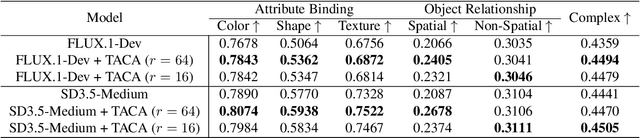
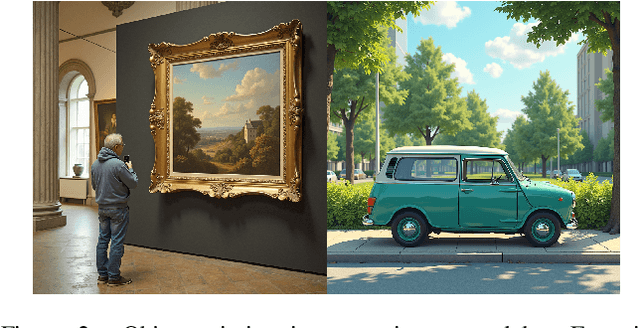
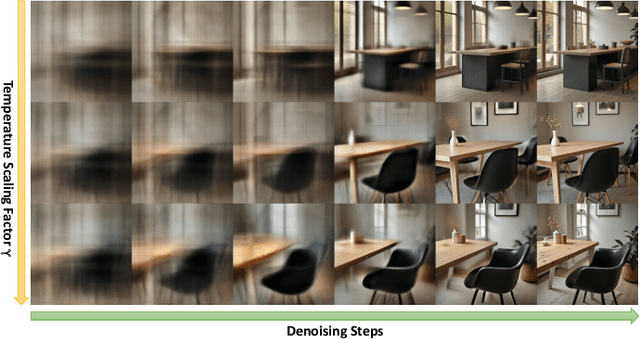
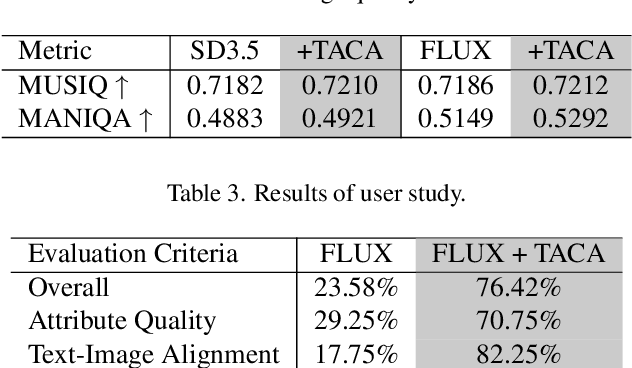
Multimodal Diffusion Transformers (MM-DiTs) have achieved remarkable progress in text-driven visual generation. However, even state-of-the-art MM-DiT models like FLUX struggle with achieving precise alignment between text prompts and generated content. We identify two key issues in the attention mechanism of MM-DiT, namely 1) the suppression of cross-modal attention due to token imbalance between visual and textual modalities and 2) the lack of timestep-aware attention weighting, which hinder the alignment. To address these issues, we propose \textbf{Temperature-Adjusted Cross-modal Attention (TACA)}, a parameter-efficient method that dynamically rebalances multimodal interactions through temperature scaling and timestep-dependent adjustment. When combined with LoRA fine-tuning, TACA significantly enhances text-image alignment on the T2I-CompBench benchmark with minimal computational overhead. We tested TACA on state-of-the-art models like FLUX and SD3.5, demonstrating its ability to improve image-text alignment in terms of object appearance, attribute binding, and spatial relationships. Our findings highlight the importance of balancing cross-modal attention in improving semantic fidelity in text-to-image diffusion models. Our codes are publicly available at \href{https://github.com/Vchitect/TACA}