 Add to Chrome
 Add to Firefox
 Add to Edge
WavFlow: Audio Generation in Waveform Space
May 18, 2026
Modern audio generation predominantly relies on latent-space compression, introducing additional complexity and potential information loss. In this work, we challenge this paradigm with WavFlow, a framework that generates high-fidelity audio directly in raw waveform space without intermediate representations. To overcome the inherent difficulties of modeling high-dimensional and low-energy signals, we reshape audio into 2D token grids through waveform patchify and introduce amplitude lifting to align signal scales, enabling stable optimization via direct x-prediction in flow matching. To capture complex semantic alignment and temporal synchronization, we leverage an automated data pipeline to curate 5 million high-quality video-text-audio triplets, allowing the model to learn fine-grained acoustic patterns from scratch. Experimental results show that WavFlow achieves competitive performance on the video-to-audio benchmark VGGSound (FD_PaSST: 59.98, IS_PANNs: 17.40, DeSync: 0.44) and the text-to-audio benchmark AudioCaps (FD_PANNs: 10.63, IS_PANNs: 12.62), matching or exceeding the performance of established latent-based methods. Our work demonstrates that intermediate compression is not a prerequisite for high-quality synthesis, offering a simpler and more scalable alternative for multimodal audio generation.

Tuna-2: Pixel Embeddings Beat Vision Encoders for Multimodal Understanding and Generation
Apr 27, 2026Unified multimodal models typically rely on pretrained vision encoders and use separate visual representations for understanding and generation, creating misalignment between the two tasks and preventing fully end-to-end optimization from raw pixels. We introduce Tuna-2, a native unified multimodal model that performs visual understanding and generation directly based on pixel embeddings. Tuna-2 drastically simplifies the model architecture by employing simple patch embedding layers to encode visual input, completely discarding the modular vision encoder designs such as the VAE or the representation encoder. Experiments show that Tuna-2 achieves state-of-the-art performance in multimodal benchmarks, demonstrating that unified pixel-space modelling can fully compete with latent-space approaches for high-quality image generation. Moreover, while the encoder-based variant converges faster in early pretraining, Tuna-2's encoder-free design achieves stronger multimodal understanding at scale, particularly on tasks requiring fine-grained visual perception. These results show that pretrained vision encoders are not necessary for multimodal modelling, and end-to-end pixel-space learning offers a scalable path toward stronger visual representations for both generation and perception.
Rein3D: Reinforced 3D Indoor Scene Generation with Panoramic Video Diffusion Models
Apr 14, 2026The growing demand for Embodied AI and VR applications has highlighted the need for synthesizing high-quality 3D indoor scenes from sparse inputs. However, existing approaches struggle to infer massive amounts of missing geometry in large unseen areas while maintaining global consistency, often producing locally plausible but globally inconsistent reconstructions. We present Rein3D, a framework that reconstructs full 360-degree indoor environments by coupling explicit 3D Gaussian Splatting (3DGS) with temporally coherent priors from video diffusion models. Our approach follows a "restore-and-refine" paradigm: we employ a radial exploration strategy to render imperfect panoramic videos along trajectories starting from the origin, effectively uncovering occluded regions from a coarse 3DGS initialization. These sequences are restored by a panoramic video-to-video diffusion model and further enhanced via video super-resolution to synthesize high-fidelity geometry and textures. Finally, these refined videos serve as pseudo-ground truths to update the global 3D Gaussian field. To support this task, we construct PanoV2V-15K, a dataset of over 15K paired clean and degraded panoramic videos for diffusion-based scene restoration. Experiments demonstrate that Rein3D produces photorealistic and globally consistent 3D scenes and significantly improves long-range camera exploration compared with existing baselines.
HiStream: Efficient High-Resolution Video Generation via Redundancy-Eliminated Streaming
Dec 24, 2025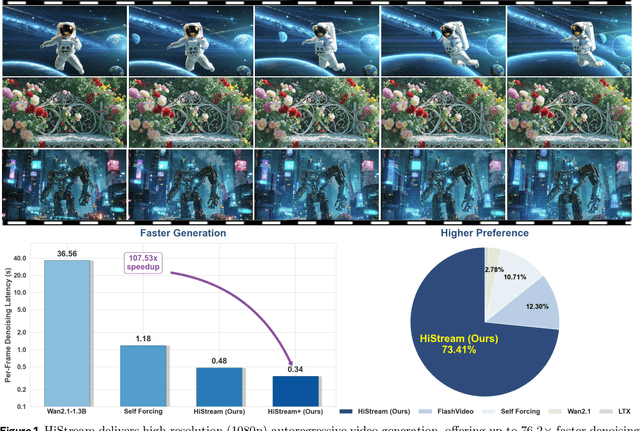
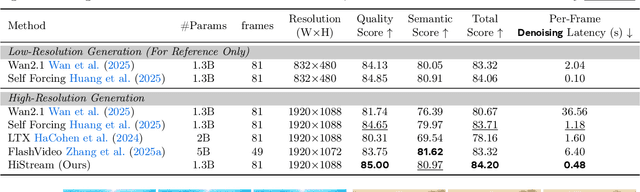
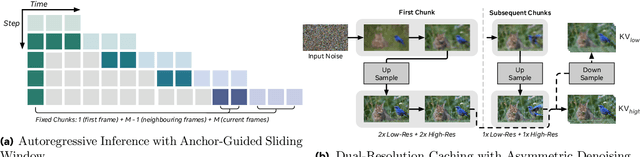
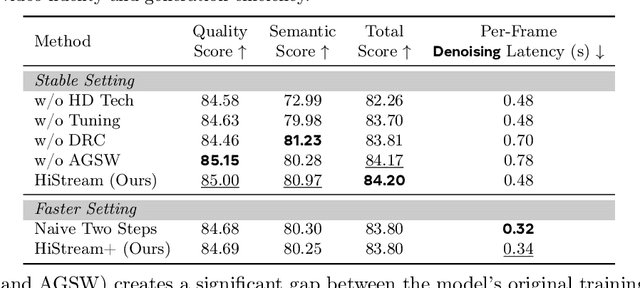
High-resolution video generation, while crucial for digital media and film, is computationally bottlenecked by the quadratic complexity of diffusion models, making practical inference infeasible. To address this, we introduce HiStream, an efficient autoregressive framework that systematically reduces redundancy across three axes: i) Spatial Compression: denoising at low resolution before refining at high resolution with cached features; ii) Temporal Compression: a chunk-by-chunk strategy with a fixed-size anchor cache, ensuring stable inference speed; and iii) Timestep Compression: applying fewer denoising steps to subsequent, cache-conditioned chunks. On 1080p benchmarks, our primary HiStream model (i+ii) achieves state-of-the-art visual quality while demonstrating up to 76.2x faster denoising compared to the Wan2.1 baseline and negligible quality loss. Our faster variant, HiStream+, applies all three optimizations (i+ii+iii), achieving a 107.5x acceleration over the baseline, offering a compelling trade-off between speed and quality, thereby making high-resolution video generation both practical and scalable.
PixelFlow: Pixel-Space Generative Models with Flow
Apr 10, 2025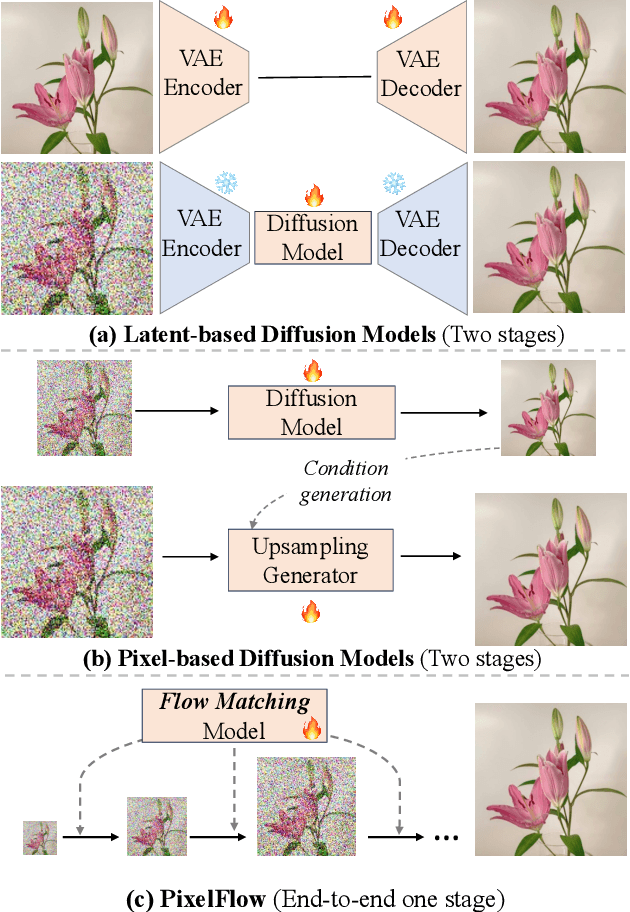
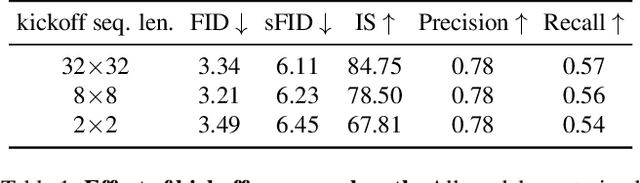
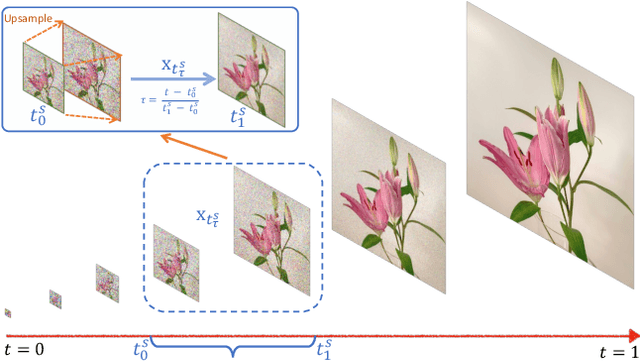
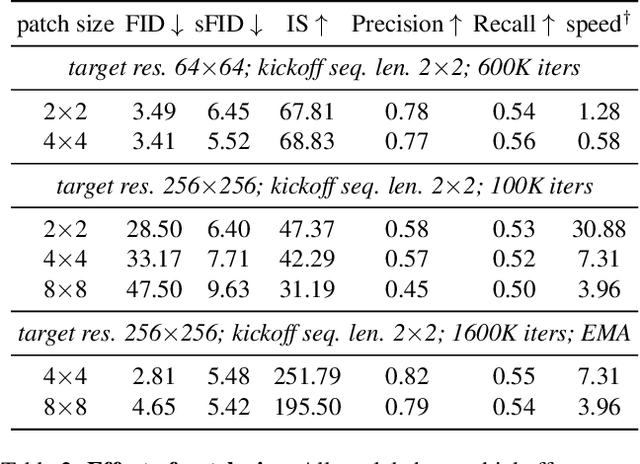
We present PixelFlow, a family of image generation models that operate directly in the raw pixel space, in contrast to the predominant latent-space models. This approach simplifies the image generation process by eliminating the need for a pre-trained Variational Autoencoder (VAE) and enabling the whole model end-to-end trainable. Through efficient cascade flow modeling, PixelFlow achieves affordable computation cost in pixel space. It achieves an FID of 1.98 on 256$\times$256 ImageNet class-conditional image generation benchmark. The qualitative text-to-image results demonstrate that PixelFlow excels in image quality, artistry, and semantic control. We hope this new paradigm will inspire and open up new opportunities for next-generation visual generation models. Code and models are available at https://github.com/ShoufaChen/PixelFlow.
Goku: Flow Based Video Generative Foundation Models
Feb 10, 2025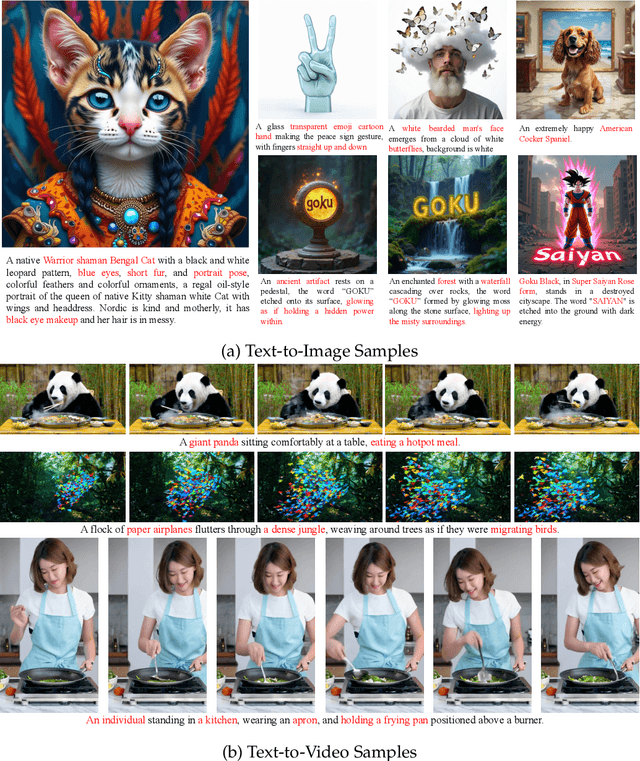

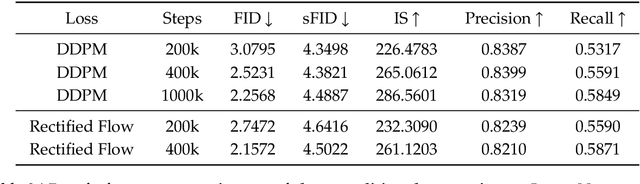
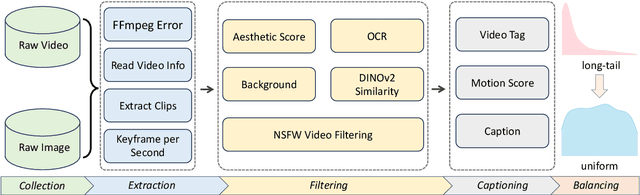
This paper introduces Goku, a state-of-the-art family of joint image-and-video generation models leveraging rectified flow Transformers to achieve industry-leading performance. We detail the foundational elements enabling high-quality visual generation, including the data curation pipeline, model architecture design, flow formulation, and advanced infrastructure for efficient and robust large-scale training. The Goku models demonstrate superior performance in both qualitative and quantitative evaluations, setting new benchmarks across major tasks. Specifically, Goku achieves 0.76 on GenEval and 83.65 on DPG-Bench for text-to-image generation, and 84.85 on VBench for text-to-video tasks. We believe that this work provides valuable insights and practical advancements for the research community in developing joint image-and-video generation models.
FlashVideo:Flowing Fidelity to Detail for Efficient High-Resolution Video Generation
Feb 07, 2025DiT diffusion models have achieved great success in text-to-video generation, leveraging their scalability in model capacity and data scale. High content and motion fidelity aligned with text prompts, however, often require large model parameters and a substantial number of function evaluations (NFEs). Realistic and visually appealing details are typically reflected in high resolution outputs, further amplifying computational demands especially for single stage DiT models. To address these challenges, we propose a novel two stage framework, FlashVideo, which strategically allocates model capacity and NFEs across stages to balance generation fidelity and quality. In the first stage, prompt fidelity is prioritized through a low resolution generation process utilizing large parameters and sufficient NFEs to enhance computational efficiency. The second stage establishes flow matching between low and high resolutions, effectively generating fine details with minimal NFEs. Quantitative and visual results demonstrate that FlashVideo achieves state-of-the-art high resolution video generation with superior computational efficiency. Additionally, the two-stage design enables users to preview the initial output before committing to full resolution generation, thereby significantly reducing computational costs and wait times as well as enhancing commercial viability .
Prompt-A-Video: Prompt Your Video Diffusion Model via Preference-Aligned LLM
Dec 19, 2024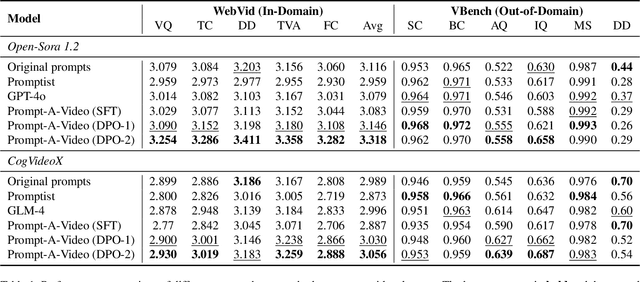
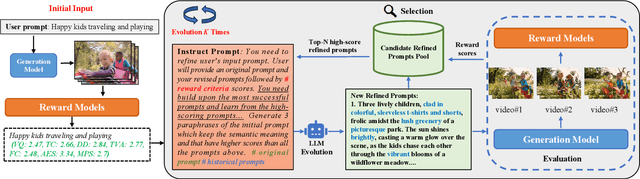
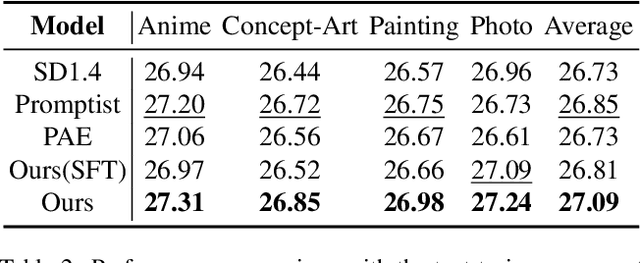
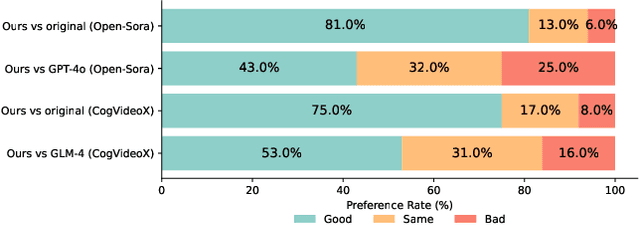
Text-to-video models have made remarkable advancements through optimization on high-quality text-video pairs, where the textual prompts play a pivotal role in determining quality of output videos. However, achieving the desired output often entails multiple revisions and iterative inference to refine user-provided prompts. Current automatic methods for refining prompts encounter challenges such as Modality-Inconsistency, Cost-Discrepancy, and Model-Unaware when applied to text-to-video diffusion models. To address these problem, we introduce an LLM-based prompt adaptation framework, termed as Prompt-A-Video, which excels in crafting Video-Centric, Labor-Free and Preference-Aligned prompts tailored to specific video diffusion model. Our approach involves a meticulously crafted two-stage optimization and alignment system. Initially, we conduct a reward-guided prompt evolution pipeline to automatically create optimal prompts pool and leverage them for supervised fine-tuning (SFT) of the LLM. Then multi-dimensional rewards are employed to generate pairwise data for the SFT model, followed by the direct preference optimization (DPO) algorithm to further facilitate preference alignment. Through extensive experimentation and comparative analyses, we validate the effectiveness of Prompt-A-Video across diverse generation models, highlighting its potential to push the boundaries of video generation.
ControlAR: Controllable Image Generation with Autoregressive Models
Oct 03, 2024


Autoregressive (AR) models have reformulated image generation as next-token prediction, demonstrating remarkable potential and emerging as strong competitors to diffusion models. However, control-to-image generation, akin to ControlNet, remains largely unexplored within AR models. Although a natural approach, inspired by advancements in Large Language Models, is to tokenize control images into tokens and prefill them into the autoregressive model before decoding image tokens, it still falls short in generation quality compared to ControlNet and suffers from inefficiency. To this end, we introduce ControlAR, an efficient and effective framework for integrating spatial controls into autoregressive image generation models. Firstly, we explore control encoding for AR models and propose a lightweight control encoder to transform spatial inputs (e.g., canny edges or depth maps) into control tokens. Then ControlAR exploits the conditional decoding method to generate the next image token conditioned on the per-token fusion between control and image tokens, similar to positional encodings. Compared to prefilling tokens, using conditional decoding significantly strengthens the control capability of AR models but also maintains the model's efficiency. Furthermore, the proposed ControlAR surprisingly empowers AR models with arbitrary-resolution image generation via conditional decoding and specific controls. Extensive experiments can demonstrate the controllability of the proposed ControlAR for the autoregressive control-to-image generation across diverse inputs, including edges, depths, and segmentation masks. Furthermore, both quantitative and qualitative results indicate that ControlAR surpasses previous state-of-the-art controllable diffusion models, e.g., ControlNet++. Code, models, and demo will soon be available at https://github.com/hustvl/ControlAR.
MobileAgentBench: An Efficient and User-Friendly Benchmark for Mobile LLM Agents
Jun 12, 2024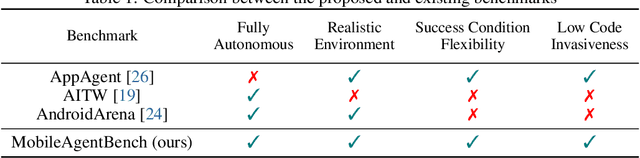
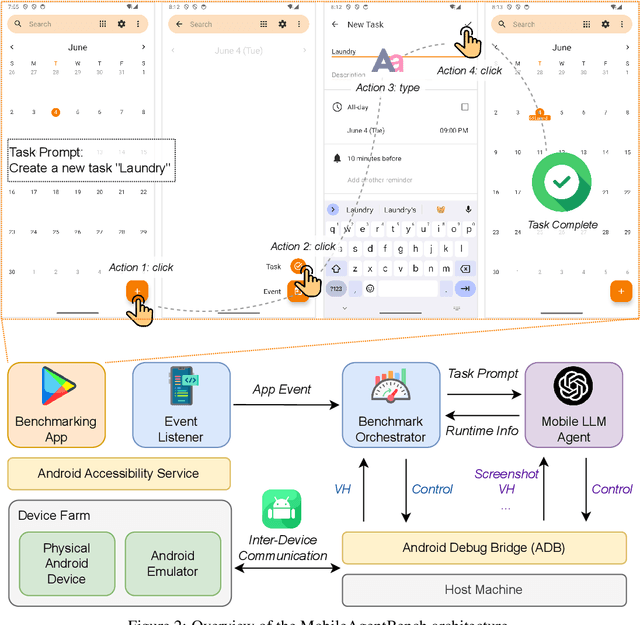
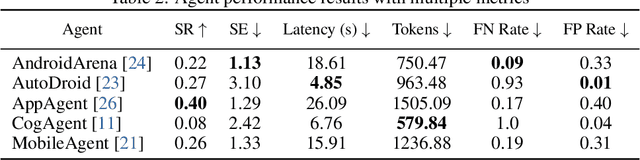
Large language model (LLM)-based mobile agents are increasingly popular due to their capability to interact directly with mobile phone Graphic User Interfaces (GUIs) and their potential to autonomously manage daily tasks. Despite their promising prospects in both academic and industrial sectors, little research has focused on benchmarking the performance of existing mobile agents, due to the inexhaustible states of apps and the vague definition of feasible action sequences. To address this challenge, we propose an efficient and user-friendly benchmark, MobileAgentBench, designed to alleviate the burden of extensive manual testing. We initially define 100 tasks across 10 open-source apps, categorized by multiple levels of difficulty. Subsequently, we evaluate several existing mobile agents, including AppAgent and MobileAgent, to thoroughly and systematically compare their performance. All materials are accessible on our project webpage: https://MobileAgentBench.github.io, contributing to the advancement of both academic and industrial fields.