 Add to Chrome
 Add to Firefox
 Add to Edge
Data Pyramid for Embodied Manipulation
Jul 27, 2026
Multimodal foundation models learned to see and to speak by consuming the whole internet. Embodied agents admit no such shortcut, since they require data that couple observations with physical states and actions. These signals can be provided, to varying degrees, by multiple data sources. In this work, we organize the embodied data ecosystem as a "pyramid" spanning five complementary sources: real-robot data, UMI-style data, egocentric and exocentric data, simulation data, and general vision-language data. We organize the pyramid around the tension between scalability and robot alignment, and further characterize each source in terms of data quality, diversity, reusability, and physical fidelity. We then analyze recent embodied foundation models through the lens of their data recipes, examining how different sources are selected, aligned, and mixed during pretraining. For embodied brain models, vision-language-action models, and world-action models alike, we relate data composition to capabilities in perception, reasoning, planning, action generation, and world prediction. We close by discussing six open challenges: building large-scale tactile datasets, collecting failure and recovery data, developing scalable data-collection pipelines, aligning actions across embodiments, leveraging egocentric data for dexterous manipulation, and designing principled data recipes for robot learning. We hope this work paves the foundation for the design of next-generation embodied systems.

Dream-Tac: A Unified Tactile World Action Model for Contact-Rich Robot Manipulation
Jun 07, 2026World action models inherit the predictive capability of world models, enabling action generation to be guided by anticipated future observations. However, they rely primarily on vision and often fail in contact-rich manipulation, where critical cues arise from physical interaction. In this paper, we propose Dream-Tac, a unified Tactile-World Action Model that jointly models actions, future visual observations, and tactile dynamics. Specifically, Dream-Tac introduces (i) contact-gated visuotactile fusion to selectively integrate tactile signals and (ii) a contact-aware attention bias to better regulate cross-modal interactions during manipulation. To support real-time deployment, we further design a dual-level acceleration strategy, reformulating the contact-aware bias to preserve the fused attention path during training and introducing cache-based diffusion acceleration at inference, achieving up to 2.9$\times$ faster training and 1.8$\times$ faster inference. Across six contact-rich manipulation tasks, Dream-Tac improves action accuracy by 31.7\% on average, demonstrating the effectiveness of unified visuotactile world modeling.Code is available at https://github.com/LYFCLOUDFAN/Dream-Tac.
RynnBrain: Open Embodied Foundation Models
Feb 13, 2026Despite rapid progress in multimodal foundation models, embodied intelligence community still lacks a unified, physically grounded foundation model that integrates perception, reasoning, and planning within real-world spatial-temporal dynamics. We introduce RynnBrain, an open-source spatiotemporal foundation model for embodied intelligence. RynnBrain strengthens four core capabilities in a unified framework: comprehensive egocentric understanding, diverse spatiotemporal localization, physically grounded reasoning, and physics-aware planning. The RynnBrain family comprises three foundation model scales (2B, 8B, and 30B-A3B MoE) and four post-trained variants tailored for downstream embodied tasks (i.e., RynnBrain-Nav, RynnBrain-Plan, and RynnBrain-VLA) or complex spatial reasoning tasks (i.e., RynnBrain-CoP). In terms of extensive evaluations on 20 embodied benchmarks and 8 general vision understanding benchmarks, our RynnBrain foundation models largely outperform existing embodied foundation models by a significant margin. The post-trained model suite further substantiates two key potentials of the RynnBrain foundation model: (i) enabling physically grounded reasoning and planning, and (ii) serving as a strong pretrained backbone that can be efficiently adapted to diverse embodied tasks.
InspecSafe-V1: A Multimodal Benchmark for Safety Assessment in Industrial Inspection Scenarios
Jan 29, 2026With the rapid development of industrial intelligence and unmanned inspection, reliable perception and safety assessment for AI systems in complex and dynamic industrial sites has become a key bottleneck for deploying predictive maintenance and autonomous inspection. Most public datasets remain limited by simulated data sources, single-modality sensing, or the absence of fine-grained object-level annotations, which prevents robust scene understanding and multimodal safety reasoning for industrial foundation models. To address these limitations, InspecSafe-V1 is released as the first multimodal benchmark dataset for industrial inspection safety assessment that is collected from routine operations of real inspection robots in real-world environments. InspecSafe-V1 covers five representative industrial scenarios, including tunnels, power facilities, sintering equipment, oil and gas petrochemical plants, and coal conveyor trestles. The dataset is constructed from 41 wheeled and rail-mounted inspection robots operating at 2,239 valid inspection sites, yielding 5,013 inspection instances. For each instance, pixel-level segmentation annotations are provided for key objects in visible-spectrum images. In addition, a semantic scene description and a corresponding safety level label are provided according to practical inspection tasks. Seven synchronized sensing modalities are further included, including infrared video, audio, depth point clouds, radar point clouds, gas measurements, temperature, and humidity, to support multimodal anomaly recognition, cross-modal fusion, and comprehensive safety assessment in industrial environments.
Vision-Language-Action Models for Autonomous Driving: Past, Present, and Future
Dec 18, 2025Autonomous driving has long relied on modular "Perception-Decision-Action" pipelines, where hand-crafted interfaces and rule-based components often break down in complex or long-tailed scenarios. Their cascaded design further propagates perception errors, degrading downstream planning and control. Vision-Action (VA) models address some limitations by learning direct mappings from visual inputs to actions, but they remain opaque, sensitive to distribution shifts, and lack structured reasoning or instruction-following capabilities. Recent progress in Large Language Models (LLMs) and multimodal learning has motivated the emergence of Vision-Language-Action (VLA) frameworks, which integrate perception with language-grounded decision making. By unifying visual understanding, linguistic reasoning, and actionable outputs, VLAs offer a pathway toward more interpretable, generalizable, and human-aligned driving policies. This work provides a structured characterization of the emerging VLA landscape for autonomous driving. We trace the evolution from early VA approaches to modern VLA frameworks and organize existing methods into two principal paradigms: End-to-End VLA, which integrates perception, reasoning, and planning within a single model, and Dual-System VLA, which separates slow deliberation (via VLMs) from fast, safety-critical execution (via planners). Within these paradigms, we further distinguish subclasses such as textual vs. numerical action generators and explicit vs. implicit guidance mechanisms. We also summarize representative datasets and benchmarks for evaluating VLA-based driving systems and highlight key challenges and open directions, including robustness, interpretability, and instruction fidelity. Overall, this work aims to establish a coherent foundation for advancing human-compatible autonomous driving systems.
Token Expand-Merge: Training-Free Token Compression for Vision-Language-Action Models
Dec 10, 2025Vision-Language-Action (VLA) models pretrained on large-scale multimodal datasets have emerged as powerful foundations for robotic perception and control. However, their massive scale, often billions of parameters, poses significant challenges for real-time deployment, as inference becomes computationally expensive and latency-sensitive in dynamic environments. To address this, we propose Token Expand-and-Merge-VLA (TEAM-VLA), a training-free token compression framework that accelerates VLA inference while preserving task performance. TEAM-VLA introduces a dynamic token expansion mechanism that identifies and samples additional informative tokens in the spatial vicinity of attention-highlighted regions, enhancing contextual completeness. These expanded tokens are then selectively merged in deeper layers under action-aware guidance, effectively reducing redundancy while maintaining semantic coherence. By coupling expansion and merging within a single feed-forward pass, TEAM-VLA achieves a balanced trade-off between efficiency and effectiveness, without any retraining or parameter updates. Extensive experiments on LIBERO benchmark demonstrate that TEAM-VLA consistently improves inference speed while maintaining or even surpassing the task success rate of full VLA models. The code is public available on \href{https://github.com/Jasper-aaa/TEAM-VLA}{https://github.com/Jasper-aaa/TEAM-VLA}
VLSA: Vision-Language-Action Models with Plug-and-Play Safety Constraint Layer
Dec 09, 2025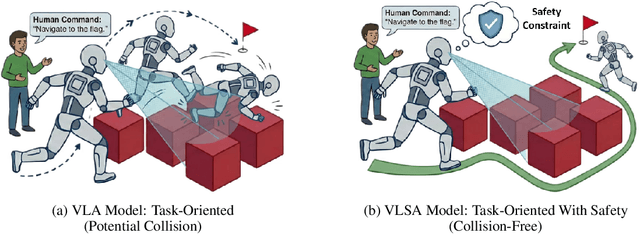
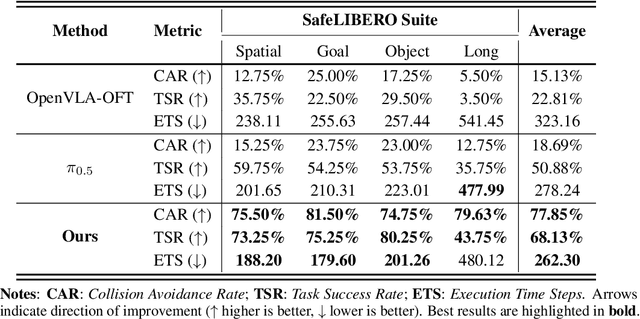
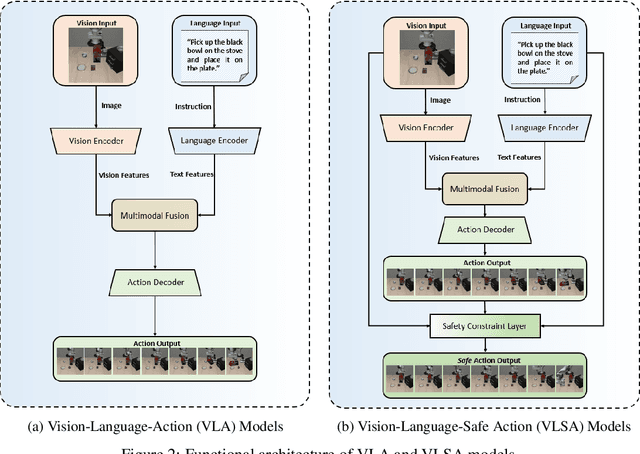
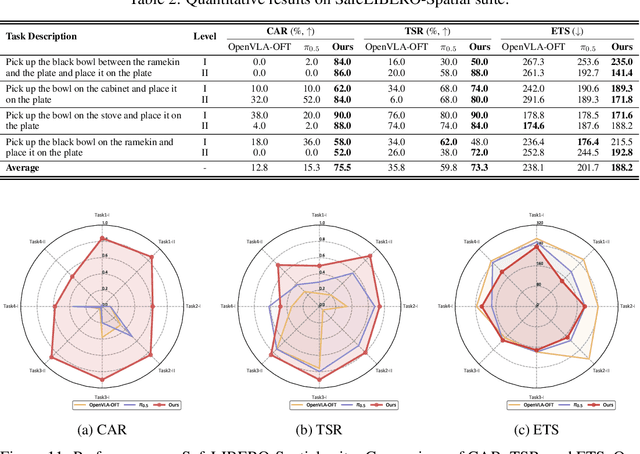
Vision-Language-Action (VLA) models have demonstrated remarkable capabilities in generalizing across diverse robotic manipulation tasks. However, deploying these models in unstructured environments remains challenging due to the critical need for simultaneous task compliance and safety assurance, particularly in preventing potential collisions during physical interactions. In this work, we introduce a Vision-Language-Safe Action (VLSA) architecture, named AEGIS, which contains a plug-and-play safety constraint (SC) layer formulated via control barrier functions. AEGIS integrates directly with existing VLA models to improve safety with theoretical guarantees, while maintaining their original instruction-following performance. To evaluate the efficacy of our architecture, we construct a comprehensive safety-critical benchmark SafeLIBERO, spanning distinct manipulation scenarios characterized by varying degrees of spatial complexity and obstacle intervention. Extensive experiments demonstrate the superiority of our method over state-of-the-art baselines. Notably, AEGIS achieves a 59.16% improvement in obstacle avoidance rate while substantially increasing the task execution success rate by 17.25%. To facilitate reproducibility and future research, we make our code, models, and the benchmark datasets publicly available at https://vlsa-aegis.github.io/.
RynnVLA-001: Using Human Demonstrations to Improve Robot Manipulation
Sep 18, 2025This paper presents RynnVLA-001, a vision-language-action(VLA) model built upon large-scale video generative pretraining from human demonstrations. We propose a novel two-stage pretraining methodology. The first stage, Ego-Centric Video Generative Pretraining, trains an Image-to-Video model on 12M ego-centric manipulation videos to predict future frames conditioned on an initial frame and a language instruction. The second stage, Human-Centric Trajectory-Aware Modeling, extends this by jointly predicting future keypoint trajectories, thereby effectively bridging visual frame prediction with action prediction. Furthermore, to enhance action representation, we propose ActionVAE, a variational autoencoder that compresses sequences of actions into compact latent embeddings, reducing the complexity of the VLA output space. When finetuned on the same downstream robotics datasets, RynnVLA-001 achieves superior performance over state-of-the-art baselines, demonstrating that the proposed pretraining strategy provides a more effective initialization for VLA models.
Towards Affordance-Aware Robotic Dexterous Grasping with Human-like Priors
Aug 12, 2025A dexterous hand capable of generalizable grasping objects is fundamental for the development of general-purpose embodied AI. However, previous methods focus narrowly on low-level grasp stability metrics, neglecting affordance-aware positioning and human-like poses which are crucial for downstream manipulation. To address these limitations, we propose AffordDex, a novel framework with two-stage training that learns a universal grasping policy with an inherent understanding of both motion priors and object affordances. In the first stage, a trajectory imitator is pre-trained on a large corpus of human hand motions to instill a strong prior for natural movement. In the second stage, a residual module is trained to adapt these general human-like motions to specific object instances. This refinement is critically guided by two components: our Negative Affordance-aware Segmentation (NAA) module, which identifies functionally inappropriate contact regions, and a privileged teacher-student distillation process that ensures the final vision-based policy is highly successful. Extensive experiments demonstrate that AffordDex not only achieves universal dexterous grasping but also remains remarkably human-like in posture and functionally appropriate in contact location. As a result, AffordDex significantly outperforms state-of-the-art baselines across seen objects, unseen instances, and even entirely novel categories.
WorldVLA: Towards Autoregressive Action World Model
Jun 26, 2025We present WorldVLA, an autoregressive action world model that unifies action and image understanding and generation. Our WorldVLA intergrates Vision-Language-Action (VLA) model and world model in one single framework. The world model predicts future images by leveraging both action and image understanding, with the purpose of learning the underlying physics of the environment to improve action generation. Meanwhile, the action model generates the subsequent actions based on image observations, aiding in visual understanding and in turn helps visual generation of the world model. We demonstrate that WorldVLA outperforms standalone action and world models, highlighting the mutual enhancement between the world model and the action model. In addition, we find that the performance of the action model deteriorates when generating sequences of actions in an autoregressive manner. This phenomenon can be attributed to the model's limited generalization capability for action prediction, leading to the propagation of errors from earlier actions to subsequent ones. To address this issue, we propose an attention mask strategy that selectively masks prior actions during the generation of the current action, which shows significant performance improvement in the action chunk generation task.