 Add to Chrome
 Add to Firefox
 Add to Edge
One-to-More: High-Fidelity Training-Free Anomaly Generation with Attention Control
Mar 18, 2026
Industrial anomaly detection (AD) is characterized by an abundance of normal images but a scarcity of anomalous ones. Although numerous few-shot anomaly synthesis methods have been proposed to augment anomalous data for downstream AD tasks, most existing approaches require time-consuming training and struggle to learn distributions that are faithful to real anomalies, thereby restricting the efficacy of AD models trained on such data. To address these limitations, we propose a training-free few-shot anomaly generation method, namely O2MAG, which leverages the self-attention in One reference anomalous image to synthesize More realistic anomalies, supporting effective downstream anomaly detection. Specifically, O2MAG manipulates three parallel diffusion processes via self-attention grafting and incorporates the anomaly mask to mitigate foreground-background query confusion, synthesizing text-guided anomalies that closely adhere to real anomalous distributions. To bridge the semantic gap between the encoded anomaly text prompts and the true anomaly semantics, Anomaly-Guided Optimization is further introduced to align the synthesis process with the target anomalous distribution, steering the generation toward realistic and text-consistent anomalies. Moreover, to mitigate faint anomaly synthesis inside anomaly masks, Dual-Attention Enhancement is adopted during generation to reinforce both self- and cross-attention on masked regions. Extensive experiments validate the effectiveness of O2MAG, demonstrating its superior performance over prior state-of-the-art methods on downstream AD tasks.

NOVA: Sparse Control, Dense Synthesis for Pair-Free Video Editing
Mar 03, 2026Recent video editing models have achieved impressive results, but most still require large-scale paired datasets. Collecting such naturally aligned pairs at scale remains highly challenging and constitutes a critical bottleneck, especially for local video editing data. Existing workarounds transfer image editing to video through global motion control for pair-free video editing, but such designs struggle with background and temporal consistency. In this paper, we propose NOVA: Sparse Control \& Dense Synthesis, a new framework for unpaired video editing. Specifically, the sparse branch provides semantic guidance through user-edited keyframes distributed across the video, and the dense branch continuously incorporates motion and texture information from the original video to maintain high fidelity and coherence. Moreover, we introduce a degradation-simulation training strategy that enables the model to learn motion reconstruction and temporal consistency by training on artificially degraded videos, thus eliminating the need for paired data. Our extensive experiments demonstrate that NOVA outperforms existing approaches in edit fidelity, motion preservation, and temporal coherence.
BFA++: Hierarchical Best-Feature-Aware Token Prune for Multi-View Vision Language Action Model
Feb 24, 2026Vision-Language-Action (VLA) models have achieved significant breakthroughs by leveraging Large Vision Language Models (VLMs) to jointly interpret instructions and visual inputs. However, the substantial increase in visual tokens, particularly from multi-view inputs, poses serious challenges to real-time robotic manipulation. Existing acceleration techniques for VLMs, such as token pruning, often result in degraded performance when directly applied to VLA models, as they overlook the relationships between different views and fail to account for the dynamic and task-specific characteristics of robotic operation. To address this, we propose BFA++, a dynamic token pruning framework designed specifically for VLA models. BFA++ introduces a hierarchical pruning strategy guided by two-level importance predictors: an intra-view predictor highlights task-relevant regions within each image to suppress spatial noise, while an inter-view predictor identifies critical camera views throughout different manipulation phases to reduce cross-view redundancy. This design enables efficient token selection while preserving essential visual cues, resulting in improved computational efficiency and higher manipulation success rates. Evaluations on the RoboTwin benchmark and real-world robotic tasks demonstrate that BFA++ consistently outperforms existing methods. BFA++ improves the success rate by about 10% on both the π0 and RDT models, achieving speedup of 1.8X and 1.5X, respectively. Our results highlight that context-sensitive and task-aware token pruning serves as a more effective strategy than full visual processing, enabling faster inference and improved manipulation accuracy in real-world robotic systems.
One Size, Many Fits: Aligning Diverse Group-Wise Click Preferences in Large-Scale Advertising Image Generation
Feb 02, 2026Advertising image generation has increasingly focused on online metrics like Click-Through Rate (CTR), yet existing approaches adopt a ``one-size-fits-all" strategy that optimizes for overall CTR while neglecting preference diversity among user groups. This leads to suboptimal performance for specific groups, limiting targeted marketing effectiveness. To bridge this gap, we present \textit{One Size, Many Fits} (OSMF), a unified framework that aligns diverse group-wise click preferences in large-scale advertising image generation. OSMF begins with product-aware adaptive grouping, which dynamically organizes users based on their attributes and product characteristics, representing each group with rich collective preference features. Building on these groups, preference-conditioned image generation employs a Group-aware Multimodal Large Language Model (G-MLLM) to generate tailored images for each group. The G-MLLM is pre-trained to simultaneously comprehend group features and generate advertising images. Subsequently, we fine-tune the G-MLLM using our proposed Group-DPO for group-wise preference alignment, which effectively enhances each group's CTR on the generated images. To further advance this field, we introduce the Grouped Advertising Image Preference Dataset (GAIP), the first large-scale public dataset of group-wise image preferences, including around 600K groups built from 40M users. Extensive experiments demonstrate that our framework achieves the state-of-the-art performance in both offline and online settings. Our code and datasets will be released at https://github.com/JD-GenX/OSMF.
StableWorld: Towards Stable and Consistent Long Interactive Video Generation
Jan 21, 2026In this paper, we explore the overlooked challenge of stability and temporal consistency in interactive video generation, which synthesizes dynamic and controllable video worlds through interactive behaviors such as camera movements and text prompts. Despite remarkable progress in world modeling, current methods still suffer from severe instability and temporal degradation, often leading to spatial drift and scene collapse during long-horizon interactions. To better understand this issue, we initially investigate the underlying causes of instability and identify that the major source of error accumulation originates from the same scene, where generated frames gradually deviate from the initial clean state and propagate errors to subsequent frames. Building upon this observation, we propose a simple yet effective method, \textbf{StableWorld}, a Dynamic Frame Eviction Mechanism. By continuously filtering out degraded frames while retaining geometrically consistent ones, StableWorld effectively prevents cumulative drift at its source, leading to more stable and temporal consistency of interactive generation. Promising results on multiple interactive video models, \eg, Matrix-Game, Open-Oasis, and Hunyuan-GameCraft, demonstrate that StableWorld is model-agnostic and can be applied to different interactive video generation frameworks to substantially improve stability, temporal consistency, and generalization across diverse interactive scenarios.
ProGuard: Towards Proactive Multimodal Safeguard
Dec 29, 2025The rapid evolution of generative models has led to a continuous emergence of multimodal safety risks, exposing the limitations of existing defense methods. To address these challenges, we propose ProGuard, a vision-language proactive guard that identifies and describes out-of-distribution (OOD) safety risks without the need for model adjustments required by traditional reactive approaches. We first construct a modality-balanced dataset of 87K samples, each annotated with both binary safety labels and risk categories under a hierarchical multimodal safety taxonomy, effectively mitigating modality bias and ensuring consistent moderation across text, image, and text-image inputs. Based on this dataset, we train our vision-language base model purely through reinforcement learning (RL) to achieve efficient and concise reasoning. To approximate proactive safety scenarios in a controlled setting, we further introduce an OOD safety category inference task and augment the RL objective with a synonym-bank-based similarity reward that encourages the model to generate concise descriptions for unseen unsafe categories. Experimental results show that ProGuard achieves performance comparable to closed-source large models on binary safety classification, substantially outperforms existing open-source guard models on unsafe content categorization. Most notably, ProGuard delivers a strong proactive moderation ability, improving OOD risk detection by 52.6% and OOD risk description by 64.8%.
LongVie 2: Multimodal Controllable Ultra-Long Video World Model
Dec 15, 2025Building video world models upon pretrained video generation systems represents an important yet challenging step toward general spatiotemporal intelligence. A world model should possess three essential properties: controllability, long-term visual quality, and temporal consistency. To this end, we take a progressive approach-first enhancing controllability and then extending toward long-term, high-quality generation. We present LongVie 2, an end-to-end autoregressive framework trained in three stages: (1) Multi-modal guidance, which integrates dense and sparse control signals to provide implicit world-level supervision and improve controllability; (2) Degradation-aware training on the input frame, bridging the gap between training and long-term inference to maintain high visual quality; and (3) History-context guidance, which aligns contextual information across adjacent clips to ensure temporal consistency. We further introduce LongVGenBench, a comprehensive benchmark comprising 100 high-resolution one-minute videos covering diverse real-world and synthetic environments. Extensive experiments demonstrate that LongVie 2 achieves state-of-the-art performance in long-range controllability, temporal coherence, and visual fidelity, and supports continuous video generation lasting up to five minutes, marking a significant step toward unified video world modeling.
SafeRBench: A Comprehensive Benchmark for Safety Assessment in Large Reasoning Models
Nov 19, 2025Large Reasoning Models (LRMs) improve answer quality through explicit chain-of-thought, yet this very capability introduces new safety risks: harmful content can be subtly injected, surface gradually, or be justified by misleading rationales within the reasoning trace. Existing safety evaluations, however, primarily focus on output-level judgments and rarely capture these dynamic risks along the reasoning process. In this paper, we present SafeRBench, the first benchmark that assesses LRM safety end-to-end -- from inputs and intermediate reasoning to final outputs. (1) Input Characterization: We pioneer the incorporation of risk categories and levels into input design, explicitly accounting for affected groups and severity, and thereby establish a balanced prompt suite reflecting diverse harm gradients. (2) Fine-Grained Output Analysis: We introduce a micro-thought chunking mechanism to segment long reasoning traces into semantically coherent units, enabling fine-grained evaluation across ten safety dimensions. (3) Human Safety Alignment: We validate LLM-based evaluations against human annotations specifically designed to capture safety judgments. Evaluations on 19 LRMs demonstrate that SafeRBench enables detailed, multidimensional safety assessment, offering insights into risks and protective mechanisms from multiple perspectives.
RealDPO: Real or Not Real, that is the Preference
Oct 16, 2025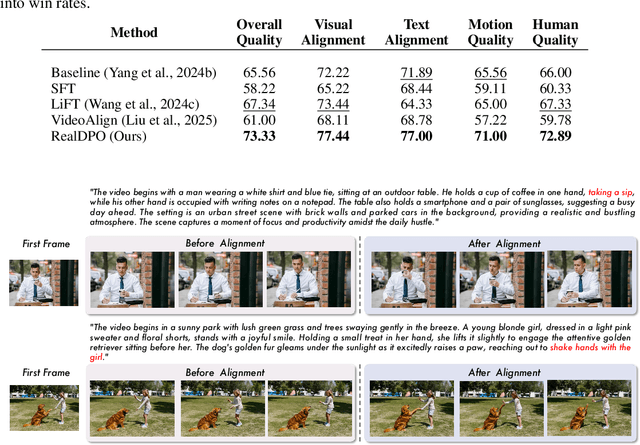
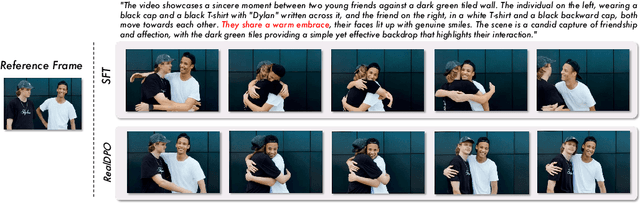
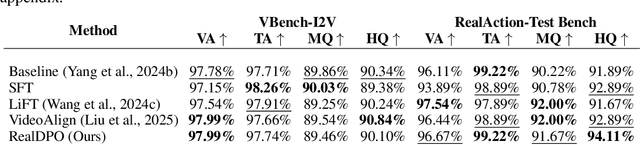
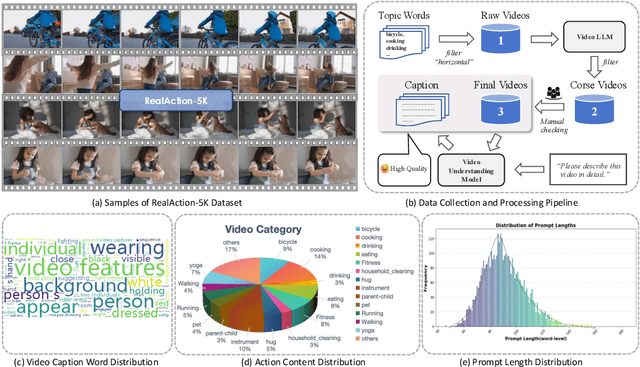
Video generative models have recently achieved notable advancements in synthesis quality. However, generating complex motions remains a critical challenge, as existing models often struggle to produce natural, smooth, and contextually consistent movements. This gap between generated and real-world motions limits their practical applicability. To address this issue, we introduce RealDPO, a novel alignment paradigm that leverages real-world data as positive samples for preference learning, enabling more accurate motion synthesis. Unlike traditional supervised fine-tuning (SFT), which offers limited corrective feedback, RealDPO employs Direct Preference Optimization (DPO) with a tailored loss function to enhance motion realism. By contrasting real-world videos with erroneous model outputs, RealDPO enables iterative self-correction, progressively refining motion quality. To support post-training in complex motion synthesis, we propose RealAction-5K, a curated dataset of high-quality videos capturing human daily activities with rich and precise motion details. Extensive experiments demonstrate that RealDPO significantly improves video quality, text alignment, and motion realism compared to state-of-the-art models and existing preference optimization techniques.
FreeMorph: Tuning-Free Generalized Image Morphing with Diffusion Model
Jul 02, 2025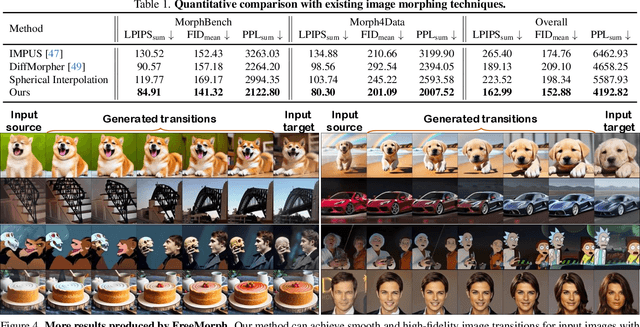


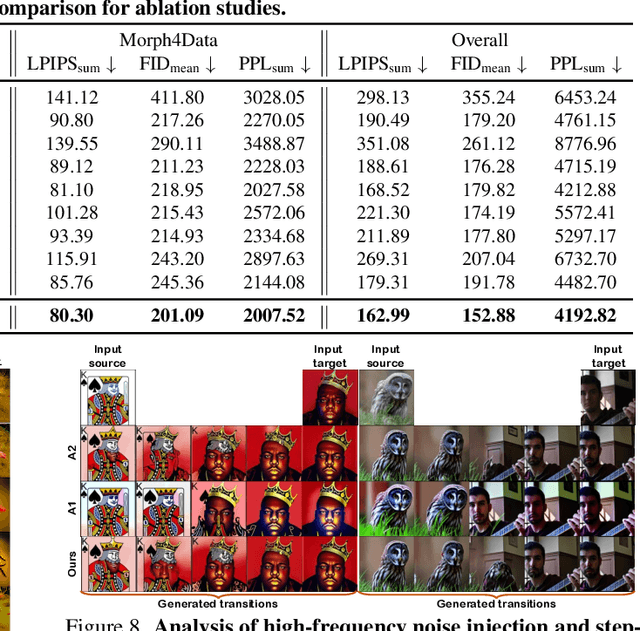
We present FreeMorph, the first tuning-free method for image morphing that accommodates inputs with different semantics or layouts. Unlike existing methods that rely on finetuning pre-trained diffusion models and are limited by time constraints and semantic/layout discrepancies, FreeMorph delivers high-fidelity image morphing without requiring per-instance training. Despite their efficiency and potential, tuning-free methods face challenges in maintaining high-quality results due to the non-linear nature of the multi-step denoising process and biases inherited from the pre-trained diffusion model. In this paper, we introduce FreeMorph to address these challenges by integrating two key innovations. 1) We first propose a guidance-aware spherical interpolation design that incorporates explicit guidance from the input images by modifying the self-attention modules, thereby addressing identity loss and ensuring directional transitions throughout the generated sequence. 2) We further introduce a step-oriented variation trend that blends self-attention modules derived from each input image to achieve controlled and consistent transitions that respect both inputs. Our extensive evaluations demonstrate that FreeMorph outperforms existing methods, being 10x ~ 50x faster and establishing a new state-of-the-art for image morphing.