 Add to Chrome
 Add to Firefox
 Add to Edge
UniVVT: A Unified End-to-End Framework for High-Fidelity Video Virtual Try-on
Aug 06, 2026
Video Virtual Try-On (VVT) synthesizes a video of a person wearing a target garment while preserving identity, motion, and scene dynamics. Dominant approaches cast VVT as mask-conditioned video inpainting and rely on separate modules for human parsing, pose estimation, and garment warping. This multi-stage design complicates deployment and, more critically, allows errors in explicit geometric priors to propagate irreversibly into the generated video. We present UniVVT, a unified end-to-end framework that reframes VVT as semantically conditioned video generation, eliminating mask, pose, and warping modules at inference. At its core, a scene-task perceiver built on a Multimodal Large Language Model jointly encodes the source video, target garment, and task instruction into compact, task-aware latent tokens, implicitly capturing what to transfer and where and how to transfer it. A lightweight semantic bridge then aligns these tokens with the conditioning space of a diffusion-based video generator, enabling coherent garment transfer. To robustly couple the heterogeneous components, we devise a three-stage progressive training strategy comprising semantic alignment, joint task adaptation, and flexible-resolution refinement. Extensive experiments demonstrate that UniVVT achieves state-of-the-art performance across multiple benchmarks, validating implicit semantic guidance as a simple and effective alternative to fragile geometric preprocessing for end-to-end virtual try-on.

CodecCap: High-Fidelity Codec-Inspired Residual Modeling for Dense Video Captioning
May 26, 2026Existing video captioning methods struggle to balance visual fidelity and redundancy: holistic captions are compact but lose fine-grained evidence, whereas segment-wise captions improve coverage but introduce heavy redundancy. We propose CodecCap, a codec-inspired framework for high-fidelity dense video captioning. Analogous to video codecs, CodecCap represents videos using keyframe and residual captions. Keyframe captions exhaustively encode stable visual context, while residual captions capture temporally only localized actions, motions and changes. This effectively preserves fine-grained visual evidence while reducing redundant descriptions. To quantify the fidelity of captions, we introduce VidCapQA, a caption-then-QA benchmark with 1,000 questions across 14 capability dimensions. Results on VidCapQA show that captions directly generated by strong VLMs still miss many visual details, highlighting caption representation as a critical bottleneck. Experiments show that CodecCap significantly surpasses direct captioning with the same underlying VLMs, suggesting keyframe-residual captioning a way for high-fidelity video-language supervision. We further use CodecCap to construct CodecVDC-100K, a large-scale dense captioning dataset with anchor, residual, scene-level, and video-level supervision.
LLaVA-OneVision-2: Towards Next-Generation Perceptual Intelligence
May 25, 2026We introduce LLaVA-OneVision-2 (LLaVA-OV-2), the most capable vision-language model in the LLaVA-OneVision series to date, achieving superior performance across a broad range of multimodal benchmarks. The model builds on a native OneVision-Encoder and incorporates Windowed Attention for efficient local computation while maintaining native resolution. Its key advance is codec-stream tokenization: it treats compressed video as a continuous bit-cost stream, where bit-cost dynamics determine adaptive temporal groups, and motion-residual cues select salient spatial evidence into compact visual canvases. This allocation concentrates a limited token budget on event-bearing content, enabling more stable long-video token compression than fixed groups of pictures. A shared 3D RoPE further places codec canvases, sampled frames, and images in a unified spatiotemporal coordinate system. Furthermore, we build the LLaVA-OV-2 data and training stack around large-scale open supervision: approximately 8M re-captioned video samples for pretraining, a 4M-sample spatial corpus for fine-tuning. We also introduce JumpScore, a temporal-localization benchmark targeting fine-grained grounding in high-frequency, densely repeated motion, a regime underrepresented by existing video evaluations. A standout capability of LLaVA-OV-2 is its unified perception across video understanding, temporal grounding, spatial grounding, and manipulation-trace reasoning. On JumpScore, LLaVA-OneVision-2-8B reaches 74.9 JumpScore mAP, surpassing Qwen3-VL-8B (30.1) by +44.8 points; under matched visual-token budgets on the same benchmark, codec-stream inputs improve temporal grounding over frame sampling by +9.7 points. Across standard benchmarks, LLaVA-OneVision-2-8B further outperforms Qwen3-VL-8B by +4.3 average points on video tasks, +5.3 on spatial tasks, and +15.6 average J&F on tracking tasks.
Eureka-Audio: Triggering Audio Intelligence in Compact Language Models
Feb 15, 2026We present Eureka-Audio, a compact yet high-performance audio language model that achieves competitive performance against models that are 4 to 18 times larger across a broad range of audio understanding benchmarks. Despite containing only 1.7B parameters, Eureka-Audio demonstrates strong performance on automatic speech recognition (ASR), audio understanding, and dense audio captioning, matching or surpassing multiple 7B to 30B audio and omni-modal baselines. The model adopts a unified end-to-end architecture composed of a lightweight language backbone, a Whisper-based audio encoder, and a sparsely activated Mixture-of-Experts (MoE) adapter that explicitly accounts for audio heterogeneity and alleviates cross-modal optimization conflicts under limited capacity. To further enhance paralinguistic reasoning, we introduce DataFlux, a closed loop audio instruction data synthesis and verification pipeline that constructs high quality, logically consistent supervision from raw audio. Extensive evaluations across ASR, knowledge reasoning, safety, instruction following, and paralinguistic benchmarks, demonstrate that Eureka-Audio achieves an efficient balance between computational cost and performance. These results establish Eureka Audio as a strong and practical baseline for lightweight audio understanding models.
OneVision-Encoder: Codec-Aligned Sparsity as a Foundational Principle for Multimodal Intelligence
Feb 09, 2026Hypothesis. Artificial general intelligence is, at its core, a compression problem. Effective compression demands resonance: deep learning scales best when its architecture aligns with the fundamental structure of the data. These are the fundamental principles. Yet, modern vision architectures have strayed from these truths: visual signals are highly redundant, while discriminative information, the surprise, is sparse. Current models process dense pixel grids uniformly, wasting vast compute on static background rather than focusing on the predictive residuals that define motion and meaning. We argue that to solve visual understanding, we must align our architectures with the information-theoretic principles of video, i.e., Codecs. Method. OneVision-Encoder encodes video by compressing predictive visual structure into semantic meaning. By adopting Codec Patchification, OV-Encoder abandons uniform computation to focus exclusively on the 3.1%-25% of regions rich in signal entropy. To unify spatial and temporal reasoning under irregular token layouts, OneVision-Encoder employs a shared 3D RoPE and is trained with a large-scale cluster discrimination objective over more than one million semantic concepts, jointly capturing object permanence and motion dynamics. Evidence. The results validate our core hypothesis: efficiency and accuracy are not a trade-off; they are positively correlated. When integrated into LLM, it consistently outperforms strong vision backbones such as Qwen3-ViT and SigLIP2 across 16 image, video, and document understanding benchmarks, despite using substantially fewer visual tokens and pretraining data. Notably, on video understanding tasks, OV-Encoder achieves an average improvement of 4.1% over Qwen3-ViT. Codec-aligned, patch-level sparsity is a foundational principle, enabling OV-Encoder as a scalable engine for next-generation visual generalists.
ERNIE 5.0 Technical Report
Feb 04, 2026In this report, we introduce ERNIE 5.0, a natively autoregressive foundation model desinged for unified multimodal understanding and generation across text, image, video, and audio. All modalities are trained from scratch under a unified next-group-of-tokens prediction objective, based on an ultra-sparse mixture-of-experts (MoE) architecture with modality-agnostic expert routing. To address practical challenges in large-scale deployment under diverse resource constraints, ERNIE 5.0 adopts a novel elastic training paradigm. Within a single pre-training run, the model learns a family of sub-models with varying depths, expert capacities, and routing sparsity, enabling flexible trade-offs among performance, model size, and inference latency in memory- or time-constrained scenarios. Moreover, we systematically address the challenges of scaling reinforcement learning to unified foundation models, thereby guaranteeing efficient and stable post-training under ultra-sparse MoE architectures and diverse multimodal settings. Extensive experiments demonstrate that ERNIE 5.0 achieves strong and balanced performance across multiple modalities. To the best of our knowledge, among publicly disclosed models, ERNIE 5.0 represents the first production-scale realization of a trillion-parameter unified autoregressive model that supports both multimodal understanding and generation. To facilitate further research, we present detailed visualizations of modality-agnostic expert routing in the unified model, alongside comprehensive empirical analysis of elastic training, aiming to offer profound insights to the community.
CORD: Bridging the Audio-Text Reasoning Gap via Weighted On-policy Cross-modal Distillation
Jan 23, 2026Large Audio Language Models (LALMs) have garnered significant research interest. Despite being built upon text-based large language models (LLMs), LALMs frequently exhibit a degradation in knowledge and reasoning capabilities. We hypothesize that this limitation stems from the failure of current training paradigms to effectively bridge the acoustic-semantic gap within the feature representation space. To address this challenge, we propose CORD, a unified alignment framework that performs online cross-modal self-distillation. Specifically, it aligns audio-conditioned reasoning with its text-conditioned counterpart within a unified model. Leveraging the text modality as an internal teacher, CORD performs multi-granularity alignment throughout the audio rollout process. At the token level, it employs on-policy reverse KL divergence with importance-aware weighting to prioritize early and semantically critical tokens. At the sequence level, CORD introduces a judge-based global reward to optimize complete reasoning trajectories via Group Relative Policy Optimization (GRPO). Empirical results across multiple benchmarks demonstrate that CORD consistently enhances audio-conditioned reasoning and substantially bridges the audio-text performance gap with only 80k synthetic training samples, validating the efficacy and data efficiency of our on-policy, multi-level cross-modal alignment approach.
MoE Adapter for Large Audio Language Models: Sparsity, Disentanglement, and Gradient-Conflict-Free
Jan 08, 2026Extending the input modality of Large Language Models~(LLMs) to the audio domain is essential for achieving comprehensive multimodal perception. However, it is well-known that acoustic information is intrinsically \textit{heterogeneous}, entangling attributes such as speech, music, and environmental context. Existing research is limited to a dense, parameter-shared adapter to model these diverse patterns, which induces \textit{gradient conflict} during optimization, as parameter updates required for distinct attributes contradict each other. To address this limitation, we introduce the \textit{\textbf{MoE-Adapter}}, a sparse Mixture-of-Experts~(MoE) architecture designed to decouple acoustic information. Specifically, it employs a dynamic gating mechanism that routes audio tokens to specialized experts capturing complementary feature subspaces while retaining shared experts for global context, thereby mitigating gradient conflicts and enabling fine-grained feature learning. Comprehensive experiments show that the MoE-Adapter achieves superior performance on both audio semantic and paralinguistic tasks, consistently outperforming dense linear baselines with comparable computational costs. Furthermore, we will release the related code and models to facilitate future research.
Straight-Line Diffusion Model for Efficient 3D Molecular Generation
Mar 04, 2025Diffusion-based models have shown great promise in molecular generation but often require a large number of sampling steps to generate valid samples. In this paper, we introduce a novel Straight-Line Diffusion Model (SLDM) to tackle this problem, by formulating the diffusion process to follow a linear trajectory. The proposed process aligns well with the noise sensitivity characteristic of molecular structures and uniformly distributes reconstruction effort across the generative process, thus enhancing learning efficiency and efficacy. Consequently, SLDM achieves state-of-the-art performance on 3D molecule generation benchmarks, delivering a 100-fold improvement in sampling efficiency. Furthermore, experiments on toy data and image generation tasks validate the generality and robustness of SLDM, showcasing its potential across diverse generative modeling domains.
UniGEM: A Unified Approach to Generation and Property Prediction for Molecules
Oct 14, 2024
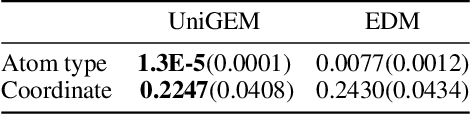


Molecular generation and molecular property prediction are both crucial for drug discovery, but they are often developed independently. Inspired by recent studies, which demonstrate that diffusion model, a prominent generative approach, can learn meaningful data representations that enhance predictive tasks, we explore the potential for developing a unified generative model in the molecular domain that effectively addresses both molecular generation and property prediction tasks. However, the integration of these tasks is challenging due to inherent inconsistencies, making simple multi-task learning ineffective. To address this, we propose UniGEM, the first unified model to successfully integrate molecular generation and property prediction, delivering superior performance in both tasks. Our key innovation lies in a novel two-phase generative process, where predictive tasks are activated in the later stages, after the molecular scaffold is formed. We further enhance task balance through innovative training strategies. Rigorous theoretical analysis and comprehensive experiments demonstrate our significant improvements in both tasks. The principles behind UniGEM hold promise for broader applications, including natural language processing and computer vision.