 Add to Chrome
 Add to Firefox
 Add to Edge
Tuna-2: Pixel Embeddings Beat Vision Encoders for Multimodal Understanding and Generation
Apr 27, 2026
Unified multimodal models typically rely on pretrained vision encoders and use separate visual representations for understanding and generation, creating misalignment between the two tasks and preventing fully end-to-end optimization from raw pixels. We introduce Tuna-2, a native unified multimodal model that performs visual understanding and generation directly based on pixel embeddings. Tuna-2 drastically simplifies the model architecture by employing simple patch embedding layers to encode visual input, completely discarding the modular vision encoder designs such as the VAE or the representation encoder. Experiments show that Tuna-2 achieves state-of-the-art performance in multimodal benchmarks, demonstrating that unified pixel-space modelling can fully compete with latent-space approaches for high-quality image generation. Moreover, while the encoder-based variant converges faster in early pretraining, Tuna-2's encoder-free design achieves stronger multimodal understanding at scale, particularly on tasks requiring fine-grained visual perception. These results show that pretrained vision encoders are not necessary for multimodal modelling, and end-to-end pixel-space learning offers a scalable path toward stronger visual representations for both generation and perception.

RationalRewards: Reasoning Rewards Scale Visual Generation Both Training and Test Time
Apr 14, 2026Most reward models for visual generation reduce rich human judgments to a single unexplained score, discarding the reasoning that underlies preference. We show that teaching reward models to produce explicit, multi-dimensional critiques before scoring transforms them from passive evaluators into active optimization tools, improving generators in two complementary ways: at training time, structured rationales provide interpretable, fine-grained rewards for reinforcement learning; at test time, a Generate-Critique-Refine loop turns critiques into targeted prompt revisions that improve outputs without any parameter updates. To train such a reward model without costly rationale annotations, we introduce Preference-Anchored Rationalization (PARROT), a principled framework that recovers high-quality rationales from readily available preference data through anchored generation, consistency filtering, and distillation. The resulting model, RationalRewards (8B), achieves state-of-the-art preference prediction among open-source reward models, competitive with Gemini-2.5-Pro, while using 10-20x less training data than comparable baselines. As an RL reward, it consistently improves text-to-image and image-editing generators beyond scalar alternatives. Most strikingly, its test-time critique-and-refine loop matches or exceeds RL-based fine-tuning on several benchmarks, suggesting that structured reasoning can unlock latent capabilities in existing generators that suboptimal prompts fail to elicit.
VecGlypher: Unified Vector Glyph Generation with Language Models
Feb 25, 2026Vector glyphs are the atomic units of digital typography, yet most learning-based pipelines still depend on carefully curated exemplar sheets and raster-to-vector postprocessing, which limits accessibility and editability. We introduce VecGlypher, a single multimodal language model that generates high-fidelity vector glyphs directly from text descriptions or image exemplars. Given a style prompt, optional reference glyph images, and a target character, VecGlypher autoregressively emits SVG path tokens, avoiding raster intermediates and producing editable, watertight outlines in one pass. A typography-aware data and training recipe makes this possible: (i) a large-scale continuation stage on 39K noisy Envato fonts to master SVG syntax and long-horizon geometry, followed by (ii) post-training on 2.5K expert-annotated Google Fonts with descriptive tags and exemplars to align language and imagery with geometry; preprocessing normalizes coordinate frames, canonicalizes paths, de-duplicates families, and quantizes coordinates for stable long-sequence decoding. On cross-family OOD evaluation, VecGlypher substantially outperforms both general-purpose LLMs and specialized vector-font baselines for text-only generation, while image-referenced generation reaches a state-of-the-art performance, with marked gains over DeepVecFont-v2 and DualVector. Ablations show that model scale and the two-stage recipe are critical and that absolute-coordinate serialization yields the best geometry. VecGlypher lowers the barrier to font creation by letting users design with words or exemplars, and provides a scalable foundation for future multimodal design tools.
HiStream: Efficient High-Resolution Video Generation via Redundancy-Eliminated Streaming
Dec 24, 2025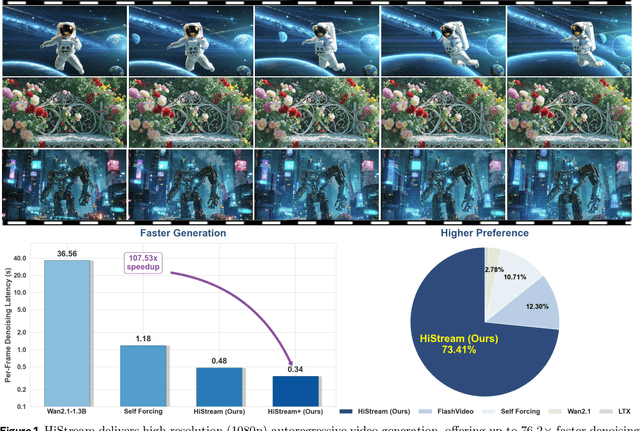
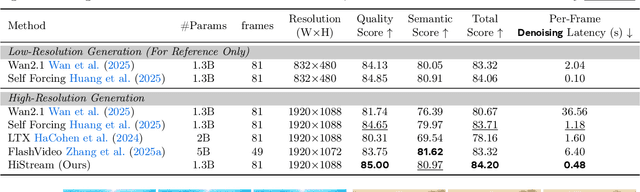
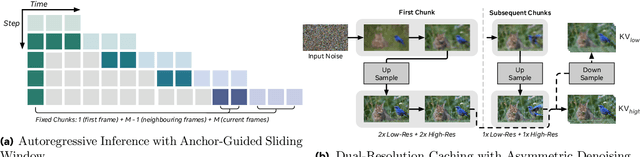
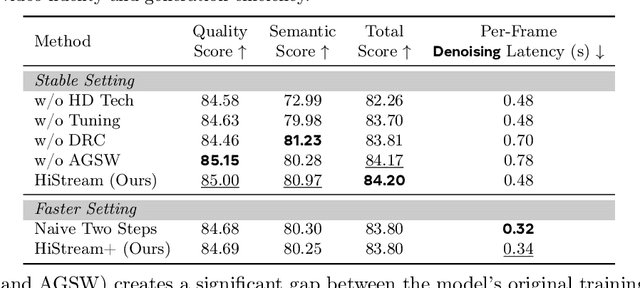
High-resolution video generation, while crucial for digital media and film, is computationally bottlenecked by the quadratic complexity of diffusion models, making practical inference infeasible. To address this, we introduce HiStream, an efficient autoregressive framework that systematically reduces redundancy across three axes: i) Spatial Compression: denoising at low resolution before refining at high resolution with cached features; ii) Temporal Compression: a chunk-by-chunk strategy with a fixed-size anchor cache, ensuring stable inference speed; and iii) Timestep Compression: applying fewer denoising steps to subsequent, cache-conditioned chunks. On 1080p benchmarks, our primary HiStream model (i+ii) achieves state-of-the-art visual quality while demonstrating up to 76.2x faster denoising compared to the Wan2.1 baseline and negligible quality loss. Our faster variant, HiStream+, applies all three optimizations (i+ii+iii), achieving a 107.5x acceleration over the baseline, offering a compelling trade-off between speed and quality, thereby making high-resolution video generation both practical and scalable.
OneStory: Coherent Multi-Shot Video Generation with Adaptive Memory
Dec 08, 2025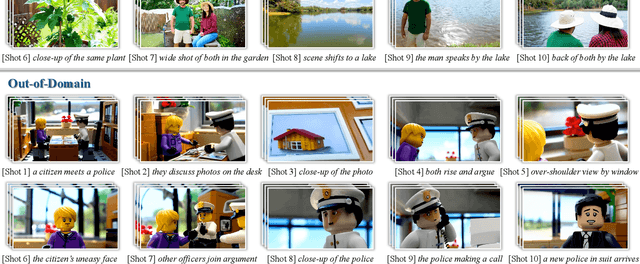
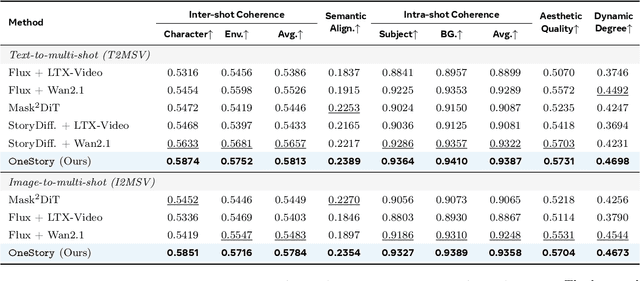
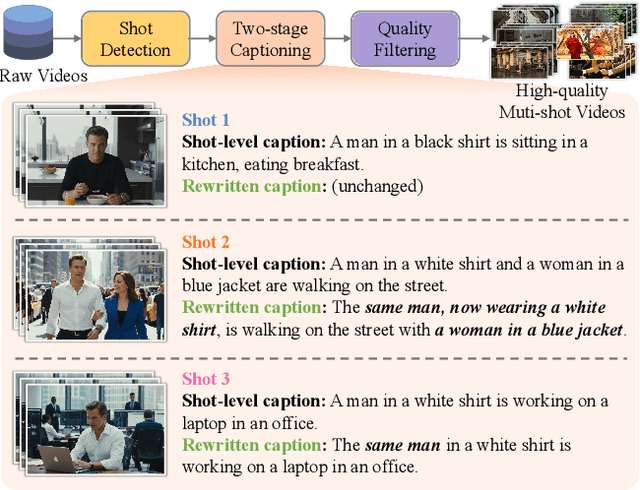

Storytelling in real-world videos often unfolds through multiple shots -- discontinuous yet semantically connected clips that together convey a coherent narrative. However, existing multi-shot video generation (MSV) methods struggle to effectively model long-range cross-shot context, as they rely on limited temporal windows or single keyframe conditioning, leading to degraded performance under complex narratives. In this work, we propose OneStory, enabling global yet compact cross-shot context modeling for consistent and scalable narrative generation. OneStory reformulates MSV as a next-shot generation task, enabling autoregressive shot synthesis while leveraging pretrained image-to-video (I2V) models for strong visual conditioning. We introduce two key modules: a Frame Selection module that constructs a semantically-relevant global memory based on informative frames from prior shots, and an Adaptive Conditioner that performs importance-guided patchification to generate compact context for direct conditioning. We further curate a high-quality multi-shot dataset with referential captions to mirror real-world storytelling patterns, and design effective training strategies under the next-shot paradigm. Finetuned from a pretrained I2V model on our curated 60K dataset, OneStory achieves state-of-the-art narrative coherence across diverse and complex scenes in both text- and image-conditioned settings, enabling controllable and immersive long-form video storytelling.
VideoEval-Pro: Robust and Realistic Long Video Understanding Evaluation
May 20, 2025Large multimodal models (LMMs) have recently emerged as a powerful tool for long video understanding (LVU), prompting the development of standardized LVU benchmarks to evaluate their performance. However, our investigation reveals a rather sober lesson for existing LVU benchmarks. First, most existing benchmarks rely heavily on multiple-choice questions (MCQs), whose evaluation results are inflated due to the possibility of guessing the correct answer; Second, a significant portion of questions in these benchmarks have strong priors to allow models to answer directly without even reading the input video. For example, Gemini-1.5-Pro can achieve over 50\% accuracy given a random frame from a long video on Video-MME. We also observe that increasing the number of frames does not necessarily lead to improvement on existing benchmarks, which is counterintuitive. As a result, the validity and robustness of current LVU benchmarks are undermined, impeding a faithful assessment of LMMs' long-video understanding capability. To tackle this problem, we propose VideoEval-Pro, a realistic LVU benchmark containing questions with open-ended short-answer, which truly require understanding the entire video. VideoEval-Pro assesses both segment-level and full-video understanding through perception and reasoning tasks. By evaluating 21 proprietary and open-source video LMMs, we conclude the following findings: (1) video LMMs show drastic performance ($>$25\%) drops on open-ended questions compared with MCQs; (2) surprisingly, higher MCQ scores do not lead to higher open-ended scores on VideoEval-Pro; (3) compared to other MCQ benchmarks, VideoEval-Pro benefits more from increasing the number of input frames. Our results show that VideoEval-Pro offers a more realistic and reliable measure of long video understanding, providing a clearer view of progress in this domain.
Vamba: Understanding Hour-Long Videos with Hybrid Mamba-Transformers
Mar 14, 2025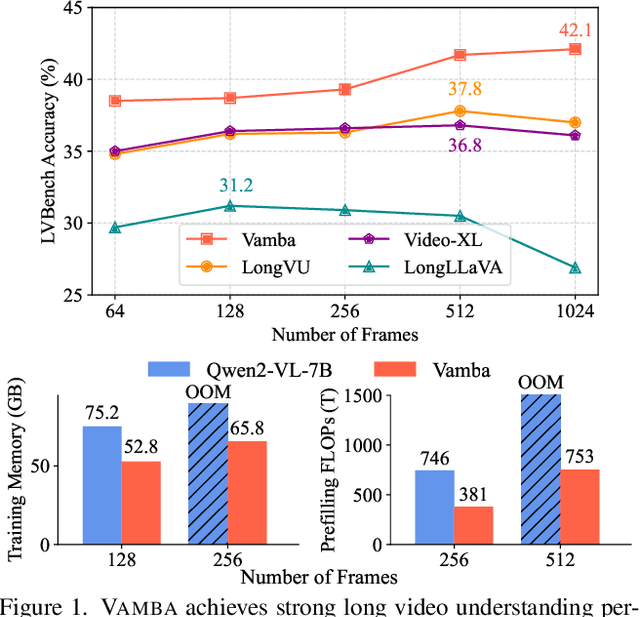

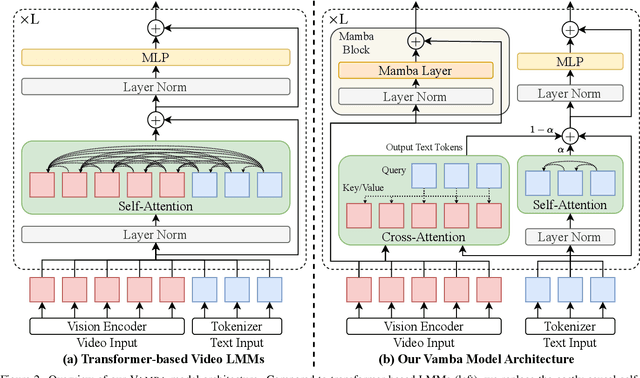
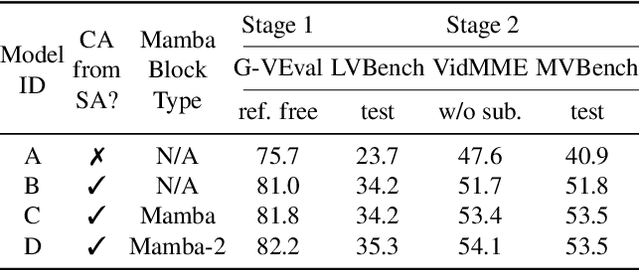
State-of-the-art transformer-based large multimodal models (LMMs) struggle to handle hour-long video inputs due to the quadratic complexity of the causal self-attention operations, leading to high computational costs during training and inference. Existing token compression-based methods reduce the number of video tokens but often incur information loss and remain inefficient for extremely long sequences. In this paper, we explore an orthogonal direction to build a hybrid Mamba-Transformer model (VAMBA) that employs Mamba-2 blocks to encode video tokens with linear complexity. Without any token reduction, VAMBA can encode more than 1024 frames (640$\times$360) on a single GPU, while transformer-based models can only encode 256 frames. On long video input, VAMBA achieves at least 50% reduction in GPU memory usage during training and inference, and nearly doubles the speed per training step compared to transformer-based LMMs. Our experimental results demonstrate that VAMBA improves accuracy by 4.3% on the challenging hour-long video understanding benchmark LVBench over prior efficient video LMMs, and maintains strong performance on a broad spectrum of long and short video understanding tasks.
VISTA: Enhancing Long-Duration and High-Resolution Video Understanding by Video Spatiotemporal Augmentation
Dec 01, 2024


Current large multimodal models (LMMs) face significant challenges in processing and comprehending long-duration or high-resolution videos, which is mainly due to the lack of high-quality datasets. To address this issue from a data-centric perspective, we propose VISTA, a simple yet effective Video Spatiotemporal Augmentation framework that synthesizes long-duration and high-resolution video instruction-following pairs from existing video-caption datasets. VISTA spatially and temporally combines videos to create new synthetic videos with extended durations and enhanced resolutions, and subsequently produces question-answer pairs pertaining to these newly synthesized videos. Based on this paradigm, we develop seven video augmentation methods and curate VISTA-400K, a video instruction-following dataset aimed at enhancing long-duration and high-resolution video understanding. Finetuning various video LMMs on our data resulted in an average improvement of 3.3% across four challenging benchmarks for long-video understanding. Furthermore, we introduce the first comprehensive high-resolution video understanding benchmark HRVideoBench, on which our finetuned models achieve a 6.5% performance gain. These results highlight the effectiveness of our framework.
OmniEdit: Building Image Editing Generalist Models Through Specialist Supervision
Nov 11, 2024
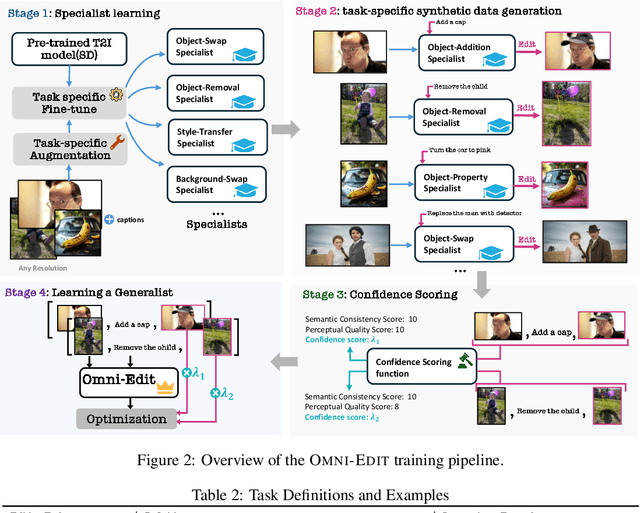

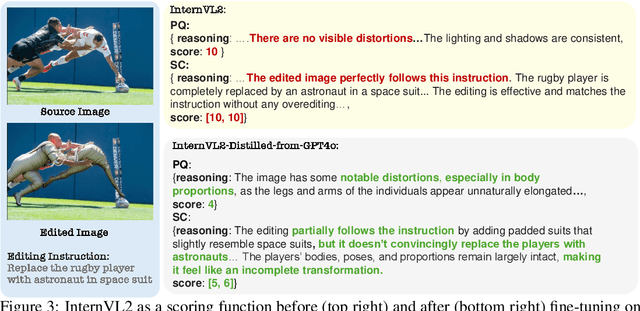
Instruction-guided image editing methods have demonstrated significant potential by training diffusion models on automatically synthesized or manually annotated image editing pairs. However, these methods remain far from practical, real-life applications. We identify three primary challenges contributing to this gap. Firstly, existing models have limited editing skills due to the biased synthesis process. Secondly, these methods are trained with datasets with a high volume of noise and artifacts. This is due to the application of simple filtering methods like CLIP-score. Thirdly, all these datasets are restricted to a single low resolution and fixed aspect ratio, limiting the versatility to handle real-world use cases. In this paper, we present \omniedit, which is an omnipotent editor to handle seven different image editing tasks with any aspect ratio seamlessly. Our contribution is in four folds: (1) \omniedit is trained by utilizing the supervision from seven different specialist models to ensure task coverage. (2) we utilize importance sampling based on the scores provided by large multimodal models (like GPT-4o) instead of CLIP-score to improve the data quality. (3) we propose a new editing architecture called EditNet to greatly boost the editing success rate, (4) we provide images with different aspect ratios to ensure that our model can handle any image in the wild. We have curated a test set containing images of different aspect ratios, accompanied by diverse instructions to cover different tasks. Both automatic evaluation and human evaluations demonstrate that \omniedit can significantly outperform all the existing models. Our code, dataset and model will be available at \url{https://tiger-ai-lab.github.io/OmniEdit/}
MMLU-Pro: A More Robust and Challenging Multi-Task Language Understanding Benchmark
Jun 04, 2024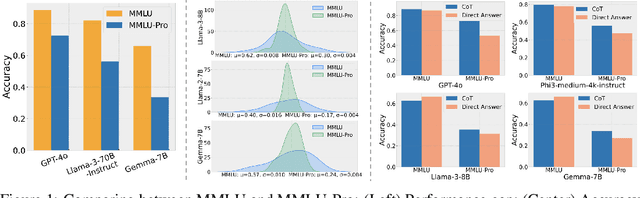

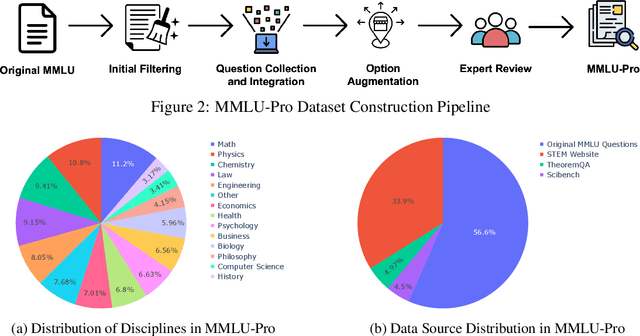
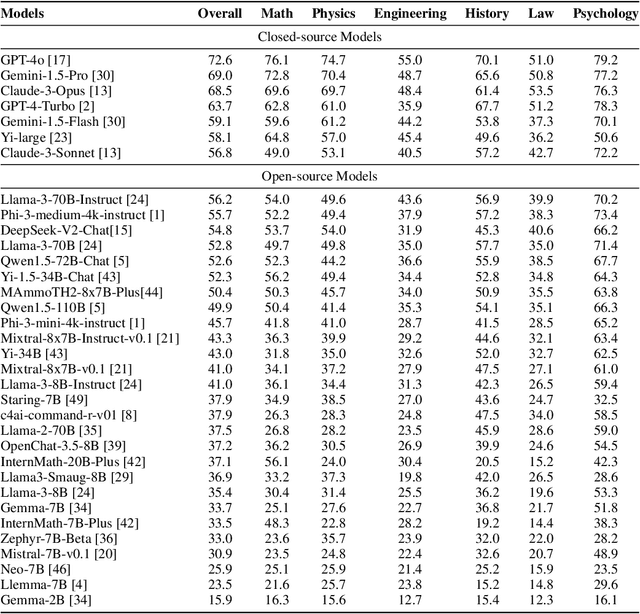
In the age of large-scale language models, benchmarks like the Massive Multitask Language Understanding (MMLU) have been pivotal in pushing the boundaries of what AI can achieve in language comprehension and reasoning across diverse domains. However, as models continue to improve, their performance on these benchmarks has begun to plateau, making it increasingly difficult to discern differences in model capabilities. This paper introduces MMLU-Pro, an enhanced dataset designed to extend the mostly knowledge-driven MMLU benchmark by integrating more challenging, reasoning-focused questions and expanding the choice set from four to ten options. Additionally, MMLU-Pro eliminates the trivial and noisy questions in MMLU. Our experimental results show that MMLU-Pro not only raises the challenge, causing a significant drop in accuracy by 16% to 33% compared to MMLU but also demonstrates greater stability under varying prompts. With 24 different prompt styles tested, the sensitivity of model scores to prompt variations decreased from 4-5% in MMLU to just 2% in MMLU-Pro. Additionally, we found that models utilizing Chain of Thought (CoT) reasoning achieved better performance on MMLU-Pro compared to direct answering, which is in stark contrast to the findings on the original MMLU, indicating that MMLU-Pro includes more complex reasoning questions. Our assessments confirm that MMLU-Pro is a more discriminative benchmark to better track progress in the field.