 Add to Chrome
 Add to Firefox
 Add to Edge
Learning Domain Agnostic Latent Embeddings of 3D Faces for Zero-shot Animal Expression Transfer
Jan 10, 2026
We present a zero-shot framework for transferring human facial expressions to 3D animal face meshes. Our method combines intrinsic geometric descriptors (HKS/WKS) with a mesh-agnostic latent embedding that disentangles facial identity and expression. The ID latent space captures species-independent facial structure, while the expression latent space encodes deformation patterns that generalize across humans and animals. Trained only with human expression pairs, the model learns the embeddings, decoupling, and recoupling of cross-identity expressions, enabling expression transfer without requiring animal expression data. To enforce geometric consistency, we employ Jacobian loss together with vertex-position and Laplacian losses. Experiments show that our approach achieves plausible cross-species expression transfer, effectively narrowing the geometric gap between human and animal facial shapes.

InfiniDepth: Arbitrary-Resolution and Fine-Grained Depth Estimation with Neural Implicit Fields
Jan 06, 2026Existing depth estimation methods are fundamentally limited to predicting depth on discrete image grids. Such representations restrict their scalability to arbitrary output resolutions and hinder the geometric detail recovery. This paper introduces InfiniDepth, which represents depth as neural implicit fields. Through a simple yet effective local implicit decoder, we can query depth at continuous 2D coordinates, enabling arbitrary-resolution and fine-grained depth estimation. To better assess our method's capabilities, we curate a high-quality 4K synthetic benchmark from five different games, spanning diverse scenes with rich geometric and appearance details. Extensive experiments demonstrate that InfiniDepth achieves state-of-the-art performance on both synthetic and real-world benchmarks across relative and metric depth estimation tasks, particularly excelling in fine-detail regions. It also benefits the task of novel view synthesis under large viewpoint shifts, producing high-quality results with fewer holes and artifacts.
CREPES-X: Hierarchical Bearing-Distance-Inertial Direct Cooperative Relative Pose Estimation System
Dec 31, 2025Relative localization is critical for cooperation in autonomous multi-robot systems. Existing approaches either rely on shared environmental features or inertial assumptions or suffer from non-line-of-sight degradation and outliers in complex environments. Robust and efficient fusion of inter-robot measurements such as bearings, distances, and inertials for tens of robots remains challenging. We present CREPES-X (Cooperative RElative Pose Estimation System with multiple eXtended features), a hierarchical relative localization framework that enhances speed, accuracy, and robustness under challenging conditions, without requiring any global information. CREPES-X starts with a compact hardware design: InfraRed (IR) LEDs, an IR camera, an ultra-wideband module, and an IMU housed in a cube no larger than 6cm on each side. Then CREPES-X implements a two-stage hierarchical estimator to meet different requirements, considering speed, accuracy, and robustness. First, we propose a single-frame relative estimator that provides instant relative poses for multi-robot setups through a closed-form solution and robust bearing outlier rejection. Then a multi-frame relative estimator is designed to offer accurate and robust relative states by exploring IMU pre-integration via robocentric relative kinematics with loosely- and tightly-coupled optimization. Extensive simulations and real-world experiments validate the effectiveness of CREPES-X, showing robustness to up to 90% bearing outliers, proving resilience in challenging conditions, and achieving RMSE of 0.073m and 1.817° in real-world datasets.
MAI-UI Technical Report: Real-World Centric Foundation GUI Agents
Dec 26, 2025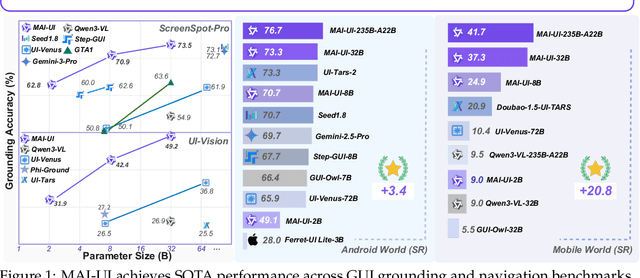
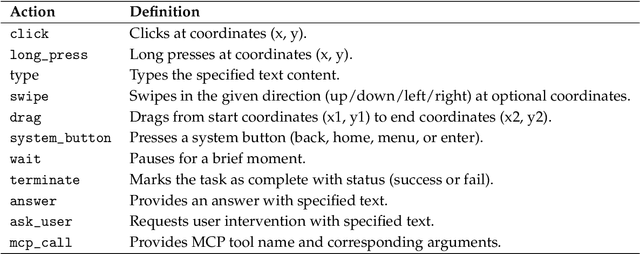
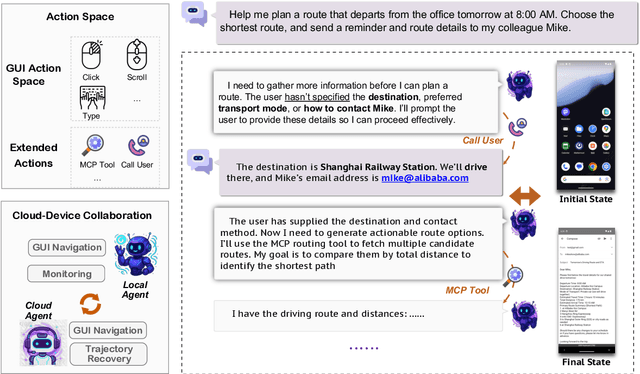
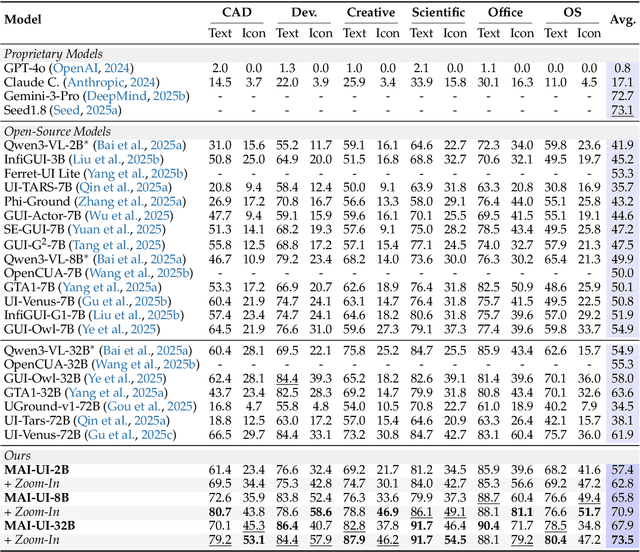
The development of GUI agents could revolutionize the next generation of human-computer interaction. Motivated by this vision, we present MAI-UI, a family of foundation GUI agents spanning the full spectrum of sizes, including 2B, 8B, 32B, and 235B-A22B variants. We identify four key challenges to realistic deployment: the lack of native agent-user interaction, the limits of UI-only operation, the absence of a practical deployment architecture, and brittleness in dynamic environments. MAI-UI addresses these issues with a unified methodology: a self-evolving data pipeline that expands the navigation data to include user interaction and MCP tool calls, a native device-cloud collaboration system routes execution by task state, and an online RL framework with advanced optimizations to scale parallel environments and context length. MAI-UI establishes new state-of-the-art across GUI grounding and mobile navigation. On grounding benchmarks, it reaches 73.5% on ScreenSpot-Pro, 91.3% on MMBench GUI L2, 70.9% on OSWorld-G, and 49.2% on UI-Vision, surpassing Gemini-3-Pro and Seed1.8 on ScreenSpot-Pro. On mobile GUI navigation, it sets a new SOTA of 76.7% on AndroidWorld, surpassing UI-Tars-2, Gemini-2.5-Pro and Seed1.8. On MobileWorld, MAI-UI obtains 41.7% success rate, significantly outperforming end-to-end GUI models and competitive with Gemini-3-Pro based agentic frameworks. Our online RL experiments show significant gains from scaling parallel environments from 32 to 512 (+5.2 points) and increasing environment step budget from 15 to 50 (+4.3 points). Finally, the native device-cloud collaboration system improves on-device performance by 33%, reduces cloud model calls by over 40%, and preserves user privacy.
ETP-R1: Evolving Topological Planning with Reinforcement Fine-tuning for Vision-Language Navigation in Continuous Environments
Dec 24, 2025Vision-Language Navigation in Continuous Environments (VLN-CE) requires an embodied agent to navigate towards target in continuous environments, following natural language instructions. While current graph-based methods offer an efficient, structured approach by abstracting the environment into a topological map and simplifying the action space to waypoint selection, they lag behind methods based on Large Vision-Language Models (LVLMs) in leveraging large-scale data and advanced training paradigms. In this paper, we try to bridge this gap by introducing ETP-R1, a framework that applies the paradigm of scaling up data and Reinforcement Fine-Tuning (RFT) to a graph-based VLN-CE model. To build a strong foundation, we first construct a high-quality, large-scale pretraining dataset using the Gemini API. This dataset consists of diverse, low-hallucination instructions for topological trajectories, providing rich supervision for our graph-based policy to map language to topological paths. This foundation is further strengthened by unifying data from both R2R and RxR tasks for joint pretraining. Building on this, we introduce a three-stage training paradigm, which culminates in the first application of closed-loop, online RFT to a graph-based VLN-CE model, powered by the Group Relative Policy Optimization (GRPO) algorithm. Extensive experiments demonstrate that our approach is highly effective, establishing new state-of-the-art performance across all major metrics on both the R2R-CE and RxR-CE benchmarks. Our code is available at https://github.com/Cepillar/ETP-R1.
Seedance 1.5 pro: A Native Audio-Visual Joint Generation Foundation Model
Dec 23, 2025Recent strides in video generation have paved the way for unified audio-visual generation. In this work, we present Seedance 1.5 pro, a foundational model engineered specifically for native, joint audio-video generation. Leveraging a dual-branch Diffusion Transformer architecture, the model integrates a cross-modal joint module with a specialized multi-stage data pipeline, achieving exceptional audio-visual synchronization and superior generation quality. To ensure practical utility, we implement meticulous post-training optimizations, including Supervised Fine-Tuning (SFT) on high-quality datasets and Reinforcement Learning from Human Feedback (RLHF) with multi-dimensional reward models. Furthermore, we introduce an acceleration framework that boosts inference speed by over 10X. Seedance 1.5 pro distinguishes itself through precise multilingual and dialect lip-syncing, dynamic cinematic camera control, and enhanced narrative coherence, positioning it as a robust engine for professional-grade content creation. Seedance 1.5 pro is now accessible on Volcano Engine at https://console.volcengine.com/ark/region:ark+cn-beijing/experience/vision?type=GenVideo.
Scaling Online Distributionally Robust Reinforcement Learning: Sample-Efficient Guarantees with General Function Approximation
Dec 22, 2025The deployment of reinforcement learning (RL) agents in real-world applications is often hindered by performance degradation caused by mismatches between training and deployment environments. Distributionally robust RL (DR-RL) addresses this issue by optimizing worst-case performance over an uncertainty set of transition dynamics. However, existing work typically relies on substantial prior knowledge-such as access to a generative model or a large offline dataset-and largely focuses on tabular methods that do not scale to complex domains. We overcome these limitations by proposing an online DR-RL algorithm with general function approximation that learns an optimal robust policy purely through interaction with the environment, without requiring prior models or offline data, enabling deployment in high-dimensional tasks. We further provide a theoretical analysis establishing a near-optimal sublinear regret bound under a total variation uncertainty set, demonstrating the sample efficiency and effectiveness of our method.
MobileWorld: Benchmarking Autonomous Mobile Agents in Agent-User Interactive, and MCP-Augmented Environments
Dec 22, 2025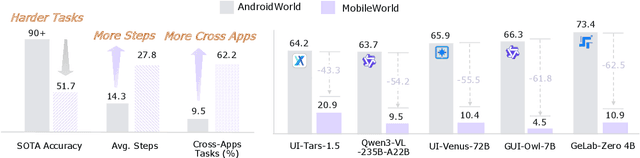
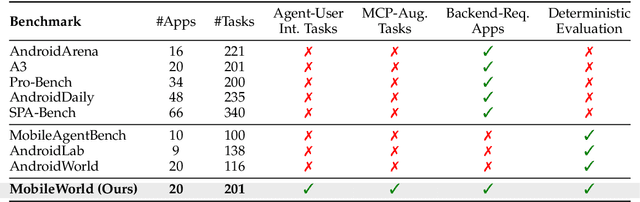
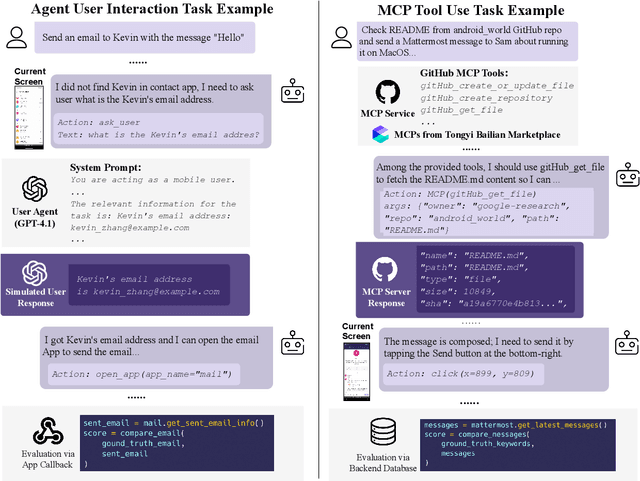

Among existing online mobile-use benchmarks, AndroidWorld has emerged as the dominant benchmark due to its reproducible environment and deterministic evaluation; however, recent agents achieving over 90% success rates indicate its saturation and motivate the need for a more challenging benchmark. In addition, its environment lacks key application categories, such as e-commerce and enterprise communication, and does not reflect realistic mobile-use scenarios characterized by vague user instructions and hybrid tool usage. To bridge this gap, we introduce MobileWorld, a substantially more challenging benchmark designed to better reflect real-world mobile usage, comprising 201 tasks across 20 applications, while maintaining the same level of reproducible evaluation as AndroidWorld. The difficulty of MobileWorld is twofold. First, it emphasizes long-horizon tasks with cross-application interactions: MobileWorld requires nearly twice as many task-completion steps on average (27.8 vs. 14.3) and includes far more multi-application tasks (62.2% vs. 9.5%) compared to AndroidWorld. Second, MobileWorld extends beyond standard GUI manipulation by introducing novel task categories, including agent-user interaction and MCP-augmented tasks. To ensure robust evaluation, we provide snapshot-based container environment and precise functional verifications, including backend database inspection and task callback APIs. We further develop a planner-executor agentic framework with extended action spaces to support user interactions and MCP calls. Our results reveal a sharp performance drop compared to AndroidWorld, with the best agentic framework and end-to-end model achieving 51.7% and 20.9% success rates, respectively. Our analysis shows that current models struggle significantly with user interaction and MCP calls, offering a strategic roadmap toward more robust, next-generation mobile intelligence.
PolaRiS: Scalable Real-to-Sim Evaluations for Generalist Robot Policies
Dec 18, 2025A significant challenge for robot learning research is our ability to accurately measure and compare the performance of robot policies. Benchmarking in robotics is historically challenging due to the stochasticity, reproducibility, and time-consuming nature of real-world rollouts. This challenge is exacerbated for recent generalist policies, which has to be evaluated across a wide variety of scenes and tasks. Evaluation in simulation offers a scalable complement to real world evaluations, but the visual and physical domain gap between existing simulation benchmarks and the real world has made them an unreliable signal for policy improvement. Furthermore, building realistic and diverse simulated environments has traditionally required significant human effort and expertise. To bridge the gap, we introduce Policy Evaluation and Environment Reconstruction in Simulation (PolaRiS), a scalable real-to-sim framework for high-fidelity simulated robot evaluation. PolaRiS utilizes neural reconstruction methods to turn short video scans of real-world scenes into interactive simulation environments. Additionally, we develop a simple simulation data co-training recipe that bridges remaining real-to-sim gaps and enables zero-shot evaluation in unseen simulation environments. Through extensive paired evaluations between simulation and the real world, we demonstrate that PolaRiS evaluations provide a much stronger correlation to real world generalist policy performance than existing simulated benchmarks. Its simplicity also enables rapid creation of diverse simulated environments. As such, this work takes a step towards distributed and democratized evaluation for the next generation of robotic foundation models.
Towards Efficient and Effective Multi-Camera Encoding for End-to-End Driving
Dec 12, 2025We present Flex, an efficient and effective scene encoder that addresses the computational bottleneck of processing high-volume multi-camera data in end-to-end autonomous driving. Flex employs a small set of learnable scene tokens to jointly encode information from all image tokens across different cameras and timesteps. By design, our approach is geometry-agnostic, learning a compact scene representation directly from data without relying on the explicit 3D inductive biases, such as Bird-Eye-View (BEV), occupancy or tri-plane representations, which are common in prior work. This holistic encoding strategy aggressively compresses the visual input for the downstream Large Language Model (LLM) based policy model. Evaluated on a large-scale proprietary dataset of 20,000 driving hours, our Flex achieves 2.2x greater inference throughput while improving driving performance by a large margin compared to state-of-the-art methods. Furthermore, we show that these compact scene tokens develop an emergent capability for scene decomposition without any explicit supervision. Our findings challenge the prevailing assumption that 3D priors are necessary, demonstrating that a data-driven, joint encoding strategy offers a more scalable, efficient and effective path for future autonomous driving systems.