 Add to Chrome
 Add to Firefox
 Add to Edge
Qwen-UI-Agent Technical Report: Toward Next-Generation Real-World Centric Foundation GUI Agents
Jul 30, 2026
GUI agents have the potential to become a general purpose executor over existing digital devices. To advance them toward real-world use, we envision agents that operate reliably on real devices, execute workflows across platforms, combine GUI interaction with CLI execution, complete long-horizon tasks, proactively initiate useful services, and autonomously improve their capabilities with minimal human effort. Guided by this vision, we present Qwen-UI-Agent, a real-world centric foundation GUI agent spanning mobile, computer-use, web, and DeepSearch environments. Qwen-UI-Agent combines diverse sandbox environments with a large-scale real-device mobile runtime. Its unified action space interleaves GUI operations with CLI execution and generates batched actions in a single model turn. An AutoResearch-style data flywheel uses agents to construct tasks and environments, diagnose failures, and plan subsequent iterations. Online RL supports training on trajectories exceeding 100 turns, with over 10,000 concurrent environments accelerating rollout. A lightweight harness layer supports proactive service initiation and stateful workflows across mobile and computer. Across a broad suite of evaluations, Qwen-UI-Agent sets state-of-the-art performance on mobile-use benchmarks while delivering competitive performance on computer- and browser-use tasks against frontier models, including Opus 4.8, Gemini 3.1 Pro, and GPT-5.6 Sol. On mobile use, it achieves 82.1% on MobileWorld, 92.2% on MobileWorld-Real, and 97.5% on AndroidDaily. On computer use, it achieves 79.5% on OSWorld-Verified and a 40.0% partial-progress score on OSWorld-v2. On browser use and GUI grounding, it achieves 73.6% on WebArena and 81.5% on ScreenSpot-Pro, respectively.

What Memory Do GUI Agents Really Need? From Passive Records to Active Task-Driving States
Jun 30, 2026Mobile GUI agents increasingly face long-horizon tasks that require reading, updating, and reusing task-relevant data across pages and applications. Existing memory methods treat memory largely as passive storage, where past observations are accumulated and retrieved when needed. Yet retrieving a value does not reveal its current role in the workflow. The agent must still infer from accumulated records whether the value should be used now, has already been used, or must wait for a later dependency. This implicit reconstruction becomes unreliable in long trajectories with similar fields, repeated values, distractors, and outdated states, causing repeated or missed operations. We propose Active Task Driving Memory (ATMem), which shifts GUI-agent memory from passive storage to an actively maintained execution state. ATMem maintains task-relevant information as a continually updated execution state that links each value to its role and current status, enabling action selection based on the current workflow state. We therefore introduce \textbf{STR-GRPO}, an online reinforcement learning method that learns to use ATMem selectively according to its contribution to task completion. STR-GRPO contrasts memory-on and memory-off rollouts to estimate when memory use improves execution, while memory-cost-aware reward discourages costly memory usage that does not improve execution. To evaluate whether agents can complete all in-scope work while avoiding out-of-scope actions over long-horizon execution, we build a challenging mobile benchmark. From a list of near identical entries, agents must act on every entry that satisfies the instruction and reject entries that violate its constraints.
One Forward Beats Two: InnerZoom for Accurate and Efficient GUI Grounding
Jun 29, 2026MLLM-based GUI grounding methods commonly formulate target localization as autoregressive coordinate generation, enabling models to leverage the strong instruction-following and semantic understanding capabilities of MLLMs. However, this formulation requires the model to retain region-level target evidence while decoding coordinate tokens with the spatial precision demanded by GUI clicking. Our diagnostic analysis reveals that target-region awareness emerges in intermediate decoder layers but is neither retained nor translated into the final coordinate prediction. Existing ZoomIn-style methods address this issue through an external crop-and-rerun pass, which improves localization but increases end-to-end latency and computational cost. To retain the accuracy benefits of two-pass zooming without this extra cost, we propose InnerZoom, a single-forward framework for cross-layer evidence bridging. InnerZoom transforms target-related cues from the original forward pass into a compact cross-layer evidence state, then preserves, refines, and reinjects this state throughout later decoding layers to guide coordinate prediction. Extensive experimental results suggest that InnerZoom-4B achieves state-of-the-art performance on all six GUI grounding benchmarks, obtaining 64.7 on OSWorld-G, 40.2 on UI-Vision, 73.1 on OSWorld-GR, and 87.6 on MMBench-GUI, surpassing the previous best results by 4.1, 3.2, 2.9, and 2.3 points, respectively. Under a controlled 4B setting, InnerZoom improves the same SFT+RL baseline by 5.3 points on average and outperforms two-pass ZoomIn by 1.3 points on average, while reducing end-to-end latency by up to 31.8% and TFLOPs by about 29%. Code and models will be publicly available.
Fine-Grained Activation Steering: Steering Less, Achieving More
Feb 04, 2026Activation steering has emerged as a cost-effective paradigm for modifying large language model (LLM) behaviors. Existing methods typically intervene at the block level, steering the bundled activations of selected attention heads, feedforward networks, or residual streams. However, we reveal that block-level activations are inherently heterogeneous, entangling beneficial, irrelevant, and harmful features, thereby rendering block-level steering coarse, inefficient, and intrusive. To investigate the root cause, we decompose block activations into fine-grained atomic unit (AU)-level activations, where each AU-level activation corresponds to a single dimension of the block activation, and each AU denotes a slice of the block weight matrix. Steering an AU-level activation is thus equivalent to steering its associated AU. Our theoretical and empirical analysis show that heterogeneity arises because different AUs or dimensions control distinct token distributions in LLM outputs. Hence, block-level steering inevitably moves helpful and harmful token directions together, which reduces efficiency. Restricting intervention to beneficial AUs yields more precise and effective steering. Building on this insight, we propose AUSteer, a simple and efficient method that operates at a finer granularity of the AU level. AUSteer first identifies discriminative AUs globally by computing activation momenta on contrastive samples. It then assigns adaptive steering strengths tailored to diverse inputs and selected AU activations. Comprehensive experiments on multiple LLMs and tasks show that AUSteer consistently surpasses advanced baselines while steering considerably fewer activations, demonstrating that steering less achieves more.
MAI-UI Technical Report: Real-World Centric Foundation GUI Agents
Dec 26, 2025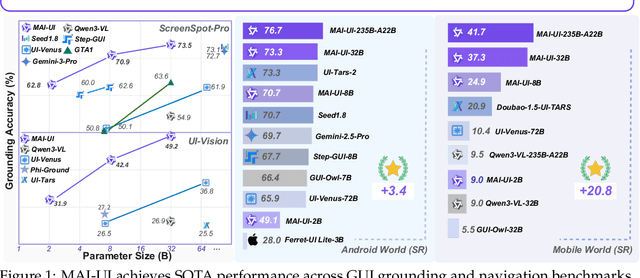
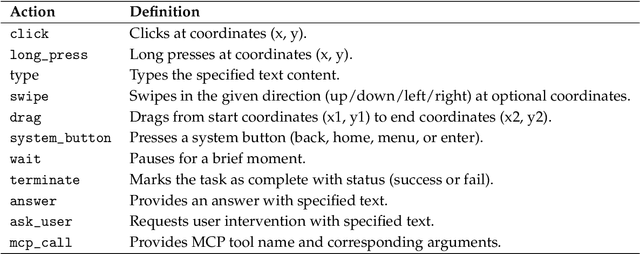
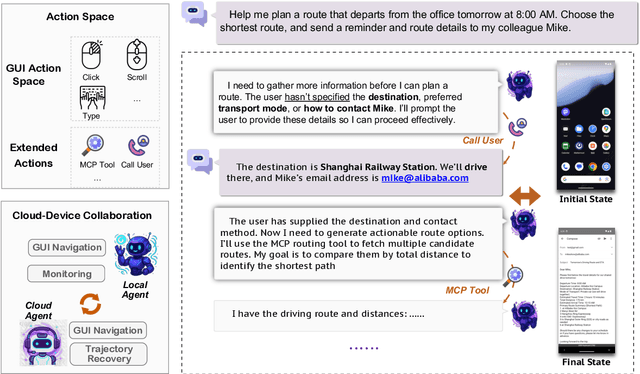
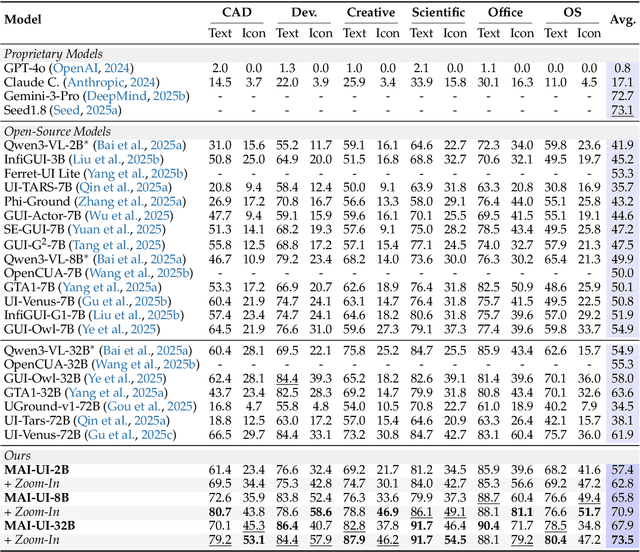
The development of GUI agents could revolutionize the next generation of human-computer interaction. Motivated by this vision, we present MAI-UI, a family of foundation GUI agents spanning the full spectrum of sizes, including 2B, 8B, 32B, and 235B-A22B variants. We identify four key challenges to realistic deployment: the lack of native agent-user interaction, the limits of UI-only operation, the absence of a practical deployment architecture, and brittleness in dynamic environments. MAI-UI addresses these issues with a unified methodology: a self-evolving data pipeline that expands the navigation data to include user interaction and MCP tool calls, a native device-cloud collaboration system routes execution by task state, and an online RL framework with advanced optimizations to scale parallel environments and context length. MAI-UI establishes new state-of-the-art across GUI grounding and mobile navigation. On grounding benchmarks, it reaches 73.5% on ScreenSpot-Pro, 91.3% on MMBench GUI L2, 70.9% on OSWorld-G, and 49.2% on UI-Vision, surpassing Gemini-3-Pro and Seed1.8 on ScreenSpot-Pro. On mobile GUI navigation, it sets a new SOTA of 76.7% on AndroidWorld, surpassing UI-Tars-2, Gemini-2.5-Pro and Seed1.8. On MobileWorld, MAI-UI obtains 41.7% success rate, significantly outperforming end-to-end GUI models and competitive with Gemini-3-Pro based agentic frameworks. Our online RL experiments show significant gains from scaling parallel environments from 32 to 512 (+5.2 points) and increasing environment step budget from 15 to 50 (+4.3 points). Finally, the native device-cloud collaboration system improves on-device performance by 33%, reduces cloud model calls by over 40%, and preserves user privacy.
MobileWorld: Benchmarking Autonomous Mobile Agents in Agent-User Interactive, and MCP-Augmented Environments
Dec 22, 2025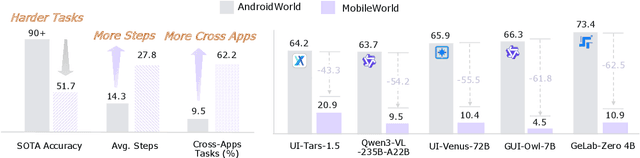
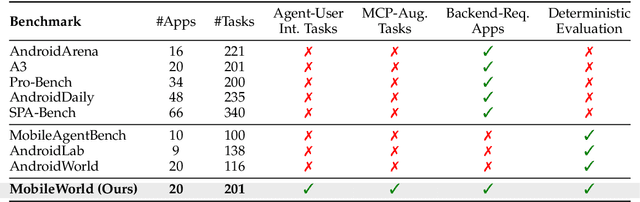
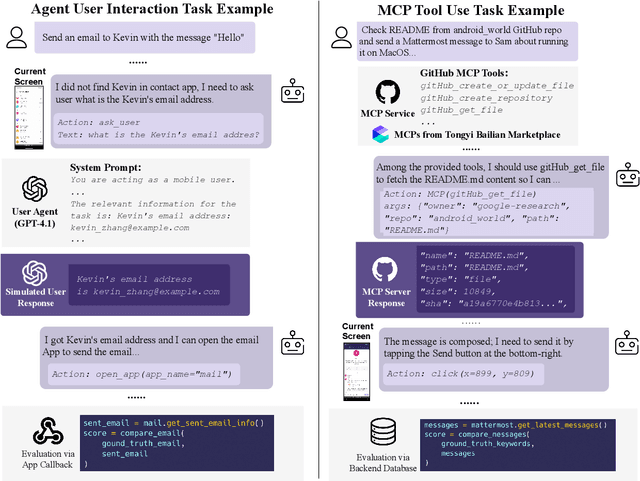

Among existing online mobile-use benchmarks, AndroidWorld has emerged as the dominant benchmark due to its reproducible environment and deterministic evaluation; however, recent agents achieving over 90% success rates indicate its saturation and motivate the need for a more challenging benchmark. In addition, its environment lacks key application categories, such as e-commerce and enterprise communication, and does not reflect realistic mobile-use scenarios characterized by vague user instructions and hybrid tool usage. To bridge this gap, we introduce MobileWorld, a substantially more challenging benchmark designed to better reflect real-world mobile usage, comprising 201 tasks across 20 applications, while maintaining the same level of reproducible evaluation as AndroidWorld. The difficulty of MobileWorld is twofold. First, it emphasizes long-horizon tasks with cross-application interactions: MobileWorld requires nearly twice as many task-completion steps on average (27.8 vs. 14.3) and includes far more multi-application tasks (62.2% vs. 9.5%) compared to AndroidWorld. Second, MobileWorld extends beyond standard GUI manipulation by introducing novel task categories, including agent-user interaction and MCP-augmented tasks. To ensure robust evaluation, we provide snapshot-based container environment and precise functional verifications, including backend database inspection and task callback APIs. We further develop a planner-executor agentic framework with extended action spaces to support user interactions and MCP calls. Our results reveal a sharp performance drop compared to AndroidWorld, with the best agentic framework and end-to-end model achieving 51.7% and 20.9% success rates, respectively. Our analysis shows that current models struggle significantly with user interaction and MCP calls, offering a strategic roadmap toward more robust, next-generation mobile intelligence.
Rethinking Prompt Optimizers: From Prompt Merits to Optimization
May 15, 2025
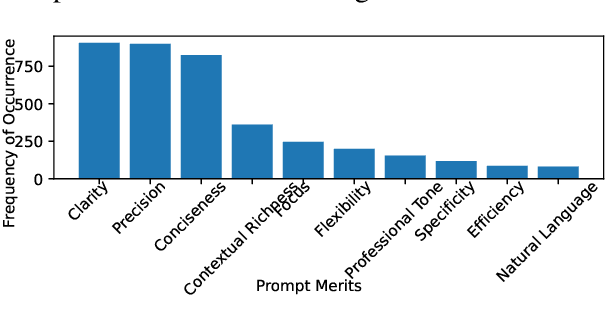
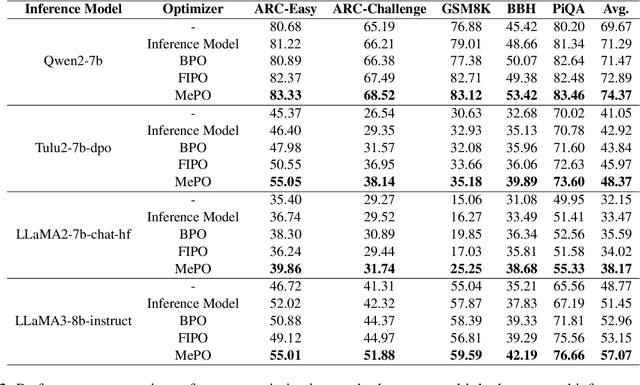
Prompt optimization (PO) offers a practical alternative to fine-tuning large language models (LLMs), enabling performance improvements without altering model weights. Existing methods typically rely on advanced, large-scale LLMs like GPT-4 to generate optimized prompts. However, due to limited downward compatibility, verbose, instruction-heavy prompts from advanced LLMs can overwhelm lightweight inference models and degrade response quality. In this work, we rethink prompt optimization through the lens of interpretable design. We first identify a set of model-agnostic prompt quality merits and empirically validate their effectiveness in enhancing prompt and response quality. We then introduce MePO, a merit-guided, lightweight, and locally deployable prompt optimizer trained on our preference dataset built from merit-aligned prompts generated by a lightweight LLM. Unlike prior work, MePO avoids online optimization reliance, reduces cost and privacy concerns, and, by learning clear, interpretable merits, generalizes effectively to both large-scale and lightweight inference models. Experiments demonstrate that MePO achieves better results across diverse tasks and model types, offering a scalable and robust solution for real-world deployment. Our model and dataset are available at: https://github.com/MidiyaZhu/MePO
Beyond the Next Token: Towards Prompt-Robust Zero-Shot Classification via Efficient Multi-Token Prediction
Apr 04, 2025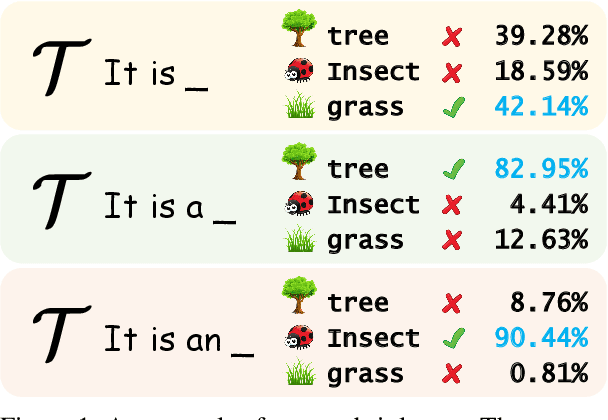
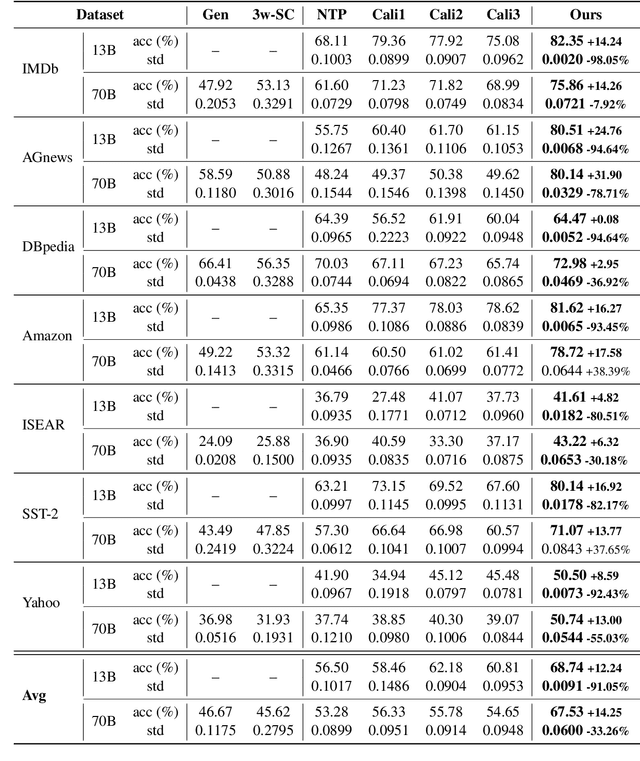
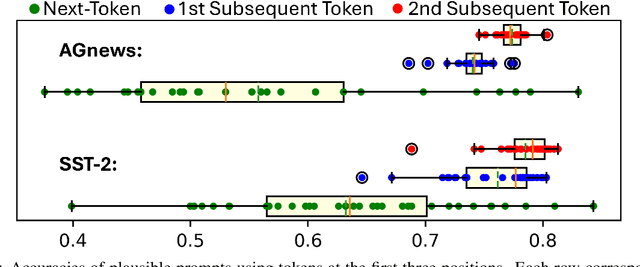
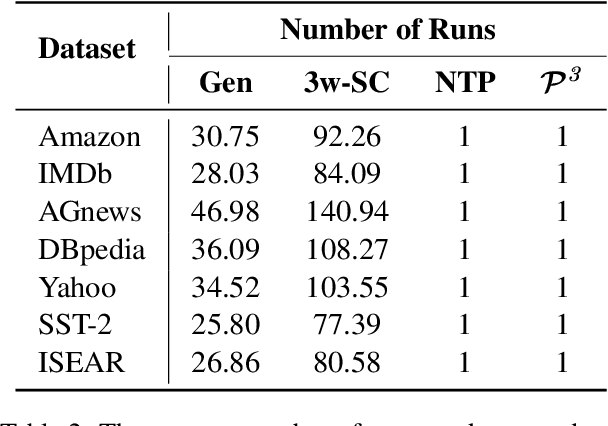
Zero-shot text classification typically relies on prompt engineering, but the inherent prompt brittleness of large language models undermines its reliability. Minor changes in prompt can cause significant discrepancies in model performance. We attribute this prompt brittleness largely to the narrow focus on nexttoken probabilities in existing methods. To address this, we propose Placeholding Parallel Prediction (P3), a novel approach that predicts token probabilities across multiple positions and simulates comprehensive sampling of generation paths in a single run of a language model. Experiments show improved accuracy and up to 98% reduction in the standard deviation across prompts, boosting robustness. Even without a prompt, P3 maintains comparable performance, reducing the need for prompt engineering.
FreeCtrl: Constructing Control Centers with Feedforward Layers for Learning-Free Controllable Text Generation
Jun 14, 2024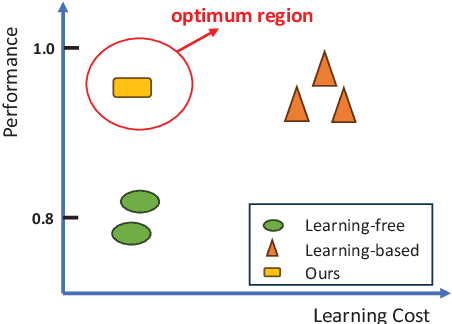

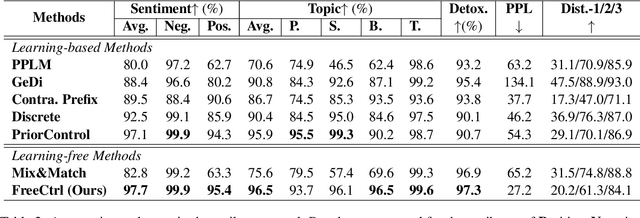
Controllable text generation (CTG) seeks to craft texts adhering to specific attributes, traditionally employing learning-based techniques such as training, fine-tuning, or prefix-tuning with attribute-specific datasets. These approaches, while effective, demand extensive computational and data resources. In contrast, some proposed learning-free alternatives circumvent learning but often yield inferior results, exemplifying the fundamental machine learning trade-off between computational expense and model efficacy. To overcome these limitations, we propose FreeCtrl, a learning-free approach that dynamically adjusts the weights of selected feedforward neural network (FFN) vectors to steer the outputs of large language models (LLMs). FreeCtrl hinges on the principle that the weights of different FFN vectors influence the likelihood of different tokens appearing in the output. By identifying and adaptively adjusting the weights of attribute-related FFN vectors, FreeCtrl can control the output likelihood of attribute keywords in the generated content. Extensive experiments on single- and multi-attribute control reveal that the learning-free FreeCtrl outperforms other learning-free and learning-based methods, successfully resolving the dilemma between learning costs and model performance.
UniBias: Unveiling and Mitigating LLM Bias through Internal Attention and FFN Manipulation
May 31, 2024Large language models (LLMs) have demonstrated impressive capabilities in various tasks using the in-context learning (ICL) paradigm. However, their effectiveness is often compromised by inherent bias, leading to prompt brittleness, i.e., sensitivity to design settings such as example selection, order, and prompt formatting. Previous studies have addressed LLM bias through external adjustment of model outputs, but the internal mechanisms that lead to such bias remain unexplored. Our work delves into these mechanisms, particularly investigating how feedforward neural networks (FFNs) and attention heads result in the bias of LLMs. By Interpreting the contribution of individual FFN vectors and attention heads, we identify the biased LLM components that skew LLMs' prediction toward specific labels. To mitigate these biases, we introduce UniBias, an inference-only method that effectively identifies and eliminates biased FFN vectors and attention heads. Extensive experiments across 12 NLP datasets demonstrate that UniBias significantly enhances ICL performance and alleviates prompt brittleness of LLMs.