 Add to Chrome
 Add to Firefox
 Add to Edge
Qwen-UI-Agent Technical Report: Toward Next-Generation Real-World Centric Foundation GUI Agents
Jul 30, 2026
GUI agents have the potential to become a general purpose executor over existing digital devices. To advance them toward real-world use, we envision agents that operate reliably on real devices, execute workflows across platforms, combine GUI interaction with CLI execution, complete long-horizon tasks, proactively initiate useful services, and autonomously improve their capabilities with minimal human effort. Guided by this vision, we present Qwen-UI-Agent, a real-world centric foundation GUI agent spanning mobile, computer-use, web, and DeepSearch environments. Qwen-UI-Agent combines diverse sandbox environments with a large-scale real-device mobile runtime. Its unified action space interleaves GUI operations with CLI execution and generates batched actions in a single model turn. An AutoResearch-style data flywheel uses agents to construct tasks and environments, diagnose failures, and plan subsequent iterations. Online RL supports training on trajectories exceeding 100 turns, with over 10,000 concurrent environments accelerating rollout. A lightweight harness layer supports proactive service initiation and stateful workflows across mobile and computer. Across a broad suite of evaluations, Qwen-UI-Agent sets state-of-the-art performance on mobile-use benchmarks while delivering competitive performance on computer- and browser-use tasks against frontier models, including Opus 4.8, Gemini 3.1 Pro, and GPT-5.6 Sol. On mobile use, it achieves 82.1% on MobileWorld, 92.2% on MobileWorld-Real, and 97.5% on AndroidDaily. On computer use, it achieves 79.5% on OSWorld-Verified and a 40.0% partial-progress score on OSWorld-v2. On browser use and GUI grounding, it achieves 73.6% on WebArena and 81.5% on ScreenSpot-Pro, respectively.

One Forward Beats Two: InnerZoom for Accurate and Efficient GUI Grounding
Jun 29, 2026MLLM-based GUI grounding methods commonly formulate target localization as autoregressive coordinate generation, enabling models to leverage the strong instruction-following and semantic understanding capabilities of MLLMs. However, this formulation requires the model to retain region-level target evidence while decoding coordinate tokens with the spatial precision demanded by GUI clicking. Our diagnostic analysis reveals that target-region awareness emerges in intermediate decoder layers but is neither retained nor translated into the final coordinate prediction. Existing ZoomIn-style methods address this issue through an external crop-and-rerun pass, which improves localization but increases end-to-end latency and computational cost. To retain the accuracy benefits of two-pass zooming without this extra cost, we propose InnerZoom, a single-forward framework for cross-layer evidence bridging. InnerZoom transforms target-related cues from the original forward pass into a compact cross-layer evidence state, then preserves, refines, and reinjects this state throughout later decoding layers to guide coordinate prediction. Extensive experimental results suggest that InnerZoom-4B achieves state-of-the-art performance on all six GUI grounding benchmarks, obtaining 64.7 on OSWorld-G, 40.2 on UI-Vision, 73.1 on OSWorld-GR, and 87.6 on MMBench-GUI, surpassing the previous best results by 4.1, 3.2, 2.9, and 2.3 points, respectively. Under a controlled 4B setting, InnerZoom improves the same SFT+RL baseline by 5.3 points on average and outperforms two-pass ZoomIn by 1.3 points on average, while reducing end-to-end latency by up to 31.8% and TFLOPs by about 29%. Code and models will be publicly available.
WebGen-R1: Incentivizing Large Language Models to Generate Functional and Aesthetic Websites with Reinforcement Learning
Apr 22, 2026While Large Language Models (LLMs) excel at function-level code generation, project-level tasks such as generating functional and visually aesthetic multi-page websites remain highly challenging. Existing works are often limited to single-page static websites, while agentic frameworks typically rely on multi-turn execution with proprietary models, leading to substantial token costs, high latency, and brittle integration. Training a small LLM end-to-end with reinforcement learning (RL) is a promising alternative, yet it faces a critical bottleneck in designing reliable and computationally feasible rewards for website generation. Unlike single-file coding tasks that can be verified by unit tests, website generation requires evaluating inherently subjective aesthetics, cross-page interactions, and functional correctness. To this end, we propose WebGen-R1, an end-to-end RL framework tailored for project-level website generation. We first introduce a scaffold-driven structured generation paradigm that constrains the large open-ended action space and preserves architectural integrity. We then design a novel cascaded multimodal reward that seamlessly couples structural guarantees with execution-grounded functional feedback and vision-based aesthetic supervision. Extensive experiments demonstrate that our WebGen-R1 substantially transforms a 7B base model from generating nearly nonfunctional websites into producing deployable, aesthetically aligned multi-page websites. Remarkably, our WebGen-R1 not only consistently outperforms heavily scaled open-source models (up to 72B), but also rivals the state-of-the-art DeepSeek-R1 (671B) in functional success, while substantially exceeding it in valid rendering and aesthetic alignment. These results position WebGen-R1 as a viable path for scaling small open models from function-level code generation to project-level web application generation.
MAI-UI Technical Report: Real-World Centric Foundation GUI Agents
Dec 26, 2025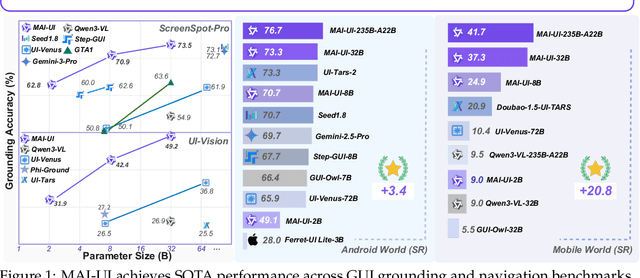
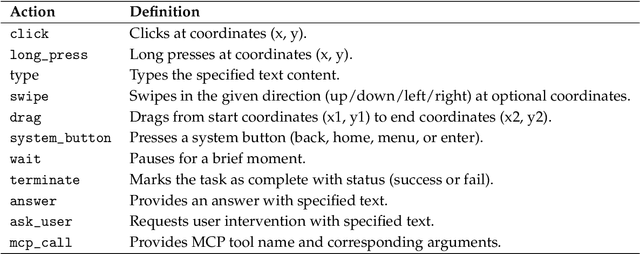
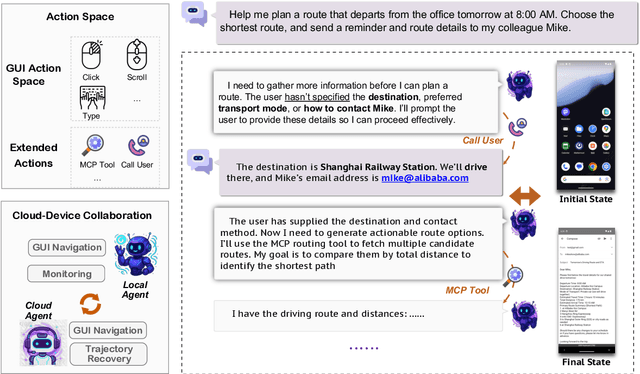
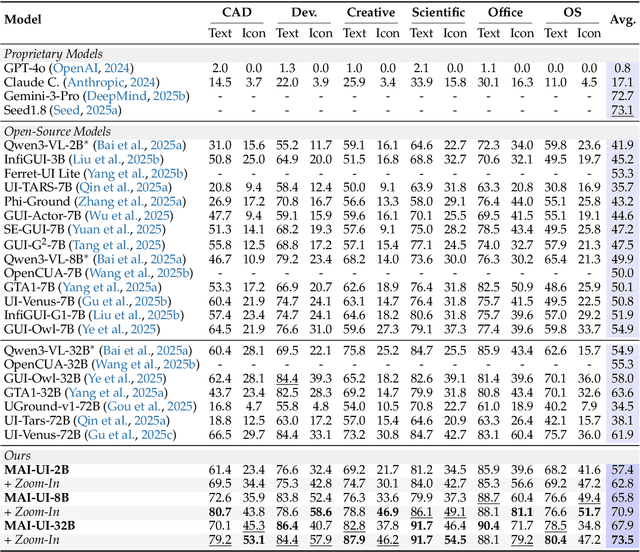
The development of GUI agents could revolutionize the next generation of human-computer interaction. Motivated by this vision, we present MAI-UI, a family of foundation GUI agents spanning the full spectrum of sizes, including 2B, 8B, 32B, and 235B-A22B variants. We identify four key challenges to realistic deployment: the lack of native agent-user interaction, the limits of UI-only operation, the absence of a practical deployment architecture, and brittleness in dynamic environments. MAI-UI addresses these issues with a unified methodology: a self-evolving data pipeline that expands the navigation data to include user interaction and MCP tool calls, a native device-cloud collaboration system routes execution by task state, and an online RL framework with advanced optimizations to scale parallel environments and context length. MAI-UI establishes new state-of-the-art across GUI grounding and mobile navigation. On grounding benchmarks, it reaches 73.5% on ScreenSpot-Pro, 91.3% on MMBench GUI L2, 70.9% on OSWorld-G, and 49.2% on UI-Vision, surpassing Gemini-3-Pro and Seed1.8 on ScreenSpot-Pro. On mobile GUI navigation, it sets a new SOTA of 76.7% on AndroidWorld, surpassing UI-Tars-2, Gemini-2.5-Pro and Seed1.8. On MobileWorld, MAI-UI obtains 41.7% success rate, significantly outperforming end-to-end GUI models and competitive with Gemini-3-Pro based agentic frameworks. Our online RL experiments show significant gains from scaling parallel environments from 32 to 512 (+5.2 points) and increasing environment step budget from 15 to 50 (+4.3 points). Finally, the native device-cloud collaboration system improves on-device performance by 33%, reduces cloud model calls by over 40%, and preserves user privacy.
MobileWorld: Benchmarking Autonomous Mobile Agents in Agent-User Interactive, and MCP-Augmented Environments
Dec 22, 2025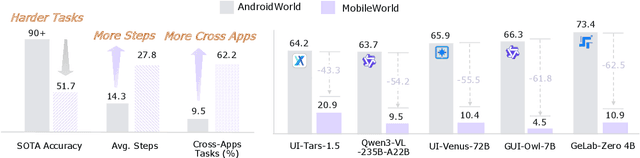
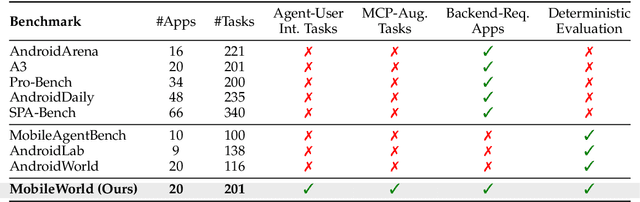
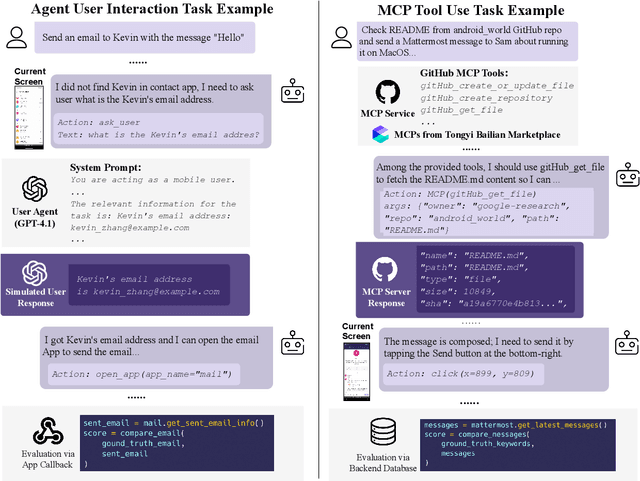

Among existing online mobile-use benchmarks, AndroidWorld has emerged as the dominant benchmark due to its reproducible environment and deterministic evaluation; however, recent agents achieving over 90% success rates indicate its saturation and motivate the need for a more challenging benchmark. In addition, its environment lacks key application categories, such as e-commerce and enterprise communication, and does not reflect realistic mobile-use scenarios characterized by vague user instructions and hybrid tool usage. To bridge this gap, we introduce MobileWorld, a substantially more challenging benchmark designed to better reflect real-world mobile usage, comprising 201 tasks across 20 applications, while maintaining the same level of reproducible evaluation as AndroidWorld. The difficulty of MobileWorld is twofold. First, it emphasizes long-horizon tasks with cross-application interactions: MobileWorld requires nearly twice as many task-completion steps on average (27.8 vs. 14.3) and includes far more multi-application tasks (62.2% vs. 9.5%) compared to AndroidWorld. Second, MobileWorld extends beyond standard GUI manipulation by introducing novel task categories, including agent-user interaction and MCP-augmented tasks. To ensure robust evaluation, we provide snapshot-based container environment and precise functional verifications, including backend database inspection and task callback APIs. We further develop a planner-executor agentic framework with extended action spaces to support user interactions and MCP calls. Our results reveal a sharp performance drop compared to AndroidWorld, with the best agentic framework and end-to-end model achieving 51.7% and 20.9% success rates, respectively. Our analysis shows that current models struggle significantly with user interaction and MCP calls, offering a strategic roadmap toward more robust, next-generation mobile intelligence.
COIG-P: A High-Quality and Large-Scale Chinese Preference Dataset for Alignment with Human Values
Apr 07, 2025Aligning large language models (LLMs) with human preferences has achieved remarkable success. However, existing Chinese preference datasets are limited by small scale, narrow domain coverage, and lack of rigorous data validation. Additionally, the reliance on human annotators for instruction and response labeling significantly constrains the scalability of human preference datasets. To address these challenges, we design an LLM-based Chinese preference dataset annotation pipeline with no human intervention. Specifically, we crawled and carefully filtered 92k high-quality Chinese queries and employed 15 mainstream LLMs to generate and score chosen-rejected response pairs. Based on it, we introduce COIG-P (Chinese Open Instruction Generalist - Preference), a high-quality, large-scale Chinese preference dataset, comprises 1,009k Chinese preference pairs spanning 6 diverse domains: Chat, Code, Math, Logic, Novel, and Role. Building upon COIG-P, to reduce the overhead of using LLMs for scoring, we trained a 8B-sized Chinese Reward Model (CRM) and meticulously constructed a Chinese Reward Benchmark (CRBench). Evaluation results based on AlignBench \citep{liu2024alignbenchbenchmarkingchinesealignment} show that that COIG-P significantly outperforms other Chinese preference datasets, and it brings significant performance improvements ranging from 2% to 12% for the Qwen2/2.5 and Infinity-Instruct-3M-0625 model series, respectively. The results on CRBench demonstrate that our CRM has a strong and robust scoring ability. We apply it to filter chosen-rejected response pairs in a test split of COIG-P, and our experiments show that it is comparable to GPT-4o in identifying low-quality samples while maintaining efficiency and cost-effectiveness. Our codes and data are released in https://github.com/multimodal-art-projection/COIG-P.
SuperGPQA: Scaling LLM Evaluation across 285 Graduate Disciplines
Feb 20, 2025Large language models (LLMs) have demonstrated remarkable proficiency in mainstream academic disciplines such as mathematics, physics, and computer science. However, human knowledge encompasses over 200 specialized disciplines, far exceeding the scope of existing benchmarks. The capabilities of LLMs in many of these specialized fields-particularly in light industry, agriculture, and service-oriented disciplines-remain inadequately evaluated. To address this gap, we present SuperGPQA, a comprehensive benchmark that evaluates graduate-level knowledge and reasoning capabilities across 285 disciplines. Our benchmark employs a novel Human-LLM collaborative filtering mechanism to eliminate trivial or ambiguous questions through iterative refinement based on both LLM responses and expert feedback. Our experimental results reveal significant room for improvement in the performance of current state-of-the-art LLMs across diverse knowledge domains (e.g., the reasoning-focused model DeepSeek-R1 achieved the highest accuracy of 61.82% on SuperGPQA), highlighting the considerable gap between current model capabilities and artificial general intelligence. Additionally, we present comprehensive insights from our management of a large-scale annotation process, involving over 80 expert annotators and an interactive Human-LLM collaborative system, offering valuable methodological guidance for future research initiatives of comparable scope.
Yi-Lightning Technical Report
Dec 03, 2024


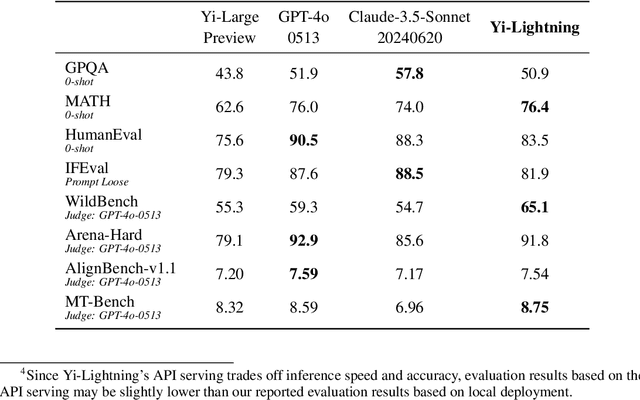
This technical report presents Yi-Lightning, our latest flagship large language model (LLM). It achieves exceptional performance, ranking 6th overall on Chatbot Arena, with particularly strong results (2nd to 4th place) in specialized categories including Chinese, Math, Coding, and Hard Prompts. Yi-Lightning leverages an enhanced Mixture-of-Experts (MoE) architecture, featuring advanced expert segmentation and routing mechanisms coupled with optimized KV-caching techniques. Our development process encompasses comprehensive pre-training, supervised fine-tuning (SFT), and reinforcement learning from human feedback (RLHF), where we devise deliberate strategies for multi-stage training, synthetic data construction, and reward modeling. Furthermore, we implement RAISE (Responsible AI Safety Engine), a four-component framework to address safety issues across pre-training, post-training, and serving phases. Empowered by our scalable super-computing infrastructure, all these innovations substantially reduce training, deployment and inference costs while maintaining high-performance standards. With further evaluations on public academic benchmarks, Yi-Lightning demonstrates competitive performance against top-tier LLMs, while we observe a notable disparity between traditional, static benchmark results and real-world, dynamic human preferences. This observation prompts a critical reassessment of conventional benchmarks' utility in guiding the development of more intelligent and powerful AI systems for practical applications. Yi-Lightning is now available through our developer platform at https://platform.lingyiwanwu.com.