 Add to Chrome
 Add to Firefox
 Add to Edge
Fast-SegSim: Real-Time Open-Vocabulary Segmentation for Robotics in Simulation
Apr 13, 2026
Open-vocabulary panoptic reconstruction is crucial for advanced robotics and simulation. However, existing 3D reconstruction methods, such as NeRF or Gaussian Splatting variants, often struggle to achieve the real-time inference frequency required by robotic control loops. Existing methods incur prohibitive latency when processing the high-dimensional features required for robust open-vocabulary segmentation. We propose Fast-SegSim, a novel, simple, and end-to-end framework built upon 2D Gaussian Splatting, designed to realize real-time, high-fidelity, and 3D-consistent open-vocabulary segmentation reconstruction. Our core contribution is a highly optimized rendering pipeline that specifically addresses the computational bottleneck of high-channel segmentation feature accumulation. We introduce two key optimizations: Precise Tile Intersection to reduce rasterization redundancy, and a novel Top-K Hard Selection strategy. This strategy leverages the geometric sparsity inherent in the 2D Gaussian representation to greatly simplify feature accumulation and alleviate bandwidth limitations, achieving render rates exceeding 40 FPS. Fast-SegSim provides critical value in robotic applications: it serves both as a high-frequency sensor input for simulation platforms like Gazebo, and its 3D-consistent outputs provide essential multi-view 'ground truth' labels for fine-tuning downstream perception tasks. We demonstrate this utility by using the generated labels to fine-tune the perception module in object goal navigation, successfully doubling the navigation success rate. Our superior rendering speed and practical utility underscore Fast-SegSim's potential to bridge the sim-to-real gap.

Ψ-Map: Panoptic Surface Integrated Mapping Enables Real2Sim Transfer
Apr 13, 2026Open-vocabulary panoptic reconstruction is essential for advanced robotics perception and simulation. However, existing methods based on 3D Gaussian Splatting (3DGS) often struggle to simultaneously achieve geometric accuracy, coherent panoptic understanding, and real-time inference frequency in large-scale scenes. In this paper, we propose a comprehensive framework that integrates geometric reinforcement, end-to-end panoptic learning, and efficient rendering. First, to ensure physical realism in large-scale environments, we leverage LiDAR data to construct plane-constrained multimodal Gaussian Mixture Models (GMMs) and employ 2D Gaussian surfels as the map representation, enabling high-precision surface alignment and continuous geometric supervision. Building upon this, to overcome the error accumulation and cumbersome cross-frame association inherent in traditional multi-stage panoptic segmentation pipelines, we design a query-guided end-to-end learning architecture. By utilizing a local cross-attention mechanism within the view frustum, the system lifts 2D mask features directly into 3D space, achieving globally consistent panoptic understanding. Finally, addressing the computational bottlenecks caused by high-dimensional semantic features, we introduce Precise Tile Intersection and a Top-K Hard Selection strategy to optimize the rendering pipeline. Experimental results demonstrate that our system achieves superior geometric and panoptic reconstruction quality in large-scale scenes while maintaining an inference rate exceeding 40 FPS, meeting the real-time requirements of robotic control loops.
Partial GFlowNet: Accelerating Convergence in Large State Spaces via Strategic Partitioning
Feb 12, 2026Generative Flow Networks (GFlowNets) have shown promising potential to generate high-scoring candidates with probability proportional to their rewards. As existing GFlowNets freely explore in state space, they encounter significant convergence challenges when scaling to large state spaces. Addressing this issue, this paper proposes to restrict the exploration of actor. A planner is introduced to partition the entire state space into overlapping partial state spaces. Given their limited size, these partial state spaces allow the actor to efficiently identify subregions with higher rewards. A heuristic strategy is introduced to switch partial regions thus preventing the actor from wasting time exploring fully explored or low-reward partial regions. By iteratively exploring these partial state spaces, the actor learns to converge towards the high-reward subregions within the entire state space. Experiments on several widely used datasets demonstrate that \modelname converges faster than existing works on large state spaces. Furthermore, \modelname not only generates candidates with higher rewards but also significantly improves their diversity.
Exploring Multiple High-Scoring Subspaces in Generative Flow Networks
Feb 12, 2026As a probabilistic sampling framework, Generative Flow Networks (GFlowNets) show strong potential for constructing complex combinatorial objects through the sequential composition of elementary components. However, existing GFlowNets often suffer from excessive exploration over vast state spaces, leading to over-sampling of low-reward regions and convergence to suboptimal distributions. Effectively biasing GFlowNets toward high-reward solutions remains a non-trivial challenge. In this paper, we propose CMAB-GFN, which integrates a combinatorial multi-armed bandit (CMAB) framework with GFlowNet policies. The CMAB component prunes low-quality actions, yielding compact high-scoring subspaces for exploration. Restricting GFNs to these compact high-scoring subspaces accelerates the discovery of high-value candidates, while the exploration of different subspaces ensures that diversity is not sacrificed. Experimental results on multiple tasks demonstrate that CMAB-GFN generates higher-reward candidates than existing approaches.
Early and Prediagnostic Detection of Pancreatic Cancer from Computed Tomography
Jan 29, 2026Pancreatic ductal adenocarcinoma (PDAC), one of the deadliest solid malignancies, is often detected at a late and inoperable stage. Retrospective reviews of prediagnostic CT scans, when conducted by expert radiologists aware that the patient later developed PDAC, frequently reveal lesions that were previously overlooked. To help detecting these lesions earlier, we developed an automated system named ePAI (early Pancreatic cancer detection with Artificial Intelligence). It was trained on data from 1,598 patients from a single medical center. In the internal test involving 1,009 patients, ePAI achieved an area under the receiver operating characteristic curve (AUC) of 0.939-0.999, a sensitivity of 95.3%, and a specificity of 98.7% for detecting small PDAC less than 2 cm in diameter, precisely localizing PDAC as small as 2 mm. In an external test involving 7,158 patients across 6 centers, ePAI achieved an AUC of 0.918-0.945, a sensitivity of 91.5%, and a specificity of 88.0%, precisely localizing PDAC as small as 5 mm. Importantly, ePAI detected PDACs on prediagnostic CT scans obtained 3 to 36 months before clinical diagnosis that had originally been overlooked by radiologists. It successfully detected and localized PDACs in 75 of 159 patients, with a median lead time of 347 days before clinical diagnosis. Our multi-reader study showed that ePAI significantly outperformed 30 board-certified radiologists by 50.3% (P < 0.05) in sensitivity while maintaining a comparable specificity of 95.4% in detecting PDACs early and prediagnostic. These findings suggest its potential of ePAI as an assistive tool to improve early detection of pancreatic cancer.
ETP-R1: Evolving Topological Planning with Reinforcement Fine-tuning for Vision-Language Navigation in Continuous Environments
Dec 24, 2025Vision-Language Navigation in Continuous Environments (VLN-CE) requires an embodied agent to navigate towards target in continuous environments, following natural language instructions. While current graph-based methods offer an efficient, structured approach by abstracting the environment into a topological map and simplifying the action space to waypoint selection, they lag behind methods based on Large Vision-Language Models (LVLMs) in leveraging large-scale data and advanced training paradigms. In this paper, we try to bridge this gap by introducing ETP-R1, a framework that applies the paradigm of scaling up data and Reinforcement Fine-Tuning (RFT) to a graph-based VLN-CE model. To build a strong foundation, we first construct a high-quality, large-scale pretraining dataset using the Gemini API. This dataset consists of diverse, low-hallucination instructions for topological trajectories, providing rich supervision for our graph-based policy to map language to topological paths. This foundation is further strengthened by unifying data from both R2R and RxR tasks for joint pretraining. Building on this, we introduce a three-stage training paradigm, which culminates in the first application of closed-loop, online RFT to a graph-based VLN-CE model, powered by the Group Relative Policy Optimization (GRPO) algorithm. Extensive experiments demonstrate that our approach is highly effective, establishing new state-of-the-art performance across all major metrics on both the R2R-CE and RxR-CE benchmarks. Our code is available at https://github.com/Cepillar/ETP-R1.
Learning Topology-Driven Multi-Subspace Fusion for Grassmannian Deep Network
Nov 14, 2025Grassmannian manifold offers a powerful carrier for geometric representation learning by modelling high-dimensional data as low-dimensional subspaces. However, existing approaches predominantly rely on static single-subspace representations, neglecting the dynamic interplay between multiple subspaces critical for capturing complex geometric structures. To address this limitation, we propose a topology-driven multi-subspace fusion framework that enables adaptive subspace collaboration on the Grassmannian. Our solution introduces two key innovations: (1) Inspired by the Kolmogorov-Arnold representation theorem, an adaptive multi-subspace modelling mechanism is proposed that dynamically selects and weights task-relevant subspaces via topological convergence analysis, and (2) a multi-subspace interaction block that fuses heterogeneous geometric representations through Fréchet mean optimisation on the manifold. Theoretically, we establish the convergence guarantees of adaptive subspaces under a projection metric topology, ensuring stable gradient-based optimisation. Practically, we integrate Riemannian batch normalisation and mutual information regularisation to enhance discriminability and robustness. Extensive experiments on 3D action recognition (HDM05, FPHA), EEG classification (MAMEM-SSVEPII), and graph tasks demonstrate state-of-the-art performance. Our work not only advances geometric deep learning but also successfully adapts the proven multi-channel interaction philosophy of Euclidean networks to non-Euclidean domains, achieving superior discriminability and interpretability.
MG2FlowNet: Accelerating High-Reward Sample Generation via Enhanced MCTS and Greediness Control
Oct 01, 2025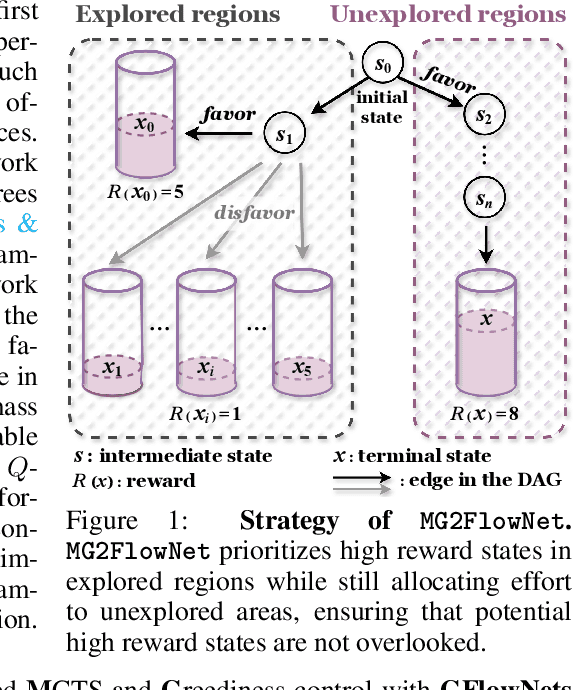
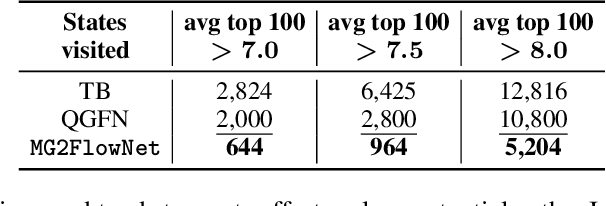
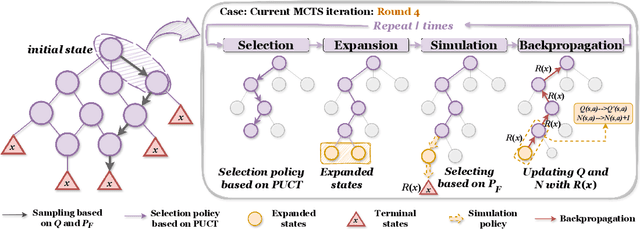
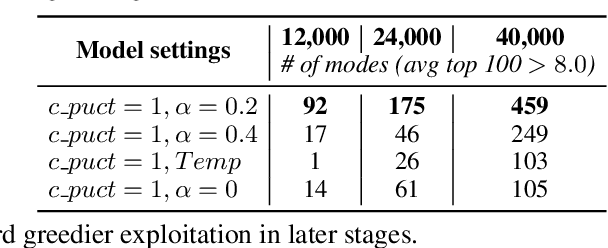
Generative Flow Networks (GFlowNets) have emerged as a powerful tool for generating diverse and high-reward structured objects by learning to sample from a distribution proportional to a given reward function. Unlike conventional reinforcement learning (RL) approaches that prioritize optimization of a single trajectory, GFlowNets seek to balance diversity and reward by modeling the entire trajectory distribution. This capability makes them especially suitable for domains such as molecular design and combinatorial optimization. However, existing GFlowNets sampling strategies tend to overexplore and struggle to consistently generate high-reward samples, particularly in large search spaces with sparse high-reward regions. Therefore, improving the probability of generating high-reward samples without sacrificing diversity remains a key challenge under this premise. In this work, we integrate an enhanced Monte Carlo Tree Search (MCTS) into the GFlowNets sampling process, using MCTS-based policy evaluation to guide the generation toward high-reward trajectories and Polynomial Upper Confidence Trees (PUCT) to balance exploration and exploitation adaptively, and we introduce a controllable mechanism to regulate the degree of greediness. Our method enhances exploitation without sacrificing diversity by dynamically balancing exploration and reward-driven guidance. The experimental results show that our method can not only accelerate the speed of discovering high-reward regions but also continuously generate high-reward samples, while preserving the diversity of the generative distribution. All implementations are available at https://github.com/ZRNB/MG2FlowNet.
High-Speed FHD Full-Color Video Computer-Generated Holography
Aug 27, 2025Computer-generated holography (CGH) is a promising technology for next-generation displays. However, generating high-speed, high-quality holographic video requires both high frame rate display and efficient computation, but is constrained by two key limitations: ($i$) Learning-based models often produce over-smoothed phases with narrow angular spectra, causing severe color crosstalk in high frame rate full-color displays such as depth-division multiplexing and thus resulting in a trade-off between frame rate and color fidelity. ($ii$) Existing frame-by-frame optimization methods typically optimize frames independently, neglecting spatial-temporal correlations between consecutive frames and leading to computationally inefficient solutions. To overcome these challenges, in this paper, we propose a novel high-speed full-color video CGH generation scheme. First, we introduce Spectrum-Guided Depth Division Multiplexing (SGDDM), which optimizes phase distributions via frequency modulation, enabling high-fidelity full-color display at high frame rates. Second, we present HoloMamba, a lightweight asymmetric Mamba-Unet architecture that explicitly models spatial-temporal correlations across video sequences to enhance reconstruction quality and computational efficiency. Extensive simulated and real-world experiments demonstrate that SGDDM achieves high-fidelity full-color display without compromise in frame rate, while HoloMamba generates FHD (1080p) full-color holographic video at over 260 FPS, more than 2.6$\times$ faster than the prior state-of-the-art Divide-Conquer-and-Merge Strategy.
Leverage Cross-Attention for End-to-End Open-Vocabulary Panoptic Reconstruction
Jan 02, 2025
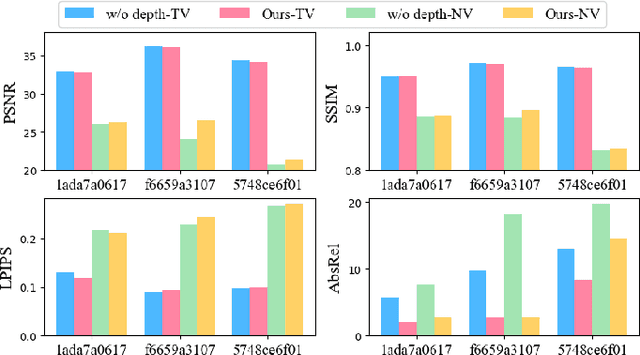


Open-vocabulary panoptic reconstruction offers comprehensive scene understanding, enabling advances in embodied robotics and photorealistic simulation. In this paper, we propose PanopticRecon++, an end-to-end method that formulates panoptic reconstruction through a novel cross-attention perspective. This perspective models the relationship between 3D instances (as queries) and the scene's 3D embedding field (as keys) through their attention map. Unlike existing methods that separate the optimization of queries and keys or overlook spatial proximity, PanopticRecon++ introduces learnable 3D Gaussians as instance queries. This formulation injects 3D spatial priors to preserve proximity while maintaining end-to-end optimizability. Moreover, this query formulation facilitates the alignment of 2D open-vocabulary instance IDs across frames by leveraging optimal linear assignment with instance masks rendered from the queries. Additionally, we ensure semantic-instance segmentation consistency by fusing query-based instance segmentation probabilities with semantic probabilities in a novel panoptic head supervised by a panoptic loss. During training, the number of instance query tokens dynamically adapts to match the number of objects. PanopticRecon++ shows competitive performance in terms of 3D and 2D segmentation and reconstruction performance on both simulation and real-world datasets, and demonstrates a user case as a robot simulator. Our project website is at: https://yuxuan1206.github.io/panopticrecon_pp/