 Add to Chrome
 Add to Firefox
 Add to Edge
NOFE -- Neural Operator Function Embedding
May 12, 2026
Most dimensionality reduction methods treat data as discrete point clouds, ignoring the continuous domain structure inherent to many real-world processes. To bridge this gap, we introduce Neural Operator Function Embedding (NOFE), a domain-aware framework for continuous dimensionality reduction. NOFE learns function-to-function mappings via a Graph Kernel Operator, enabling mesh-free evaluation at arbitrary query locations independent of input discretization. We establish NOFE as approximation of sheaf-to-sheaf mappings, generalizing Sheaf Neural Networks to continuous domains. We evaluate NOFE across different datasets, comparing it against PCA, t-SNE, and UMAP. Our results demonstrate that NOFE significantly outperforms baselines in local structure preservation, achieving a local Stress of 0.111 compared to 0.398 for PCA, 0.773 for t-SNE, and 0.791 for UMAP for the ERA5 climate reanalysis dataset. NOFE also exhibits robust sampling independence, reducing the Patch Stitching Error by up to $20.0\times$ relative to UMAP (59.0 vs. 267.6 under regional normalization) and ensuring consistency across disjoint domain patches. While maintaining competitive global structure preservation (Stress-1: 0.379 vs. PCA's 0.268), NOFE resolves fine-grained structures and produces smooth, consistent embeddings that generalize across varying sample densities, addressing key limitations of discrete reduction methods.

Seedance 1.5 pro: A Native Audio-Visual Joint Generation Foundation Model
Dec 23, 2025Recent strides in video generation have paved the way for unified audio-visual generation. In this work, we present Seedance 1.5 pro, a foundational model engineered specifically for native, joint audio-video generation. Leveraging a dual-branch Diffusion Transformer architecture, the model integrates a cross-modal joint module with a specialized multi-stage data pipeline, achieving exceptional audio-visual synchronization and superior generation quality. To ensure practical utility, we implement meticulous post-training optimizations, including Supervised Fine-Tuning (SFT) on high-quality datasets and Reinforcement Learning from Human Feedback (RLHF) with multi-dimensional reward models. Furthermore, we introduce an acceleration framework that boosts inference speed by over 10X. Seedance 1.5 pro distinguishes itself through precise multilingual and dialect lip-syncing, dynamic cinematic camera control, and enhanced narrative coherence, positioning it as a robust engine for professional-grade content creation. Seedance 1.5 pro is now accessible on Volcano Engine at https://console.volcengine.com/ark/region:ark+cn-beijing/experience/vision?type=GenVideo.
Keypoint Counting Classifiers: Turning Vision Transformers into Self-Explainable Models Without Training
Dec 19, 2025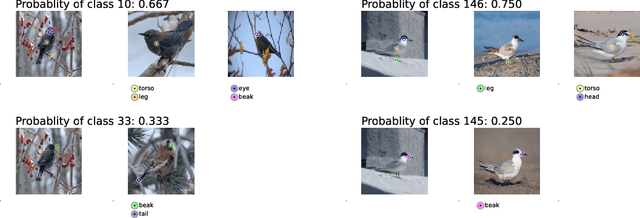
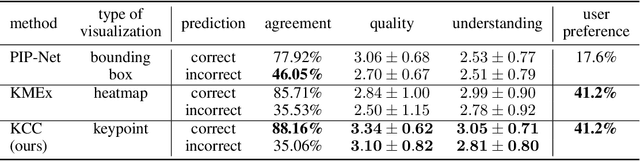
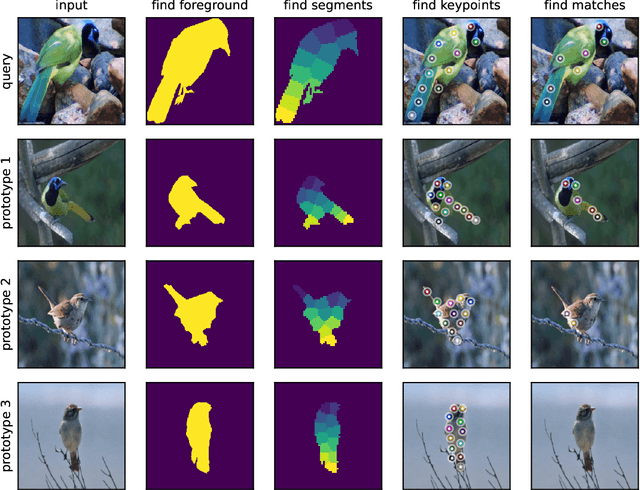
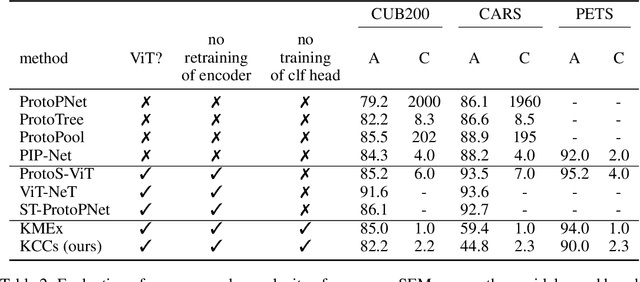
Current approaches for designing self-explainable models (SEMs) require complicated training procedures and specific architectures which makes them impractical. With the advance of general purpose foundation models based on Vision Transformers (ViTs), this impracticability becomes even more problematic. Therefore, new methods are necessary to provide transparency and reliability to ViT-based foundation models. In this work, we present a new method for turning any well-trained ViT-based model into a SEM without retraining, which we call Keypoint Counting Classifiers (KCCs). Recent works have shown that ViTs can automatically identify matching keypoints between images with high precision, and we build on these results to create an easily interpretable decision process that is inherently visualizable in the input. We perform an extensive evaluation which show that KCCs improve the human-machine communication compared to recent baselines. We believe that KCCs constitute an important step towards making ViT-based foundation models more transparent and reliable.
Virtual Width Networks
Nov 17, 2025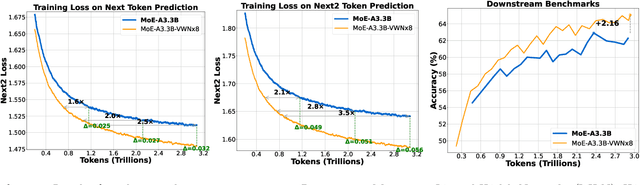
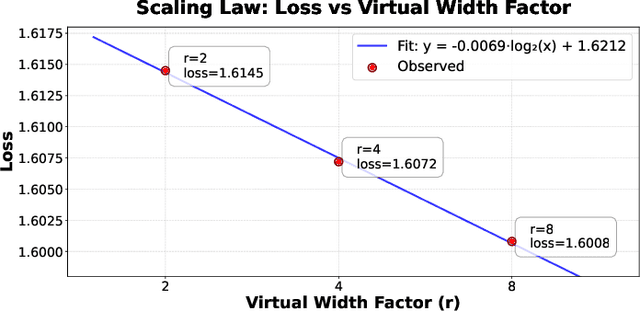
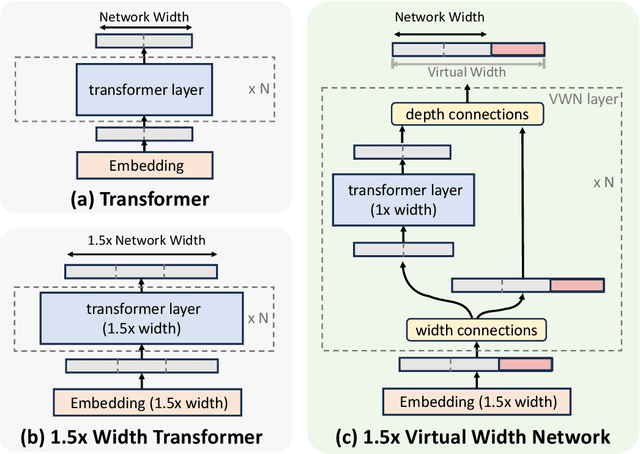
We introduce Virtual Width Networks (VWN), a framework that delivers the benefits of wider representations without incurring the quadratic cost of increasing the hidden size. VWN decouples representational width from backbone width, expanding the embedding space while keeping backbone compute nearly constant. In our large-scale experiment, an 8-times expansion accelerates optimization by over 2 times for next-token and 3 times for next-2-token prediction. The advantage amplifies over training as both the loss gap grows and the convergence-speedup ratio increases, showing that VWN is not only token-efficient but also increasingly effective with scale. Moreover, we identify an approximately log-linear scaling relation between virtual width and loss reduction, offering an initial empirical basis and motivation for exploring virtual-width scaling as a new dimension of large-model efficiency.
UltraMemV2: Memory Networks Scaling to 120B Parameters with Superior Long-Context Learning
Aug 26, 2025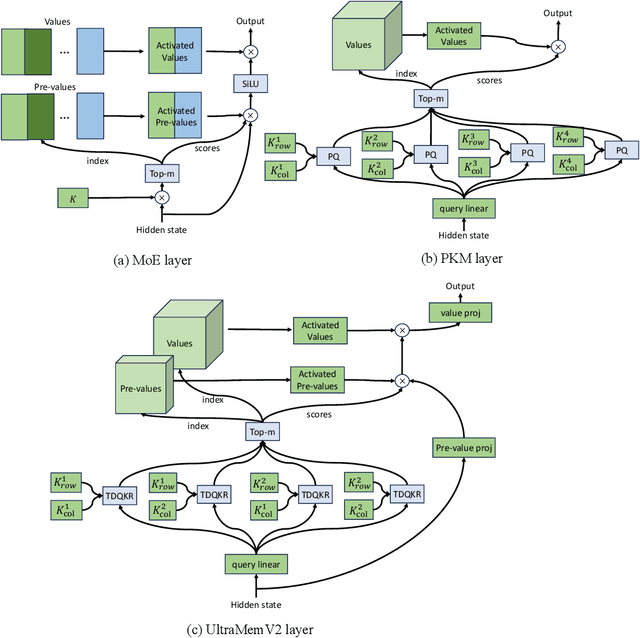
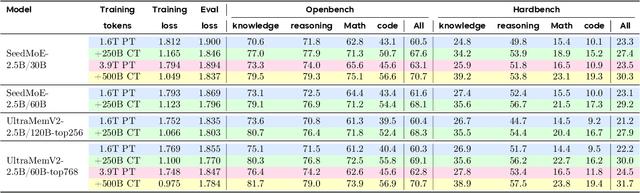

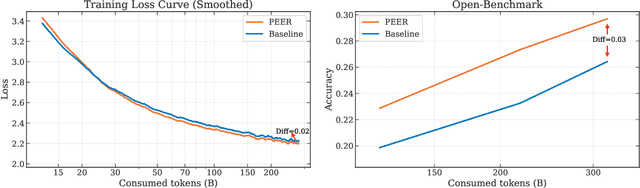
While Mixture of Experts (MoE) models achieve remarkable efficiency by activating only subsets of parameters, they suffer from high memory access costs during inference. Memory-layer architectures offer an appealing alternative with very few memory access, but previous attempts like UltraMem have only matched the performance of 2-expert MoE models, falling significantly short of state-of-the-art 8-expert configurations. We present UltraMemV2, a redesigned memory-layer architecture that closes this performance gap. Our approach introduces five key improvements: integrating memory layers into every transformer block, simplifying value expansion with single linear projections, adopting FFN-based value processing from PEER, implementing principled parameter initialization, and rebalancing memory-to-FFN computation ratios. Through extensive evaluation, we demonstrate that UltraMemV2 achieves performance parity with 8-expert MoE models under same computation and parameters but significantly low memory access. Notably, UltraMemV2 shows superior performance on memory-intensive tasks, with improvements of +1.6 points on long-context memorization, +6.2 points on multi-round memorization, and +7.9 points on in-context learning. We validate our approach at scale with models up to 2.5B activated parameters from 120B total parameters, and establish that activation density has greater impact on performance than total sparse parameter count. Our work brings memory-layer architectures to performance parity with state-of-the-art MoE models, presenting a compelling alternative for efficient sparse computation.
Fisheye-GS: Lightweight and Extensible Gaussian Splatting Module for Fisheye Cameras
Sep 11, 2024Recently, 3D Gaussian Splatting (3DGS) has garnered attention for its high fidelity and real-time rendering. However, adapting 3DGS to different camera models, particularly fisheye lenses, poses challenges due to the unique 3D to 2D projection calculation. Additionally, there are inefficiencies in the tile-based splatting, especially for the extreme curvature and wide field of view of fisheye lenses, which are crucial for its broader real-life applications. To tackle these challenges, we introduce Fisheye-GS.This innovative method recalculates the projection transformation and its gradients for fisheye cameras. Our approach can be seamlessly integrated as a module into other efficient 3D rendering methods, emphasizing its extensibility, lightweight nature, and modular design. Since we only modified the projection component, it can also be easily adapted for use with different camera models. Compared to methods that train after undistortion, our approach demonstrates a clear improvement in visual quality.
FlashGS: Efficient 3D Gaussian Splatting for Large-scale and High-resolution Rendering
Aug 15, 2024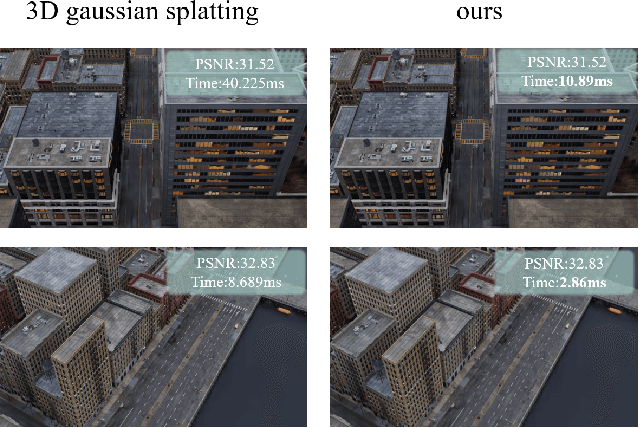

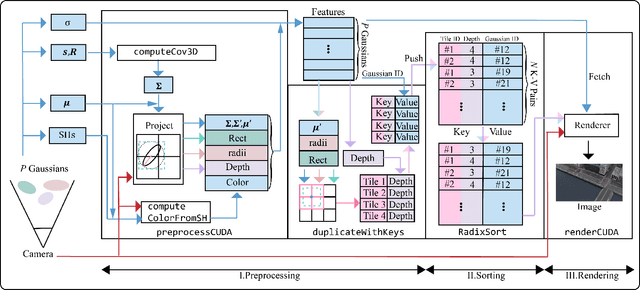
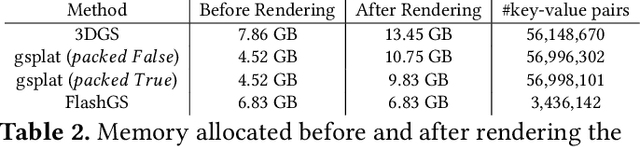
This work introduces FlashGS, an open-source CUDA Python library, designed to facilitate the efficient differentiable rasterization of 3D Gaussian Splatting through algorithmic and kernel-level optimizations. FlashGS is developed based on the observations from a comprehensive analysis of the rendering process to enhance computational efficiency and bring the technique to wide adoption. The paper includes a suite of optimization strategies, encompassing redundancy elimination, efficient pipelining, refined control and scheduling mechanisms, and memory access optimizations, all of which are meticulously integrated to amplify the performance of the rasterization process. An extensive evaluation of FlashGS' performance has been conducted across a diverse spectrum of synthetic and real-world large-scale scenes, encompassing a variety of image resolutions. The empirical findings demonstrate that FlashGS consistently achieves an average 4x acceleration over mobile consumer GPUs, coupled with reduced memory consumption. These results underscore the superior performance and resource optimization capabilities of FlashGS, positioning it as a formidable tool in the domain of 3D rendering.
Perspective+ Unet: Enhancing Segmentation with Bi-Path Fusion and Efficient Non-Local Attention for Superior Receptive Fields
Jun 20, 2024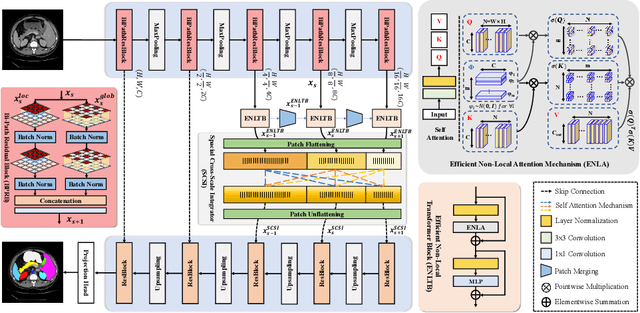
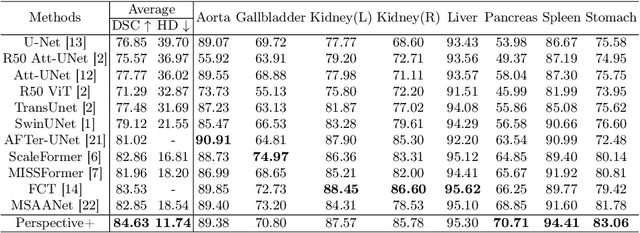
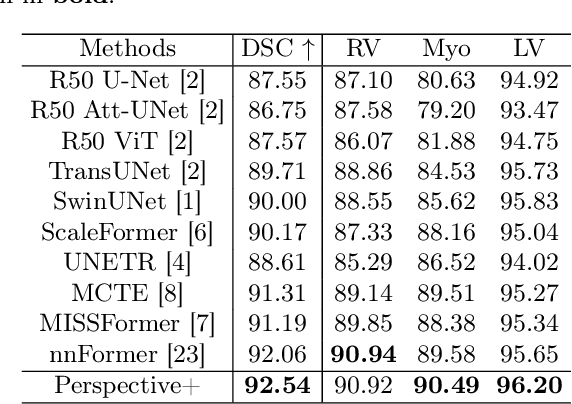
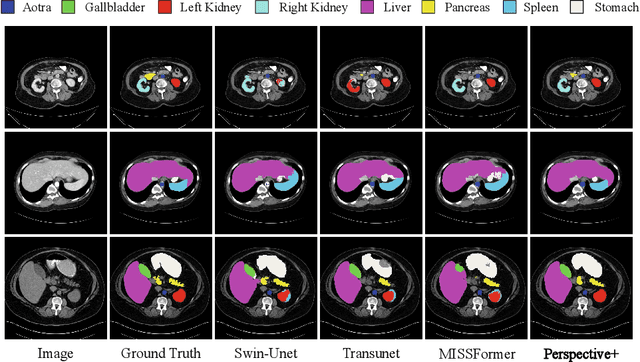
Precise segmentation of medical images is fundamental for extracting critical clinical information, which plays a pivotal role in enhancing the accuracy of diagnoses, formulating effective treatment plans, and improving patient outcomes. Although Convolutional Neural Networks (CNNs) and non-local attention methods have achieved notable success in medical image segmentation, they either struggle to capture long-range spatial dependencies due to their reliance on local features, or face significant computational and feature integration challenges when attempting to address this issue with global attention mechanisms. To overcome existing limitations in medical image segmentation, we propose a novel architecture, Perspective+ Unet. This framework is characterized by three major innovations: (i) It introduces a dual-pathway strategy at the encoder stage that combines the outcomes of traditional and dilated convolutions. This not only maintains the local receptive field but also significantly expands it, enabling better comprehension of the global structure of images while retaining detail sensitivity. (ii) The framework incorporates an efficient non-local transformer block, named ENLTB, which utilizes kernel function approximation for effective long-range dependency capture with linear computational and spatial complexity. (iii) A Spatial Cross-Scale Integrator strategy is employed to merge global dependencies and local contextual cues across model stages, meticulously refining features from various levels to harmonize global and local information. Experimental results on the ACDC and Synapse datasets demonstrate the effectiveness of our proposed Perspective+ Unet. The code is available in the supplementary material.