 Add to Chrome
 Add to Firefox
 Add to Edge
Visual Verification Enables Inference-time Steering and Autonomous Policy Improvement
Jun 16, 2026
Robots deployed in the real world should learn from their experience and improve over time. This requires a mechanism of practicing and learning from feedback. In this paper, we propose VERITAS, a generator-verifier framework for generalist robot policies for inference-time policy steering and self-improvement. We use a pre-trained generalist robot policy as a ``generator'' and pair it with a gradient-free ``visual verifier'' that evaluates actions at inference time. This framework enables inference-time steering that improves policy performance without additional training. We demonstrate that inference-time verification consistently outperforms vanilla generalists without training on additional demonstration data. Additionally, we demonstrate that the verified rollouts provide effective supervision for offline policy improvement: policies fine-tuned on verified self-generated trajectories achieve consistent performance gains. Notably, we find that post-training with verified rollouts achieves comparable efficiency to expert demonstrations, while requiring no human interventions. Our results highlight inference-time verification as a practical and scalable mechanism for improving robotic policies during deployment.

MolmoB0T: Large-Scale Simulation Enables Zero-Shot Manipulation
Mar 17, 2026A prevailing view in robot learning is that simulation alone is not enough; effective sim-to-real transfer is widely believed to require at least some real-world data collection or task-specific fine-tuning to bridge the gap between simulated and physical environments. We challenge that assumption. With sufficiently large-scale and diverse simulated synthetic training data, we show that zero-shot transfer to the real world is not only possible, but effective for both static and mobile manipulation. We introduce MolmoBot-Engine, a fully open-source pipeline for procedural data generation across robots, tasks, and diverse simulated environments in MolmoSpaces. With it, we release MolmoBot-Data, a dataset of 1.8 million expert trajectories for articulated object manipulation and pick-and-place tasks. We train three policy classes: MolmoBot, a Molmo2-based multi-frame vision-language model with a flow-matching action head; MolmoBot-Pi0, which replicates the $π_0$ architecture to enable direct comparison; and MolmoBot-SPOC, a lightweight policy suitable for edge deployment and amenable to RL fine-tuning. We evaluate on two robotic platforms: the Franka FR3 for tabletop manipulation tasks and the Rainbow Robotics RB-Y1 mobile manipulator for door opening, drawer manipulation, cabinet interaction, and mobile pick-and-place. Without any real-world fine-tuning, our policies achieve zero-shot transfer to unseen objects and environments. On tabletop pick-and-place, MolmoBot achieves a success rate of 79.2% in real world evaluations across 4 settings, outperforming $π_{0.5}$ at 39.2%. Our results demonstrate that procedural environment generation combined with diverse articulated assets can produce robust manipulation policies that generalize broadly to the real world. Technical Blog: https://allenai.org/blog/molmobot-robot-manipulation
D-REX: Differentiable Real-to-Sim-to-Real Engine for Learning Dexterous Grasping
Mar 01, 2026Simulation provides a cost-effective and flexible platform for data generation and policy learning to develop robotic systems. However, bridging the gap between simulation and real-world dynamics remains a significant challenge, especially in physical parameter identification. In this work, we introduce a real-to-sim-to-real engine that leverages the Gaussian Splat representations to build a differentiable engine, enabling object mass identification from real-world visual observations and robot control signals, while enabling grasping policy learning simultaneously. Through optimizing the mass of the manipulated object, our method automatically builds high-fidelity and physically plausible digital twins. Additionally, we propose a novel approach to train force-aware grasping policies from limited data by transferring feasible human demonstrations into simulated robot demonstrations. Through comprehensive experiments, we demonstrate that our engine achieves accurate and robust performance in mass identification across various object geometries and mass values. Those optimized mass values facilitate force-aware policy learning, achieving superior and high performance in object grasping, effectively reducing the sim-to-real gap.
LAP: Language-Action Pre-Training Enables Zero-shot Cross-Embodiment Transfer
Feb 15, 2026A long-standing goal in robotics is a generalist policy that can be deployed zero-shot on new robot embodiments without per-embodiment adaptation. Despite large-scale multi-embodiment pre-training, existing Vision-Language-Action models (VLAs) remain tightly coupled to their training embodiments and typically require costly fine-tuning. We introduce Language-Action Pre-training (LAP), a simple recipe that represents low-level robot actions directly in natural language, aligning action supervision with the pre-trained vision-language model's input-output distribution. LAP requires no learned tokenizer, no costly annotation, and no embodiment-specific architectural design. Based on LAP, we present LAP-3B, which to the best of our knowledge is the first VLA to achieve substantial zero-shot transfer to previously unseen robot embodiments without any embodiment-specific fine-tuning. Across multiple novel robots and manipulation tasks, LAP-3B attains over 50% average zero-shot success, delivering roughly a 2x improvement over the strongest prior VLAs. We further show that LAP enables efficient adaptation and favorable scaling, while unifying action prediction and VQA in a shared language-action format that yields additional gains through co-training.
PolaRiS: Scalable Real-to-Sim Evaluations for Generalist Robot Policies
Dec 18, 2025A significant challenge for robot learning research is our ability to accurately measure and compare the performance of robot policies. Benchmarking in robotics is historically challenging due to the stochasticity, reproducibility, and time-consuming nature of real-world rollouts. This challenge is exacerbated for recent generalist policies, which has to be evaluated across a wide variety of scenes and tasks. Evaluation in simulation offers a scalable complement to real world evaluations, but the visual and physical domain gap between existing simulation benchmarks and the real world has made them an unreliable signal for policy improvement. Furthermore, building realistic and diverse simulated environments has traditionally required significant human effort and expertise. To bridge the gap, we introduce Policy Evaluation and Environment Reconstruction in Simulation (PolaRiS), a scalable real-to-sim framework for high-fidelity simulated robot evaluation. PolaRiS utilizes neural reconstruction methods to turn short video scans of real-world scenes into interactive simulation environments. Additionally, we develop a simple simulation data co-training recipe that bridges remaining real-to-sim gaps and enables zero-shot evaluation in unseen simulation environments. Through extensive paired evaluations between simulation and the real world, we demonstrate that PolaRiS evaluations provide a much stronger correlation to real world generalist policy performance than existing simulated benchmarks. Its simplicity also enables rapid creation of diverse simulated environments. As such, this work takes a step towards distributed and democratized evaluation for the next generation of robotic foundation models.
SeFA-Policy: Fast and Accurate Visuomotor Policy Learning with Selective Flow Alignment
Nov 11, 2025Developing efficient and accurate visuomotor policies poses a central challenge in robotic imitation learning. While recent rectified flow approaches have advanced visuomotor policy learning, they suffer from a key limitation: After iterative distillation, generated actions may deviate from the ground-truth actions corresponding to the current visual observation, leading to accumulated error as the reflow process repeats and unstable task execution. We present Selective Flow Alignment (SeFA), an efficient and accurate visuomotor policy learning framework. SeFA resolves this challenge by a selective flow alignment strategy, which leverages expert demonstrations to selectively correct generated actions and restore consistency with observations, while preserving multimodality. This design introduces a consistency correction mechanism that ensures generated actions remain observation-aligned without sacrificing the efficiency of one-step flow inference. Extensive experiments across both simulated and real-world manipulation tasks show that SeFA Policy surpasses state-of-the-art diffusion-based and flow-based policies, achieving superior accuracy and robustness while reducing inference latency by over 98%. By unifying rectified flow efficiency with observation-consistent action generation, SeFA provides a scalable and dependable solution for real-time visuomotor policy learning. Code is available on https://github.com/RongXueZoe/SeFA.
RoboVerse: Towards a Unified Platform, Dataset and Benchmark for Scalable and Generalizable Robot Learning
Apr 26, 2025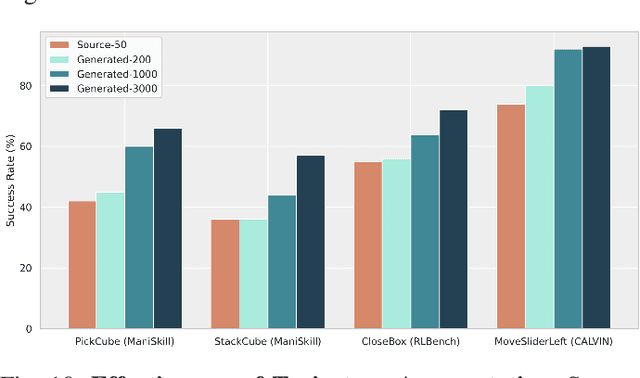
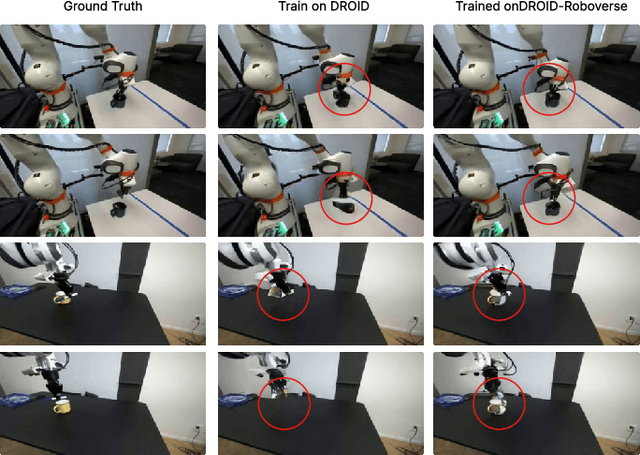
Data scaling and standardized evaluation benchmarks have driven significant advances in natural language processing and computer vision. However, robotics faces unique challenges in scaling data and establishing evaluation protocols. Collecting real-world data is resource-intensive and inefficient, while benchmarking in real-world scenarios remains highly complex. Synthetic data and simulation offer promising alternatives, yet existing efforts often fall short in data quality, diversity, and benchmark standardization. To address these challenges, we introduce RoboVerse, a comprehensive framework comprising a simulation platform, a synthetic dataset, and unified benchmarks. Our simulation platform supports multiple simulators and robotic embodiments, enabling seamless transitions between different environments. The synthetic dataset, featuring high-fidelity physics and photorealistic rendering, is constructed through multiple approaches. Additionally, we propose unified benchmarks for imitation learning and reinforcement learning, enabling evaluation across different levels of generalization. At the core of the simulation platform is MetaSim, an infrastructure that abstracts diverse simulation environments into a universal interface. It restructures existing simulation environments into a simulator-agnostic configuration system, as well as an API aligning different simulator functionalities, such as launching simulation environments, loading assets with initial states, stepping the physics engine, etc. This abstraction ensures interoperability and extensibility. Comprehensive experiments demonstrate that RoboVerse enhances the performance of imitation learning, reinforcement learning, world model learning, and sim-to-real transfer. These results validate the reliability of our dataset and benchmarks, establishing RoboVerse as a robust solution for advancing robot learning.
KUDA: Keypoints to Unify Dynamics Learning and Visual Prompting for Open-Vocabulary Robotic Manipulation
Mar 13, 2025With the rapid advancement of large language models (LLMs) and vision-language models (VLMs), significant progress has been made in developing open-vocabulary robotic manipulation systems. However, many existing approaches overlook the importance of object dynamics, limiting their applicability to more complex, dynamic tasks. In this work, we introduce KUDA, an open-vocabulary manipulation system that integrates dynamics learning and visual prompting through keypoints, leveraging both VLMs and learning-based neural dynamics models. Our key insight is that a keypoint-based target specification is simultaneously interpretable by VLMs and can be efficiently translated into cost functions for model-based planning. Given language instructions and visual observations, KUDA first assigns keypoints to the RGB image and queries the VLM to generate target specifications. These abstract keypoint-based representations are then converted into cost functions, which are optimized using a learned dynamics model to produce robotic trajectories. We evaluate KUDA on a range of manipulation tasks, including free-form language instructions across diverse object categories, multi-object interactions, and deformable or granular objects, demonstrating the effectiveness of our framework. The project page is available at http://kuda-dynamics.github.io.
Learning from Massive Human Videos for Universal Humanoid Pose Control
Dec 18, 2024


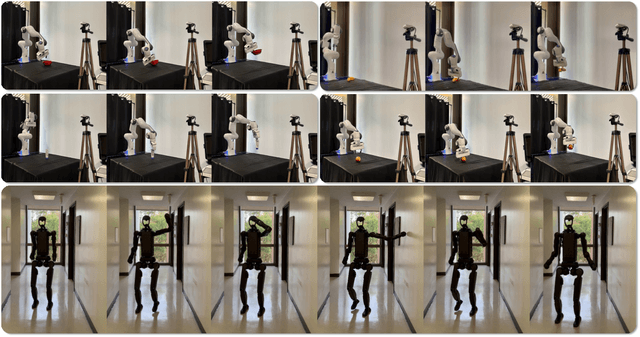
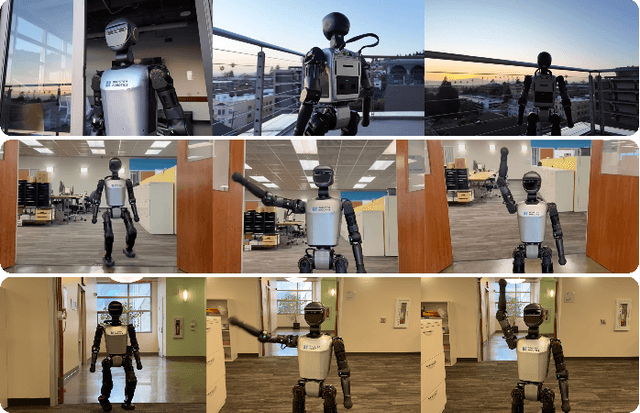
Scalable learning of humanoid robots is crucial for their deployment in real-world applications. While traditional approaches primarily rely on reinforcement learning or teleoperation to achieve whole-body control, they are often limited by the diversity of simulated environments and the high costs of demonstration collection. In contrast, human videos are ubiquitous and present an untapped source of semantic and motion information that could significantly enhance the generalization capabilities of humanoid robots. This paper introduces Humanoid-X, a large-scale dataset of over 20 million humanoid robot poses with corresponding text-based motion descriptions, designed to leverage this abundant data. Humanoid-X is curated through a comprehensive pipeline: data mining from the Internet, video caption generation, motion retargeting of humans to humanoid robots, and policy learning for real-world deployment. With Humanoid-X, we further train a large humanoid model, UH-1, which takes text instructions as input and outputs corresponding actions to control a humanoid robot. Extensive simulated and real-world experiments validate that our scalable training approach leads to superior generalization in text-based humanoid control, marking a significant step toward adaptable, real-world-ready humanoid robots.
Dynamic 3D Gaussian Tracking for Graph-Based Neural Dynamics Modeling
Oct 24, 2024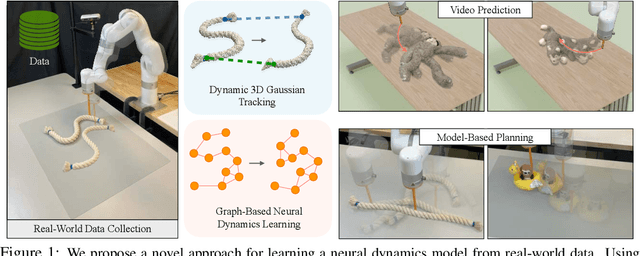
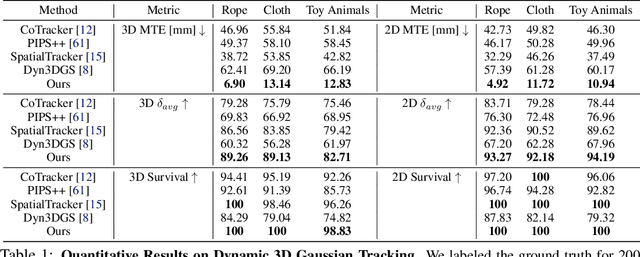
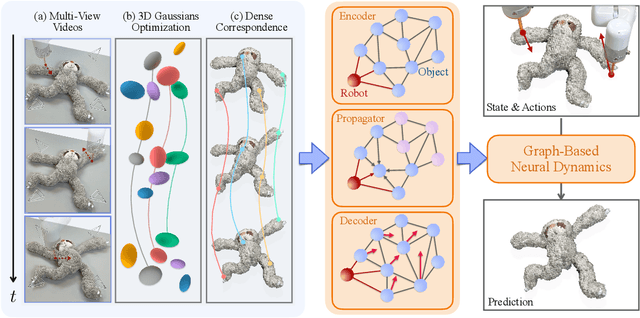
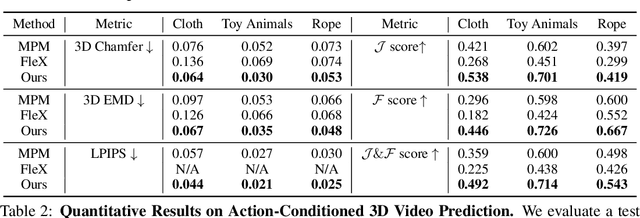
Videos of robots interacting with objects encode rich information about the objects' dynamics. However, existing video prediction approaches typically do not explicitly account for the 3D information from videos, such as robot actions and objects' 3D states, limiting their use in real-world robotic applications. In this work, we introduce a framework to learn object dynamics directly from multi-view RGB videos by explicitly considering the robot's action trajectories and their effects on scene dynamics. We utilize the 3D Gaussian representation of 3D Gaussian Splatting (3DGS) to train a particle-based dynamics model using Graph Neural Networks. This model operates on sparse control particles downsampled from the densely tracked 3D Gaussian reconstructions. By learning the neural dynamics model on offline robot interaction data, our method can predict object motions under varying initial configurations and unseen robot actions. The 3D transformations of Gaussians can be interpolated from the motions of control particles, enabling the rendering of predicted future object states and achieving action-conditioned video prediction. The dynamics model can also be applied to model-based planning frameworks for object manipulation tasks. We conduct experiments on various kinds of deformable materials, including ropes, clothes, and stuffed animals, demonstrating our framework's ability to model complex shapes and dynamics. Our project page is available at https://gs-dynamics.github.io.