 Add to Chrome
 Add to Firefox
 Add to Edge
ASK-NN: An Asymmetric Nearest-Neighbor Test that detects Distribution Drifts in Natural Language
Jul 17, 2026
Hallucinations and artificial text in LLM-generated outputs often appear as distributional deviations between prompt and response hidden-state distributions. Since prompts or retrieved contexts typically serve as reference samples and responses as query samples, with major differences in length, these asymmetries motivate the use of change test statistics that treat the two samples differently. We consider an asymmetric two-sample test ASK-NN based on the directed k-nearest-neighbor graph. Our statistic counts reference points whose nearest neighbor in the pooled sample is also a reference point. Under the permutation null, it admits an exact finite-sample conditional mean and variance; we further establish asymptotic normality and consistency under fixed alternatives. ASK-NN is computationally effective and easy to implement. Empirically, it is competitive with kernel and graph-based baselines on synthetic benchmarks, artificial-text detection, and LLM hallucination detection from token-level hidden states.

DemoBridge: A Simulation-in-the-Loop Toolkit for Single-View Human Demonstration Retargeting
Jul 10, 2026We present DemoBridge, an toolkit that turns a single-view RGB stereo recording of a human hand demonstration into an executable, physics-validated robot-arm trajectory. Retargeting across the embodiment gap is hard. A robot arm reaches a target with a long, articulated body whose links carry far more collision volume than a hand. Solving inverse kinematics for the mapped end-effector pose often yields no collision-free solution, and a trajectory imposes this at every waypoint. A single view adds noise, leaving the demonstrated reference inaccurate. At the core of DemoBridge is a single collision-aware planner. It optimizes the whole joint trajectory at once, reasoning jointly over alternative grasp poses, whole-arm and grasped-object collision, and fidelity to the demonstrated path. A physics simulator runs in the loop. It validates each phase as it is produced and backtracks on failure, so a demonstration that cannot be reproduced as given is re-planned rather than discarded. The resulting action sequence is dynamically stable and faithful to the demonstrated manipulation. It also doubles as a ready-to-use simulation rollout for policy learning. Grasp timing is inferred automatically, and the perception backends, robot, and pipeline stages are swappable from configuration. We evaluate whole-pipeline retargeting on three real-demonstration tasks and the planner on a controlled synthetic benchmark. Our code is available at https://gitlab.kuleuven.be/u0123974/demo-bridge/ .
Duet: Dual-Robot Understanding via Efficient Teaching
Jun 18, 2026Dual-robot collaboration enables tasks that exceed the reach and payload of a single robot, such as collaboratively transporting objects across environments and executing coordinated handovers. Data acquisition is the primary bottleneck for training these systems. To this end, we introduce DUET, a dual-robot learning framework for mobile manipulation. For efficient data collection, we create a unified dual-embodiment synchronized VR-based teleoperation system for in-domain heterogeneous robot data collection. We further develop a complementary tracking pipeline that records human-human coordination and collaborative mobile manipulation priors. To allow efficient learning, we introduce an Action Chunking Transformer based architecture that first pretrains collaborative policies on efficient human-human demonstrations, before finetuning them on a minimal set of real-robot teleoperation trajectories. We develop a benchmark of four collaborative tasks to evaluate our framework using a Unitree G1 humanoid and a Dexmate Vega1 mobile manipulator. The results demonstrate that harnessing human priors not only yields superior task performance compared to baselines trained only on robot data, but also reduces the total human effort required for data collection. Our human data collection pipeline achieves 5.4x acceleration on average from teleoperation, but we perform equally or better than robot-only data trained policies across all tasks. Our project page is available at https://zhaoy37.github.io/Duet/.
MilliVid: Hierarchical Latents for Long-Range Consistency in Video Generation
Jun 08, 2026Video generative models have become increasingly powerful, but long-range consistency remains challenging to achieve because even a few dozen frames require impractically long transformer sequence lengths. We show that this issue can be mitigated by generating video using coarse-to-fine rollout within a multi-scale token space. Our approach is simple: first, we pre-train an autoencoder that compresses each frame into a hierarchy of tokens, with levels ranging from the typical latent resolution to only a handful of tokens per frame. The coarsest levels capture the most consequential information, such as scene layout and semantics, while finer levels add high-frequency appearance and texture. Then, we train a video diffusion model to generate these tokens using coarse-to-fine rollout. By carefully controlling the level of detail at which frames are generated and used as context during each rollout step, we are able to preserve long-range consistency in geometry and object permanence while spending less compute on the long-range consistency of less perceptually relevant details. We validate this approach using a custom dataset of long Minecraft videos, where it produces substantially more consistent rollouts compared to existing baselines.
SceneSmith: Agentic Generation of Simulation-Ready Indoor Scenes
Feb 09, 2026Simulation has become a key tool for training and evaluating home robots at scale, yet existing environments fail to capture the diversity and physical complexity of real indoor spaces. Current scene synthesis methods produce sparsely furnished rooms that lack the dense clutter, articulated furniture, and physical properties essential for robotic manipulation. We introduce SceneSmith, a hierarchical agentic framework that generates simulation-ready indoor environments from natural language prompts. SceneSmith constructs scenes through successive stages$\unicode{x2013}$from architectural layout to furniture placement to small object population$\unicode{x2013}$each implemented as an interaction among VLM agents: designer, critic, and orchestrator. The framework tightly integrates asset generation through text-to-3D synthesis for static objects, dataset retrieval for articulated objects, and physical property estimation. SceneSmith generates 3-6x more objects than prior methods, with <2% inter-object collisions and 96% of objects remaining stable under physics simulation. In a user study with 205 participants, it achieves 92% average realism and 91% average prompt faithfulness win rates against baselines. We further demonstrate that these environments can be used in an end-to-end pipeline for automatic robot policy evaluation.
AnyView: Synthesizing Any Novel View in Dynamic Scenes
Jan 23, 2026Modern generative video models excel at producing convincing, high-quality outputs, but struggle to maintain multi-view and spatiotemporal consistency in highly dynamic real-world environments. In this work, we introduce \textbf{AnyView}, a diffusion-based video generation framework for \emph{dynamic view synthesis} with minimal inductive biases or geometric assumptions. We leverage multiple data sources with various levels of supervision, including monocular (2D), multi-view static (3D) and multi-view dynamic (4D) datasets, to train a generalist spatiotemporal implicit representation capable of producing zero-shot novel videos from arbitrary camera locations and trajectories. We evaluate AnyView on standard benchmarks, showing competitive results with the current state of the art, and propose \textbf{AnyViewBench}, a challenging new benchmark tailored towards \emph{extreme} dynamic view synthesis in diverse real-world scenarios. In this more dramatic setting, we find that most baselines drastically degrade in performance, as they require significant overlap between viewpoints, while AnyView maintains the ability to produce realistic, plausible, and spatiotemporally consistent videos when prompted from \emph{any} viewpoint. Results, data, code, and models can be viewed at: https://tri-ml.github.io/AnyView/
PolaRiS: Scalable Real-to-Sim Evaluations for Generalist Robot Policies
Dec 18, 2025A significant challenge for robot learning research is our ability to accurately measure and compare the performance of robot policies. Benchmarking in robotics is historically challenging due to the stochasticity, reproducibility, and time-consuming nature of real-world rollouts. This challenge is exacerbated for recent generalist policies, which has to be evaluated across a wide variety of scenes and tasks. Evaluation in simulation offers a scalable complement to real world evaluations, but the visual and physical domain gap between existing simulation benchmarks and the real world has made them an unreliable signal for policy improvement. Furthermore, building realistic and diverse simulated environments has traditionally required significant human effort and expertise. To bridge the gap, we introduce Policy Evaluation and Environment Reconstruction in Simulation (PolaRiS), a scalable real-to-sim framework for high-fidelity simulated robot evaluation. PolaRiS utilizes neural reconstruction methods to turn short video scans of real-world scenes into interactive simulation environments. Additionally, we develop a simple simulation data co-training recipe that bridges remaining real-to-sim gaps and enables zero-shot evaluation in unseen simulation environments. Through extensive paired evaluations between simulation and the real world, we demonstrate that PolaRiS evaluations provide a much stronger correlation to real world generalist policy performance than existing simulated benchmarks. Its simplicity also enables rapid creation of diverse simulated environments. As such, this work takes a step towards distributed and democratized evaluation for the next generation of robotic foundation models.
GTR: Gaussian Splatting Tracking and Reconstruction of Unknown Objects Based on Appearance and Geometric Complexity
May 17, 2025We present a novel method for 6-DoF object tracking and high-quality 3D reconstruction from monocular RGBD video. Existing methods, while achieving impressive results, often struggle with complex objects, particularly those exhibiting symmetry, intricate geometry or complex appearance. To bridge these gaps, we introduce an adaptive method that combines 3D Gaussian Splatting, hybrid geometry/appearance tracking, and key frame selection to achieve robust tracking and accurate reconstructions across a diverse range of objects. Additionally, we present a benchmark covering these challenging object classes, providing high-quality annotations for evaluating both tracking and reconstruction performance. Our approach demonstrates strong capabilities in recovering high-fidelity object meshes, setting a new standard for single-sensor 3D reconstruction in open-world environments.
Steerable Scene Generation with Post Training and Inference-Time Search
May 07, 2025Training robots in simulation requires diverse 3D scenes that reflect the specific challenges of downstream tasks. However, scenes that satisfy strict task requirements, such as high-clutter environments with plausible spatial arrangement, are rare and costly to curate manually. Instead, we generate large-scale scene data using procedural models that approximate realistic environments for robotic manipulation, and adapt it to task-specific goals. We do this by training a unified diffusion-based generative model that predicts which objects to place from a fixed asset library, along with their SE(3) poses. This model serves as a flexible scene prior that can be adapted using reinforcement learning-based post training, conditional generation, or inference-time search, steering generation toward downstream objectives even when they differ from the original data distribution. Our method enables goal-directed scene synthesis that respects physical feasibility and scales across scene types. We introduce a novel MCTS-based inference-time search strategy for diffusion models, enforce feasibility via projection and simulation, and release a dataset of over 44 million SE(3) scenes spanning five diverse environments. Website with videos, code, data, and model weights: https://steerable-scene-generation.github.io/
ZeroGrasp: Zero-Shot Shape Reconstruction Enabled Robotic Grasping
Apr 15, 2025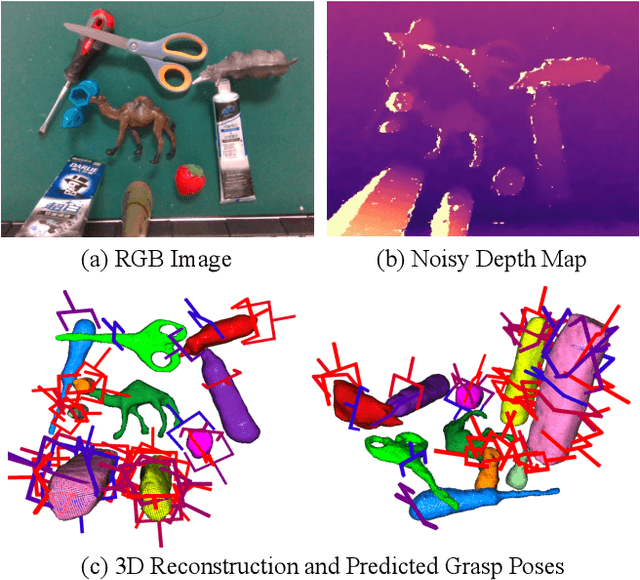
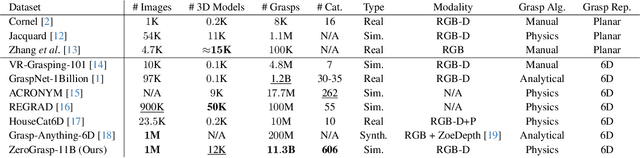
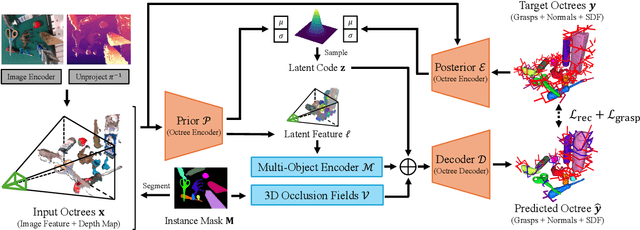
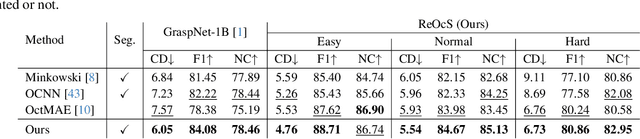
Robotic grasping is a cornerstone capability of embodied systems. Many methods directly output grasps from partial information without modeling the geometry of the scene, leading to suboptimal motion and even collisions. To address these issues, we introduce ZeroGrasp, a novel framework that simultaneously performs 3D reconstruction and grasp pose prediction in near real-time. A key insight of our method is that occlusion reasoning and modeling the spatial relationships between objects is beneficial for both accurate reconstruction and grasping. We couple our method with a novel large-scale synthetic dataset, which comprises 1M photo-realistic images, high-resolution 3D reconstructions and 11.3B physically-valid grasp pose annotations for 12K objects from the Objaverse-LVIS dataset. We evaluate ZeroGrasp on the GraspNet-1B benchmark as well as through real-world robot experiments. ZeroGrasp achieves state-of-the-art performance and generalizes to novel real-world objects by leveraging synthetic data.