 Add to Chrome
 Add to Firefox
 Add to Edge
SG-WAM: Text-Grounded and Spatial-aware Semantic Guidance for World-Action Models
Aug 09, 2026
World-Action Models (WAMs) have emerged as a promising paradigm for robotic manipulation. However, most existing WAMs generate future videos and actions by relying mainly on visual cues rather than language instructions, since off-the-shelf text encoders embed instructions independently of visual observations. As a result, the videos predicted by these WAMs are often semantically misaligned with their corresponding language instructions, which degrades the accuracy of the predicted actions. To overcome this limitation, we propose SG-WAM, a semantic guidance method for world-action models that leverages a vision-language model (VLM) as a semantic planner to enhance the instruction-grounding capacity of world-action models. Specifically, we train a VLM-based planner to predict text-grounded and spatial-aware semantic foresight. The text-grounded semantic foresight grounds the instruction by identifying the correct target objects, and the spatial-aware semantic foresight provides the scene geometry for precise manipulation. We then inject this foresight into the world-action model as high-level semantic guidance, ensuring that both future-video generation and action prediction faithfully follow the language instruction. Extensive experiments in simulation and the real world demonstrate the superiority of our semantic guidance method, showcasing precise manipulation and strong instruction-following capabilities.

HiL-ResRL: A Model-Agnostic Finetuning Adapter via Human-in-the-loop Residual Reinforcement Learning
Jun 22, 2026Recent advancements in generative imitation learning have significantly propelled the field of robotic manipulation. However, the majority of existing models rely heavily on Behavior Cloning (BC), a paradigm that suffers from compounding errors and distributional shift. Consequently, the efficacy of these models in practical industrial deployments remains limited. To address these challenges, we introduce a novel, plug-and-play fine-tuning pipeline designed to facilitate the robust deployment of Vision-Language-Action (VLA) models in real-world environments. In contrast to contemporary reinforcement learning (RL) fine-tuning strategies, which are often constrained by specific model architectures, our proposed framework is model-agnostic and adaptable to a diverse range of VLA models. We conceptualize VLA-generated actions as a unified interface, upon which we train a residual policy. This policy is designed to rectify suboptimal actions and address the distributional shift inherent in imitation learning. Additionally, we incorporate human-in-the-loop guidance to ensure safe exploration and maximize training efficiency. We conduct experiments directly in real-world robotic settings. The results demonstrate that within only 1.5 hour of real-world online RL training, the average success rate exceeds 95% on real robots. Our work presents a practical solution for deploying behavior cloning models in industrial scenarios.
HyperSim: A Holistic Sim-To-Real Framework For Robust Robotic Manipulation
May 26, 2026Scaling data volume and diversity is critical for generalizing embodied intelligence. While synthetic data generation offers a scalable alternative to expensive physical data acquisition, transferring robotic manipulation policies from simulation to the real world (sim-to-real) remains a formidable challenge due to the domain gap. This paper presents HyperSim, a holistic framework spanning from synthetic data generation to policy training and seamless real-world deployment. To systematically bridge the sim-to-real gap, HyperSim is realized through three core pillars: high-fidelity environment synthesis, adversarial trajectory generation, and sim-and-real co-training. Collectively, these modules address domain discrepancies by enhancing visual fidelity, expanding data coverage, and enforcing domain-invariant representations. We rigorously validate HyperSim through a large-scale empirical study involving 400 real-world task executions across two representative manipulation models. Assessed across three fine-grained metrics, our complete pipeline achieves remarkable sim-to-real success rates of 80% and 95% with ACT and π_{0}, respectively. Furthermore, policies trained on our adversarial trajectories exhibit significantly enhanced robustness against dynamic uncertainties, achieving a 35% higher completion rate under physical perturbations.
CPPO: Contrastive Perception for Vision Language Policy Optimization
Jan 01, 2026We introduce CPPO, a Contrastive Perception Policy Optimization method for finetuning vision-language models (VLMs). While reinforcement learning (RL) has advanced reasoning in language models, extending it to multimodal reasoning requires improving both the perception and reasoning aspects. Prior works tackle this challenge mainly with explicit perception rewards, but disentangling perception tokens from reasoning tokens is difficult, requiring extra LLMs, ground-truth data, forced separation of perception from reasoning by policy model, or applying rewards indiscriminately to all output tokens. CPPO addresses this problem by detecting perception tokens via entropy shifts in the model outputs under perturbed input images. CPPO then extends the RL objective function with a Contrastive Perception Loss (CPL) that enforces consistency under information-preserving perturbations and sensitivity under information-removing ones. Experiments show that CPPO surpasses previous perception-rewarding methods, while avoiding extra models, making training more efficient and scalable.
ETP-R1: Evolving Topological Planning with Reinforcement Fine-tuning for Vision-Language Navigation in Continuous Environments
Dec 24, 2025Vision-Language Navigation in Continuous Environments (VLN-CE) requires an embodied agent to navigate towards target in continuous environments, following natural language instructions. While current graph-based methods offer an efficient, structured approach by abstracting the environment into a topological map and simplifying the action space to waypoint selection, they lag behind methods based on Large Vision-Language Models (LVLMs) in leveraging large-scale data and advanced training paradigms. In this paper, we try to bridge this gap by introducing ETP-R1, a framework that applies the paradigm of scaling up data and Reinforcement Fine-Tuning (RFT) to a graph-based VLN-CE model. To build a strong foundation, we first construct a high-quality, large-scale pretraining dataset using the Gemini API. This dataset consists of diverse, low-hallucination instructions for topological trajectories, providing rich supervision for our graph-based policy to map language to topological paths. This foundation is further strengthened by unifying data from both R2R and RxR tasks for joint pretraining. Building on this, we introduce a three-stage training paradigm, which culminates in the first application of closed-loop, online RFT to a graph-based VLN-CE model, powered by the Group Relative Policy Optimization (GRPO) algorithm. Extensive experiments demonstrate that our approach is highly effective, establishing new state-of-the-art performance across all major metrics on both the R2R-CE and RxR-CE benchmarks. Our code is available at https://github.com/Cepillar/ETP-R1.
Dynamic Mixture of Progressive Parameter-Efficient Expert Library for Lifelong Robot Learning
Jun 06, 2025A generalist agent must continuously learn and adapt throughout its lifetime, achieving efficient forward transfer while minimizing catastrophic forgetting. Previous work within the dominant pretrain-then-finetune paradigm has explored parameter-efficient fine-tuning for single-task adaptation, effectively steering a frozen pretrained model with a small number of parameters. However, in the context of lifelong learning, these methods rely on the impractical assumption of a test-time task identifier and restrict knowledge sharing among isolated adapters. To address these limitations, we propose Dynamic Mixture of Progressive Parameter-Efficient Expert Library (DMPEL) for lifelong robot learning. DMPEL progressively learn a low-rank expert library and employs a lightweight router to dynamically combine experts into an end-to-end policy, facilitating flexible behavior during lifelong adaptation. Moreover, by leveraging the modular structure of the fine-tuned parameters, we introduce coefficient replay to guide the router in accurately retrieving frozen experts for previously encountered tasks, thereby mitigating catastrophic forgetting. This method is significantly more storage- and computationally-efficient than applying demonstration replay to the entire policy. Extensive experiments on the lifelong manipulation benchmark LIBERO demonstrate that our framework outperforms state-of-the-art lifelong learning methods in success rates across continual adaptation, while utilizing minimal trainable parameters and storage.
OccluGaussian: Occlusion-Aware Gaussian Splatting for Large Scene Reconstruction and Rendering
Mar 20, 2025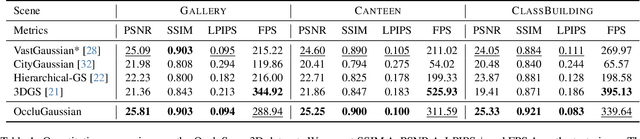
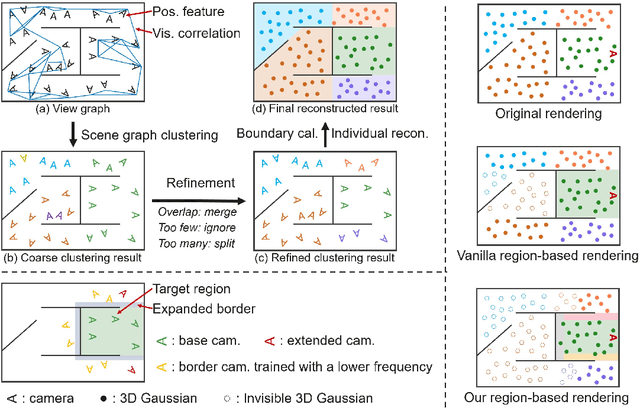
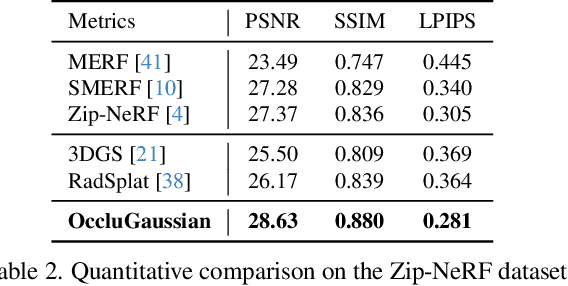
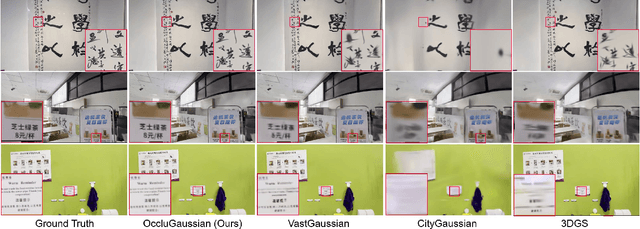
In large-scale scene reconstruction using 3D Gaussian splatting, it is common to partition the scene into multiple smaller regions and reconstruct them individually. However, existing division methods are occlusion-agnostic, meaning that each region may contain areas with severe occlusions. As a result, the cameras within those regions are less correlated, leading to a low average contribution to the overall reconstruction. In this paper, we propose an occlusion-aware scene division strategy that clusters training cameras based on their positions and co-visibilities to acquire multiple regions. Cameras in such regions exhibit stronger correlations and a higher average contribution, facilitating high-quality scene reconstruction. We further propose a region-based rendering technique to accelerate large scene rendering, which culls Gaussians invisible to the region where the viewpoint is located. Such a technique significantly speeds up the rendering without compromising quality. Extensive experiments on multiple large scenes show that our method achieves superior reconstruction results with faster rendering speed compared to existing state-of-the-art approaches. Project page: https://occlugaussian.github.io.
Scale Disparity of Instances in Interactive Point Cloud Segmentation
Jul 19, 2024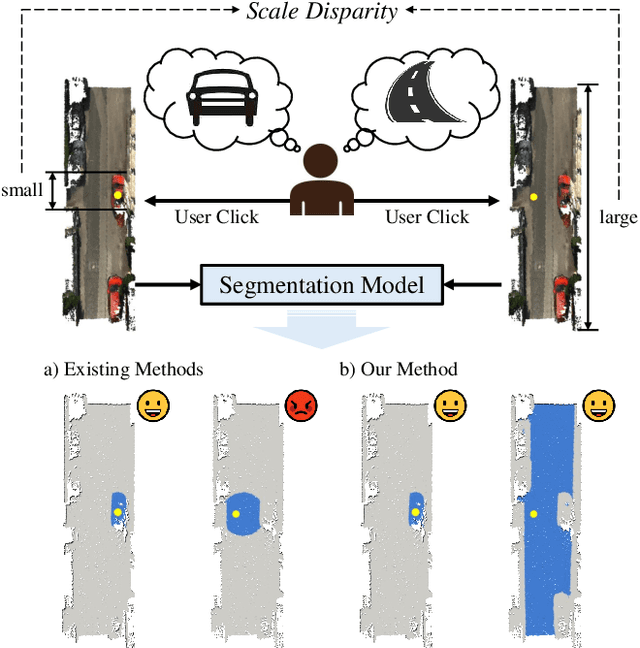

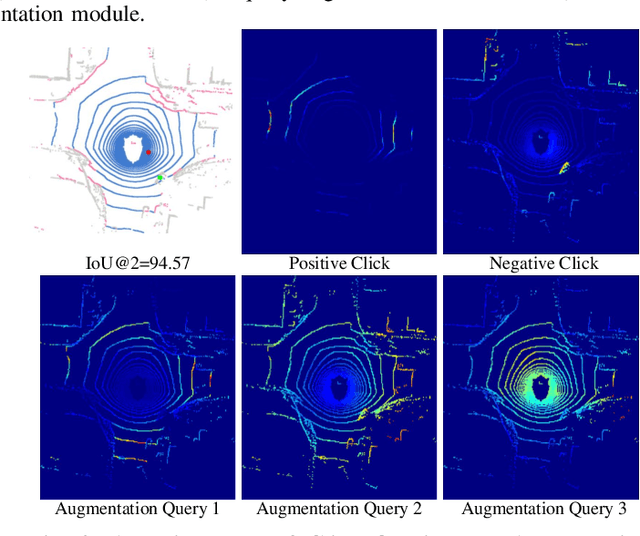
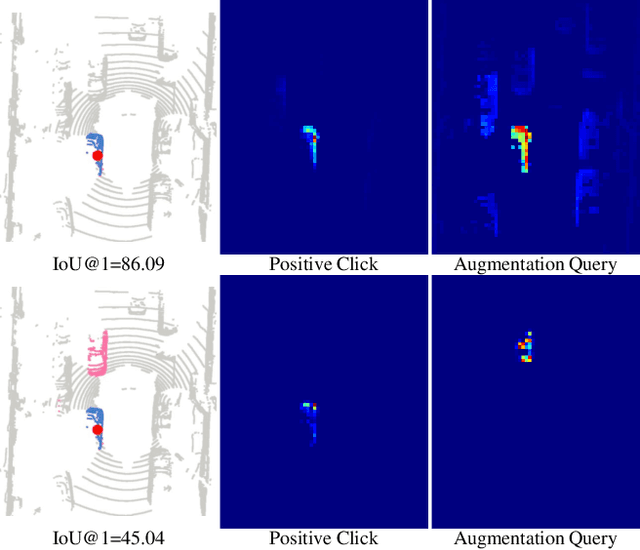
Interactive point cloud segmentation has become a pivotal task for understanding 3D scenes, enabling users to guide segmentation models with simple interactions such as clicks, therefore significantly reducing the effort required to tailor models to diverse scenarios and new categories. However, in the realm of interactive segmentation, the meaning of instance diverges from that in instance segmentation, because users might desire to segment instances of both thing and stuff categories that vary greatly in scale. Existing methods have focused on thing categories, neglecting the segmentation of stuff categories and the difficulties arising from scale disparity. To bridge this gap, we propose ClickFormer, an innovative interactive point cloud segmentation model that accurately segments instances of both thing and stuff categories. We propose a query augmentation module to augment click queries by a global query sampling strategy, thus maintaining consistent performance across different instance scales. Additionally, we employ global attention in the query-voxel transformer to mitigate the risk of generating false positives, along with several other network structure improvements to further enhance the model's segmentation performance. Experiments demonstrate that ClickFormer outperforms existing interactive point cloud segmentation methods across both indoor and outdoor datasets, providing more accurate segmentation results with fewer user clicks in an open-world setting.
Preserving Full Degradation Details for Blind Image Super-Resolution
Jul 02, 2024

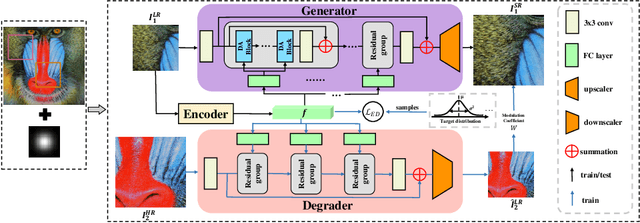

The performance of image super-resolution relies heavily on the accuracy of degradation information, especially under blind settings. Due to absence of true degradation models in real-world scenarios, previous methods learn distinct representations by distinguishing different degradations in a batch. However, the most significant degradation differences may provide shortcuts for the learning of representations such that subtle difference may be discarded. In this paper, we propose an alternative to learn degradation representations through reproducing degraded low-resolution (LR) images. By guiding the degrader to reconstruct input LR images, full degradation information can be encoded into the representations. In addition, we develop an energy distance loss to facilitate the learning of the degradation representations by introducing a bounded constraint. Experiments show that our representations can extract accurate and highly robust degradation information. Moreover, evaluations on both synthetic and real images demonstrate that our ReDSR achieves state-of-the-art performance for the blind SR tasks.
PanopticRecon: Leverage Open-vocabulary Instance Segmentation for Zero-shot Panoptic Reconstruction
Jul 01, 2024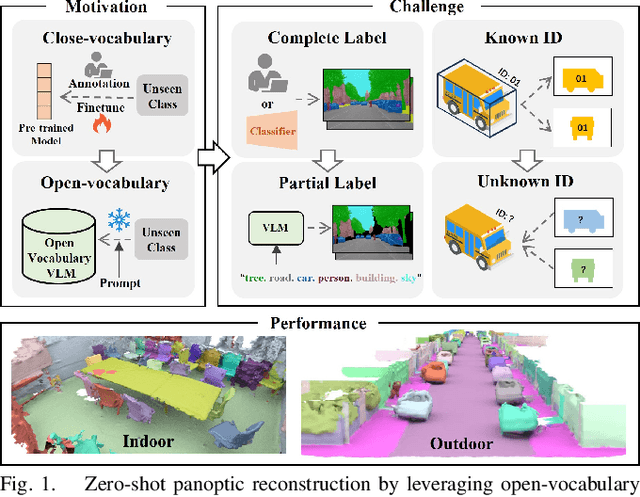
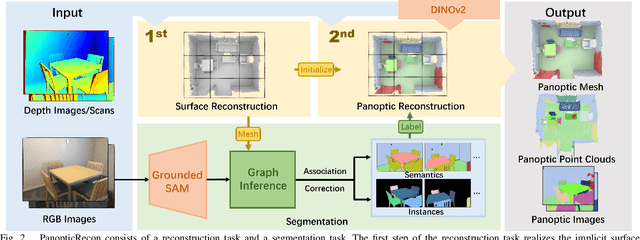
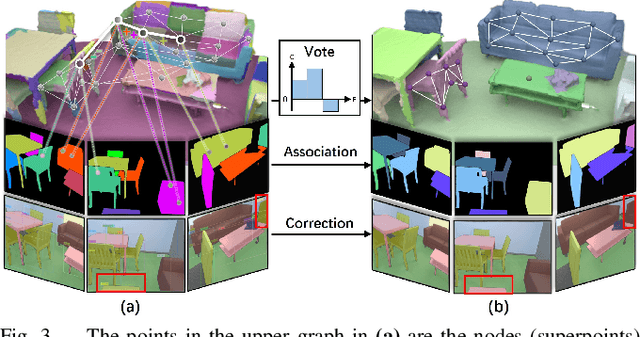
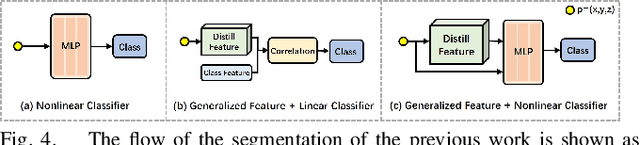
Panoptic reconstruction is a challenging task in 3D scene understanding. However, most existing methods heavily rely on pre-trained semantic segmentation models and known 3D object bounding boxes for 3D panoptic segmentation, which is not available for in-the-wild scenes. In this paper, we propose a novel zero-shot panoptic reconstruction method from RGB-D images of scenes. For zero-shot segmentation, we leverage open-vocabulary instance segmentation, but it has to face partial labeling and instance association challenges. We tackle both challenges by propagating partial labels with the aid of dense generalized features and building a 3D instance graph for associating 2D instance IDs. Specifically, we exploit partial labels to learn a classifier for generalized semantic features to provide complete labels for scenes with dense distilled features. Moreover, we formulate instance association as a 3D instance graph segmentation problem, allowing us to fully utilize the scene geometry prior and all 2D instance masks to infer global unique pseudo 3D instance ID. Our method outperforms state-of-the-art methods on the indoor dataset ScanNet V2 and the outdoor dataset KITTI-360, demonstrating the effectiveness of our graph segmentation method and reconstruction network.