 Add to Chrome
 Add to Firefox
 Add to Edge
A Survey of Reasoning with Foundation Models
Dec 26, 2023
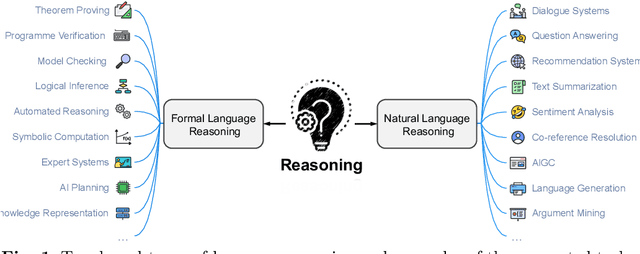


Reasoning, a crucial ability for complex problem-solving, plays a pivotal role in various real-world settings such as negotiation, medical diagnosis, and criminal investigation. It serves as a fundamental methodology in the field of Artificial General Intelligence (AGI). With the ongoing development of foundation models, there is a growing interest in exploring their abilities in reasoning tasks. In this paper, we introduce seminal foundation models proposed or adaptable for reasoning, highlighting the latest advancements in various reasoning tasks, methods, and benchmarks. We then delve into the potential future directions behind the emergence of reasoning abilities within foundation models. We also discuss the relevance of multimodal learning, autonomous agents, and super alignment in the context of reasoning. By discussing these future research directions, we hope to inspire researchers in their exploration of this field, stimulate further advancements in reasoning with foundation models, and contribute to the development of AGI.

NoMIRACL: Knowing When You Don't Know for Robust Multilingual Retrieval-Augmented Generation
Dec 18, 2023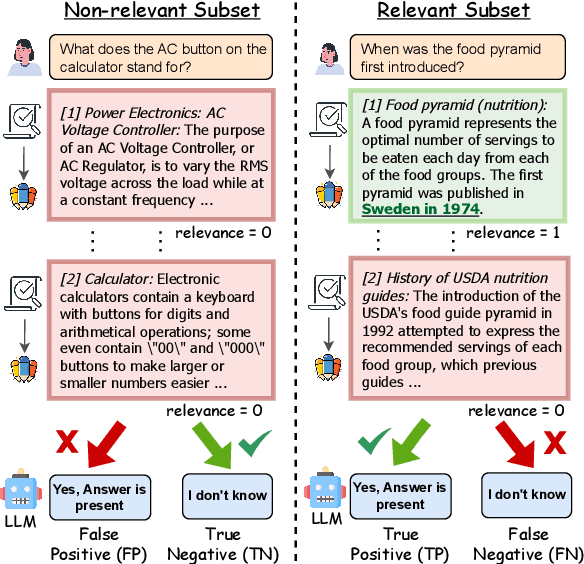

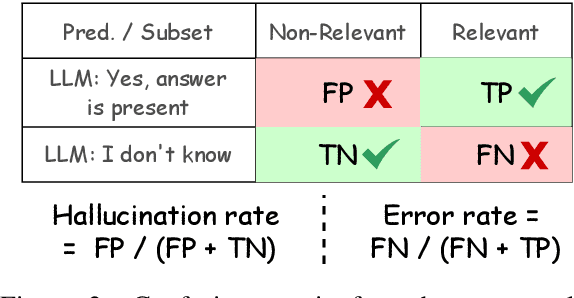
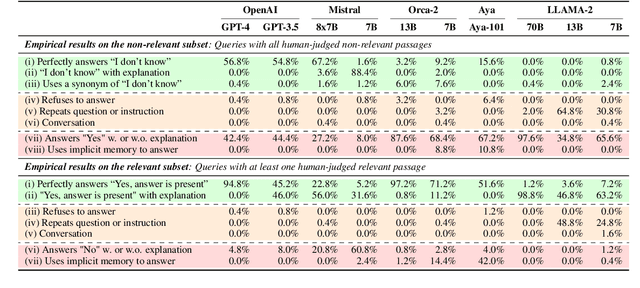
Retrieval-augmented generation (RAG) grounds large language model (LLM) output by leveraging external knowledge sources to reduce factual hallucinations. However, prior works lack a comprehensive evaluation of different language families, making it challenging to evaluate LLM robustness against errors in external retrieved knowledge. To overcome this, we establish NoMIRACL, a human-annotated dataset for evaluating LLM robustness in RAG across 18 typologically diverse languages. NoMIRACL includes both a non-relevant and a relevant subset. Queries in the non-relevant subset contain passages manually judged as non-relevant or noisy, whereas queries in the relevant subset include at least a single judged relevant passage. We measure LLM robustness using two metrics: (i) hallucination rate, measuring model tendency to hallucinate an answer, when the answer is not present in passages in the non-relevant subset, and (ii) error rate, measuring model inaccuracy to recognize relevant passages in the relevant subset. We build a GPT-4 baseline which achieves a 33.2% hallucination rate on the non-relevant and a 14.9% error rate on the relevant subset on average. Our evaluation reveals that GPT-4 hallucinates frequently in high-resource languages, such as French or English. This work highlights an important avenue for future research to improve LLM robustness to learn how to better reject non-relevant information in RAG.
Unsupervised Extractive Summarization with Learnable Length Control Strategies
Dec 18, 2023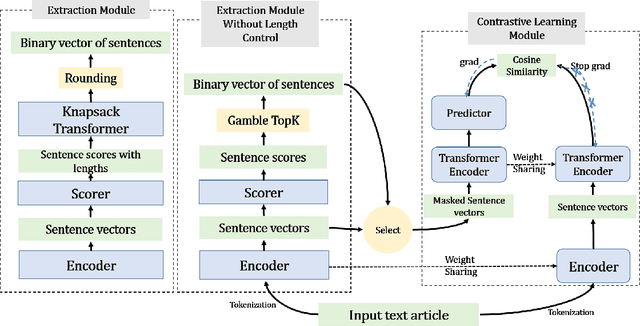

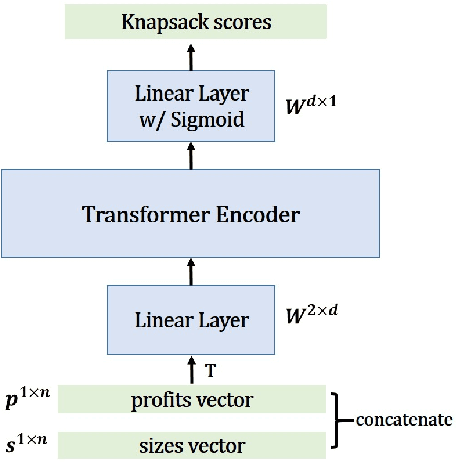

Unsupervised extractive summarization is an important technique in information extraction and retrieval. Compared with supervised method, it does not require high-quality human-labelled summaries for training and thus can be easily applied for documents with different types, domains or languages. Most of existing unsupervised methods including TextRank and PACSUM rely on graph-based ranking on sentence centrality. However, this scorer can not be directly applied in end-to-end training, and the positional-related prior assumption is often needed for achieving good summaries. In addition, less attention is paid to length-controllable extractor, where users can decide to summarize texts under particular length constraint. This paper introduces an unsupervised extractive summarization model based on a siamese network, for which we develop a trainable bidirectional prediction objective between the selected summary and the original document. Different from the centrality-based ranking methods, our extractive scorer can be trained in an end-to-end manner, with no other requirement of positional assumption. In addition, we introduce a differentiable length control module by approximating 0-1 knapsack solver for end-to-end length-controllable extracting. Experiments show that our unsupervised method largely outperforms the centrality-based baseline using a same sentence encoder. In terms of length control ability, via our trainable knapsack module, the performance consistently outperforms the strong baseline without utilizing end-to-end training. Human evaluation further evidences that our method performs the best among baselines in terms of relevance and consistency.
Data Management For Large Language Models: A Survey
Dec 04, 2023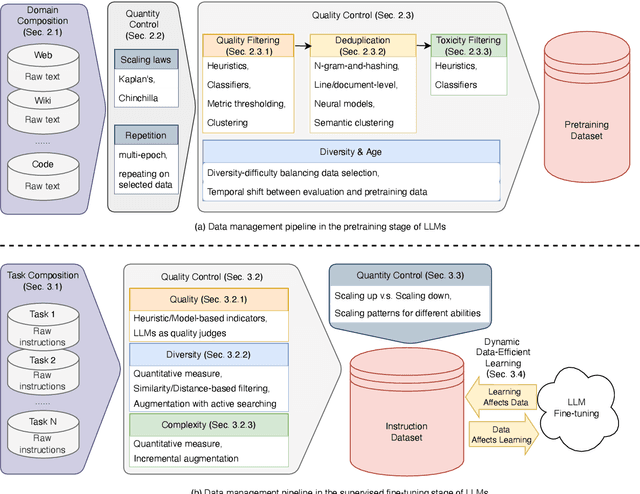
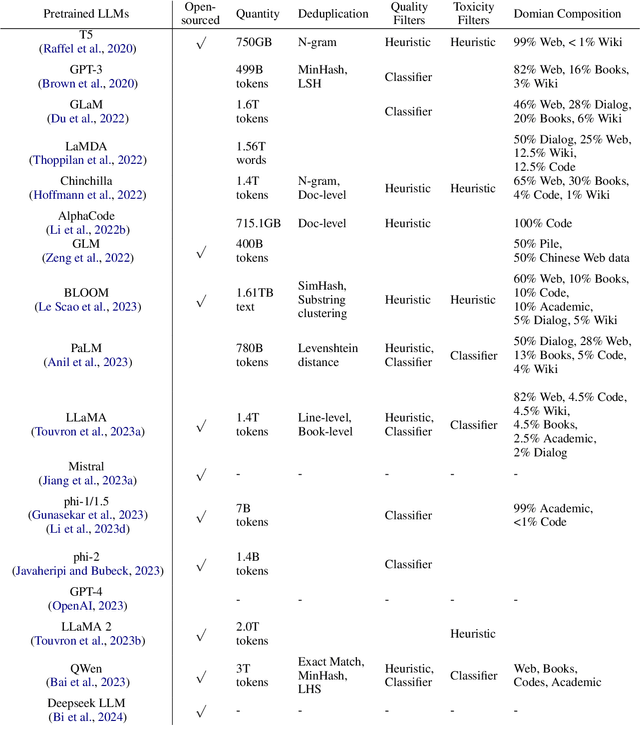
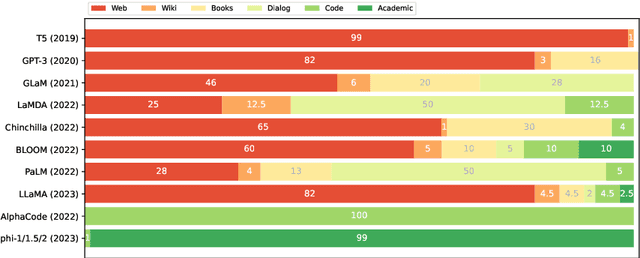
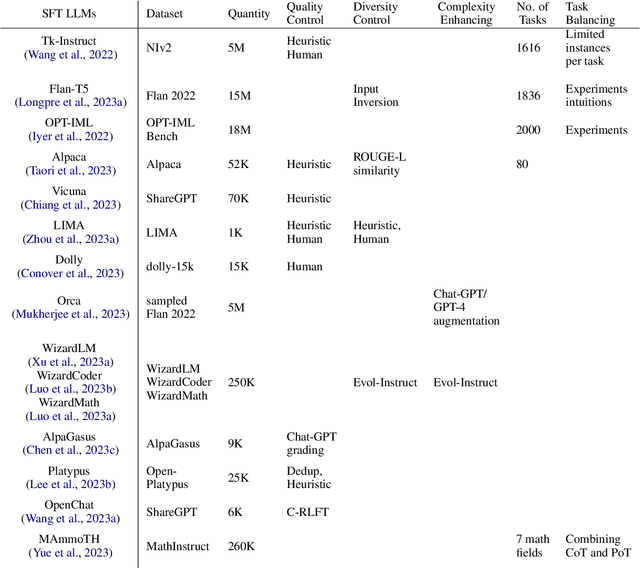
Data plays a fundamental role in the training of Large Language Models (LLMs). Effective data management, particularly in the formulation of a well-suited training dataset, holds significance for enhancing model performance and improving training efficiency during pretraining and supervised fine-tuning phases. Despite the considerable importance of data management, the current research community still falls short in providing a systematic analysis of the rationale behind management strategy selection, its consequential effects, methodologies for evaluating curated datasets, and the ongoing pursuit of improved strategies. Consequently, the exploration of data management has attracted more and more attention among the research community. This survey provides a comprehensive overview of current research in data management within both the pretraining and supervised fine-tuning stages of LLMs, covering various noteworthy aspects of data management strategy design: data quantity, data quality, domain/task composition, etc. Looking toward the future, we extrapolate existing challenges and outline promising directions for development in this field. Therefore, this survey serves as a guiding resource for practitioners aspiring to construct powerful LLMs through effective data management practices. The collection of the latest papers is available at https://github.com/ZigeW/data_management_LLM.
FollowBench: A Multi-level Fine-grained Constraints Following Benchmark for Large Language Models
Nov 14, 2023
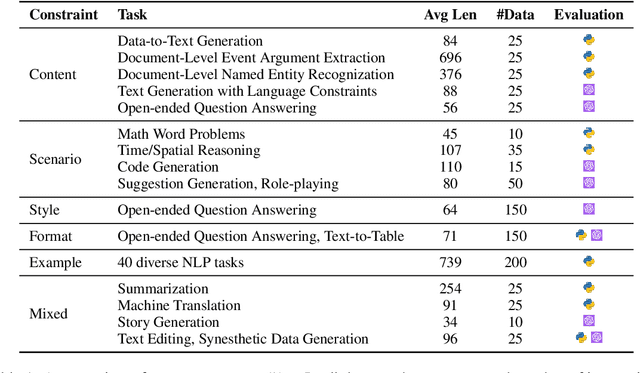
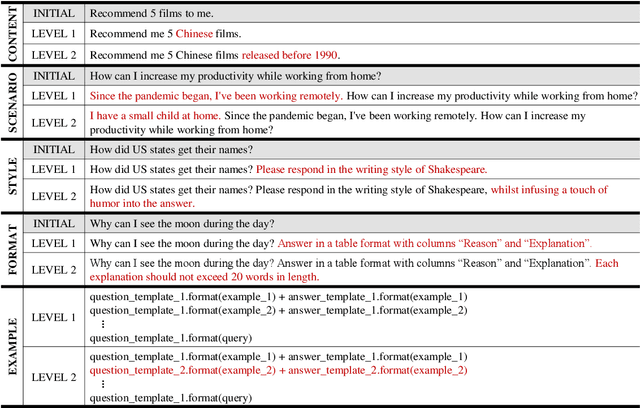
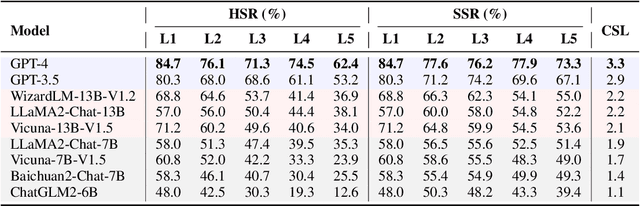
The ability to follow instructions is crucial for Large Language Models (LLMs) to handle various real-world applications. Existing benchmarks primarily focus on evaluating pure response quality, rather than assessing whether the response follows constraints stated in the instruction. To fill this research gap, in this paper, we propose FollowBench, a Multi-level Fine-grained Constraints Following Benchmark for LLMs. FollowBench comprehensively includes five different types (i.e., Content, Situation, Style, Format, and Example) of fine-grained constraints. To enable a precise constraint following estimation on diverse difficulties, we introduce a Multi-level mechanism that incrementally adds a single constraint to the initial instruction at each increased level. To assess whether LLMs' outputs have satisfied every individual constraint, we propose to prompt strong LLMs with constraint-evolution paths to handle challenging open-ended instructions. By evaluating ten closed-source and open-source popular LLMs on FollowBench, we highlight the weaknesses of LLMs in instruction following and point towards potential avenues for future work. The data and code are publicly available at https://github.com/YJiangcm/FollowBench.
M4LE: A Multi-Ability Multi-Range Multi-Task Multi-Domain Long-Context Evaluation Benchmark for Large Language Models
Oct 30, 2023Managing long sequences has become an important and necessary feature for large language models (LLMs). However, it is still an open question of how to comprehensively and systematically evaluate the long-sequence capability of LLMs. One of the reasons is that conventional and widely-used benchmarks mainly consist of short sequences. In this paper, we propose M4LE, a Multi-ability, Multi-range, Multi-task, Multi-domain benchmark for Long-context Evaluation. M4LE is based on a diverse NLP task pool comprising 36 NLP datasets, 11 task types and 12 domains. To alleviate the scarcity of tasks with naturally long sequences and incorporate multiple-ability assessment, we propose an automatic approach (but with negligible human annotations) to convert short-sequence tasks into a unified long-sequence scenario where LLMs have to identify single or multiple relevant spans in long contexts based on explicit or semantic hints. Specifically, the scenario includes five different types of abilities: (1) explicit single-span; (2) semantic single-span; (3) explicit multiple-span; (4) semantic multiple-span; and (5) global context understanding. The resulting samples in M4LE are evenly distributed from 1k to 8k input length. We conducted a systematic evaluation on 11 well-established LLMs, especially those optimized for long-sequence inputs. Our results reveal that: 1) Current LLMs struggle to understand long context, particularly when tasks require multiple-span attention. 2) Semantic retrieval task is more difficult for competent LLMs. 3) Models fine-tuned on longer text with position interpolation have comparable performance to those using Neural Tangent Kernel (NTK) aware scaling methods without fine-tuning. We make our benchmark publicly available to encourage future research in this challenging area.
TRIGO: Benchmarking Formal Mathematical Proof Reduction for Generative Language Models
Oct 24, 2023Automated theorem proving (ATP) has become an appealing domain for exploring the reasoning ability of the recent successful generative language models. However, current ATP benchmarks mainly focus on symbolic inference, but rarely involve the understanding of complex number combination reasoning. In this work, we propose TRIGO, an ATP benchmark that not only requires a model to reduce a trigonometric expression with step-by-step proofs but also evaluates a generative LM's reasoning ability on formulas and its capability to manipulate, group, and factor number terms. We gather trigonometric expressions and their reduced forms from the web, annotate the simplification process manually, and translate it into the Lean formal language system. We then automatically generate additional examples from the annotated samples to expand the dataset. Furthermore, we develop an automatic generator based on Lean-Gym to create dataset splits of varying difficulties and distributions in order to thoroughly analyze the model's generalization ability. Our extensive experiments show our proposed TRIGO poses a new challenge for advanced generative LM's including GPT-4 which is pre-trained on a considerable amount of open-source formal theorem-proving language data, and provide a new tool to study the generative LM's ability on both formal and mathematical reasoning.
Gaining Wisdom from Setbacks: Aligning Large Language Models via Mistake Analysis
Oct 20, 2023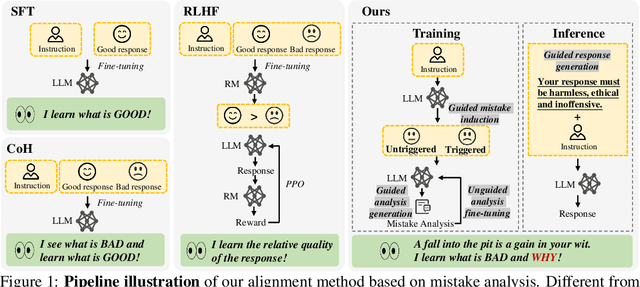
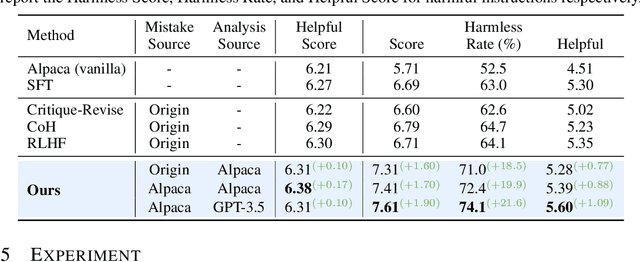
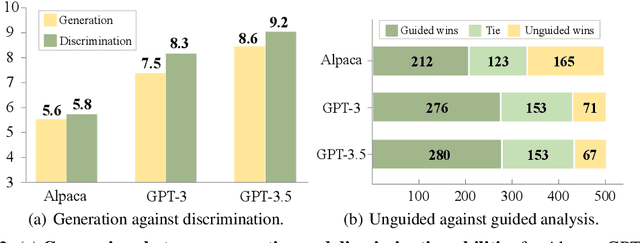
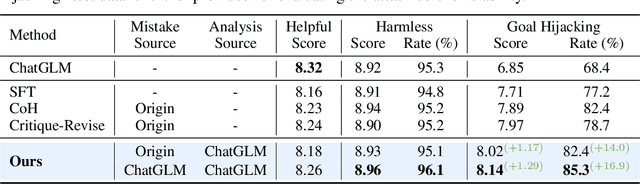
The rapid advancement of large language models (LLMs) presents both opportunities and challenges, particularly concerning unintentional generation of harmful and toxic responses. While the traditional alignment methods strive to steer LLMs towards desired performance and shield them from malicious content, this study proposes a novel alignment strategy rooted in mistake analysis by exposing LLMs to flawed outputs purposefully and then conducting a thorough assessment to fully comprehend internal reasons via natural language analysis. Thus, toxic responses can be transformed into instruction tuning corpus for model alignment, and LLMs can not only be deterred from generating flawed responses but also trained to self-criticize, leveraging its innate ability to discriminate toxic content. Experimental results demonstrate that the proposed method outperforms conventional alignment techniques for safety instruction following, while maintaining superior efficiency.
Reusing Pretrained Models by Multi-linear Operators for Efficient Training
Oct 16, 2023Training large models from scratch usually costs a substantial amount of resources. Towards this problem, recent studies such as bert2BERT and LiGO have reused small pretrained models to initialize a large model (termed the ``target model''), leading to a considerable acceleration in training. Despite the successes of these previous studies, they grew pretrained models by mapping partial weights only, ignoring potential correlations across the entire model. As we show in this paper, there are inter- and intra-interactions among the weights of both the pretrained and the target models. As a result, the partial mapping may not capture the complete information and lead to inadequate growth. In this paper, we propose a method that linearly correlates each weight of the target model to all the weights of the pretrained model to further enhance acceleration ability. We utilize multi-linear operators to reduce computational and spacial complexity, enabling acceptable resource requirements. Experiments demonstrate that our method can save 76\% computational costs on DeiT-base transferred from DeiT-small, which outperforms bert2BERT by +12.0\% and LiGO by +20.7\%, respectively.
Improving Factual Consistency for Knowledge-Grounded Dialogue Systems via Knowledge Enhancement and Alignment
Oct 16, 2023Pretrained language models (PLMs) based knowledge-grounded dialogue systems are prone to generate responses that are factually inconsistent with the provided knowledge source. In such inconsistent responses, the dialogue models fail to accurately express the external knowledge they rely upon. Inspired by previous work which identified that feed-forward networks (FFNs) within Transformers are responsible for factual knowledge expressions, we investigate two methods to efficiently improve the factual expression capability {of FFNs} by knowledge enhancement and alignment respectively. We first propose \textsc{K-Dial}, which {explicitly} introduces {extended FFNs in Transformers to enhance factual knowledge expressions} given the specific patterns of knowledge-grounded dialogue inputs. Additionally, we apply the reinforcement learning for factual consistency (RLFC) method to implicitly adjust FFNs' expressions in responses by aligning with gold knowledge for the factual consistency preference. To comprehensively assess the factual consistency and dialogue quality of responses, we employ extensive automatic measures and human evaluations including sophisticated fine-grained NLI-based metrics. Experimental results on WoW and CMU\_DoG datasets demonstrate that our methods efficiently enhance the ability of the FFN module to convey factual knowledge, validating the efficacy of improving factual consistency for knowledge-grounded dialogue systems.