 Add to Chrome
 Add to Firefox
 Add to Edge
BOSCH: Black-Box Binary Optimization for Short-Context Attention-Head Selection in LLMs
Apr 07, 2026
Post-training hybridization of large language models (LLMs) often replaces quadratic self-attention with sliding-window attention (SWA) to reduce KV cache usage and improve latency. Existing hybridization schemes are typically defined either at the layer level (e.g., interleaving) or at the head level via static rankings from local to global. Layer-level schemes ignore that local and global dependencies are routed through heads within the same layer, while static head-level rankings suffer from entanglement: a head's local/global behavior can change after hybridization. We propose BOSCH, Black-box Binary Optimization for Short-context Head Selection, a training-free method that formulates the problem as a Large Neighborhood Search and decomposes it into three subproblems: (i) layer-importance detection via small-budget black-box probes, (ii) adaptive per-layer SWA-ratio assignment based on these sensitivities, and (iii) grouped head-level optimization within ratio buckets. Extensive experiments on 4 LLMs ranging from 1.7B to 30B parameters, across 4 SWA ratios, show that BOSCH consistently outperforms layer-level heuristics and 6 strong static head-level methods, with larger gains at higher SWA ratios. Under continual pretraining, BOSCH recover original long-context performance faster and to a higher level. Analysis of the selected heads reveals substantial turnover for BOSCH across different SWA ratios, underscoring the importance of performing head-level selection for each target ratio rather than relying on fixed locality rankings.

TrasMuon: Trust-Region Adaptive Scaling for Orthogonalized Momentum Optimizers
Feb 13, 2026Muon-style optimizers leverage Newton-Schulz (NS) iterations to orthogonalize updates, yielding update geometries that often outperform Adam-series methods. However, this orthogonalization discards magnitude information, rendering training sensitive to step-size hyperparameters and vulnerable to high-energy bursts. To mitigate this, we introduce TrasMuon (\textbf{T}rust \textbf{R}egion \textbf{A}daptive \textbf{S}caling \textbf{Muon}). TrasMuon preserves the near-isometric geometry of Muon while stabilizing magnitudes through (i) global RMS calibration and (ii) energy-based trust-region clipping. We demonstrate that while reintroducing adaptive scaling improves optimization efficiency, it typically exacerbates instability due to high-energy outliers. TrasMuon addresses this by defining a trust region based on relative energy ratios, confining updates to a stable zone. Empirical experiments on vision and language models demonstrate that TrasMuon converges faster than baselines. Furthermore, experiments without warmup stages confirm TrasMuon's superior stability and robustness.
Distributed Hybrid Parallelism for Large Language Models: Comparative Study and System Design Guide
Feb 09, 2026With the rapid growth of large language models (LLMs), a wide range of methods have been developed to distribute computation and memory across hardware devices for efficient training and inference. While existing surveys provide descriptive overviews of these techniques, systematic analysis of their benefits and trade offs and how such insights can inform principled methodology for designing optimal distributed systems remain limited. This paper offers a comprehensive review of collective operations and distributed parallel strategies, complemented by mathematical formulations to deepen theoretical understanding. We further examine hybrid parallelization designs, emphasizing communication computation overlap across different stages of model deployment, including both training and inference. Recent advances in automated search for optimal hybrid parallelization strategies using cost models are also discussed. Moreover, we present case studies with mainstream architecture categories to reveal empirical insights to guide researchers and practitioners in parallelism strategy selection. Finally, we highlight open challenges and limitations of current LLM training paradigms and outline promising directions for the next generation of large scale model development.
EPAS: Efficient Training with Progressive Activation Sharing
Jan 27, 2026We present a novel method for Efficient training with Progressive Activation Sharing (EPAS). This method bridges progressive training paradigm with the phenomenon of redundant QK (or KV ) activations across deeper layers of transformers. EPAS gradually grows a sharing region during training by switching decoder layers to activation sharing mode. This results in throughput increase due to reduced compute. To utilize deeper layer redundancy, the sharing region starts from the deep end of the model and grows towards the shallow end. The EPAS trained models allow for variable region lengths of activation sharing for different compute budgets during inference. Empirical evaluations with QK activation sharing in LLaMA models ranging from 125M to 7B parameters show up to an 11.1% improvement in training throughput and up to a 29% improvement in inference throughput while maintaining similar loss curve to the baseline models. Furthermore, applying EPAS in continual pretraining to transform TinyLLaMA into an attention-sharing model yields up to a 10% improvement in average accuracy over state-of-the-art methods, emphasizing the significance of progressive training in cross layer activation sharing models.
Thinking Long, but Short: Stable Sequential Test-Time Scaling for Large Reasoning Models
Jan 14, 2026Sequential test-time scaling is a promising training-free method to improve large reasoning model accuracy, but as currently implemented, significant limitations have been observed. Inducing models to think for longer can increase their accuracy, but as the length of reasoning is further extended, it has also been shown to result in accuracy degradation and model instability. This work presents a novel sequential test-time scaling method, Min-Seek, which improves model accuracy significantly over a wide range of induced thoughts, stabilizing the accuracy of sequential scaling, and removing the need for reasoning length fine-tuning. Beyond improving model accuracy over a variety of reasoning tasks, our method is inherently efficient, as only the KV pairs of one additional induced thought are kept in the KV cache during reasoning. With a custom KV cache which stores keys without position embeddings, by dynamically encoding them contiguously before each new generated thought, our method can continue to reason well beyond a model's maximum context length, and under mild conditions has linear computational complexity.
A method for improving multilingual quality and diversity of instruction fine-tuning datasets
Sep 19, 2025Multilingual Instruction Fine-Tuning (IFT) is essential for enabling large language models (LLMs) to generalize effectively across diverse linguistic and cultural contexts. However, the scarcity of high-quality multilingual training data and corresponding building method remains a critical bottleneck. While data selection has shown promise in English settings, existing methods often fail to generalize across languages due to reliance on simplistic heuristics or language-specific assumptions. In this work, we introduce Multilingual Data Quality and Diversity (M-DaQ), a novel method for improving LLMs multilinguality, by selecting high-quality and semantically diverse multilingual IFT samples. We further conduct the first systematic investigation of the Superficial Alignment Hypothesis (SAH) in multilingual setting. Empirical results across 18 languages demonstrate that models fine-tuned with M-DaQ method achieve significant performance gains over vanilla baselines over 60% win rate. Human evaluations further validate these gains, highlighting the increment of cultural points in the response. We release the M-DaQ code to support future research.
RationAnomaly: Log Anomaly Detection with Rationality via Chain-of-Thought and Reinforcement Learning
Sep 18, 2025Logs constitute a form of evidence signaling the operational status of software systems. Automated log anomaly detection is crucial for ensuring the reliability of modern software systems. However, existing approaches face significant limitations: traditional deep learning models lack interpretability and generalization, while methods leveraging Large Language Models are often hindered by unreliability and factual inaccuracies. To address these issues, we propose RationAnomaly, a novel framework that enhances log anomaly detection by synergizing Chain-of-Thought (CoT) fine-tuning with reinforcement learning. Our approach first instills expert-like reasoning patterns using CoT-guided supervised fine-tuning, grounded in a high-quality dataset corrected through a rigorous expert-driven process. Subsequently, a reinforcement learning phase with a multi-faceted reward function optimizes for accuracy and logical consistency, effectively mitigating hallucinations. Experimentally, RationAnomaly outperforms state-of-the-art baselines, achieving superior F1-scores on key benchmarks while providing transparent, step-by-step analytical outputs. We have released the corresponding resources, including code and datasets.
Nested-ReFT: Efficient Reinforcement Learning for Large Language Model Fine-Tuning via Off-Policy Rollouts
Aug 13, 2025Advanced reasoning in LLMs on challenging domains like mathematical reasoning can be tackled using verifiable rewards based reinforced fine-tuning (ReFT). In standard ReFT frameworks, a behavior model generates multiple completions with answers per problem, for the answer to be then scored by a reward function. While such RL post-training methods demonstrate significant performance improvements across challenging reasoning domains, the computational cost of generating completions during training with multiple inference steps makes the training cost non-trivial. To address this, we draw inspiration from off-policy RL, and speculative decoding to introduce a novel ReFT framework, dubbed Nested-ReFT, where a subset of layers of the target model acts as the behavior model to generate off-policy completions during training. The behavior model configured with dynamic layer skipping per batch during training decreases the inference cost compared to the standard ReFT frameworks. Our theoretical analysis shows that Nested-ReFT yields unbiased gradient estimates with controlled variance. Our empirical analysis demonstrates improved computational efficiency measured as tokens/sec across multiple math reasoning benchmarks and model sizes. Additionally, we explore three variants of bias mitigation to minimize the off-policyness in the gradient updates that allows for maintaining performance that matches the baseline ReFT performance.
PoTPTQ: A Two-step Power-of-Two Post-training for LLMs
Jul 16, 2025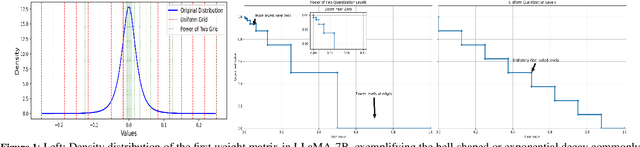
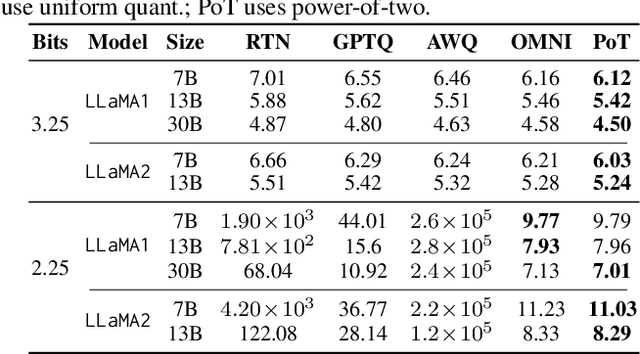
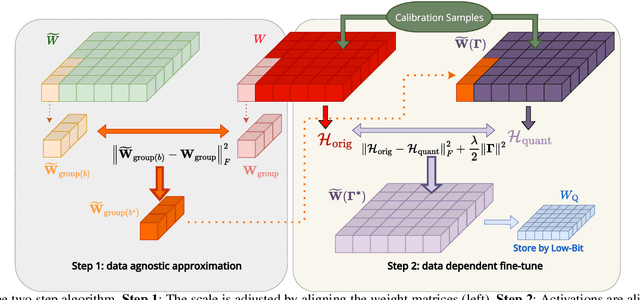
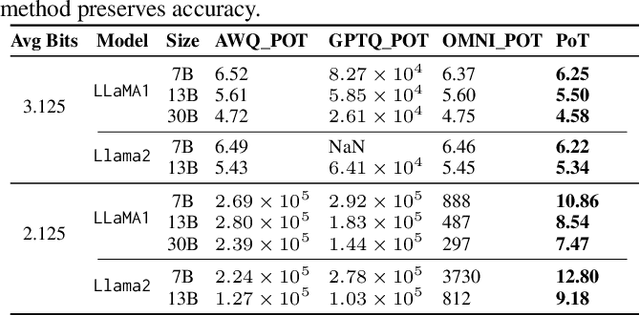
Large Language Models (LLMs) have demonstrated remarkable performance across various natural language processing (NLP) tasks. However, their deployment is challenging due to the substantial computational resources required. Power-of-two (PoT) quantization is a general tool to counteract this difficulty. Albeit previous works on PoT quantization can be efficiently dequantized on CPUs using fixed-point addition, it showed less effectiveness on GPUs. The reason is entanglement of the sign bit and sequential bit manipulations needed for dequantization. We propose a novel POT quantization framework for LLM weights that (i) outperforms state-of-the-art accuracy in extremely low-precision number formats, and (ii) enables faster inference through more efficient dequantization. To maintain the accuracy of the quantized model, we introduce a two-step post-training algorithm: (i) initialize the quantization scales with a robust starting point, and (ii) refine these scales using a minimal calibration set. The performance of our PoT post-training algorithm surpasses the current state-of-the-art in integer quantization, particularly at low precisions such as 2- and 3-bit formats. Our PoT quantization accelerates the dequantization step required for the floating point inference and leads to $3.67\times$ speed up on a NVIDIA V100, and $1.63\times$ on a NVIDIA RTX 4090, compared to uniform integer dequantization.
ECHO-LLaMA: Efficient Caching for High-Performance LLaMA Training
May 22, 2025This paper introduces ECHO-LLaMA, an efficient LLaMA architecture designed to improve both the training speed and inference throughput of LLaMA architectures while maintaining its learning capacity. ECHO-LLaMA transforms LLaMA models into shared KV caching across certain layers, significantly reducing KV computational complexity while maintaining or improving language performance. Experimental results demonstrate that ECHO-LLaMA achieves up to 77\% higher token-per-second throughput during training, up to 16\% higher Model FLOPs Utilization (MFU), and up to 14\% lower loss when trained on an equal number of tokens. Furthermore, on the 1.1B model, ECHO-LLaMA delivers approximately 7\% higher test-time throughput compared to the baseline. By introducing a computationally efficient adaptation mechanism, ECHO-LLaMA offers a scalable and cost-effective solution for pretraining and finetuning large language models, enabling faster and more resource-efficient training without compromising performance.