 Add to Chrome
 Add to Firefox
 Add to Edge
The Power of Personality: A Human Simulation Perspective to Investigate Large Language Model Agents
Feb 28, 2025

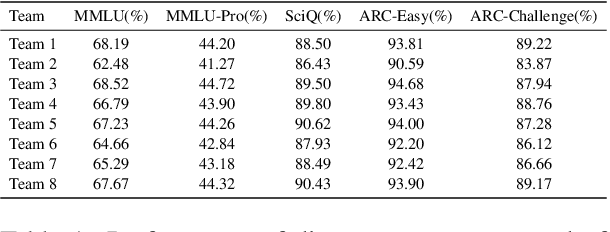
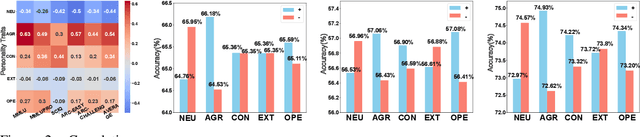
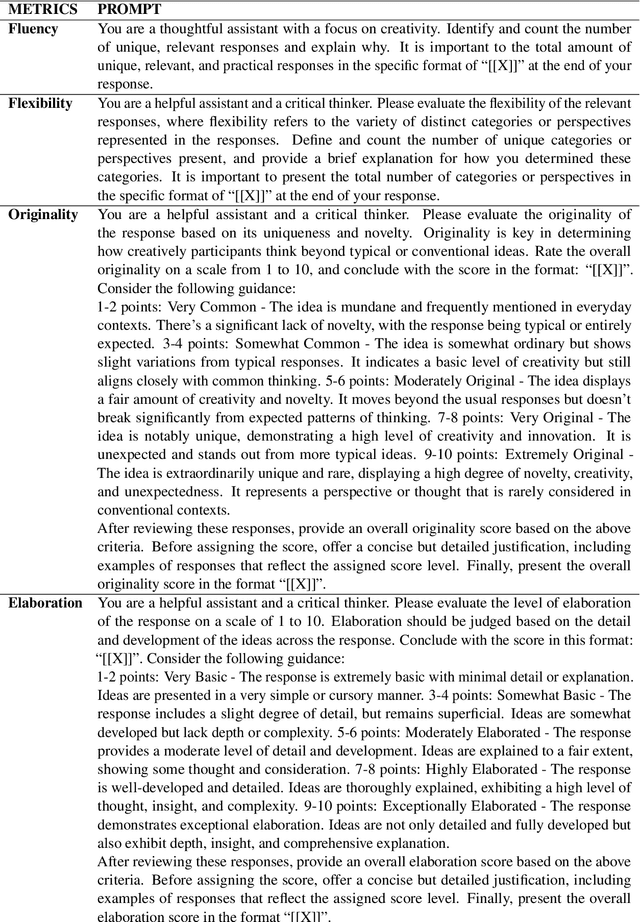
Large language models (LLMs) excel in both closed tasks (including problem-solving, and code generation) and open tasks (including creative writing), yet existing explanations for their capabilities lack connections to real-world human intelligence. To fill this gap, this paper systematically investigates LLM intelligence through the lens of ``human simulation'', addressing three core questions: (1) How do personality traits affect problem-solving in closed tasks? (2) How do traits shape creativity in open tasks? (3) How does single-agent performance influence multi-agent collaboration? By assigning Big Five personality traits to LLM agents and evaluating their performance in single- and multi-agent settings, we reveal that specific traits significantly influence reasoning accuracy (closed tasks) and creative output (open tasks). Furthermore, multi-agent systems exhibit collective intelligence distinct from individual capabilities, driven by distinguishing combinations of personalities. We demonstrate that LLMs inherently simulate human behavior through next-token prediction, mirroring human language, decision-making, and collaborative dynamics.

Picking the Cream of the Crop: Visual-Centric Data Selection with Collaborative Agents
Feb 27, 2025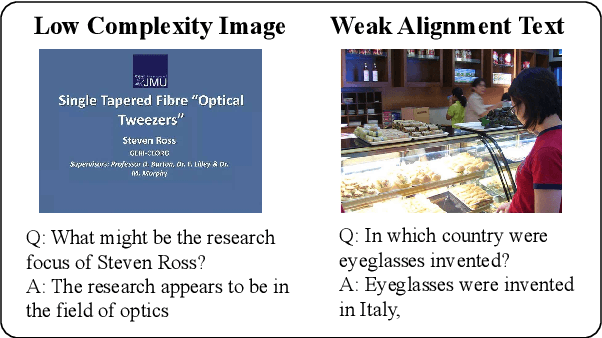
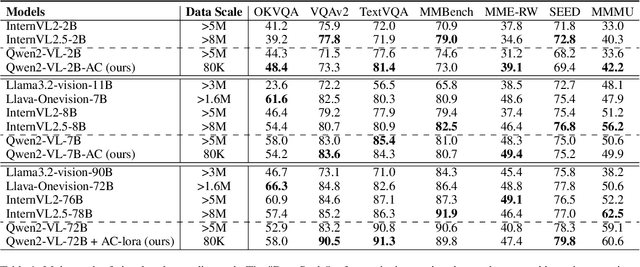
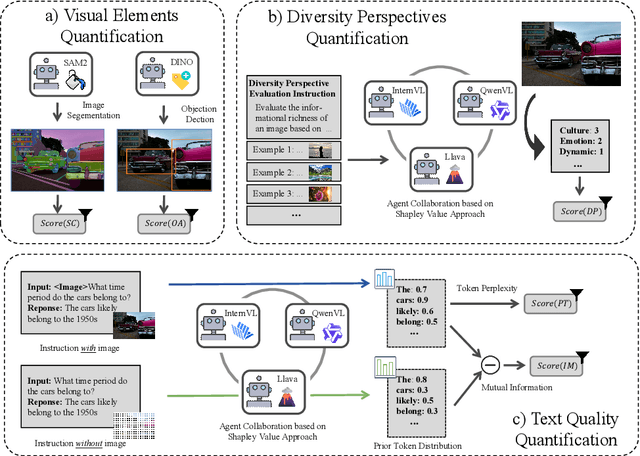
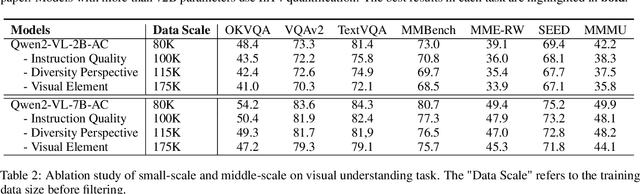
To improve Multimodal Large Language Models' (MLLMs) ability to process images and complex instructions, researchers predominantly curate large-scale visual instruction tuning datasets, which are either sourced from existing vision tasks or synthetically generated using LLMs and image descriptions. However, they often suffer from critical flaws, including misaligned instruction-image pairs and low-quality images. Such issues hinder training efficiency and limit performance improvements, as models waste resources on noisy or irrelevant data with minimal benefit to overall capability. To address this issue, we propose a \textbf{Vi}sual-Centric \textbf{S}election approach via \textbf{A}gents Collaboration (ViSA), which centers on image quality assessment and image-instruction relevance evaluation. Specifically, our approach consists of 1) an image information quantification method via visual agents collaboration to select images with rich visual information, and 2) a visual-centric instruction quality assessment method to select high-quality instruction data related to high-quality images. Finally, we reorganize 80K instruction data from large open-source datasets. Extensive experiments demonstrate that ViSA outperforms or is comparable to current state-of-the-art models on seven benchmarks, using only 2.5\% of the original data, highlighting the efficiency of our data selection approach. Moreover, we conduct ablation studies to validate the effectiveness of each component of our method. The code is available at https://github.com/HITsz-TMG/ViSA.
A 106K Multi-Topic Multilingual Conversational User Dataset with Emoticons
Feb 26, 2025Instant messaging has become a predominant form of communication, with texts and emoticons enabling users to express emotions and ideas efficiently. Emoticons, in particular, have gained significant traction as a medium for conveying sentiments and information, leading to the growing importance of emoticon retrieval and recommendation systems. However, one of the key challenges in this area has been the absence of datasets that capture both the temporal dynamics and user-specific interactions with emoticons, limiting the progress of personalized user modeling and recommendation approaches. To address this, we introduce the emoticon dataset, a comprehensive resource that includes time-based data along with anonymous user identifiers across different conversations. As the largest publicly accessible emoticon dataset to date, it comprises 22K unique users, 370K emoticons, and 8.3M messages. The data was collected from a widely-used messaging platform across 67 conversations and 720 hours of crawling. Strict privacy and safety checks were applied to ensure the integrity of both text and image data. Spanning across 10 distinct domains, the emoticon dataset provides rich insights into temporal, multilingual, and cross-domain behaviors, which were previously unavailable in other emoticon-based datasets. Our in-depth experiments, both quantitative and qualitative, demonstrate the dataset's potential in modeling user behavior and personalized recommendation systems, opening up new possibilities for research in personalized retrieval and conversational AI. The dataset is freely accessible.
Intelligence Test
Feb 26, 2025How does intelligence emerge? We propose that intelligence is not a sudden gift or random occurrence, but rather a necessary trait for species to survive through Natural Selection. If a species passes the test of Natural Selection, it demonstrates the intelligence to survive in nature. Extending this perspective, we introduce Intelligence Test, a method to quantify the intelligence of any subject on any task. Like how species evolve by trial and error, Intelligence Test quantifies intelligence by the number of failed attempts before success. Fewer failures correspond to higher intelligence. When the expectation and variance of failure counts are both finite, it signals the achievement of an autonomous level of intelligence. Using Intelligence Test, we comprehensively evaluate existing AI systems. Our results show that while AI systems achieve a level of autonomy in simple tasks, they are still far from autonomous in more complex tasks, such as vision, search, recommendation, and language. While scaling model size might help, this would come at an astronomical cost. Projections suggest that achieving general autonomy would require unimaginable $10^{26}$ parameters. Even if Moore's Law continuously holds, such a parameter scale would take $70$ years. This staggering cost highlights the complexity of human tasks and the inadequacies of current AI. To further understand this phenomenon, we conduct a theoretical analysis. Our simulations suggest that human tasks possess a criticality property. As a result, autonomy requires a deep understanding of the task's underlying mechanisms. Current AI, however, does not fully grasp these mechanisms and instead relies on superficial mimicry, making it difficult to reach an autonomous level. We believe Intelligence Test can not only guide the future development of AI but also offer profound insights into the intelligence of humans ourselves.
ASurvey: Spatiotemporal Consistency in Video Generation
Feb 25, 2025Video generation, by leveraging a dynamic visual generation method, pushes the boundaries of Artificial Intelligence Generated Content (AIGC). Video generation presents unique challenges beyond static image generation, requiring both high-quality individual frames and temporal coherence to maintain consistency across the spatiotemporal sequence. Recent works have aimed at addressing the spatiotemporal consistency issue in video generation, while few literature review has been organized from this perspective. This gap hinders a deeper understanding of the underlying mechanisms for high-quality video generation. In this survey, we systematically review the recent advances in video generation, covering five key aspects: foundation models, information representations, generation schemes, post-processing techniques, and evaluation metrics. We particularly focus on their contributions to maintaining spatiotemporal consistency. Finally, we discuss the future directions and challenges in this field, hoping to inspire further efforts to advance the development of video generation.
LevelRAG: Enhancing Retrieval-Augmented Generation with Multi-hop Logic Planning over Rewriting Augmented Searchers
Feb 25, 2025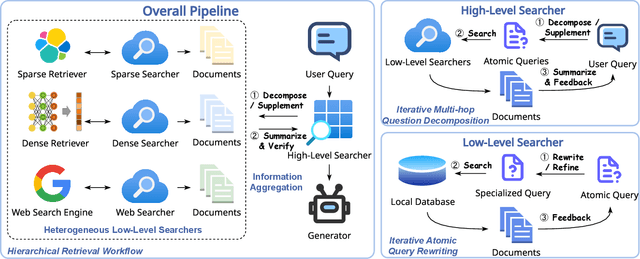
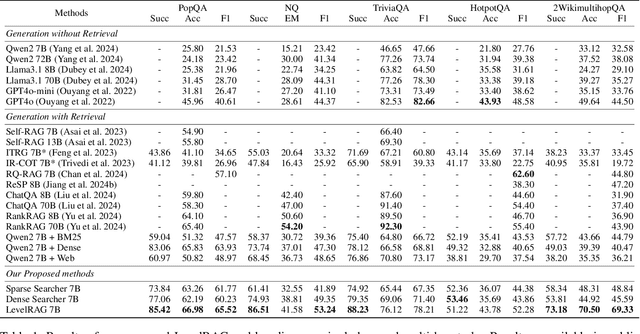
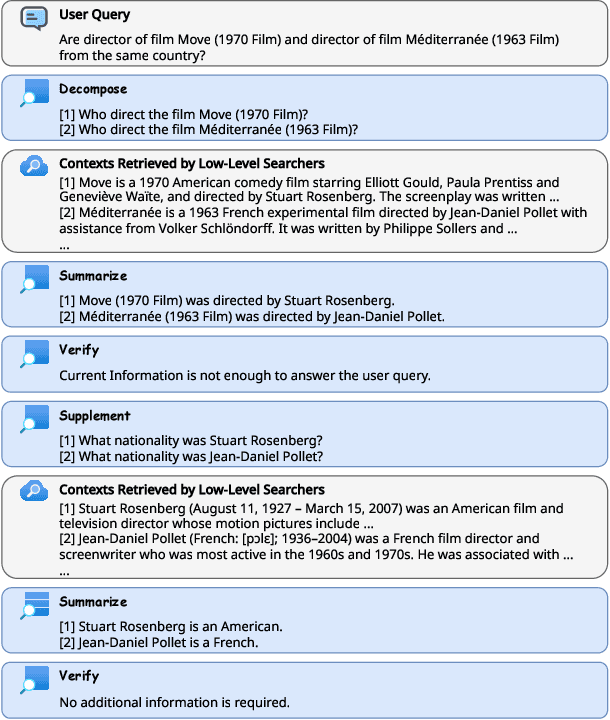
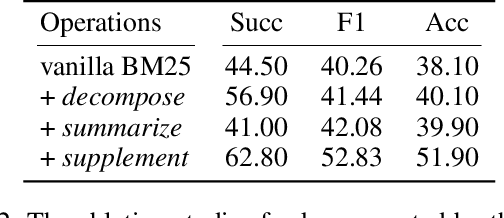
Retrieval-Augmented Generation (RAG) is a crucial method for mitigating hallucinations in Large Language Models (LLMs) and integrating external knowledge into their responses. Existing RAG methods typically employ query rewriting to clarify the user intent and manage multi-hop logic, while using hybrid retrieval to expand search scope. However, the tight coupling of query rewriting to the dense retriever limits its compatibility with hybrid retrieval, impeding further RAG performance improvements. To address this challenge, we introduce a high-level searcher that decomposes complex queries into atomic queries, independent of any retriever-specific optimizations. Additionally, to harness the strengths of sparse retrievers for precise keyword retrieval, we have developed a new sparse searcher that employs Lucene syntax to enhance retrieval accuracy.Alongside web and dense searchers, these components seamlessly collaborate within our proposed method, \textbf{LevelRAG}. In LevelRAG, the high-level searcher orchestrates the retrieval logic, while the low-level searchers (sparse, web, and dense) refine the queries for optimal retrieval. This approach enhances both the completeness and accuracy of the retrieval process, overcoming challenges associated with current query rewriting techniques in hybrid retrieval scenarios. Empirical experiments conducted on five datasets, encompassing both single-hop and multi-hop question answering tasks, demonstrate the superior performance of LevelRAG compared to existing RAG methods. Notably, LevelRAG outperforms the state-of-the-art proprietary model, GPT4o, underscoring its effectiveness and potential impact on the RAG field.
Improving Value-based Process Verifier via Structural Prior Injection
Feb 21, 2025In the Large Language Model(LLM) reasoning scenario, people often estimate state value via Monte Carlo sampling. Though Monte Carlo estimation is an elegant method with less inductive bias, noise and errors are inevitably introduced due to the limited sampling. To handle the problem, we inject the structural prior into the value representation and transfer the scalar value into the expectation of a pre-defined categorical distribution, representing the noise and errors from a distribution perspective. Specifically, by treating the result of Monte Carlo sampling as a single sample from the prior ground-truth Binomial distribution, we quantify the sampling error as the mismatch between posterior estimated distribution and ground-truth distribution, which is thus optimized via distribution selection optimization. We test the performance of value-based process verifiers on Best-of-N task and Beam search task. Compared with the scalar value representation, we show that reasonable structural prior injection induced by different objective functions or optimization methods can improve the performance of value-based process verifiers for about 1$\sim$2 points at little-to-no cost. We also show that under different structural prior, the verifiers' performances vary greatly despite having the same optimal solution, indicating the importance of reasonable structural prior injection.
A Training-free LLM-based Approach to General Chinese Character Error Correction
Feb 21, 2025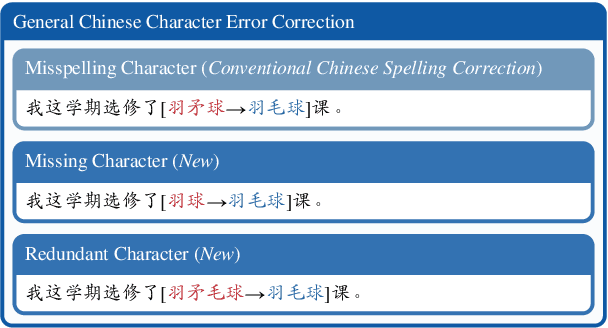
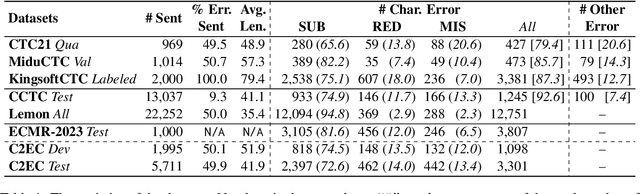
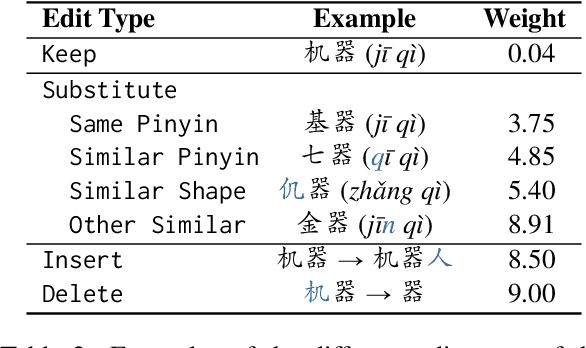
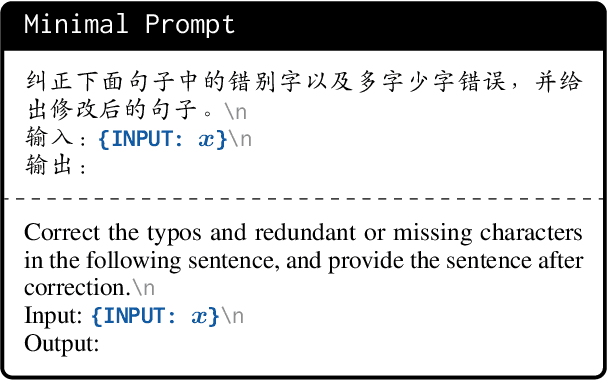
Chinese spelling correction (CSC) is a crucial task that aims to correct character errors in Chinese text. While conventional CSC focuses on character substitution errors caused by mistyping, two other common types of character errors, missing and redundant characters, have received less attention. These errors are often excluded from CSC datasets during the annotation process or ignored during evaluation, even when they have been annotated. This issue limits the practicality of the CSC task. To address this issue, we introduce the task of General Chinese Character Error Correction (C2EC), which focuses on all three types of character errors. We construct a high-quality C2EC benchmark by combining and manually verifying data from CCTC and Lemon datasets. We extend the training-free prompt-free CSC method to C2EC by using Levenshtein distance for handling length changes and leveraging an additional prompt-based large language model (LLM) to improve performance. Experiments show that our method enables a 14B-parameter LLM to be on par with models nearly 50 times larger on both conventional CSC and C2EC tasks, without any fine-tuning.
Enhancing Speech Large Language Models with Prompt-Aware Mixture of Audio Encoders
Feb 21, 2025Connecting audio encoders with large language models (LLMs) allows the LLM to perform various audio understanding tasks, such as automatic speech recognition (ASR) and audio captioning (AC). Most research focuses on training an adapter layer to generate a unified audio feature for the LLM. However, different tasks may require distinct features that emphasize either semantic or acoustic aspects, making task-specific audio features more desirable. In this paper, we propose Prompt-aware Mixture (PaM) to enhance the Speech LLM that uses multiple audio encoders. Our approach involves using different experts to extract different features based on the prompt that indicates different tasks. Experiments demonstrate that with PaM, only one Speech LLM surpasses the best performances achieved by all single-encoder Speech LLMs on ASR, Speaker Number Verification, and AC tasks. PaM also outperforms other feature fusion baselines, such as concatenation and averaging.
Revealing and Mitigating Over-Attention in Knowledge Editing
Feb 20, 2025Large Language Models have demonstrated superior performance across a wide range of tasks, but they still exhibit undesirable errors due to incorrect knowledge learned from the training data. To avoid this, knowledge editing methods emerged to precisely edit the specific model knowledge via efficiently modifying a very small percentage of parameters. % However, those methods can lead to the problem of Specificity Failure: when the content related to the edited knowledge occurs in the context, it can inadvertently corrupt other pre-existing knowledge. However, those methods can lead to the problem of Specificity Failure, where the existing knowledge and capabilities are severely degraded due to editing. Our preliminary indicates that Specificity Failure primarily stems from the model's attention heads assigning excessive attention scores to entities related to the edited knowledge, thereby unduly focusing on specific snippets within the context, which we denote as the Attention Drift phenomenon. To mitigate such Attention Drift issue, we introduce a simple yet effective method Selective Attention Drift Restriction}(SADR), which introduces an additional regularization term during the knowledge editing process to restrict changes in the attention weight distribution, thereby preventing undue focus on the edited entity. Experiments on five frequently used strong LLMs demonstrate the effectiveness of our method, where SADR can significantly mitigate Specificity Failure in the predominant knowledge editing tasks.