 Add to Chrome
 Add to Firefox
 Add to Edge
TraceViT: Grounded Trace Supervision for Visual Abstract Reasoning
Jul 31, 2026
The Abstraction and Reasoning Corpus (ARC) tests whether a model can infer an unseen transformation from a few input-output examples and apply it to a new grid. Looped visual reasoners refine predictions over multiple iterations, but conventional training constrains only the final output, leaving intermediate refinements unconstrained. We propose that these refinements should instead follow the transformation step by step. We introduce TraceViT, a looped visual reasoner trained with semantically monotonic transformation chains. We obtain these chains by rewriting and verifying programmatic task implementations, decomposing each solution into intermediate grid states. Each iteration is grounded by a task reference derived from the few-shot demonstrations and an object workspace representing the current grid state. Because these chains may differ in length from the loop, soft trace alignment enforces only their ordering, letting the model allocate iterations freely. TraceViT achieves 67.8% pass@2 on ARC-AGI-1 and 24.3% on ARC-AGI-2. Controlled ablations on ARC-AGI-1 show that trace supervision becomes beneficial only when paired with grounding. Code and data will be available at https://github.com/LiuBinnan/TraceViT.

End-to-End Radar and Communication Modulation Recognition with Neuromorphic Computing
Jun 23, 2026Although deep learning-based methods can achieve high accuracy in automatic modulation recognition (AMR) tasks, their high computational cost makes it difficult to strike a balance between accuracy and power consumption, thereby limiting their application on resource-constrained platforms. Neuromorphic architectures that perform spike-driven inference with modest energy budgets have recently been explored for vision and timeseries tasks. Motivated by these works, we propose EMRFormer, a novel end-to-end spiking nerural network (SNN) architecture that applies spike-driven transformer to the constraints of neuromorphic hardware for AMR. The model incorporates an adaptive spike encoder and Integer Leaky Integrate-and-Fire neurons to mitigate the degradation of effective information and enhance SNN representational capacity. By integrating spike-separable Convolution Neural Networks (SSCNN) into Spike-Driven Transformers (SpikeFormer), EMRFormer effectively extracts multi-scale temporal features from the raw IQ waveforms. We validate our approach across various mainstream datasets, the experimental results show that EMRFormer achieves state-of-the-art interms of accuracy, outperforming all the baselines. Furthermore, the model maintains strong performance in low signal-to-noise(SNR) environments and reduces theoretical energy consumption by over 90%. Finally, we evaluate our model on a KA200 neuromorphic chip. The results show that our model achieves up to 5 times reduction in power compared to running on a 3090 GPU or an Orin NX. This work demonstrates a promising pathway for AMR on resource-constrained devices.
Monocular Depth Estimation From the Perspective of Feature Restoration: A Diffusion Enhanced Depth Restoration Approach
Apr 09, 2026Monocular Depth Estimation (MDE) is a fundamental computer vision task with important applications in 3D vision. The current mainstream MDE methods employ an encoder-decoder architecture with multi-level/scale feature processing. However, the limitations of the current architecture and the effects of different-level features on the prediction accuracy are not evaluated. In this paper, we first investigate the above problem and show that there is still substantial potential in the current framework if encoder features can be improved. Therefore, we propose to formulate the depth estimation problem from the feature restoration perspective, by treating pretrained encoder features as degraded features of an assumed ground truth feature that yields the ground truth depth map. Then an Invertible Transform-enhanced Indirect Diffusion (InvT-IndDiffusion) module is developed for feature restoration. Due to the absence of direct supervision on feature, only indirect supervision from the final sparse depth map is used. During the iterative procedure of diffusion, this results in feature deviations among steps. The proposed InvT-IndDiffusion solves this problem by using an invertible transform-based decoder under the bi-Lipschitz condition. Finally, a plug-and-play Auxiliary Viewpoint-based Low-level Feature Enhancement module (AV-LFE) is developed to enhance local details with auxiliary viewpoint when available. Experiments demonstrate that the proposed method achieves better performance than the state-of-the-art methods on various datasets. Specifically on the KITTI benchmark, compared with the baseline, the performance is improved by 4.09% and 37.77% under different training settings in terms of RMSE. Code is available at https://github.com/whitehb1/IID-RDepth.
Adaptive Depth-converted-Scale Convolution for Self-supervised Monocular Depth Estimation
Apr 09, 2026Self-supervised monocular depth estimation (MDE) has received increasing interests in the last few years. The objects in the scene, including the object size and relationship among different objects, are the main clues to extract the scene structure. However, previous works lack the explicit handling of the changing sizes of the object due to the change of its depth. Especially in a monocular video, the size of the same object is continuously changed, resulting in size and depth ambiguity. To address this problem, we propose a Depth-converted-Scale Convolution (DcSConv) enhanced monocular depth estimation framework, by incorporating the prior relationship between the object depth and object scale to extract features from appropriate scales of the convolution receptive field. The proposed DcSConv focuses on the adaptive scale of the convolution filter instead of the local deformation of its shape. It establishes that the scale of the convolution filter matters no less (or even more in the evaluated task) than its local deformation. Moreover, a Depth-converted-Scale aware Fusion (DcS-F) is developed to adaptively fuse the DcSConv features and the conventional convolution features. Our DcSConv enhanced monocular depth estimation framework can be applied on top of existing CNN based methods as a plug-and-play module to enhance the conventional convolution block. Extensive experiments with different baselines have been conducted on the KITTI benchmark and our method achieves the best results with an improvement up to 11.6% in terms of SqRel reduction. Ablation study also validates the effectiveness of each proposed module.
Scal3R: Scalable Test-Time Training for Large-Scale 3D Reconstruction
Apr 09, 2026This paper addresses the task of large-scale 3D scene reconstruction from long video sequences. Recent feed-forward reconstruction models have shown promising results by directly regressing 3D geometry from RGB images without explicit 3D priors or geometric constraints. However, these methods often struggle to maintain reconstruction accuracy and consistency over long sequences due to limited memory capacity and the inability to effectively capture global contextual cues. In contrast, humans can naturally exploit the global understanding of the scene to inform local perception. Motivated by this, we propose a novel neural global context representation that efficiently compresses and retains long-range scene information, enabling the model to leverage extensive contextual cues for enhanced reconstruction accuracy and consistency. The context representation is realized through a set of lightweight neural sub-networks that are rapidly adapted during test time via self-supervised objectives, which substantially increases memory capacity without incurring significant computational overhead. The experiments on multiple large-scale benchmarks, including the KITTI Odometry~\cite{Geiger2012CVPR} and Oxford Spires~\cite{tao2025spires} datasets, demonstrate the effectiveness of our approach in handling ultra-large scenes, achieving leading pose accuracy and state-of-the-art 3D reconstruction accuracy while maintaining efficiency. Code is available at https://zju3dv.github.io/scal3r.
LiftFormer: Lifting and Frame Theory Based Monocular Depth Estimation Using Depth and Edge Oriented Subspace Representation
Apr 08, 2026Monocular depth estimation (MDE) has attracted increasing interest in the past few years, owing to its important role in 3D vision. MDE is the estimation of a depth map from a monocular image/video to represent the 3D structure of a scene, which is a highly ill-posed problem. To solve this problem, in this paper, we propose a LiftFormer based on lifting theory topology, for constructing an intermediate subspace that bridges the image color features and depth values, and a subspace that enhances the depth prediction around edges. MDE is formulated by transforming the depth value prediction problem into depth-oriented geometric representation (DGR) subspace feature representation, thus bridging the learning from color values to geometric depth values. A DGR subspace is constructed based on frame theory by using linearly dependent vectors in accordance with depth bins to provide a redundant and robust representation. The image spatial features are transformed into the DGR subspace, where these features correspond directly to the depth values. Moreover, considering that edges usually present sharp changes in a depth map and tend to be erroneously predicted, an edge-aware representation (ER) subspace is constructed, where depth features are transformed and further used to enhance the local features around edges. The experimental results demonstrate that our LiftFormer achieves state-of-the-art performance on widely used datasets, and an ablation study validates the effectiveness of both proposed lifting modules in our LiftFormer.
MSVIT: Improving Spiking Vision Transformer Using Multi-scale Attention Fusion
May 19, 2025The combination of Spiking Neural Networks(SNNs) with Vision Transformer architectures has attracted significant attention due to the great potential for energy-efficient and high-performance computing paradigms. However, a substantial performance gap still exists between SNN-based and ANN-based transformer architectures. While existing methods propose spiking self-attention mechanisms that are successfully combined with SNNs, the overall architectures proposed by these methods suffer from a bottleneck in effectively extracting features from different image scales. In this paper, we address this issue and propose MSVIT, a novel spike-driven Transformer architecture, which firstly uses multi-scale spiking attention (MSSA) to enrich the capability of spiking attention blocks. We validate our approach across various main data sets. The experimental results show that MSVIT outperforms existing SNN-based models, positioning itself as a state-of-the-art solution among SNN-transformer architectures. The codes are available at https://github.com/Nanhu-AI-Lab/MSViT.
Generative Compositor for Few-Shot Visual Information Extraction
Mar 21, 2025Visual Information Extraction (VIE), aiming at extracting structured information from visually rich document images, plays a pivotal role in document processing. Considering various layouts, semantic scopes, and languages, VIE encompasses an extensive range of types, potentially numbering in the thousands. However, many of these types suffer from a lack of training data, which poses significant challenges. In this paper, we propose a novel generative model, named Generative Compositor, to address the challenge of few-shot VIE. The Generative Compositor is a hybrid pointer-generator network that emulates the operations of a compositor by retrieving words from the source text and assembling them based on the provided prompts. Furthermore, three pre-training strategies are employed to enhance the model's perception of spatial context information. Besides, a prompt-aware resampler is specially designed to enable efficient matching by leveraging the entity-semantic prior contained in prompts. The introduction of the prompt-based retrieval mechanism and the pre-training strategies enable the model to acquire more effective spatial and semantic clues with limited training samples. Experiments demonstrate that the proposed method achieves highly competitive results in the full-sample training, while notably outperforms the baseline in the 1-shot, 5-shot, and 10-shot settings.
SOOD++: Leveraging Unlabeled Data to Boost Oriented Object Detection
Jul 01, 2024Semi-supervised object detection (SSOD), leveraging unlabeled data to boost object detectors, has become a hot topic recently. However, existing SSOD approaches mainly focus on horizontal objects, leaving multi-oriented objects common in aerial images unexplored. At the same time, the annotation cost of multi-oriented objects is significantly higher than that of their horizontal counterparts. Therefore, in this paper, we propose a simple yet effective Semi-supervised Oriented Object Detection method termed SOOD++. Specifically, we observe that objects from aerial images are usually arbitrary orientations, small scales, and aggregation, which inspires the following core designs: a Simple Instance-aware Dense Sampling (SIDS) strategy is used to generate comprehensive dense pseudo-labels; the Geometry-aware Adaptive Weighting (GAW) loss dynamically modulates the importance of each pair between pseudo-label and corresponding prediction by leveraging the intricate geometric information of aerial objects; we treat aerial images as global layouts and explicitly build the many-to-many relationship between the sets of pseudo-labels and predictions via the proposed Noise-driven Global Consistency (NGC). Extensive experiments conducted on various multi-oriented object datasets under various labeled settings demonstrate the effectiveness of our method. For example, on the DOTA-V1.5 benchmark, the proposed method outperforms previous state-of-the-art (SOTA) by a large margin (+2.92, +2.39, and +2.57 mAP under 10%, 20%, and 30% labeled data settings, respectively) with single-scale training and testing. More importantly, it still improves upon a strong supervised baseline with 70.66 mAP, trained using the full DOTA-V1.5 train-val set, by +1.82 mAP, resulting in a 72.48 mAP, pushing the new state-of-the-art. The code will be made available.
Roadside Monocular 3D Detection via 2D Detection Prompting
Apr 04, 2024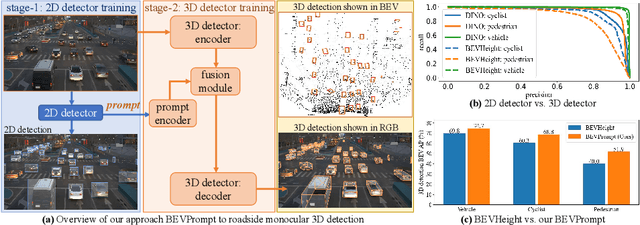
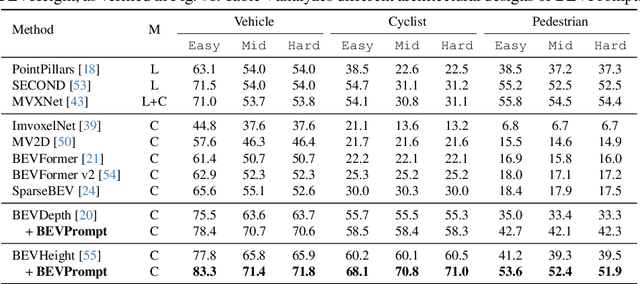
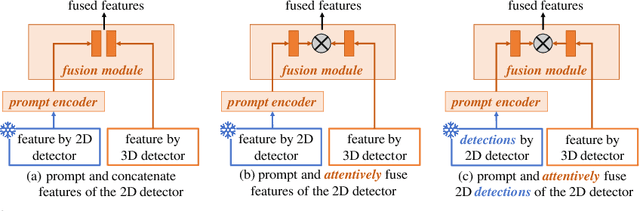
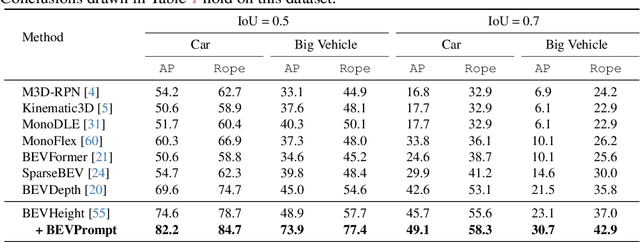
The problem of roadside monocular 3D detection requires detecting objects of interested classes in a 2D RGB frame and predicting their 3D information such as locations in bird's-eye-view (BEV). It has broad applications in traffic control, vehicle-vehicle communication, and vehicle-infrastructure cooperative perception. To approach this problem, we present a novel and simple method by prompting the 3D detector using 2D detections. Our method builds on a key insight that, compared with 3D detectors, a 2D detector is much easier to train and performs significantly better w.r.t detections on the 2D image plane. That said, one can exploit 2D detections of a well-trained 2D detector as prompts to a 3D detector, being trained in a way of inflating such 2D detections to 3D towards 3D detection. To construct better prompts using the 2D detector, we explore three techniques: (a) concatenating both 2D and 3D detectors' features, (b) attentively fusing 2D and 3D detectors' features, and (c) encoding predicted 2D boxes x, y, width, height, label and attentively fusing such with the 3D detector's features. Surprisingly, the third performs the best. Moreover, we present a yaw tuning tactic and a class-grouping strategy that merges classes based on their functionality; these techniques improve 3D detection performance further. Comprehensive ablation studies and extensive experiments demonstrate that our method resoundingly outperforms prior works, achieving the state-of-the-art on two large-scale roadside 3D detection benchmarks.