 Add to Chrome
 Add to Firefox
 Add to Edge
PhoneWorld: Scaling Phone-Use Agent Environments
May 28, 2026
A central bottleneck for phone-use agents is that controllable, reproducible environments covering real mobile behavior are hard to build at scale. Existing mobile-agent benchmarks have made important progress on evaluation, but they do not by themselves provide a scalable way to construct many new phone-use environments. We present PhoneWorld, a reusable pipeline that converts real GUI trajectories and screenshots into controllable phone-use environments, executable tasks, automatic verifiers, and training rollouts. Rather than hand-building one mobile benchmark at a time, PhoneWorld uses real trajectories to recover which screens matter, how screens connect, which interactions must change environment state, and which user goals admit automatic verification. From these signals, it builds runnable mock Android apps backed by read-only app content and mutable state, then derives executable tasks, rule-based verifiers, and training rollouts from the same environments. In its current instantiation, PhoneWorld covers 34 apps across 16 domains, spanning common consumer mobile behaviors such as search, browsing, shopping, booking, media, and social interaction. Under a fixed training budget, replacing 10K steps from an auxiliary AndroidWorld corpus in an AndroidWorld-based baseline with broad PhoneWorld supervision improves all four evaluation benchmarks at once, raising HYMobileBench by 17.7 points, AndroidControl by 6.0 points, AndroidWorld by 14.7 points, and PhoneWorld by 52.5 points. We then study two additional scaling questions: increasing the amount of PhoneWorld supervision strongly improves PhoneWorld performance, and under a fixed PhoneWorld budget, expanding app coverage yields even larger gains. Overall, PhoneWorld shifts the focus from building one mobile benchmark at a time to scaling the supply of phone-use environments themselves.

Do Phone-Use Agents Respect Your Privacy?
Apr 02, 2026We study whether phone-use agents respect privacy while completing benign mobile tasks. This question has remained hard to answer because privacy-compliant behavior is not operationalized for phone-use agents, and ordinary apps do not reveal exactly what data agents type into which form entries during execution. To make this question measurable, we introduce MyPhoneBench, a verifiable evaluation framework for privacy behavior in mobile agents. We operationalize privacy-respecting phone use as permissioned access, minimal disclosure, and user-controlled memory through a minimal privacy contract, iMy, and pair it with instrumented mock apps plus rule-based auditing that make unnecessary permission requests, deceptive re-disclosure, and unnecessary form filling observable and reproducible. Across five frontier models on 10 mobile apps and 300 tasks, we find that task success, privacy-compliant task completion, and later-session use of saved preferences are distinct capabilities, and no single model dominates all three. Evaluating success and privacy jointly reshuffles the model ordering relative to either metric alone. The most persistent failure mode across models is simple data minimization: agents still fill optional personal entries that the task does not require. These results show that privacy failures arise from over-helpful execution of benign tasks, and that success-only evaluation overestimates the deployment readiness of current phone-use agents. All code, mock apps, and agent trajectories are publicly available at~ https://github.com/FreedomIntelligence/MyPhoneBench.
MMTIT-Bench: A Multilingual and Multi-Scenario Benchmark with Cognition-Perception-Reasoning Guided Text-Image Machine Translation
Mar 25, 2026End-to-end text-image machine translation (TIMT), which directly translates textual content in images across languages, is crucial for real-world multilingual scene understanding. Despite advances in vision-language large models (VLLMs), robustness across diverse visual scenes and low-resource languages remains underexplored due to limited evaluation resources. We present MMTIT-Bench, a human-verified multilingual and multi-scenario benchmark with 1,400 images spanning fourteen non-English and non-Chinese languages and diverse settings such as documents, scenes, and web images, enabling rigorous assessment of end-to-end TIMT. Beyond benchmarking, we study how reasoning-oriented data design improves translation. Although recent VLLMs have begun to incorporate long Chain-of-Thought (CoT) reasoning, effective thinking paradigms for TIMT are still immature: existing designs either cascade parsing and translation in a sequential manner or focus on language-only reasoning, overlooking the visual cognition central to VLLMs. We propose Cognition-Perception-Reasoning for Translation (CPR-Trans), a data paradigm that integrates scene cognition, text perception, and translation reasoning within a unified reasoning process. Using a VLLM-driven data generation pipeline, CPR-Trans provides structured, interpretable supervision that aligns perception with reasoning. Experiments on 3B and 7B models show consistent gains in accuracy and interpretability. We will release MMTIT-Bench to promote the multilingual and multi-scenario TIMT research upon acceptance.
Towards Real-World Document Parsing via Realistic Scene Synthesis and Document-Aware Training
Mar 25, 2026Document parsing has recently advanced with multimodal large language models (MLLMs) that directly map document images to structured outputs. Traditional cascaded pipelines depend on precise layout analysis and often fail under casually captured or non-standard conditions. Although end-to-end approaches mitigate this dependency, they still exhibit repetitive, hallucinated, and structurally inconsistent predictions - primarily due to the scarcity of large-scale, high-quality full-page (document-level) end-to-end parsing data and the lack of structure-aware training strategies. To address these challenges, we propose a data-training co-design framework for robust end-to-end document parsing. A Realistic Scene Synthesis strategy constructs large-scale, structurally diverse full-page end-to-end supervision by composing layout templates with rich document elements, while a Document-Aware Training Recipe introduces progressive learning and structure-token optimization to enhance structural fidelity and decoding stability. We further build Wild-OmniDocBench, a benchmark derived from real-world captured documents for robustness evaluation. Integrated into a 1B-parameter MLLM, our method achieves superior accuracy and robustness across both scanned/digital and real-world captured scenarios. All models, data synthesis pipelines, and benchmarks will be publicly released to advance future research in document understanding.
Prune Redundancy, Preserve Essence: Vision Token Compression in VLMs via Synergistic Importance-Diversity
Mar 11, 2026Vision-language models (VLMs) face significant computational inefficiencies caused by excessive generation of visual tokens. While prior work shows that a large fraction of visual tokens are redundant, existing compression methods struggle to balance importance preservation and information diversity. To address this, we propose PruneSID, a training-free Synergistic Importance-Diversity approach featuring a two-stage pipeline: (1) Principal Semantic Components Analysis (PSCA) for clustering tokens into semantically coherent groups, ensuring comprehensive concept coverage, and (2) Intra-group Non-Maximum Suppression (NMS) for pruning redundant tokens while preserving key representative tokens within each group. Additionally, PruneSID incorporates an information-aware dynamic compression ratio mechanism that optimizes token compression rates based on image complexity, enabling more effective average information preservation across diverse scenes. Extensive experiments demonstrate state-of-the-art performance, achieving 96.3% accuracy on LLaVA-1.5 with only 11.1% token retention, and 92.8% accuracy at extreme compression rates (5.6%) on LLaVA-NeXT, outperforming prior methods by 2.5% with 7.8 $\times$ faster prefilling speed compared to the original model. Our framework generalizes across diverse VLMs and both image and video modalities, showcasing strong cross-modal versatility. Code is available at https://github.com/ZhengyaoFang/PruneSID.
Recognition-Synergistic Scene Text Editing
Mar 11, 2025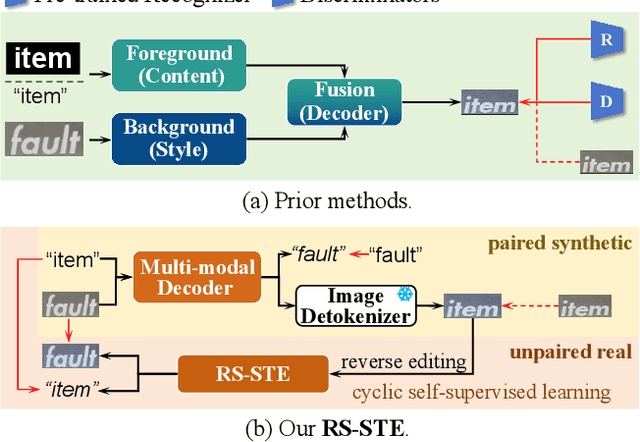
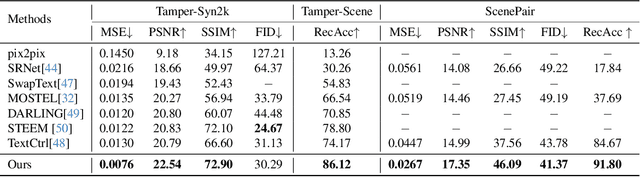
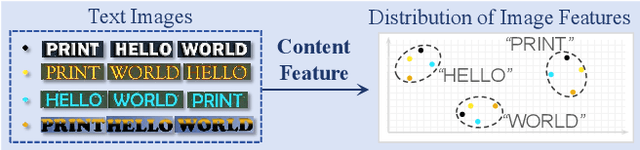
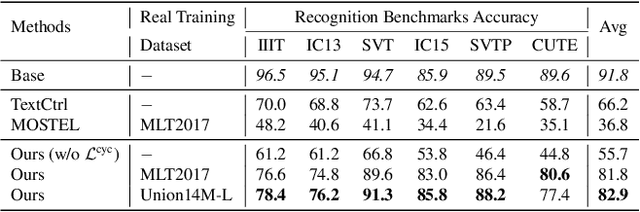
Scene text editing aims to modify text content within scene images while maintaining style consistency. Traditional methods achieve this by explicitly disentangling style and content from the source image and then fusing the style with the target content, while ensuring content consistency using a pre-trained recognition model. Despite notable progress, these methods suffer from complex pipelines, leading to suboptimal performance in complex scenarios. In this work, we introduce Recognition-Synergistic Scene Text Editing (RS-STE), a novel approach that fully exploits the intrinsic synergy of text recognition for editing. Our model seamlessly integrates text recognition with text editing within a unified framework, and leverages the recognition model's ability to implicitly disentangle style and content while ensuring content consistency. Specifically, our approach employs a multi-modal parallel decoder based on transformer architecture, which predicts both text content and stylized images in parallel. Additionally, our cyclic self-supervised fine-tuning strategy enables effective training on unpaired real-world data without ground truth, enhancing style and content consistency through a twice-cyclic generation process. Built on a relatively simple architecture, \mymodel achieves state-of-the-art performance on both synthetic and real-world benchmarks, and further demonstrates the effectiveness of leveraging the generated hard cases to boost the performance of downstream recognition tasks. Code is available at https://github.com/ZhengyaoFang/RS-STE.
R-CoT: Reverse Chain-of-Thought Problem Generation for Geometric Reasoning in Large Multimodal Models
Oct 23, 2024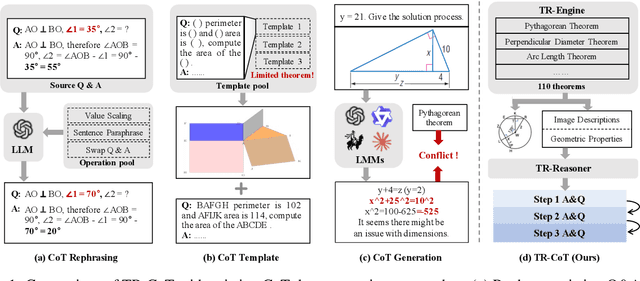
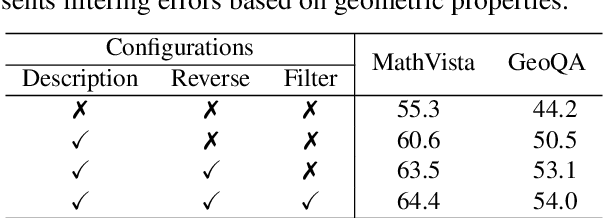
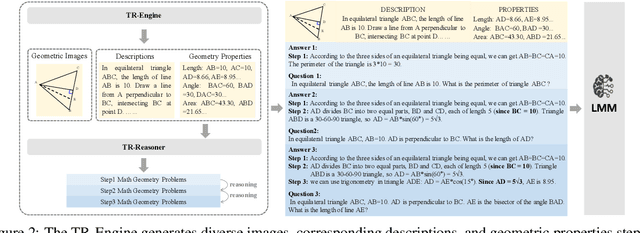
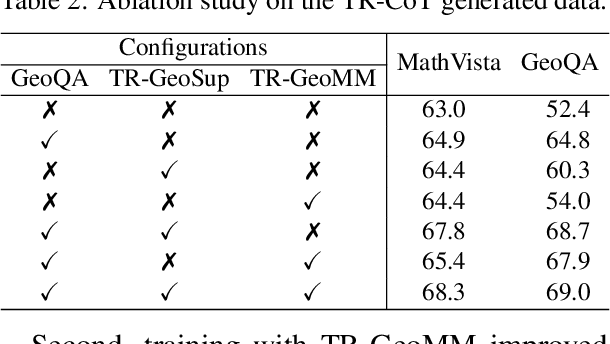
Existing Large Multimodal Models (LMMs) struggle with mathematical geometric reasoning due to a lack of high-quality image-text paired data. Current geometric data generation approaches, which apply preset templates to generate geometric data or use Large Language Models (LLMs) to rephrase questions and answers (Q&A), unavoidably limit data accuracy and diversity. To synthesize higher-quality data, we propose a two-stage Reverse Chain-of-Thought (R-CoT) geometry problem generation pipeline. First, we introduce GeoChain to produce high-fidelity geometric images and corresponding descriptions highlighting relations among geometric elements. We then design a Reverse A&Q method that reasons step-by-step based on the descriptions and generates questions in reverse from the reasoning results. Experiments demonstrate that the proposed method brings significant and consistent improvements on multiple LMM baselines, achieving new performance records in the 2B, 7B, and 8B settings. Notably, R-CoT-8B significantly outperforms previous state-of-the-art open-source mathematical models by 16.6% on MathVista and 9.2% on GeoQA, while also surpassing the closed-source model GPT-4o by an average of 13% across both datasets. The code is available at https://github.com/dle666/R-CoT.
WeCromCL: Weakly Supervised Cross-Modality Contrastive Learning for Transcription-only Supervised Text Spotting
Jul 28, 2024Transcription-only Supervised Text Spotting aims to learn text spotters relying only on transcriptions but no text boundaries for supervision, thus eliminating expensive boundary annotation. The crux of this task lies in locating each transcription in scene text images without location annotations. In this work, we formulate this challenging problem as a Weakly Supervised Cross-modality Contrastive Learning problem, and design a simple yet effective model dubbed WeCromCL that is able to detect each transcription in a scene image in a weakly supervised manner. Unlike typical methods for cross-modality contrastive learning that focus on modeling the holistic semantic correlation between an entire image and a text description, our WeCromCL conducts atomistic contrastive learning to model the character-wise appearance consistency between a text transcription and its correlated region in a scene image to detect an anchor point for the transcription in a weakly supervised manner. The detected anchor points by WeCromCL are further used as pseudo location labels to guide the learning of text spotting. Extensive experiments on four challenging benchmarks demonstrate the superior performance of our model over other methods. Code will be released.
StrucTexTv3: An Efficient Vision-Language Model for Text-rich Image Perception, Comprehension, and Beyond
Jun 04, 2024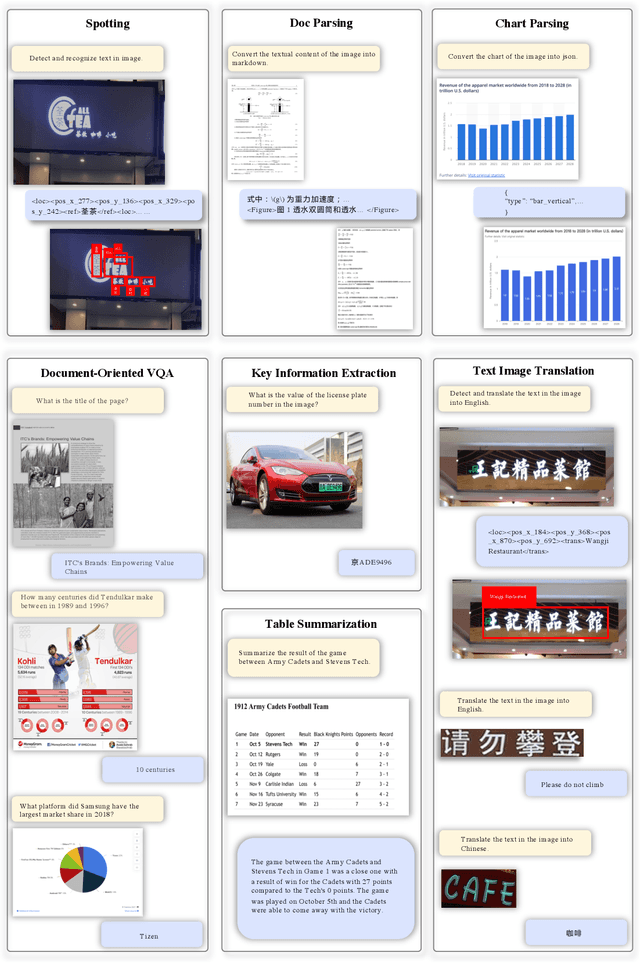
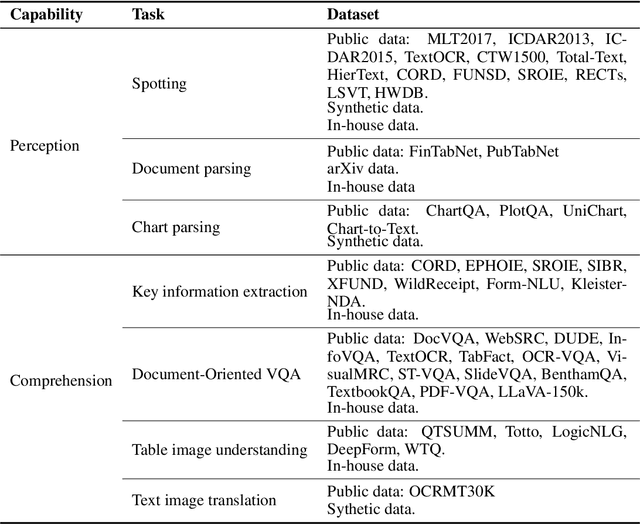
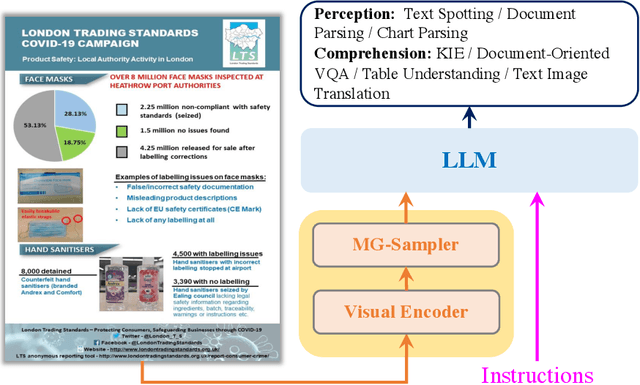
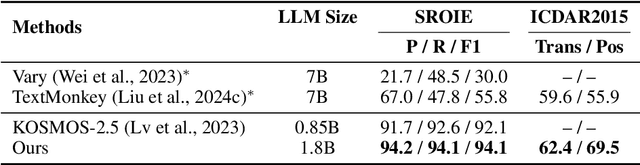
Text-rich images have significant and extensive value, deeply integrated into various aspects of human life. Notably, both visual cues and linguistic symbols in text-rich images play crucial roles in information transmission but are accompanied by diverse challenges. Therefore, the efficient and effective understanding of text-rich images is a crucial litmus test for the capability of Vision-Language Models. We have crafted an efficient vision-language model, StrucTexTv3, tailored to tackle various intelligent tasks for text-rich images. The significant design of StrucTexTv3 is presented in the following aspects: Firstly, we adopt a combination of an effective multi-scale reduced visual transformer and a multi-granularity token sampler (MG-Sampler) as a visual token generator, successfully solving the challenges of high-resolution input and complex representation learning for text-rich images. Secondly, we enhance the perception and comprehension abilities of StrucTexTv3 through instruction learning, seamlessly integrating various text-oriented tasks into a unified framework. Thirdly, we have curated a comprehensive collection of high-quality text-rich images, abbreviated as TIM-30M, encompassing diverse scenarios like incidental scenes, office documents, web pages, and screenshots, thereby improving the robustness of our model. Our method achieved SOTA results in text-rich image perception tasks, and significantly improved performance in comprehension tasks. Among multimodal models with LLM decoder of approximately 1.8B parameters, it stands out as a leader, which also makes the deployment of edge devices feasible. In summary, the StrucTexTv3 model, featuring efficient structural design, outstanding performance, and broad adaptability, offers robust support for diverse intelligent application tasks involving text-rich images, thus exhibiting immense potential for widespread application.
Towards Unified Multi-granularity Text Detection with Interactive Attention
May 30, 2024
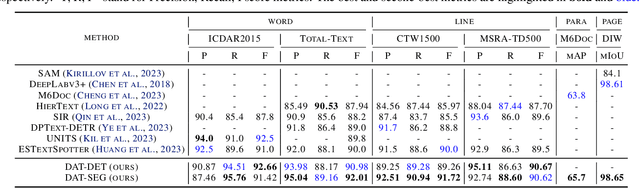
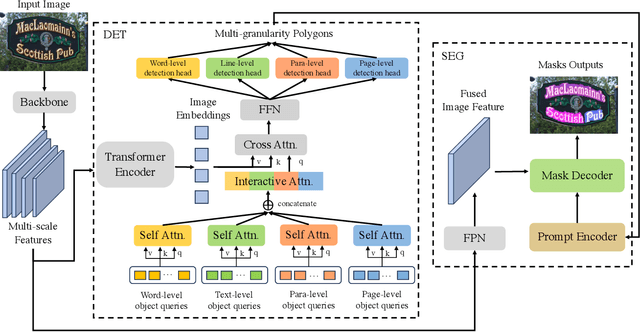

Existing OCR engines or document image analysis systems typically rely on training separate models for text detection in varying scenarios and granularities, leading to significant computational complexity and resource demands. In this paper, we introduce "Detect Any Text" (DAT), an advanced paradigm that seamlessly unifies scene text detection, layout analysis, and document page detection into a cohesive, end-to-end model. This design enables DAT to efficiently manage text instances at different granularities, including *word*, *line*, *paragraph* and *page*. A pivotal innovation in DAT is the across-granularity interactive attention module, which significantly enhances the representation learning of text instances at varying granularities by correlating structural information across different text queries. As a result, it enables the model to achieve mutually beneficial detection performances across multiple text granularities. Additionally, a prompt-based segmentation module refines detection outcomes for texts of arbitrary curvature and complex layouts, thereby improving DAT's accuracy and expanding its real-world applicability. Experimental results demonstrate that DAT achieves state-of-the-art performances across a variety of text-related benchmarks, including multi-oriented/arbitrarily-shaped scene text detection, document layout analysis and page detection tasks.