 Add to Chrome
 Add to Firefox
 Add to Edge
Loong: A Human-Like Long Document Translation Agent with Observe-and-Act Adaptive Context Selection
May 28, 2026
Document-level translation remains one of the most challenging tasks for large language models, which are constrained by limited context windows that impede global cohesion, while simultaneously suffering from redundant contextual information that degrades translation quality. To address this, we propose a human-like long document translation agent called Loong, which leverages a 3E memory module (Essence-Exemplar-Entity) to store summaries, sentence pairs, and entity records as historical context. Instead of passively attending to all history, Loong performs deep reasoning to adaptively identify the optimal context for translation guidance. Loong optimizes its context policy through reinforcement learning, utilizing preference data derived from its own sampled observe-and-act reasoning trajectories. Empirical evaluations demonstrate that Loong achieves substantial translation quality improvements in English $\Leftrightarrow$ Chinese, German, and French directions, with average gains of up to 13.0 points across the three evaluation metrics. Furthermore, Loong exhibits strong generalization across domains and robustness against contextual noise, while maintaining remarkable stability in ultra-long document translation. Our code is released at https://github.com/YutongWang1216/LoongDocMT.

The GaoYao Benchmark: A Comprehensive Framework for Evaluating Multilingual and Multicultural Abilities of Large Language Models
Apr 22, 2026Evaluating the multilingual and multicultural capabilities of Large Language Models (LLMs) is essential for their global utility. However, current benchmarks face three critical limitations: (1) fragmented evaluation dimensions that often neglect deep cultural nuances; (2) insufficient language coverage in subjective tasks relying on low-quality machine translation; and (3) shallow analysis that lacks diagnostic depth beyond simple rankings. To address these, we introduce GaoYao, a comprehensive benchmark with 182.3k samples, 26 languages and 51 nations/areas. First, GaoYao proposes a unified framework categorizing evaluation tasks into three cultural layers (General Multilingual, Cross-cultural, Monocultural) and nine cognitive sub-layers. Second, we achieve native-quality expansion by leveraging experts to rigorously localize subjective benchmarks into 19 languages and synthesizing cross-cultural test sets for 34 cultures, surpassing prior coverage by up to 111%. Third, we conduct an in-depth diagnostic analysis on 20+ flagship and compact LLMs. Our findings reveal significant geographical performance disparities and distinct gaps between tasks, offering a reliable map for future work. We release the benchmark (https://github.com/lunyiliu/GaoYao).
Cross-Preference Learning for Sentence-Level and Context-Aware Machine Translation
Mar 26, 2026Context-aware machine translation (MT) leverages document-level information, yet it does not consistently outperform sentence-level MT, as contextual signals are unevenly beneficial across sentences. Existing training objectives do not explicitly model this variability, limiting a model's ability to adaptively exploit context. In this paper, we propose Cross-Preference Learning (CPL), a preference-based training framework that explicitly captures the complementary benefits of sentence-level and context-aware MT. CPL achieves this by integrating both intra- and cross-condition preferences into the preference optimization objective. The introduction of intra- and cross-condition preferences provides explicit supervision on when and how contextual information improves translation quality. We validate the proposed approach on several public context-aware MT tasks using multiple models, including Qwen3-4B, Qwen3-8B, and Llama-3-8B. Experimental results demonstrate consistent improvements in translation quality and robustness across both input conditions, achieved without any architectural modifications.
Chart Specification: Structural Representations for Incentivizing VLM Reasoning in Chart-to-Code Generation
Feb 11, 2026Vision-Language Models (VLMs) have shown promise in generating plotting code from chart images, yet achieving structural fidelity remains challenging. Existing approaches largely rely on supervised fine-tuning, encouraging surface-level token imitation rather than faithful modeling of underlying chart structure, which often leads to hallucinated or semantically inconsistent outputs. We propose Chart Specification, a structured intermediate representation that shifts training from text imitation to semantically grounded supervision. Chart Specification filters syntactic noise to construct a structurally balanced training set and supports a Spec-Align Reward that provides fine-grained, verifiable feedback on structural correctness, enabling reinforcement learning to enforce consistent plotting logic. Experiments on three public benchmarks show that our method consistently outperforms prior approaches. With only 3K training samples, we achieve strong data efficiency, surpassing leading baselines by up to 61.7% on complex benchmarks, and scaling to 4K samples establishes new state-of-the-art results across all evaluated metrics. Overall, our results demonstrate that precise structural supervision offers an efficient pathway to high-fidelity chart-to-code generation. Code and dataset are available at: https://github.com/Mighten/chart-specification-paper
A method for improving multilingual quality and diversity of instruction fine-tuning datasets
Sep 19, 2025Multilingual Instruction Fine-Tuning (IFT) is essential for enabling large language models (LLMs) to generalize effectively across diverse linguistic and cultural contexts. However, the scarcity of high-quality multilingual training data and corresponding building method remains a critical bottleneck. While data selection has shown promise in English settings, existing methods often fail to generalize across languages due to reliance on simplistic heuristics or language-specific assumptions. In this work, we introduce Multilingual Data Quality and Diversity (M-DaQ), a novel method for improving LLMs multilinguality, by selecting high-quality and semantically diverse multilingual IFT samples. We further conduct the first systematic investigation of the Superficial Alignment Hypothesis (SAH) in multilingual setting. Empirical results across 18 languages demonstrate that models fine-tuned with M-DaQ method achieve significant performance gains over vanilla baselines over 60% win rate. Human evaluations further validate these gains, highlighting the increment of cultural points in the response. We release the M-DaQ code to support future research.
CultureScope: A Dimensional Lens for Probing Cultural Understanding in LLMs
Sep 19, 2025As large language models (LLMs) are increasingly deployed in diverse cultural environments, evaluating their cultural understanding capability has become essential for ensuring trustworthy and culturally aligned applications. However, most existing benchmarks lack comprehensiveness and are challenging to scale and adapt across different cultural contexts, because their frameworks often lack guidance from well-established cultural theories and tend to rely on expert-driven manual annotations. To address these issues, we propose CultureScope, the most comprehensive evaluation framework to date for assessing cultural understanding in LLMs. Inspired by the cultural iceberg theory, we design a novel dimensional schema for cultural knowledge classification, comprising 3 layers and 140 dimensions, which guides the automated construction of culture-specific knowledge bases and corresponding evaluation datasets for any given languages and cultures. Experimental results demonstrate that our method can effectively evaluate cultural understanding. They also reveal that existing large language models lack comprehensive cultural competence, and merely incorporating multilingual data does not necessarily enhance cultural understanding. All code and data files are available at https://github.com/HoganZinger/Culture
RationAnomaly: Log Anomaly Detection with Rationality via Chain-of-Thought and Reinforcement Learning
Sep 18, 2025Logs constitute a form of evidence signaling the operational status of software systems. Automated log anomaly detection is crucial for ensuring the reliability of modern software systems. However, existing approaches face significant limitations: traditional deep learning models lack interpretability and generalization, while methods leveraging Large Language Models are often hindered by unreliability and factual inaccuracies. To address these issues, we propose RationAnomaly, a novel framework that enhances log anomaly detection by synergizing Chain-of-Thought (CoT) fine-tuning with reinforcement learning. Our approach first instills expert-like reasoning patterns using CoT-guided supervised fine-tuning, grounded in a high-quality dataset corrected through a rigorous expert-driven process. Subsequently, a reinforcement learning phase with a multi-faceted reward function optimizes for accuracy and logical consistency, effectively mitigating hallucinations. Experimentally, RationAnomaly outperforms state-of-the-art baselines, achieving superior F1-scores on key benchmarks while providing transparent, step-by-step analytical outputs. We have released the corresponding resources, including code and datasets.
MIDB: Multilingual Instruction Data Booster for Enhancing Multilingual Instruction Synthesis
May 23, 2025
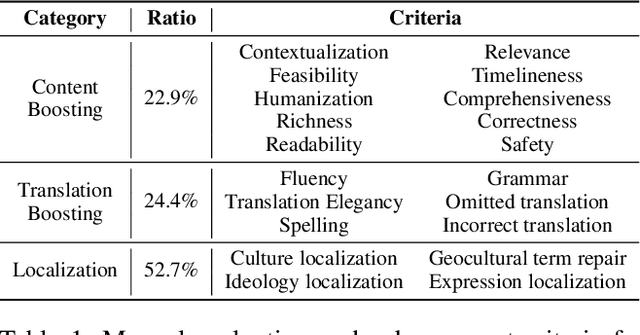
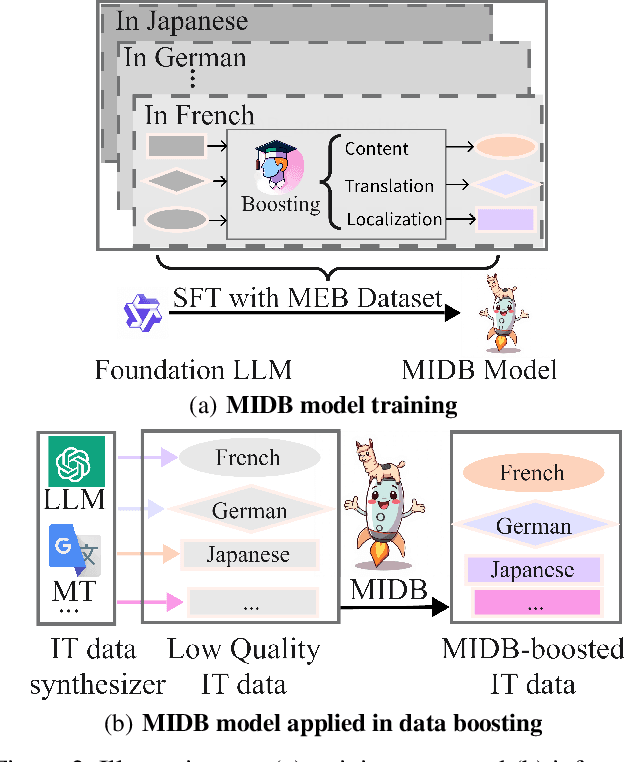
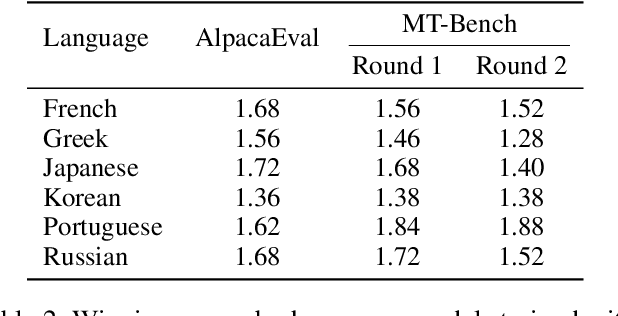
Despite doubts on data quality, instruction synthesis has been widely applied into instruction tuning (IT) of LLMs as an economic and rapid alternative. Recent endeavors focus on improving data quality for synthesized instruction pairs in English and have facilitated IT of English-centric LLMs. However, data quality issues in multilingual synthesized instruction pairs are even more severe, since the common synthesizing practice is to translate English synthesized data into other languages using machine translation (MT). Besides the known content errors in these English synthesized data, multilingual synthesized instruction data are further exposed to defects introduced by MT and face insufficient localization of the target languages. In this paper, we propose MIDB, a Multilingual Instruction Data Booster to automatically address the quality issues in multilingual synthesized data. MIDB is trained on around 36.8k revision examples across 16 languages by human linguistic experts, thereby can boost the low-quality data by addressing content errors and MT defects, and improving localization in these synthesized data. Both automatic and human evaluation indicate that not only MIDB steadily improved instruction data quality in 16 languages, but also the instruction-following and cultural-understanding abilities of multilingual LLMs fine-tuned on MIDB-boosted data were significantly enhanced.
ELSPR: Evaluator LLM Training Data Self-Purification on Non-Transitive Preferences via Tournament Graph Reconstruction
May 23, 2025Large language models (LLMs) are widely used as evaluators for open-ended tasks, while previous research has emphasized biases in LLM evaluations, the issue of non-transitivity in pairwise comparisons remains unresolved: non-transitive preferences for pairwise comparisons, where evaluators prefer A over B, B over C, but C over A. Our results suggest that low-quality training data may reduce the transitivity of preferences generated by the Evaluator LLM. To address this, We propose a graph-theoretic framework to analyze and mitigate this problem by modeling pairwise preferences as tournament graphs. We quantify non-transitivity and introduce directed graph structural entropy to measure the overall clarity of preferences. Our analysis reveals significant non-transitivity in advanced Evaluator LLMs (with Qwen2.5-Max exhibiting 67.96%), as well as high entropy values (0.8095 for Qwen2.5-Max), reflecting low overall clarity of preferences. To address this issue, we designed a filtering strategy, ELSPR, to eliminate preference data that induces non-transitivity, retaining only consistent and transitive preference data for model fine-tuning. Experiments demonstrate that models fine-tuned with filtered data reduce non-transitivity by 13.78% (from 64.28% to 50.50%), decrease structural entropy by 0.0879 (from 0.8113 to 0.7234), and align more closely with human evaluators (human agreement rate improves by 0.6% and Spearman correlation increases by 0.01).
Two Intermediate Translations Are Better Than One: Fine-tuning LLMs for Document-level Translation Refinement
Apr 08, 2025Recent research has shown that large language models (LLMs) can enhance translation quality through self-refinement. In this paper, we build on this idea by extending the refinement from sentence-level to document-level translation, specifically focusing on document-to-document (Doc2Doc) translation refinement. Since sentence-to-sentence (Sent2Sent) and Doc2Doc translation address different aspects of the translation process, we propose fine-tuning LLMs for translation refinement using two intermediate translations, combining the strengths of both Sent2Sent and Doc2Doc. Additionally, recognizing that the quality of intermediate translations varies, we introduce an enhanced fine-tuning method with quality awareness that assigns lower weights to easier translations and higher weights to more difficult ones, enabling the model to focus on challenging translation cases. Experimental results across ten translation tasks with LLaMA-3-8B-Instruct and Mistral-Nemo-Instruct demonstrate the effectiveness of our approach.