 Add to Chrome
 Add to Firefox
 Add to Edge
HY-Embodied-0.5: Embodied Foundation Models for Real-World Agents
Apr 08, 2026
We introduce HY-Embodied-0.5, a family of foundation models specifically designed for real-world embodied agents. To bridge the gap between general Vision-Language Models (VLMs) and the demands of embodied agents, our models are developed to enhance the core capabilities required by embodied intelligence: spatial and temporal visual perception, alongside advanced embodied reasoning for prediction, interaction, and planning. The HY-Embodied-0.5 suite comprises two primary variants: an efficient model with 2B activated parameters designed for edge deployment, and a powerful model with 32B activated parameters targeted for complex reasoning. To support the fine-grained visual perception essential for embodied tasks, we adopt a Mixture-of-Transformers (MoT) architecture to enable modality-specific computing. By incorporating latent tokens, this design effectively enhances the perceptual representation of the models. To improve reasoning capabilities, we introduce an iterative, self-evolving post-training paradigm. Furthermore, we employ on-policy distillation to transfer the advanced capabilities of the large model to the smaller variant, thereby maximizing the performance potential of the compact model. Extensive evaluations across 22 benchmarks, spanning visual perception, spatial reasoning, and embodied understanding, demonstrate the effectiveness of our approach. Our MoT-2B model outperforms similarly sized state-of-the-art models on 16 benchmarks, while the 32B variant achieves performance comparable to frontier models such as Gemini 3.0 Pro. In downstream robot control experiments, we leverage our robust VLM foundation to train an effective Vision-Language-Action (VLA) model, achieving compelling results in real-world physical evaluations. Code and models are open-sourced at https://github.com/Tencent-Hunyuan/HY-Embodied.

Think Fast and Slow: Step-Level Cognitive Depth Adaptation for LLM Agents
Feb 13, 2026Large language models (LLMs) are increasingly deployed as autonomous agents for multi-turn decision-making tasks. However, current agents typically rely on fixed cognitive patterns: non-thinking models generate immediate responses, while thinking models engage in deep reasoning uniformly. This rigidity is inefficient for long-horizon tasks, where cognitive demands vary significantly from step to step, with some requiring strategic planning and others only routine execution. In this paper, we introduce CogRouter, a framework that trains agents to dynamically adapt cognitive depth at each step. Grounded in ACT-R theory, we design four hierarchical cognitive levels ranging from instinctive responses to strategic planning. Our two-stage training approach includes Cognition-aware Supervised Fine-tuning (CoSFT) to instill stable level-specific patterns, and Cognition-aware Policy Optimization (CoPO) for step-level credit assignment via confidence-aware advantage reweighting. The key insight is that appropriate cognitive depth should maximize the confidence of the resulting action. Experiments on ALFWorld and ScienceWorld demonstrate that CogRouter achieves state-of-the-art performance with superior efficiency. With Qwen2.5-7B, it reaches an 82.3% success rate, outperforming GPT-4o (+40.3%), OpenAI-o3 (+18.3%), and GRPO (+14.0%), while using 62% fewer tokens.
HY3D-Bench: Generation of 3D Assets
Feb 03, 2026While recent advances in neural representations and generative models have revolutionized 3D content creation, the field remains constrained by significant data processing bottlenecks. To address this, we introduce HY3D-Bench, an open-source ecosystem designed to establish a unified, high-quality foundation for 3D generation. Our contributions are threefold: (1) We curate a library of 250k high-fidelity 3D objects distilled from large-scale repositories, employing a rigorous pipeline to deliver training-ready artifacts, including watertight meshes and multi-view renderings; (2) We introduce structured part-level decomposition, providing the granularity essential for fine-grained perception and controllable editing; and (3) We bridge real-world distribution gaps via a scalable AIGC synthesis pipeline, contributing 125k synthetic assets to enhance diversity in long-tail categories. Validated empirically through the training of Hunyuan3D-2.1-Small, HY3D-Bench democratizes access to robust data resources, aiming to catalyze innovation across 3D perception, robotics, and digital content creation.
The Script is All You Need: An Agentic Framework for Long-Horizon Dialogue-to-Cinematic Video Generation
Jan 27, 2026Recent advances in video generation have produced models capable of synthesizing stunning visual content from simple text prompts. However, these models struggle to generate long-form, coherent narratives from high-level concepts like dialogue, revealing a ``semantic gap'' between a creative idea and its cinematic execution. To bridge this gap, we introduce a novel, end-to-end agentic framework for dialogue-to-cinematic-video generation. Central to our framework is ScripterAgent, a model trained to translate coarse dialogue into a fine-grained, executable cinematic script. To enable this, we construct ScriptBench, a new large-scale benchmark with rich multimodal context, annotated via an expert-guided pipeline. The generated script then guides DirectorAgent, which orchestrates state-of-the-art video models using a cross-scene continuous generation strategy to ensure long-horizon coherence. Our comprehensive evaluation, featuring an AI-powered CriticAgent and a new Visual-Script Alignment (VSA) metric, shows our framework significantly improves script faithfulness and temporal fidelity across all tested video models. Furthermore, our analysis uncovers a crucial trade-off in current SOTA models between visual spectacle and strict script adherence, providing valuable insights for the future of automated filmmaking.
HY-Motion 1.0: Scaling Flow Matching Models for Text-To-Motion Generation
Dec 29, 2025We present HY-Motion 1.0, a series of state-of-the-art, large-scale, motion generation models capable of generating 3D human motions from textual descriptions. HY-Motion 1.0 represents the first successful attempt to scale up Diffusion Transformer (DiT)-based flow matching models to the billion-parameter scale within the motion generation domain, delivering instruction-following capabilities that significantly outperform current open-source benchmarks. Uniquely, we introduce a comprehensive, full-stage training paradigm -- including large-scale pretraining on over 3,000 hours of motion data, high-quality fine-tuning on 400 hours of curated data, and reinforcement learning from both human feedback and reward models -- to ensure precise alignment with the text instruction and high motion quality. This framework is supported by our meticulous data processing pipeline, which performs rigorous motion cleaning and captioning. Consequently, our model achieves the most extensive coverage, spanning over 200 motion categories across 6 major classes. We release HY-Motion 1.0 to the open-source community to foster future research and accelerate the transition of 3D human motion generation models towards commercial maturity.
Too Good to be Bad: On the Failure of LLMs to Role-Play Villains
Nov 12, 2025Large Language Models (LLMs) are increasingly tasked with creative generation, including the simulation of fictional characters. However, their ability to portray non-prosocial, antagonistic personas remains largely unexamined. We hypothesize that the safety alignment of modern LLMs creates a fundamental conflict with the task of authentically role-playing morally ambiguous or villainous characters. To investigate this, we introduce the Moral RolePlay benchmark, a new dataset featuring a four-level moral alignment scale and a balanced test set for rigorous evaluation. We task state-of-the-art LLMs with role-playing characters from moral paragons to pure villains. Our large-scale evaluation reveals a consistent, monotonic decline in role-playing fidelity as character morality decreases. We find that models struggle most with traits directly antithetical to safety principles, such as ``Deceitful'' and ``Manipulative'', often substituting nuanced malevolence with superficial aggression. Furthermore, we demonstrate that general chatbot proficiency is a poor predictor of villain role-playing ability, with highly safety-aligned models performing particularly poorly. Our work provides the first systematic evidence of this critical limitation, highlighting a key tension between model safety and creative fidelity. Our benchmark and findings pave the way for developing more nuanced, context-aware alignment methods.
BatonVoice: An Operationalist Framework for Enhancing Controllable Speech Synthesis with Linguistic Intelligence from LLMs
Sep 30, 2025The rise of Large Language Models (LLMs) is reshaping multimodel models, with speech synthesis being a prominent application. However, existing approaches often underutilize the linguistic intelligence of these models, typically failing to leverage their powerful instruction-following capabilities. This limitation hinders the model's ability to follow text instructions for controllable Text-to-Speech~(TTS). To address this, we propose a new paradigm inspired by ``operationalism'' that decouples instruction understanding from speech generation. We introduce BatonVoice, a framework where an LLM acts as a ``conductor'', understanding user instructions and generating a textual ``plan'' -- explicit vocal features (e.g., pitch, energy). A separate TTS model, the ``orchestra'', then generates the speech from these features. To realize this component, we develop BatonTTS, a TTS model trained specifically for this task. Our experiments demonstrate that BatonVoice achieves strong performance in controllable and emotional speech synthesis, outperforming strong open- and closed-source baselines. Notably, our approach enables remarkable zero-shot cross-lingual generalization, accurately applying feature control abilities to languages unseen during post-training. This demonstrates that objectifying speech into textual vocal features can more effectively unlock the linguistic intelligence of LLMs.
Hunyuan3D Studio: End-to-End AI Pipeline for Game-Ready 3D Asset Generation
Sep 16, 2025
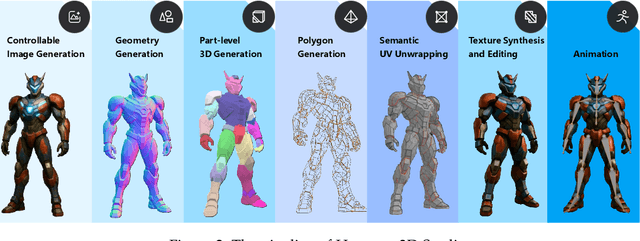

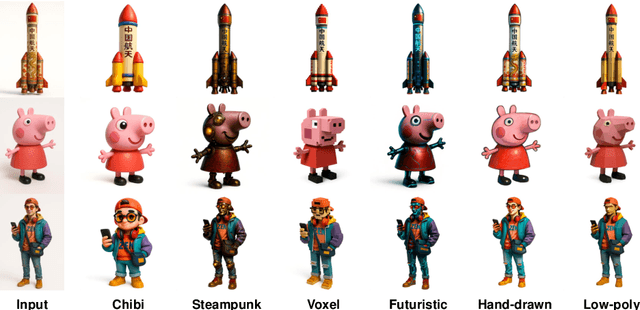
The creation of high-quality 3D assets, a cornerstone of modern game development, has long been characterized by labor-intensive and specialized workflows. This paper presents Hunyuan3D Studio, an end-to-end AI-powered content creation platform designed to revolutionize the game production pipeline by automating and streamlining the generation of game-ready 3D assets. At its core, Hunyuan3D Studio integrates a suite of advanced neural modules (such as Part-level 3D Generation, Polygon Generation, Semantic UV, etc.) into a cohesive and user-friendly system. This unified framework allows for the rapid transformation of a single concept image or textual description into a fully-realized, production-quality 3D model complete with optimized geometry and high-fidelity PBR textures. We demonstrate that assets generated by Hunyuan3D Studio are not only visually compelling but also adhere to the stringent technical requirements of contemporary game engines, significantly reducing iteration time and lowering the barrier to entry for 3D content creation. By providing a seamless bridge from creative intent to technical asset, Hunyuan3D Studio represents a significant leap forward for AI-assisted workflows in game development and interactive media.
HunyuanWorld 1.0: Generating Immersive, Explorable, and Interactive 3D Worlds from Words or Pixels
Jul 29, 2025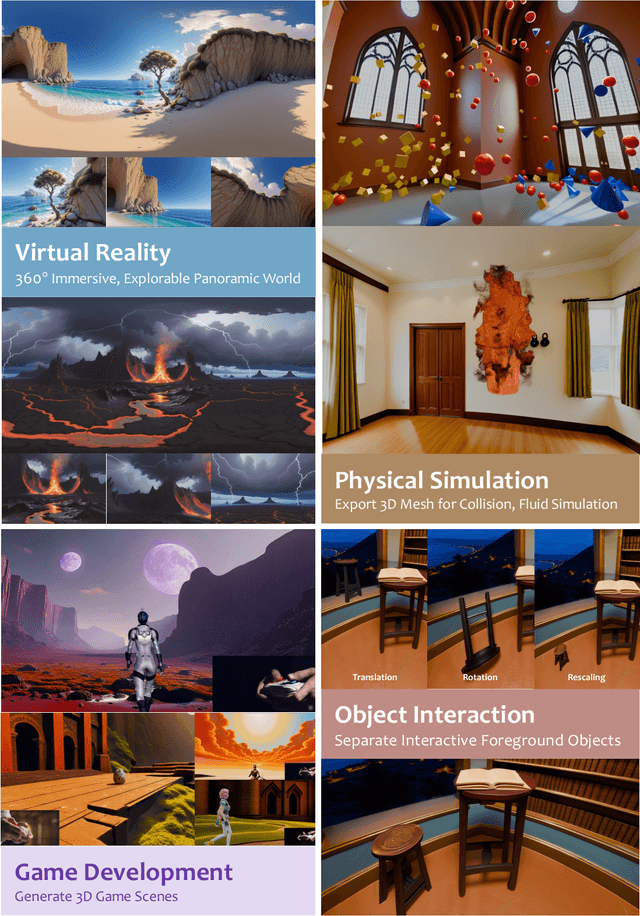

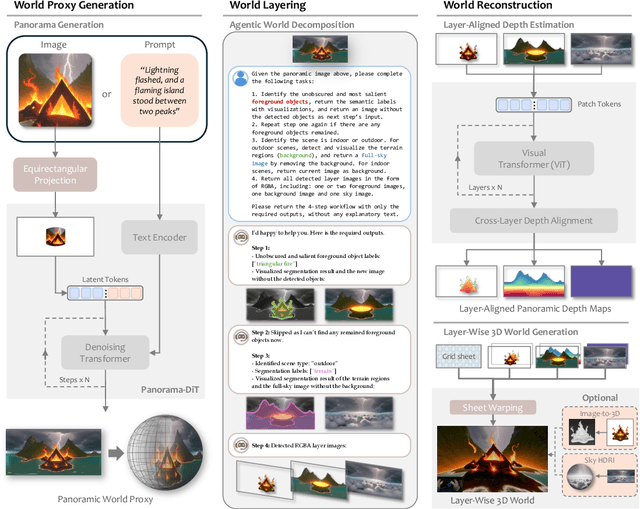
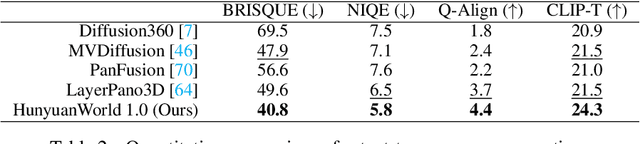
Creating immersive and playable 3D worlds from texts or images remains a fundamental challenge in computer vision and graphics. Existing world generation approaches typically fall into two categories: video-based methods that offer rich diversity but lack 3D consistency and rendering efficiency, and 3D-based methods that provide geometric consistency but struggle with limited training data and memory-inefficient representations. To address these limitations, we present HunyuanWorld 1.0, a novel framework that combines the best of both worlds for generating immersive, explorable, and interactive 3D scenes from text and image conditions. Our approach features three key advantages: 1) 360{\deg} immersive experiences via panoramic world proxies; 2) mesh export capabilities for seamless compatibility with existing computer graphics pipelines; 3) disentangled object representations for augmented interactivity. The core of our framework is a semantically layered 3D mesh representation that leverages panoramic images as 360{\deg} world proxies for semantic-aware world decomposition and reconstruction, enabling the generation of diverse 3D worlds. Extensive experiments demonstrate that our method achieves state-of-the-art performance in generating coherent, explorable, and interactive 3D worlds while enabling versatile applications in virtual reality, physical simulation, game development, and interactive content creation.
X-Omni: Reinforcement Learning Makes Discrete Autoregressive Image Generative Models Great Again
Jul 29, 2025Numerous efforts have been made to extend the ``next token prediction'' paradigm to visual contents, aiming to create a unified approach for both image generation and understanding. Nevertheless, attempts to generate images through autoregressive modeling with discrete tokens have been plagued by issues such as low visual fidelity, distorted outputs, and failure to adhere to complex instructions when rendering intricate details. These shortcomings are likely attributed to cumulative errors during autoregressive inference or information loss incurred during the discretization process. Probably due to this challenge, recent research has increasingly shifted toward jointly training image generation with diffusion objectives and language generation with autoregressive objectives, moving away from unified modeling approaches. In this work, we demonstrate that reinforcement learning can effectively mitigate artifacts and largely enhance the generation quality of a discrete autoregressive modeling method, thereby enabling seamless integration of image and language generation. Our framework comprises a semantic image tokenizer, a unified autoregressive model for both language and images, and an offline diffusion decoder for image generation, termed X-Omni. X-Omni achieves state-of-the-art performance in image generation tasks using a 7B language model, producing images with high aesthetic quality while exhibiting strong capabilities in following instructions and rendering long texts.