 Add to Chrome
 Add to Firefox
 Add to Edge
Hy-Embodied-VLM-1.0: Efficient Physical-World Agents
Jul 14, 2026
Building capable embodied agents requires not only multimodal perception and understanding, but also agentic capabilities for reasoning about actions, adapting to evolving situations, and interacting with the physical world. In this report, we introduce Hy-Embodied-VLM-1.0, an efficient and powerful embodied foundation model specifically designed for embodied agents operating in the physical world. To cultivate such capabilities from the pre-training stage onward, we define an action-centric capability taxonomy comprising three progressive dimensions: Action-Relevant State Understanding, Action-Transition Reasoning, and Sequential and Adaptive Reasoning. Guided by this taxonomy, we develop a systematic data pipeline and curate data mixtures spanning both pre-training and post-training. To deliver strong physical-world understanding and interaction capabilities while supporting latency-sensitive deployment, we build our model on the Hy3-A3B language backbone and the Hy-ViT2 vision encoder. Its efficient Mixture-of-Experts architecture combines strong model capacity with high inference efficiency. We evaluate Hy-Embodied-VLM-1.0 on a comprehensive suite of 38 benchmarks covering embodied perception, physical-world understanding, and embodied reasoning. The model achieves the best performance among similarly sized models on 19 of the 38 benchmarks and substantially outperforms strong competitors, including Qwen3.6-A3B and Cosmos 3. Compared with the previous-generation Hy-Embodied-0.5 MoT-2B, Hy-Embodied-VLM-1.0 improves average performance by 8.4%. Despite activating only 3B parameters, it achieves performance close to that of the previous-generation model with 32B activated parameters. Beyond static benchmark evaluation, Hy-Embodied-VLM-1.0 also demonstrates strong performance on embodied agentic tasks requiring multi-turn interaction and long-horizon reasoning.

ViQ: Text-Aligned Visual Quantized Representations at Any Resolution
Jun 25, 2026A unified representation for text and vision is a natural pursuit, as it enables simpler multimodal modeling and more efficient training. However, representing images as discrete signals in the same way as text inevitably introduces severe information loss. Existing work struggles to balance low-level details and high-level semantics in discrete representations: reconstruction-oriented representations often lack semantic information, whereas semantically stronger features typically suffer from severe loss of detail. We present ViQ, a Visual Quantized Representations framework, which is designed to balance semantics and details in discrete representations while supporting inputs at native resolutions, thereby enabling it to serve as a unified and general discrete representation for arbitrary visual inputs. Our approach structures quantization learning into two stages: text-aligned pre-training and feature discretization. With text-aligned pre-training, we enhance the visual encoder semantic-rich supervision from the pretrained language model and enable it to process native-resolution visual inputs. During discretization, we propose a proximal representation learning strategy to progressively compact the feature space, along with a position-aware head-wise quantization mechanism that enables flexible processing of arbitrary resolutions. Extensive experiments on multimodal tasks demonstrate that ViQ achieves competitive performance compared to state-of-the-art multimodal vision encoders with continuous and high-dimensional visual features, while maintaining high precision in low-level reconstruction. We also show that multimodal training with visual quantized representations largely improves efficiency, yielding up to 20\%-70\% acceleration with different base LLMs and training recipes.
Hy-Embodied-0.5-VLA: From Vision-Language-Action Models to a Real-World Robot Learning Stack
Jun 12, 2026In this report, we present Hy-Embodied-0.5-VLA, abbreviated as HyVLA-0.5, an end-to-end system that spans the full robot learning stack: data collection, model design, continued pre-training and supervised fine-tuning, RL post-training, and real-world deployment. Each component serves a distinct role in this stack.
GEM: Generative Supervision Helps Embodied Intelligence
May 27, 2026Embodied Vision-Language Models (VLMs) have demonstrated impressive performance and generalization in robotics, particularly within Vision-Language-Action frameworks. However, a significant gap remains between the high-level semantic focus of standard text-guided pre-training paradigms and the low-level spatial and physical knowledge critical for execution in embodied environments. In this paper, we introduce GEM, a Generative-supervised Embodied vision-language Model designed to bridge this divide. We propose integrating a depth map generation task directly into the VLM pre-training phase. By training this generative objective jointly with the main model, we observe substantial improvements in embodied intelligence, significantly enhancing both semantic understanding and physical operation capabilities. To support this paradigm, we curate and release GEM-4M, a comprehensive large-scale dataset featuring a mixture of grounding, reasoning, and planning data paired with high-quality depth supervision. Extensive experiments demonstrate that GEM achieves state-of-the-art results across diverse embodied benchmarks. Furthermore, our deployed action model, GEM-VLA, exhibits vastly superior task execution abilities in both simulation environments and real-world evaluations. Code, models, and datasets are available at https://zhaorw02.github.io/GEM/
HY-Embodied-0.5: Embodied Foundation Models for Real-World Agents
Apr 08, 2026We introduce HY-Embodied-0.5, a family of foundation models specifically designed for real-world embodied agents. To bridge the gap between general Vision-Language Models (VLMs) and the demands of embodied agents, our models are developed to enhance the core capabilities required by embodied intelligence: spatial and temporal visual perception, alongside advanced embodied reasoning for prediction, interaction, and planning. The HY-Embodied-0.5 suite comprises two primary variants: an efficient model with 2B activated parameters designed for edge deployment, and a powerful model with 32B activated parameters targeted for complex reasoning. To support the fine-grained visual perception essential for embodied tasks, we adopt a Mixture-of-Transformers (MoT) architecture to enable modality-specific computing. By incorporating latent tokens, this design effectively enhances the perceptual representation of the models. To improve reasoning capabilities, we introduce an iterative, self-evolving post-training paradigm. Furthermore, we employ on-policy distillation to transfer the advanced capabilities of the large model to the smaller variant, thereby maximizing the performance potential of the compact model. Extensive evaluations across 22 benchmarks, spanning visual perception, spatial reasoning, and embodied understanding, demonstrate the effectiveness of our approach. Our MoT-2B model outperforms similarly sized state-of-the-art models on 16 benchmarks, while the 32B variant achieves performance comparable to frontier models such as Gemini 3.0 Pro. In downstream robot control experiments, we leverage our robust VLM foundation to train an effective Vision-Language-Action (VLA) model, achieving compelling results in real-world physical evaluations. Code and models are open-sourced at https://github.com/Tencent-Hunyuan/HY-Embodied.
Spatial-TTT: Streaming Visual-based Spatial Intelligence with Test-Time Training
Mar 12, 2026Humans perceive and understand real-world spaces through a stream of visual observations. Therefore, the ability to streamingly maintain and update spatial evidence from potentially unbounded video streams is essential for spatial intelligence. The core challenge is not simply longer context windows but how spatial information is selected, organized, and retained over time. In this paper, we propose Spatial-TTT towards streaming visual-based spatial intelligence with test-time training (TTT), which adapts a subset of parameters (fast weights) to capture and organize spatial evidence over long-horizon scene videos. Specifically, we design a hybrid architecture and adopt large-chunk updates parallel with sliding-window attention for efficient spatial video processing. To further promote spatial awareness, we introduce a spatial-predictive mechanism applied to TTT layers with 3D spatiotemporal convolution, which encourages the model to capture geometric correspondence and temporal continuity across frames. Beyond architecture design, we construct a dataset with dense 3D spatial descriptions, which guides the model to update its fast weights to memorize and organize global 3D spatial signals in a structured manner. Extensive experiments demonstrate that Spatial-TTT improves long-horizon spatial understanding and achieves state-of-the-art performance on video spatial benchmarks. Project page: https://liuff19.github.io/Spatial-TTT.
Vision Generalist Model: A Survey
Jun 11, 2025Recently, we have witnessed the great success of the generalist model in natural language processing. The generalist model is a general framework trained with massive data and is able to process various downstream tasks simultaneously. Encouraged by their impressive performance, an increasing number of researchers are venturing into the realm of applying these models to computer vision tasks. However, the inputs and outputs of vision tasks are more diverse, and it is difficult to summarize them as a unified representation. In this paper, we provide a comprehensive overview of the vision generalist models, delving into their characteristics and capabilities within the field. First, we review the background, including the datasets, tasks, and benchmarks. Then, we dig into the design of frameworks that have been proposed in existing research, while also introducing the techniques employed to enhance their performance. To better help the researchers comprehend the area, we take a brief excursion into related domains, shedding light on their interconnections and potential synergies. To conclude, we provide some real-world application scenarios, undertake a thorough examination of the persistent challenges, and offer insights into possible directions for future research endeavors.
XMask3D: Cross-modal Mask Reasoning for Open Vocabulary 3D Semantic Segmentation
Nov 20, 2024


Existing methodologies in open vocabulary 3D semantic segmentation primarily concentrate on establishing a unified feature space encompassing 3D, 2D, and textual modalities. Nevertheless, traditional techniques such as global feature alignment or vision-language model distillation tend to impose only approximate correspondence, struggling notably with delineating fine-grained segmentation boundaries. To address this gap, we propose a more meticulous mask-level alignment between 3D features and the 2D-text embedding space through a cross-modal mask reasoning framework, XMask3D. In our approach, we developed a mask generator based on the denoising UNet from a pre-trained diffusion model, leveraging its capability for precise textual control over dense pixel representations and enhancing the open-world adaptability of the generated masks. We further integrate 3D global features as implicit conditions into the pre-trained 2D denoising UNet, enabling the generation of segmentation masks with additional 3D geometry awareness. Subsequently, the generated 2D masks are employed to align mask-level 3D representations with the vision-language feature space, thereby augmenting the open vocabulary capability of 3D geometry embeddings. Finally, we fuse complementary 2D and 3D mask features, resulting in competitive performance across multiple benchmarks for 3D open vocabulary semantic segmentation. Code is available at https://github.com/wangzy22/XMask3D.
FlowTurbo: Towards Real-time Flow-Based Image Generation with Velocity Refiner
Sep 26, 2024Building on the success of diffusion models in visual generation, flow-based models reemerge as another prominent family of generative models that have achieved competitive or better performance in terms of both visual quality and inference speed. By learning the velocity field through flow-matching, flow-based models tend to produce a straighter sampling trajectory, which is advantageous during the sampling process. However, unlike diffusion models for which fast samplers are well-developed, efficient sampling of flow-based generative models has been rarely explored. In this paper, we propose a framework called FlowTurbo to accelerate the sampling of flow-based models while still enhancing the sampling quality. Our primary observation is that the velocity predictor's outputs in the flow-based models will become stable during the sampling, enabling the estimation of velocity via a lightweight velocity refiner. Additionally, we introduce several techniques including a pseudo corrector and sample-aware compilation to further reduce inference time. Since FlowTurbo does not change the multi-step sampling paradigm, it can be effectively applied for various tasks such as image editing, inpainting, etc. By integrating FlowTurbo into different flow-based models, we obtain an acceleration ratio of 53.1%$\sim$58.3% on class-conditional generation and 29.8%$\sim$38.5% on text-to-image generation. Notably, FlowTurbo reaches an FID of 2.12 on ImageNet with 100 (ms / img) and FID of 3.93 with 38 (ms / img), achieving the real-time image generation and establishing the new state-of-the-art. Code is available at https://github.com/shiml20/FlowTurbo.
OpenVoice: Versatile Instant Voice Cloning
Dec 03, 2023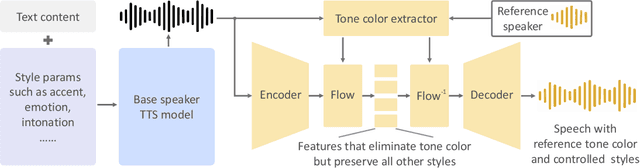
We introduce OpenVoice, a versatile voice cloning approach that requires only a short audio clip from the reference speaker to replicate their voice and generate speech in multiple languages. OpenVoice represents a significant advancement in addressing the following open challenges in the field: 1) Flexible Voice Style Control. OpenVoice enables granular control over voice styles, including emotion, accent, rhythm, pauses, and intonation, in addition to replicating the tone color of the reference speaker. The voice styles are not directly copied from and constrained by the style of the reference speaker. Previous approaches lacked the ability to flexibly manipulate voice styles after cloning. 2) Zero-Shot Cross-Lingual Voice Cloning. OpenVoice achieves zero-shot cross-lingual voice cloning for languages not included in the massive-speaker training set. Unlike previous approaches, which typically require extensive massive-speaker multi-lingual (MSML) dataset for all languages, OpenVoice can clone voices into a new language without any massive-speaker training data for that language. OpenVoice is also computationally efficient, costing tens of times less than commercially available APIs that offer even inferior performance. To foster further research in the field, we have made the source code and trained model publicly accessible. We also provide qualitative results in our demo website. Prior to its public release, our internal version of OpenVoice was used tens of millions of times by users worldwide between May and October 2023, serving as the backend of MyShell.ai.