 Add to Chrome
 Add to Firefox
 Add to Edge
Hunyuan3D-Buffalo 1.0: A Unified Multimodal Model for Scalable 3D Generation, Understanding, and Editing
Aug 03, 2026
Recent advances in image generation have demonstrated the potential of unified multimodal models that integrate understanding, generation, and editing. However, unified 3D modeling remains constrained by scarce multimodal data, particularly the lack of large-scale and geometrically consistent editing data. To address this limitation, we propose Hunyuan3D-Buffalo 1.0, a unified framework supporting 3D understanding, text-to-3D generation, instruction-guided 3D editing, and text-grounded part generation within a single architecture. To enable scalable training, we construct an 87M-scale 3D multimodal corpus, comprising 25M understanding samples, 50M text-to-3D pairs, and 12M editing pairs generated using Nano3D-v2. Architecturally, the framework combines Hunyuan3D-VLM for semantic, structural, and spatial understanding with Hunyuan3D DiT for high-fidelity 3D synthesis. The VLM provides multimodal semantic conditions for generation, while editing and part generation additionally condition the diffusion process on the source object representation to preserve its overall structure and unedited regions. Extensive experiments show that Hunyuan3D-Buffalo 1.0 achieves state-of-the-art or leading performance on text-to-3D generation and 3D editing benchmarks, while exhibiting strong understanding and part-generation capabilities. Our analysis further shows that both generation and understanding improve editing, demonstrating the effectiveness of unified 3D multimodal training. Project Page: https://tencent-hunyuan.github.io/Hunyuan3D-Buffalo1.0/

HY3D-Bench: Generation of 3D Assets
Feb 03, 2026While recent advances in neural representations and generative models have revolutionized 3D content creation, the field remains constrained by significant data processing bottlenecks. To address this, we introduce HY3D-Bench, an open-source ecosystem designed to establish a unified, high-quality foundation for 3D generation. Our contributions are threefold: (1) We curate a library of 250k high-fidelity 3D objects distilled from large-scale repositories, employing a rigorous pipeline to deliver training-ready artifacts, including watertight meshes and multi-view renderings; (2) We introduce structured part-level decomposition, providing the granularity essential for fine-grained perception and controllable editing; and (3) We bridge real-world distribution gaps via a scalable AIGC synthesis pipeline, contributing 125k synthetic assets to enhance diversity in long-tail categories. Validated empirically through the training of Hunyuan3D-2.1-Small, HY3D-Bench democratizes access to robust data resources, aiming to catalyze innovation across 3D perception, robotics, and digital content creation.
Hunyuan3D Studio: End-to-End AI Pipeline for Game-Ready 3D Asset Generation
Sep 16, 2025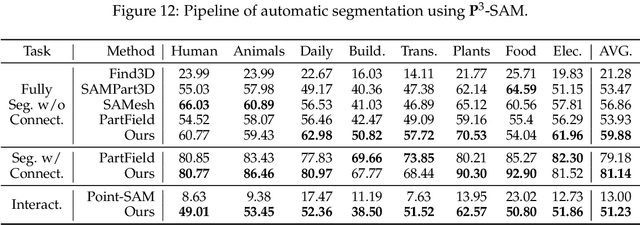
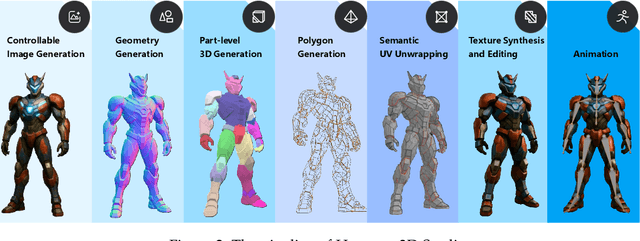

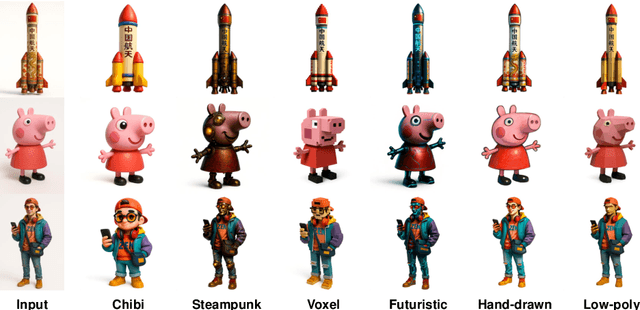
The creation of high-quality 3D assets, a cornerstone of modern game development, has long been characterized by labor-intensive and specialized workflows. This paper presents Hunyuan3D Studio, an end-to-end AI-powered content creation platform designed to revolutionize the game production pipeline by automating and streamlining the generation of game-ready 3D assets. At its core, Hunyuan3D Studio integrates a suite of advanced neural modules (such as Part-level 3D Generation, Polygon Generation, Semantic UV, etc.) into a cohesive and user-friendly system. This unified framework allows for the rapid transformation of a single concept image or textual description into a fully-realized, production-quality 3D model complete with optimized geometry and high-fidelity PBR textures. We demonstrate that assets generated by Hunyuan3D Studio are not only visually compelling but also adhere to the stringent technical requirements of contemporary game engines, significantly reducing iteration time and lowering the barrier to entry for 3D content creation. By providing a seamless bridge from creative intent to technical asset, Hunyuan3D Studio represents a significant leap forward for AI-assisted workflows in game development and interactive media.
HunyuanWorld 1.0: Generating Immersive, Explorable, and Interactive 3D Worlds from Words or Pixels
Jul 29, 2025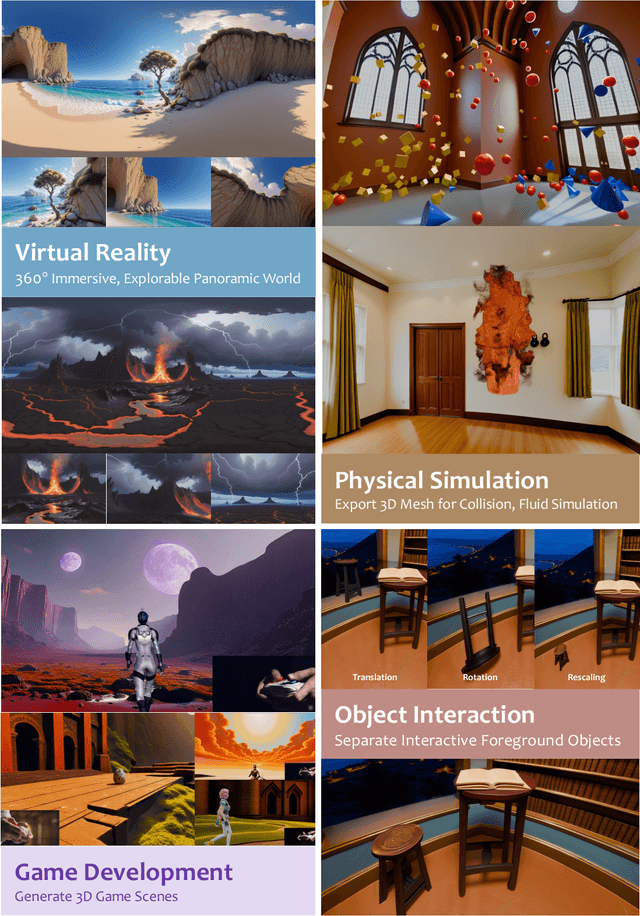

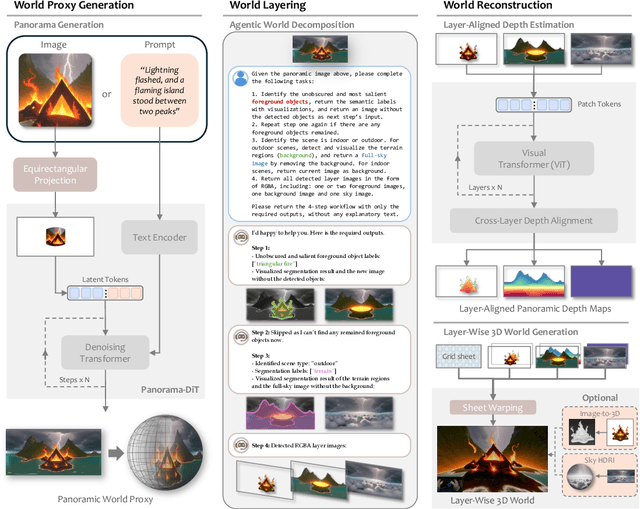
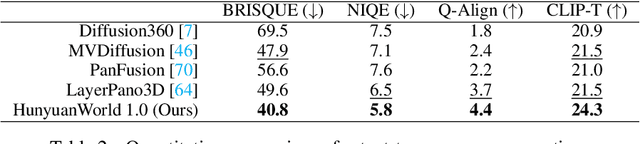
Creating immersive and playable 3D worlds from texts or images remains a fundamental challenge in computer vision and graphics. Existing world generation approaches typically fall into two categories: video-based methods that offer rich diversity but lack 3D consistency and rendering efficiency, and 3D-based methods that provide geometric consistency but struggle with limited training data and memory-inefficient representations. To address these limitations, we present HunyuanWorld 1.0, a novel framework that combines the best of both worlds for generating immersive, explorable, and interactive 3D scenes from text and image conditions. Our approach features three key advantages: 1) 360{\deg} immersive experiences via panoramic world proxies; 2) mesh export capabilities for seamless compatibility with existing computer graphics pipelines; 3) disentangled object representations for augmented interactivity. The core of our framework is a semantically layered 3D mesh representation that leverages panoramic images as 360{\deg} world proxies for semantic-aware world decomposition and reconstruction, enabling the generation of diverse 3D worlds. Extensive experiments demonstrate that our method achieves state-of-the-art performance in generating coherent, explorable, and interactive 3D worlds while enabling versatile applications in virtual reality, physical simulation, game development, and interactive content creation.
Hunyuan3D 2.1: From Images to High-Fidelity 3D Assets with Production-Ready PBR Material
Jun 18, 20253D AI-generated content (AIGC) is a passionate field that has significantly accelerated the creation of 3D models in gaming, film, and design. Despite the development of several groundbreaking models that have revolutionized 3D generation, the field remains largely accessible only to researchers, developers, and designers due to the complexities involved in collecting, processing, and training 3D models. To address these challenges, we introduce Hunyuan3D 2.1 as a case study in this tutorial. This tutorial offers a comprehensive, step-by-step guide on processing 3D data, training a 3D generative model, and evaluating its performance using Hunyuan3D 2.1, an advanced system for producing high-resolution, textured 3D assets. The system comprises two core components: the Hunyuan3D-DiT for shape generation and the Hunyuan3D-Paint for texture synthesis. We will explore the entire workflow, including data preparation, model architecture, training strategies, evaluation metrics, and deployment. By the conclusion of this tutorial, you will have the knowledge to finetune or develop a robust 3D generative model suitable for applications in gaming, virtual reality, and industrial design.
Mesh-RFT: Enhancing Mesh Generation via Fine-grained Reinforcement Fine-Tuning
May 22, 2025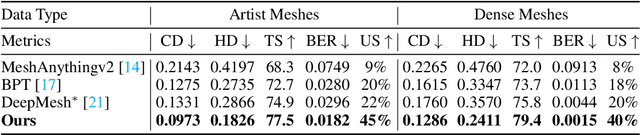
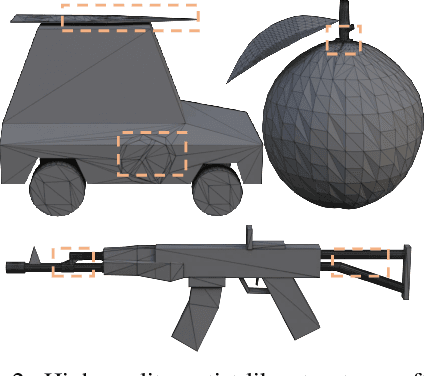
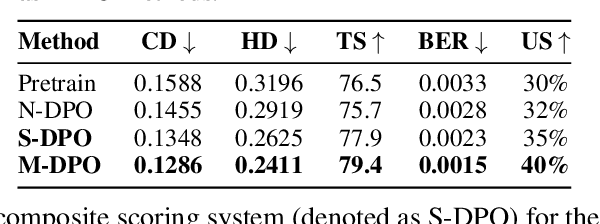
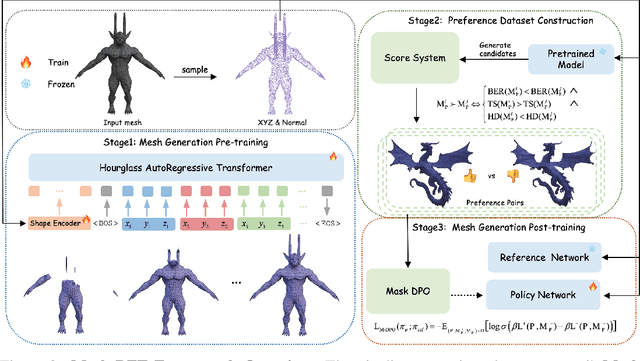
Existing pretrained models for 3D mesh generation often suffer from data biases and produce low-quality results, while global reinforcement learning (RL) methods rely on object-level rewards that struggle to capture local structure details. To address these challenges, we present \textbf{Mesh-RFT}, a novel fine-grained reinforcement fine-tuning framework that employs Masked Direct Preference Optimization (M-DPO) to enable localized refinement via quality-aware face masking. To facilitate efficient quality evaluation, we introduce an objective topology-aware scoring system to evaluate geometric integrity and topological regularity at both object and face levels through two metrics: Boundary Edge Ratio (BER) and Topology Score (TS). By integrating these metrics into a fine-grained RL strategy, Mesh-RFT becomes the first method to optimize mesh quality at the granularity of individual faces, resolving localized errors while preserving global coherence. Experiment results show that our M-DPO approach reduces Hausdorff Distance (HD) by 24.6\% and improves Topology Score (TS) by 3.8\% over pre-trained models, while outperforming global DPO methods with a 17.4\% HD reduction and 4.9\% TS gain. These results demonstrate Mesh-RFT's ability to improve geometric integrity and topological regularity, achieving new state-of-the-art performance in production-ready mesh generation. Project Page: \href{https://hitcslj.github.io/mesh-rft/}{this https URL}.
RomanTex: Decoupling 3D-aware Rotary Positional Embedded Multi-Attention Network for Texture Synthesis
Mar 24, 2025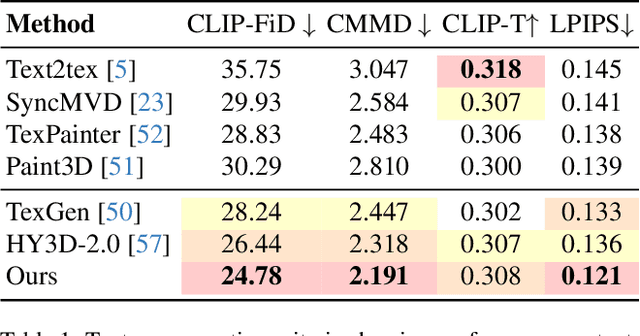
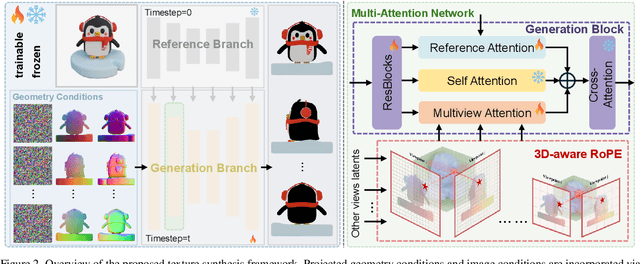
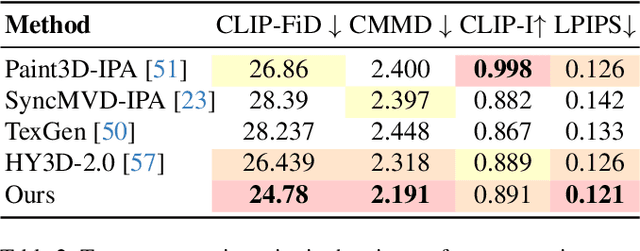
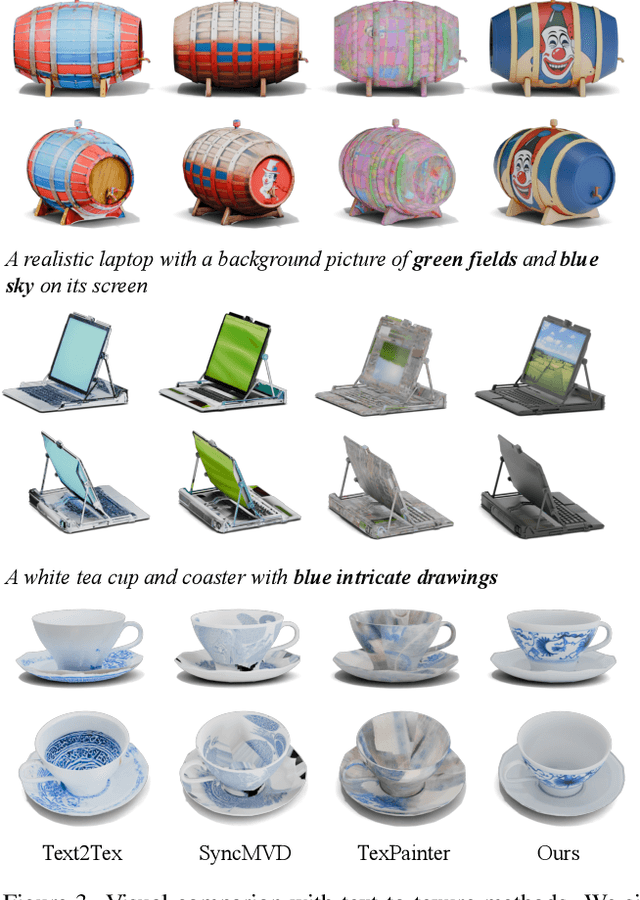
Painting textures for existing geometries is a critical yet labor-intensive process in 3D asset generation. Recent advancements in text-to-image (T2I) models have led to significant progress in texture generation. Most existing research approaches this task by first generating images in 2D spaces using image diffusion models, followed by a texture baking process to achieve UV texture. However, these methods often struggle to produce high-quality textures due to inconsistencies among the generated multi-view images, resulting in seams and ghosting artifacts. In contrast, 3D-based texture synthesis methods aim to address these inconsistencies, but they often neglect 2D diffusion model priors, making them challenging to apply to real-world objects To overcome these limitations, we propose RomanTex, a multiview-based texture generation framework that integrates a multi-attention network with an underlying 3D representation, facilitated by our novel 3D-aware Rotary Positional Embedding. Additionally, we incorporate a decoupling characteristic in the multi-attention block to enhance the model's robustness in image-to-texture task, enabling semantically-correct back-view synthesis. Furthermore, we introduce a geometry-related Classifier-Free Guidance (CFG) mechanism to further improve the alignment with both geometries and images. Quantitative and qualitative evaluations, along with comprehensive user studies, demonstrate that our method achieves state-of-the-art results in texture quality and consistency.
Hunyuan3D 2.0: Scaling Diffusion Models for High Resolution Textured 3D Assets Generation
Jan 21, 2025


We present Hunyuan3D 2.0, an advanced large-scale 3D synthesis system for generating high-resolution textured 3D assets. This system includes two foundation components: a large-scale shape generation model -- Hunyuan3D-DiT, and a large-scale texture synthesis model -- Hunyuan3D-Paint. The shape generative model, built on a scalable flow-based diffusion transformer, aims to create geometry that properly aligns with a given condition image, laying a solid foundation for downstream applications. The texture synthesis model, benefiting from strong geometric and diffusion priors, produces high-resolution and vibrant texture maps for either generated or hand-crafted meshes. Furthermore, we build Hunyuan3D-Studio -- a versatile, user-friendly production platform that simplifies the re-creation process of 3D assets. It allows both professional and amateur users to manipulate or even animate their meshes efficiently. We systematically evaluate our models, showing that Hunyuan3D 2.0 outperforms previous state-of-the-art models, including the open-source models and closed-source models in geometry details, condition alignment, texture quality, and etc. Hunyuan3D 2.0 is publicly released in order to fill the gaps in the open-source 3D community for large-scale foundation generative models. The code and pre-trained weights of our models are available at: https://github.com/Tencent/Hunyuan3D-2
Tencent Hunyuan3D-1.0: A Unified Framework for Text-to-3D and Image-to-3D Generation
Nov 05, 2024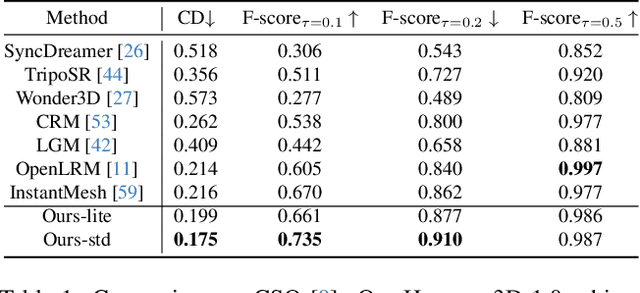


While 3D generative models have greatly improved artists' workflows, the existing diffusion models for 3D generation suffer from slow generation and poor generalization. To address this issue, we propose a two-stage approach named Hunyuan3D-1.0 including a lite version and a standard version, that both support text- and image-conditioned generation. In the first stage, we employ a multi-view diffusion model that efficiently generates multi-view RGB in approximately 4 seconds. These multi-view images capture rich details of the 3D asset from different viewpoints, relaxing the tasks from single-view to multi-view reconstruction. In the second stage, we introduce a feed-forward reconstruction model that rapidly and faithfully reconstructs the 3D asset given the generated multi-view images in approximately 7 seconds. The reconstruction network learns to handle noises and in-consistency introduced by the multi-view diffusion and leverages the available information from the condition image to efficiently recover the 3D structure. Our framework involves the text-to-image model, i.e., Hunyuan-DiT, making it a unified framework to support both text- and image-conditioned 3D generation. Our standard version has 3x more parameters than our lite and other existing model. Our Hunyuan3D-1.0 achieves an impressive balance between speed and quality, significantly reducing generation time while maintaining the quality and diversity of the produced assets.
M3oE: Multi-Domain Multi-Task Mixture-of Experts Recommendation Framework
Apr 29, 2024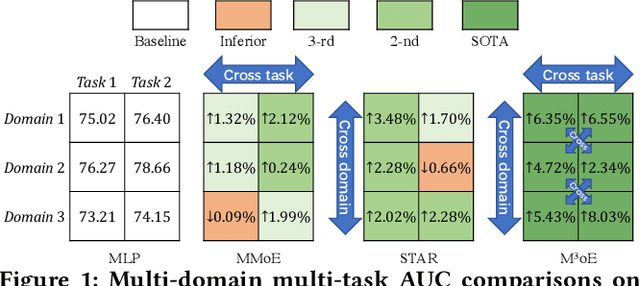
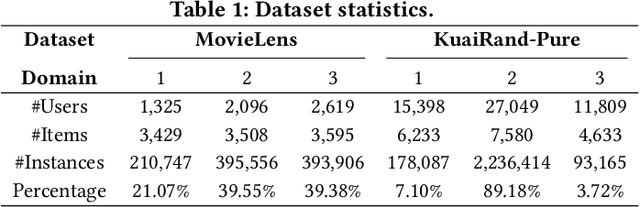
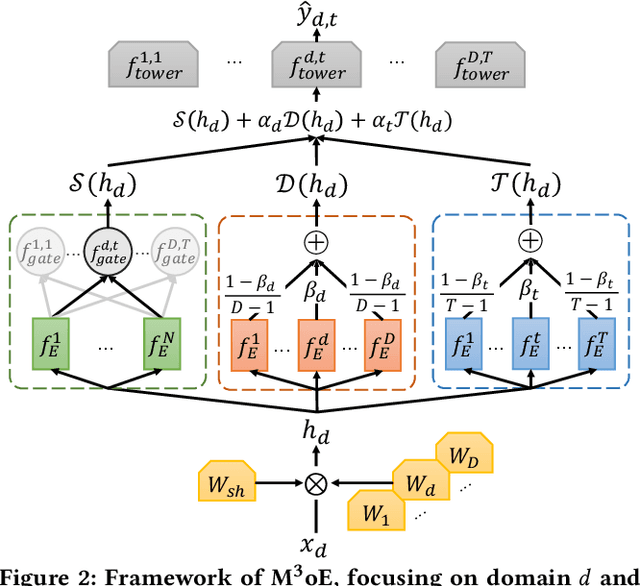
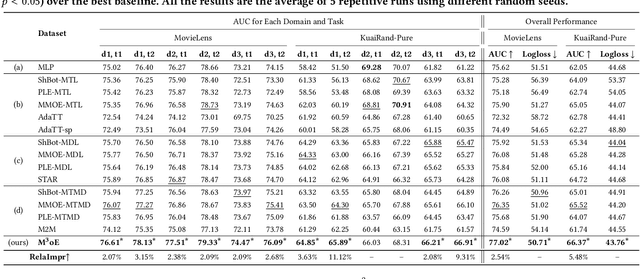
Multi-domain recommendation and multi-task recommendation have demonstrated their effectiveness in leveraging common information from different domains and objectives for comprehensive user modeling. Nonetheless, the practical recommendation usually faces multiple domains and tasks simultaneously, which cannot be well-addressed by current methods. To this end, we introduce M3oE, an adaptive multi-domain multi-task mixture-of-experts recommendation framework. M3oE integrates multi-domain information, maps knowledge across domains and tasks, and optimizes multiple objectives. We leverage three mixture-of-experts modules to learn common, domain-aspect, and task-aspect user preferences respectively to address the complex dependencies among multiple domains and tasks in a disentangled manner. Additionally, we design a two-level fusion mechanism for precise control over feature extraction and fusion across diverse domains and tasks. The framework's adaptability is further enhanced by applying AutoML technique, which allows dynamic structure optimization. To the best of the authors' knowledge, our M3oE is the first effort to solve multi-domain multi-task recommendation self-adaptively. Extensive experiments on two benchmark datasets against diverse baselines demonstrate M3oE's superior performance. The implementation code is available to ensure reproducibility.