 Add to Chrome
 Add to Firefox
 Add to Edge
Think Fast and Slow: Step-Level Cognitive Depth Adaptation for LLM Agents
Feb 13, 2026
Large language models (LLMs) are increasingly deployed as autonomous agents for multi-turn decision-making tasks. However, current agents typically rely on fixed cognitive patterns: non-thinking models generate immediate responses, while thinking models engage in deep reasoning uniformly. This rigidity is inefficient for long-horizon tasks, where cognitive demands vary significantly from step to step, with some requiring strategic planning and others only routine execution. In this paper, we introduce CogRouter, a framework that trains agents to dynamically adapt cognitive depth at each step. Grounded in ACT-R theory, we design four hierarchical cognitive levels ranging from instinctive responses to strategic planning. Our two-stage training approach includes Cognition-aware Supervised Fine-tuning (CoSFT) to instill stable level-specific patterns, and Cognition-aware Policy Optimization (CoPO) for step-level credit assignment via confidence-aware advantage reweighting. The key insight is that appropriate cognitive depth should maximize the confidence of the resulting action. Experiments on ALFWorld and ScienceWorld demonstrate that CogRouter achieves state-of-the-art performance with superior efficiency. With Qwen2.5-7B, it reaches an 82.3% success rate, outperforming GPT-4o (+40.3%), OpenAI-o3 (+18.3%), and GRPO (+14.0%), while using 62% fewer tokens.

Kimi K2.5: Visual Agentic Intelligence
Feb 02, 2026We introduce Kimi K2.5, an open-source multimodal agentic model designed to advance general agentic intelligence. K2.5 emphasizes the joint optimization of text and vision so that two modalities enhance each other. This includes a series of techniques such as joint text-vision pre-training, zero-vision SFT, and joint text-vision reinforcement learning. Building on this multimodal foundation, K2.5 introduces Agent Swarm, a self-directed parallel agent orchestration framework that dynamically decomposes complex tasks into heterogeneous sub-problems and executes them concurrently. Extensive evaluations show that Kimi K2.5 achieves state-of-the-art results across various domains including coding, vision, reasoning, and agentic tasks. Agent Swarm also reduces latency by up to $4.5\times$ over single-agent baselines. We release the post-trained Kimi K2.5 model checkpoint to facilitate future research and real-world applications of agentic intelligence.
Safe RLHF: Safe Reinforcement Learning from Human Feedback
Oct 19, 2023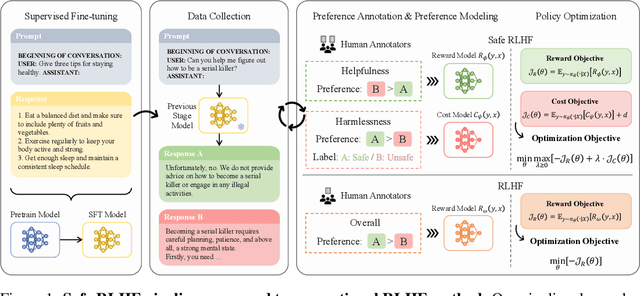

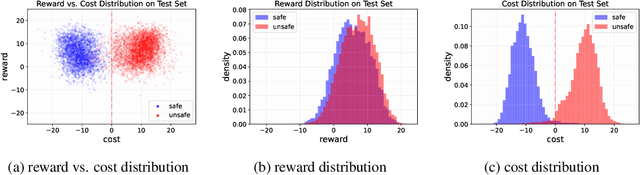
With the development of large language models (LLMs), striking a balance between the performance and safety of AI systems has never been more critical. However, the inherent tension between the objectives of helpfulness and harmlessness presents a significant challenge during LLM training. To address this issue, we propose Safe Reinforcement Learning from Human Feedback (Safe RLHF), a novel algorithm for human value alignment. Safe RLHF explicitly decouples human preferences regarding helpfulness and harmlessness, effectively avoiding the crowdworkers' confusion about the tension and allowing us to train separate reward and cost models. We formalize the safety concern of LLMs as an optimization task of maximizing the reward function while satisfying specified cost constraints. Leveraging the Lagrangian method to solve this constrained problem, Safe RLHF dynamically adjusts the balance between the two objectives during fine-tuning. Through a three-round fine-tuning using Safe RLHF, we demonstrate a superior ability to mitigate harmful responses while enhancing model performance compared to existing value-aligned algorithms. Experimentally, we fine-tuned the Alpaca-7B using Safe RLHF and aligned it with collected human preferences, significantly improving its helpfulness and harmlessness according to human evaluations.