 Add to Chrome
 Add to Firefox
 Add to Edge
Defending Against Backdoor Attacks via Alignment Checking in Model-Contrastive Federated Learning
Jul 29, 2026
Federated Learning (FL) is vulnerable to backdoor attacks because of its distributed nature in edge computing scenarios. Existing defense methods show limited efficacy as they overlook the deviations among benign local updates caused by statistical heterogeneity and the stealthiness of backdoor attacks. To tackle these issues, we propose FedDAB, a two-phase method that combines local contrastive regularization with alignment checking, to defend against backdoor attacks. In the first phase, FedDAB introduces a novel model-contrastive term into the local objective to enhance direction and magnitude consistency among benign updates. In the second phase, FedDAB employs an alignment checking strategy to evaluate each local update in terms of overall-direction alignment and parameter-level alignment with historical information, excluding updates that exhibit abnormal alignment patterns from global aggregation. We theoretically prove FedDAB's robustness with a convergence rate of $\mathcal{O}(1/T)$. Extensive experiments show that FedDAB outperforms existing defense methods against backdoor attacks.

GaMi: Geometry-Agnostic Material Identification via Cross-Modal Subtractive Disentanglement
May 29, 2026Non-contact material identification enables adaptive interaction for embodied intelligence yet faces challenges from geometry-induced variations (e.g., orientation, shape, distance) and single-modality ambiguities. In this paper, we present GaMi, a multimodal material identification system integrating mmWave and acoustic sensing to robustly operate under unconstrained geometric conditions. By leveraging the insight of shared geometric consistency between co-located bimodal sensors, GaMi employs an intra-sample cross-modal subtractive disentanglement framework. By semantically aligning modalities and subtracting the shared geometric context, it isolates intrinsic material features. Furthermore, GaMi incorporates inter-sample contrastive learning to correct the residual interference caused by cross-modal misalignment. Additionally, a pairing-based adaptation strategy between two modalities enables few-shot generalization across devices. Extensive evaluations on 20 materials show that GaMi achieves 95.2% accuracy, outperforming single-modality baselines across unseen geometric conditions.
Case-Based Calibration of Adaptive Reasoning and Execution for LLM Tool Use
May 14, 2026Tool use extends large language models beyond parametric knowledge, but reliable execution requires balancing appropriate reasoning depth with strict structural validity. We approach this problem from a case-based perspective to present CAST, a case-driven framework that treats historical execution trajectories as structured cases. Instead of reusing raw exemplar outputs, CAST extracts case-derived signals to identify complexity profiles for estimating optimal reasoning strategies, alongside failure profiles to map likely structural breakdowns. The framework translates this knowledge into a fine-grained reward design and adaptive reasoning, enabling the model to autonomously internalize case-based strategies during reinforcement learning. Experiments on BFCLv2 and ToolBench demonstrate that CAST improves both schema-faithful execution and task-level tool-use success while reducing unnecessary deliberation. The approach achieves up to 5.85 percentage points gain in overall execution accuracy and reduces average reasoning length by 26%, significantly mitigating high-impact structural errors. Ultimately, this demonstrates how historical execution cases can provide reusable adaptation knowledge for calibrated tool use.
Improving Multi-turn Dialogue Consistency with Self-Recall Thinking
May 14, 2026Large language model (LLM) based multi-turn dialogue systems often struggle to track dependencies across non-adjacent turns, undermining both consistency and scalability. As conversations lengthen, essential information becomes sparse and is buried in irrelevant context, while processing the entire dialogue history incurs severe efficiency bottlenecks. Existing solutions either rely on high latency external memory or lose fine-grained details through iterative summarization. In this paper, we propose Self-Recall Thinking (SRT), a framework designed to address long-range contextual dependency and sparse informative signals in multi-turn dialogue. SRT identifies helpful historical turns and uses them to generate contextually appropriate responses, enabling the model to selectively recall and reason over context during inference. This process yields an endogenous reasoning process that integrates interpretable recall steps without external modules. SRT incorporates: (1) Dependency Construction: Generating and converting it into self-recall chains; (2)Capability Initialization: Training to enable reasoning chains with recall tokens capability; (3)Reasoning Improvement: Refining accuracy via verifiable rewards to optimize recall and reasoning for correct answers. Experiments on multiple datasets demonstrate that SRT improves F1 score by 4.7% and reduces end-to-end latency by 14.7% over prior methods, achieving a balance between reasoning latency and accuracy, and outperforming state-of-the-art baselines.
FAIL: Flow Matching Adversarial Imitation Learning for Image Generation
Feb 12, 2026Post-training of flow matching models-aligning the output distribution with a high-quality target-is mathematically equivalent to imitation learning. While Supervised Fine-Tuning mimics expert demonstrations effectively, it cannot correct policy drift in unseen states. Preference optimization methods address this but require costly preference pairs or reward modeling. We propose Flow Matching Adversarial Imitation Learning (FAIL), which minimizes policy-expert divergence through adversarial training without explicit rewards or pairwise comparisons. We derive two algorithms: FAIL-PD exploits differentiable ODE solvers for low-variance pathwise gradients, while FAIL-PG provides a black-box alternative for discrete or computationally constrained settings. Fine-tuning FLUX with only 13,000 demonstrations from Nano Banana pro, FAIL achieves competitive performance on prompt following and aesthetic benchmarks. Furthermore, the framework generalizes effectively to discrete image and video generation, and functions as a robust regularizer to mitigate reward hacking in reward-based optimization. Code and data are available at https://github.com/HansPolo113/FAIL.
GenArena: How Can We Achieve Human-Aligned Evaluation for Visual Generation Tasks?
Feb 05, 2026The rapid advancement of visual generation models has outpaced traditional evaluation approaches, necessitating the adoption of Vision-Language Models as surrogate judges. In this work, we systematically investigate the reliability of the prevailing absolute pointwise scoring standard, across a wide spectrum of visual generation tasks. Our analysis reveals that this paradigm is limited due to stochastic inconsistency and poor alignment with human perception. To resolve these limitations, we introduce GenArena, a unified evaluation framework that leverages a pairwise comparison paradigm to ensure stable and human-aligned evaluation. Crucially, our experiments uncover a transformative finding that simply adopting this pairwise protocol enables off-the-shelf open-source models to outperform top-tier proprietary models. Notably, our method boosts evaluation accuracy by over 20% and achieves a Spearman correlation of 0.86 with the authoritative LMArena leaderboard, drastically surpassing the 0.36 correlation of pointwise methods. Based on GenArena, we benchmark state-of-the-art visual generation models across diverse tasks, providing the community with a rigorous and automated evaluation standard for visual generation.
X-Omni: Reinforcement Learning Makes Discrete Autoregressive Image Generative Models Great Again
Jul 29, 2025Numerous efforts have been made to extend the ``next token prediction'' paradigm to visual contents, aiming to create a unified approach for both image generation and understanding. Nevertheless, attempts to generate images through autoregressive modeling with discrete tokens have been plagued by issues such as low visual fidelity, distorted outputs, and failure to adhere to complex instructions when rendering intricate details. These shortcomings are likely attributed to cumulative errors during autoregressive inference or information loss incurred during the discretization process. Probably due to this challenge, recent research has increasingly shifted toward jointly training image generation with diffusion objectives and language generation with autoregressive objectives, moving away from unified modeling approaches. In this work, we demonstrate that reinforcement learning can effectively mitigate artifacts and largely enhance the generation quality of a discrete autoregressive modeling method, thereby enabling seamless integration of image and language generation. Our framework comprises a semantic image tokenizer, a unified autoregressive model for both language and images, and an offline diffusion decoder for image generation, termed X-Omni. X-Omni achieves state-of-the-art performance in image generation tasks using a 7B language model, producing images with high aesthetic quality while exhibiting strong capabilities in following instructions and rendering long texts.
ReDDiT: Rehashing Noise for Discrete Visual Generation
May 26, 2025Discrete diffusion models are gaining traction in the visual generative area for their efficiency and compatibility. However, the pioneered attempts still fall behind the continuous counterparts, which we attribute to the noise (absorbing state) design and sampling heuristics. In this study, we propose the rehashing noise framework for discrete diffusion transformer, termed ReDDiT, to extend absorbing states and improve expressive capacity of discrete diffusion models. ReDDiT enriches the potential paths that latent variables can traverse during training with randomized multi-index corruption. The derived rehash sampler, which reverses the randomized absorbing paths, guarantees the diversity and low discrepancy of the generation process. These reformulations lead to more consistent and competitive generation quality, mitigating the need for heavily tuned randomness. Experiments show that ReDDiT significantly outperforms the baseline (reducing gFID from 6.18 to 1.61) and is on par with the continuous counterparts with higher efficiency.
Emu3: Next-Token Prediction is All You Need
Sep 27, 2024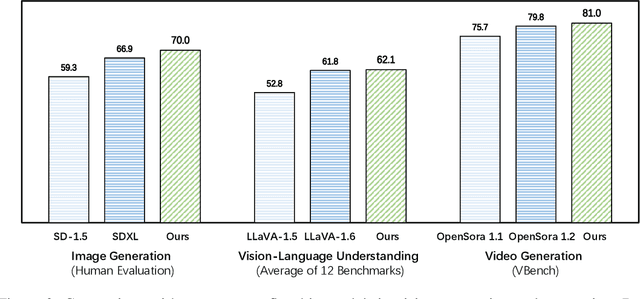

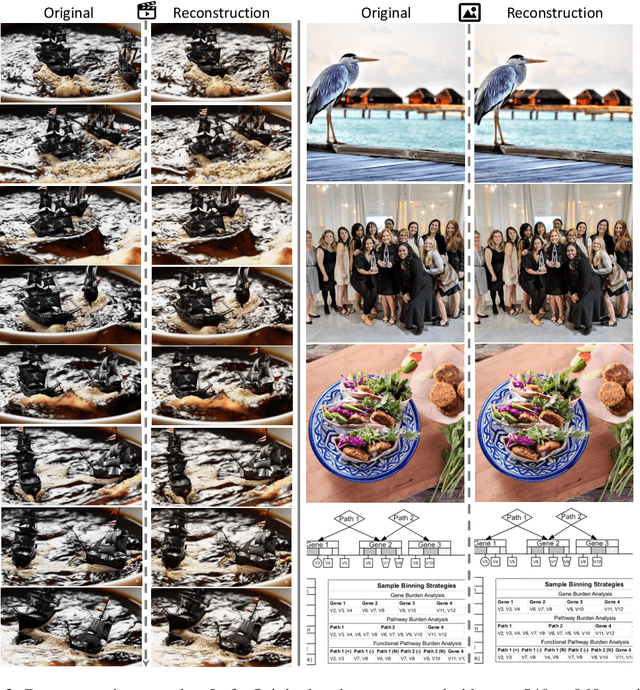
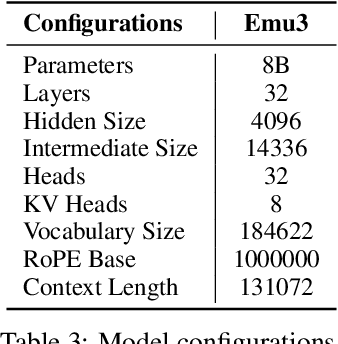
While next-token prediction is considered a promising path towards artificial general intelligence, it has struggled to excel in multimodal tasks, which are still dominated by diffusion models (e.g., Stable Diffusion) and compositional approaches (e.g., CLIP combined with LLMs). In this paper, we introduce Emu3, a new suite of state-of-the-art multimodal models trained solely with next-token prediction. By tokenizing images, text, and videos into a discrete space, we train a single transformer from scratch on a mixture of multimodal sequences. Emu3 outperforms several well-established task-specific models in both generation and perception tasks, surpassing flagship models such as SDXL and LLaVA-1.6, while eliminating the need for diffusion or compositional architectures. Emu3 is also capable of generating high-fidelity video via predicting the next token in a video sequence. We simplify complex multimodal model designs by converging on a singular focus: tokens, unlocking great potential for scaling both during training and inference. Our results demonstrate that next-token prediction is a promising path towards building general multimodal intelligence beyond language. We open-source key techniques and models to support further research in this direction.
Correspondence-Guided SfM-Free 3D Gaussian Splatting for NVS
Aug 16, 2024Novel View Synthesis (NVS) without Structure-from-Motion (SfM) pre-processed camera poses--referred to as SfM-free methods--is crucial for promoting rapid response capabilities and enhancing robustness against variable operating conditions. Recent SfM-free methods have integrated pose optimization, designing end-to-end frameworks for joint camera pose estimation and NVS. However, most existing works rely on per-pixel image loss functions, such as L2 loss. In SfM-free methods, inaccurate initial poses lead to misalignment issue, which, under the constraints of per-pixel image loss functions, results in excessive gradients, causing unstable optimization and poor convergence for NVS. In this study, we propose a correspondence-guided SfM-free 3D Gaussian splatting for NVS. We use correspondences between the target and the rendered result to achieve better pixel alignment, facilitating the optimization of relative poses between frames. We then apply the learned poses to optimize the entire scene. Each 2D screen-space pixel is associated with its corresponding 3D Gaussians through approximated surface rendering to facilitate gradient back propagation. Experimental results underline the superior performance and time efficiency of the proposed approach compared to the state-of-the-art baselines.