 Add to Chrome
 Add to Firefox
 Add to Edge
HY-Motion 1.0: Scaling Flow Matching Models for Text-To-Motion Generation
Dec 29, 2025
We present HY-Motion 1.0, a series of state-of-the-art, large-scale, motion generation models capable of generating 3D human motions from textual descriptions. HY-Motion 1.0 represents the first successful attempt to scale up Diffusion Transformer (DiT)-based flow matching models to the billion-parameter scale within the motion generation domain, delivering instruction-following capabilities that significantly outperform current open-source benchmarks. Uniquely, we introduce a comprehensive, full-stage training paradigm -- including large-scale pretraining on over 3,000 hours of motion data, high-quality fine-tuning on 400 hours of curated data, and reinforcement learning from both human feedback and reward models -- to ensure precise alignment with the text instruction and high motion quality. This framework is supported by our meticulous data processing pipeline, which performs rigorous motion cleaning and captioning. Consequently, our model achieves the most extensive coverage, spanning over 200 motion categories across 6 major classes. We release HY-Motion 1.0 to the open-source community to foster future research and accelerate the transition of 3D human motion generation models towards commercial maturity.

Learning Audio-Driven Viseme Dynamics for 3D Face Animation
Jan 15, 2023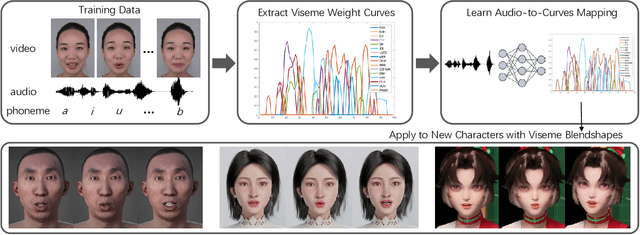
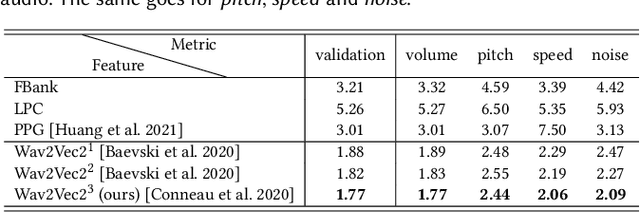
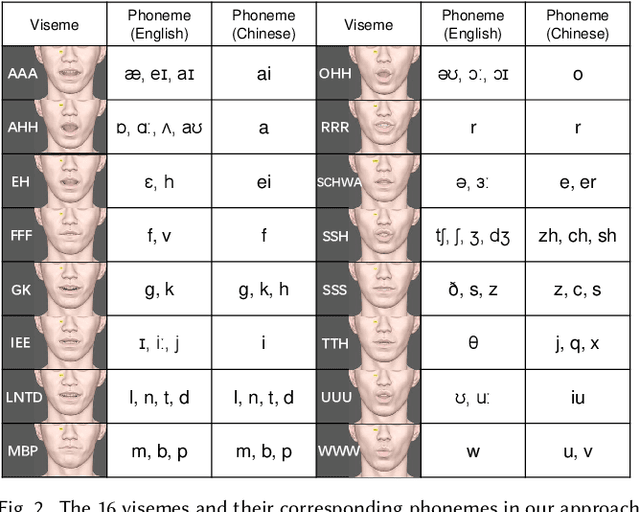
We present a novel audio-driven facial animation approach that can generate realistic lip-synchronized 3D facial animations from the input audio. Our approach learns viseme dynamics from speech videos, produces animator-friendly viseme curves, and supports multilingual speech inputs. The core of our approach is a novel parametric viseme fitting algorithm that utilizes phoneme priors to extract viseme parameters from speech videos. With the guidance of phonemes, the extracted viseme curves can better correlate with phonemes, thus more controllable and friendly to animators. To support multilingual speech inputs and generalizability to unseen voices, we take advantage of deep audio feature models pretrained on multiple languages to learn the mapping from audio to viseme curves. Our audio-to-curves mapping achieves state-of-the-art performance even when the input audio suffers from distortions of volume, pitch, speed, or noise. Lastly, a viseme scanning approach for acquiring high-fidelity viseme assets is presented for efficient speech animation production. We show that the predicted viseme curves can be applied to different viseme-rigged characters to yield various personalized animations with realistic and natural facial motions. Our approach is artist-friendly and can be easily integrated into typical animation production workflows including blendshape or bone based animation.