 Add to Chrome
 Add to Firefox
 Add to Edge
Think Fast and Slow: Step-Level Cognitive Depth Adaptation for LLM Agents
Feb 13, 2026
Large language models (LLMs) are increasingly deployed as autonomous agents for multi-turn decision-making tasks. However, current agents typically rely on fixed cognitive patterns: non-thinking models generate immediate responses, while thinking models engage in deep reasoning uniformly. This rigidity is inefficient for long-horizon tasks, where cognitive demands vary significantly from step to step, with some requiring strategic planning and others only routine execution. In this paper, we introduce CogRouter, a framework that trains agents to dynamically adapt cognitive depth at each step. Grounded in ACT-R theory, we design four hierarchical cognitive levels ranging from instinctive responses to strategic planning. Our two-stage training approach includes Cognition-aware Supervised Fine-tuning (CoSFT) to instill stable level-specific patterns, and Cognition-aware Policy Optimization (CoPO) for step-level credit assignment via confidence-aware advantage reweighting. The key insight is that appropriate cognitive depth should maximize the confidence of the resulting action. Experiments on ALFWorld and ScienceWorld demonstrate that CogRouter achieves state-of-the-art performance with superior efficiency. With Qwen2.5-7B, it reaches an 82.3% success rate, outperforming GPT-4o (+40.3%), OpenAI-o3 (+18.3%), and GRPO (+14.0%), while using 62% fewer tokens.

Hallucination Mitigating for Medical Report Generation
Jan 22, 2026In the realm of medical report generation (MRG), the integration of natural language processing has emerged as a vital tool to alleviate the workload of radiologists. Despite the impressive capabilities demonstrated by large vision language models (LVLMs) in understanding natural language, their susceptibility to generating plausible yet inaccurate claims, known as ``hallucinations'', raises concerns-especially in the nuanced and critical field of medical. In this work, we introduce a framework, \textbf{K}nowledge-\textbf{E}nhanced with Fine-Grained \textbf{R}einforced Rewards \textbf{M}edical Report Generation (KERM), to tackle the issue. Our approach refines the input to the LVLM by first utilizing MedCLIP for knowledge retrieval, incorporating relevant lesion fact sentences from a curated knowledge corpus. We then introduce a novel purification module to ensure the retrieved knowledge is contextually relevant to the patient's clinical context. Subsequently, we employ fine-grained rewards to guide these models in generating highly supportive and clinically relevant descriptions, ensuring the alignment of model's outputs with desired behaviors. Experimental results on IU-Xray and MIMIC-CXR datasets validate the effectiveness of our approach in mitigating hallucinations and enhancing report quality.
An Empirical Investigation of Domain Adaptation Ability for Chinese Spelling Check Models
Jan 26, 2024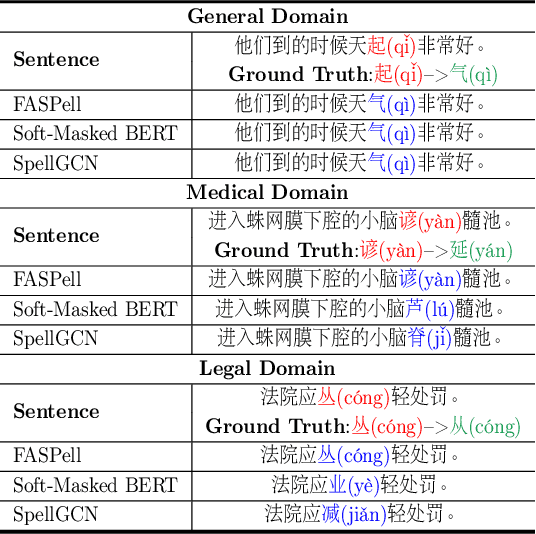
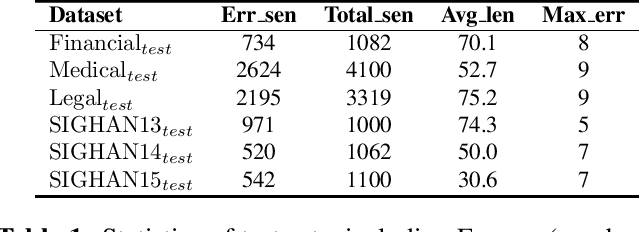
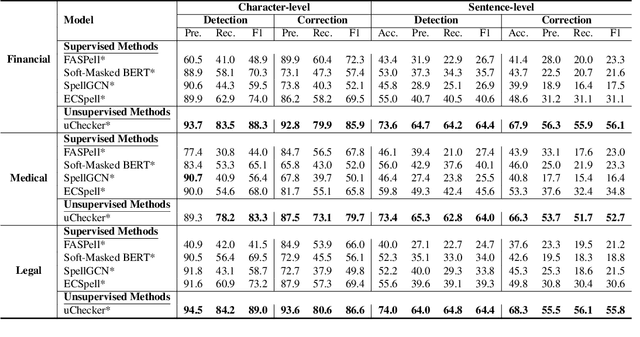
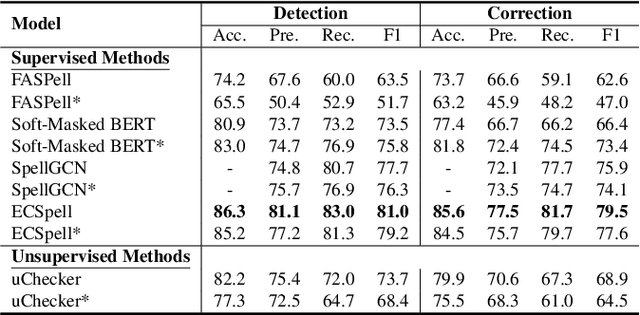
Chinese Spelling Check (CSC) is a meaningful task in the area of Natural Language Processing (NLP) which aims at detecting spelling errors in Chinese texts and then correcting these errors. However, CSC models are based on pretrained language models, which are trained on a general corpus. Consequently, their performance may drop when confronted with downstream tasks involving domain-specific terms. In this paper, we conduct a thorough evaluation about the domain adaption ability of various typical CSC models by building three new datasets encompassing rich domain-specific terms from the financial, medical, and legal domains. Then we conduct empirical investigations in the corresponding domain-specific test datasets to ascertain the cross-domain adaptation ability of several typical CSC models. We also test the performance of the popular large language model ChatGPT. As shown in our experiments, the performances of the CSC models drop significantly in the new domains.
Medical Report Generation based on Segment-Enhanced Contrastive Representation Learning
Dec 26, 2023Automated radiology report generation has the potential to improve radiology reporting and alleviate the workload of radiologists. However, the medical report generation task poses unique challenges due to the limited availability of medical data and the presence of data bias. To maximize the utility of available data and reduce data bias, we propose MSCL (Medical image Segmentation with Contrastive Learning), a framework that utilizes the Segment Anything Model (SAM) to segment organs, abnormalities, bones, etc., and can pay more attention to the meaningful ROIs in the image to get better visual representations. Then we introduce a supervised contrastive loss that assigns more weight to reports that are semantically similar to the target while training. The design of this loss function aims to mitigate the impact of data bias and encourage the model to capture the essential features of a medical image and generate high-quality reports. Experimental results demonstrate the effectiveness of our proposed model, where we achieve state-of-the-art performance on the IU X-Ray public dataset.