 Add to Chrome
 Add to Firefox
 Add to Edge
HY-World 2.0: A Multi-Modal World Model for Reconstructing, Generating, and Simulating 3D Worlds
Apr 15, 2026
We introduce HY-World 2.0, a multi-modal world model framework that advances our prior project HY-World 1.0. HY-World 2.0 accommodates diverse input modalities, including text prompts, single-view images, multi-view images, and videos, and produces 3D world representations. With text or single-view image inputs, the model performs world generation, synthesizing high-fidelity, navigable 3D Gaussian Splatting (3DGS) scenes. This is achieved through a four-stage method: a) Panorama Generation with HY-Pano 2.0, b) Trajectory Planning with WorldNav, c) World Expansion with WorldStereo 2.0, and d) World Composition with WorldMirror 2.0. Specifically, we introduce key innovations to enhance panorama fidelity, enable 3D scene understanding and planning, and upgrade WorldStereo, our keyframe-based view generation model with consistent memory. We also upgrade WorldMirror, a feed-forward model for universal 3D prediction, by refining model architecture and learning strategy, enabling world reconstruction from multi-view images or videos. Also, we introduce WorldLens, a high-performance 3DGS rendering platform featuring a flexible engine-agnostic architecture, automatic IBL lighting, efficient collision detection, and training-rendering co-design, enabling interactive exploration of 3D worlds with character support. Extensive experiments demonstrate that HY-World 2.0 achieves state-of-the-art performance on several benchmarks among open-source approaches, delivering results comparable to the closed-source model Marble. We release all model weights, code, and technical details to facilitate reproducibility and support further research on 3D world models.

WorldStereo: Bridging Camera-Guided Video Generation and Scene Reconstruction via 3D Geometric Memories
Mar 02, 2026Recent advances in foundational Video Diffusion Models (VDMs) have yielded significant progress. Yet, despite the remarkable visual quality of generated videos, reconstructing consistent 3D scenes from these outputs remains challenging, due to limited camera controllability and inconsistent generated content when viewed from distinct camera trajectories. In this paper, we propose WorldStereo, a novel framework that bridges camera-guided video generation and 3D reconstruction via two dedicated geometric memory modules. Formally, the global-geometric memory enables precise camera control while injecting coarse structural priors through incrementally updated point clouds. Moreover, the spatial-stereo memory constrains the model's attention receptive fields with 3D correspondence to focus on fine-grained details from the memory bank. These components enable WorldStereo to generate multi-view-consistent videos under precise camera control, facilitating high-quality 3D reconstruction. Furthermore, the flexible control branch-based WorldStereo shows impressive efficiency, benefiting from the distribution matching distilled VDM backbone without joint training. Extensive experiments across both camera-guided video generation and 3D reconstruction benchmarks demonstrate the effectiveness of our approach. Notably, we show that WorldStereo acts as a powerful world model, tackling diverse scene generation tasks (whether starting from perspective or panoramic images) with high-fidelity 3D results. Models will be released.
WorldCompass: Reinforcement Learning for Long-Horizon World Models
Feb 09, 2026This work presents WorldCompass, a novel Reinforcement Learning (RL) post-training framework for the long-horizon, interactive video-based world models, enabling them to explore the world more accurately and consistently based on interaction signals. To effectively "steer" the world model's exploration, we introduce three core innovations tailored to the autoregressive video generation paradigm: 1) Clip-level rollout Strategy: We generate and evaluate multiple samples at a single target clip, which significantly boosts rollout efficiency and provides fine-grained reward signals. 2) Complementary Reward Functions: We design reward functions for both interaction-following accuracy and visual quality, which provide direct supervision and effectively suppress reward-hacking behaviors. 3) Efficient RL Algorithm: We employ the negative-aware fine-tuning strategy coupled with various efficiency optimizations to efficiently and effectively enhance model capacity. Evaluations on the SoTA open-source world model, WorldPlay, demonstrate that WorldCompass significantly improves interaction accuracy and visual fidelity across various scenarios.
HunyuanWorld 1.0: Generating Immersive, Explorable, and Interactive 3D Worlds from Words or Pixels
Jul 29, 2025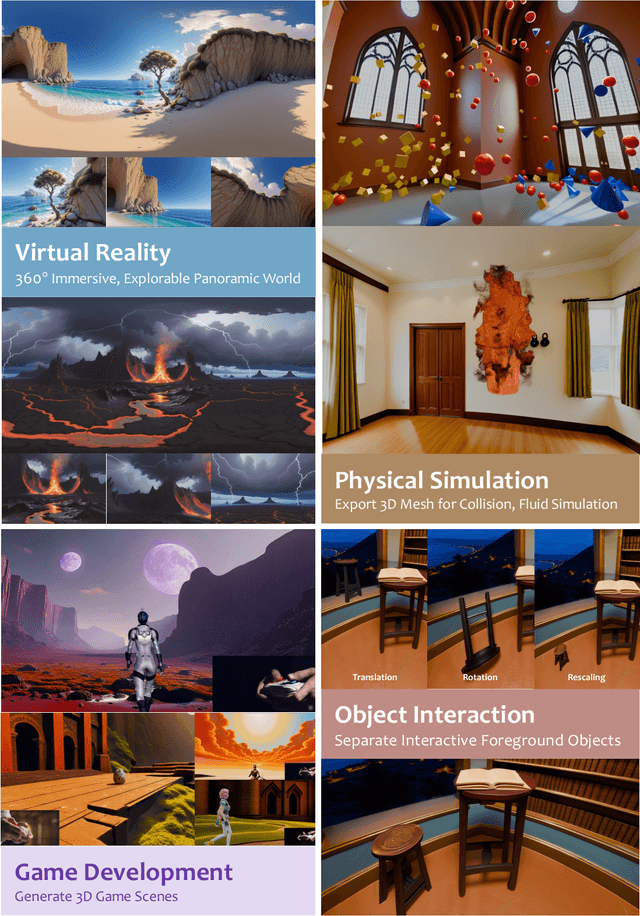

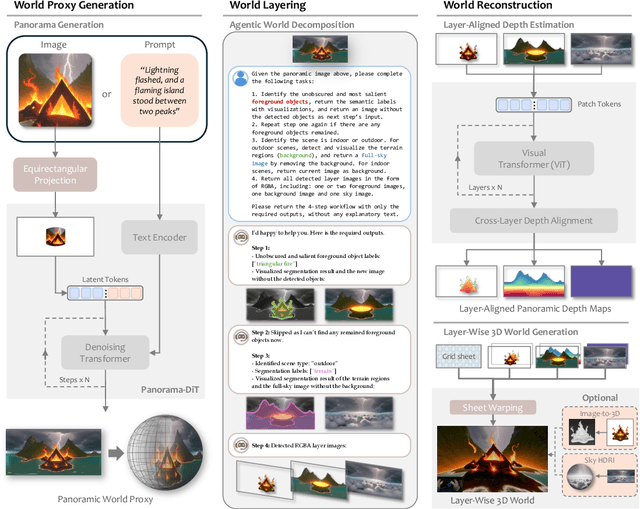
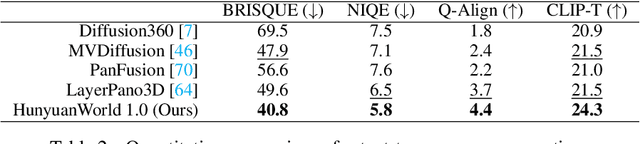
Creating immersive and playable 3D worlds from texts or images remains a fundamental challenge in computer vision and graphics. Existing world generation approaches typically fall into two categories: video-based methods that offer rich diversity but lack 3D consistency and rendering efficiency, and 3D-based methods that provide geometric consistency but struggle with limited training data and memory-inefficient representations. To address these limitations, we present HunyuanWorld 1.0, a novel framework that combines the best of both worlds for generating immersive, explorable, and interactive 3D scenes from text and image conditions. Our approach features three key advantages: 1) 360{\deg} immersive experiences via panoramic world proxies; 2) mesh export capabilities for seamless compatibility with existing computer graphics pipelines; 3) disentangled object representations for augmented interactivity. The core of our framework is a semantically layered 3D mesh representation that leverages panoramic images as 360{\deg} world proxies for semantic-aware world decomposition and reconstruction, enabling the generation of diverse 3D worlds. Extensive experiments demonstrate that our method achieves state-of-the-art performance in generating coherent, explorable, and interactive 3D worlds while enabling versatile applications in virtual reality, physical simulation, game development, and interactive content creation.
Hunyuan3D 2.0: Scaling Diffusion Models for High Resolution Textured 3D Assets Generation
Jan 21, 2025


We present Hunyuan3D 2.0, an advanced large-scale 3D synthesis system for generating high-resolution textured 3D assets. This system includes two foundation components: a large-scale shape generation model -- Hunyuan3D-DiT, and a large-scale texture synthesis model -- Hunyuan3D-Paint. The shape generative model, built on a scalable flow-based diffusion transformer, aims to create geometry that properly aligns with a given condition image, laying a solid foundation for downstream applications. The texture synthesis model, benefiting from strong geometric and diffusion priors, produces high-resolution and vibrant texture maps for either generated or hand-crafted meshes. Furthermore, we build Hunyuan3D-Studio -- a versatile, user-friendly production platform that simplifies the re-creation process of 3D assets. It allows both professional and amateur users to manipulate or even animate their meshes efficiently. We systematically evaluate our models, showing that Hunyuan3D 2.0 outperforms previous state-of-the-art models, including the open-source models and closed-source models in geometry details, condition alignment, texture quality, and etc. Hunyuan3D 2.0 is publicly released in order to fill the gaps in the open-source 3D community for large-scale foundation generative models. The code and pre-trained weights of our models are available at: https://github.com/Tencent/Hunyuan3D-2