 Add to Chrome
 Add to Firefox
 Add to Edge
Mesh BDF: Barycentric Dominance Field for 3D Native Mesh Generation
Jun 30, 2026
Autoregressive (AR) modeling has recently achieved remarkable progress in native 3D mesh generation, largely due to its natural ability to handle variable-length, discrete data structures. However, the inherent constraints of the AR paradigm severely restrict the generated meshes, leading to limited face counts, bounded vertex resolutions, and difficulties in supporting textures. To overcome these bottlenecks, we propose the Barycentric Dominance Field (BDF), a continuous representation defined on triangular mesh surfaces that elegantly encodes vertex topological connectivity. BDF bridges the fundamental gap between discrete mesh topology and continuous diffusion-based generative modeling by transforming connectivity into a continuous surface signal. As an intrinsic mesh property, BDF shares strong similarities with texture maps, enabling its seamless integration into existing 3D diffusion pipelines without requiring architectural modifications. Extensive experiments demonstrate that BDF empowers diffusion models to generate native meshes with significantly higher quality, greater scalability, and stronger robustness compared to state-of-the-art autoregressive methods.

PolyFlow: Continuous Topology Embedding Flow Matching for Artist-style Mesh Generation
Jun 25, 2026Autoregressive Transformers dominate high-quality mesh generation by producing artist-worthy topologies, yet their inherent sequential decoding induces substantial computational overhead, falling orders of magnitude slower than parallel generative models. On the other hand, while continuous diffusion and flow-matching methods support efficient parallel synthesis across a variety of domains, they cannot be directly applied to meshes: mesh connectivity is inherently discrete and incompatible with standard continuous noise injection and denoising operations. To resolve this fundamental incompatibility, we introduce a compact topology embedder that projects discrete mesh vertex positions and normals into continuous per-vertex embeddings, where the original discrete adjacency information can be faithfully recovered via spacetime distance thresholding. After pretraining and freezing this embedder, any raw mesh can be fully converted into a continuous per-vertex state space unifying position, normal, and implicit topological attributes. Built upon this novel continuous mesh representation, we present PolyFlow, a Transformer-based flow-matching framework that achieves fully parallel vertex state denoising conditioned on extracted point-cloud features. During inference, our model completes generation rapidly via an ODE solver, and supports explicit, precise control over output mesh resolution by directly specifying the target vertex count. Extensive evaluations on the Toys4K benchmark demonstrate that PolyFlow surpasses state-of-the-art autoregressive baselines in both Chamfer Distance and Hausdorff Distance.
Mesh-Pro: Asynchronous Advantage-guided Ranking Preference Optimization for Artist-style Quadrilateral Mesh Generation
Feb 28, 2026Reinforcement learning (RL) has demonstrated remarkable success in text and image generation, yet its potential in 3D generation remains largely unexplored. Existing attempts typically rely on offline direct preference optimization (DPO) method, which suffers from low training efficiency and limited generalization. In this work, we aim to enhance both the training efficiency and generation quality of RL in 3D mesh generation. Specifically, (1) we design the first asynchronous online RL framework tailored for 3D mesh generation post-training efficiency improvement, which is 3.75$\times$ faster than synchronous RL. (2) We propose Advantage-guided Ranking Preference Optimization (ARPO), a novel RL algorithm that achieves a better trade-off between training efficiency and generalization than current RL algorithms designed for 3D mesh generation, such as DPO and group relative policy optimization (GRPO). (3) Based on asynchronous ARPO, we propose Mesh-Pro, which additionally introduces a novel diagonal-aware mixed triangular-quadrilateral tokenization for mesh representation and a ray-based reward for geometric integrity. Mesh-Pro achieves state-of-the-art performance on artistic and dense meshes.
Hunyuan3D Studio: End-to-End AI Pipeline for Game-Ready 3D Asset Generation
Sep 16, 2025
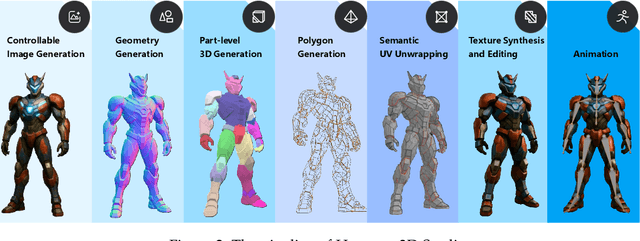

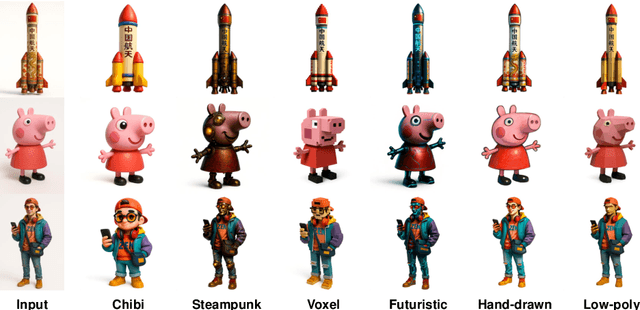
The creation of high-quality 3D assets, a cornerstone of modern game development, has long been characterized by labor-intensive and specialized workflows. This paper presents Hunyuan3D Studio, an end-to-end AI-powered content creation platform designed to revolutionize the game production pipeline by automating and streamlining the generation of game-ready 3D assets. At its core, Hunyuan3D Studio integrates a suite of advanced neural modules (such as Part-level 3D Generation, Polygon Generation, Semantic UV, etc.) into a cohesive and user-friendly system. This unified framework allows for the rapid transformation of a single concept image or textual description into a fully-realized, production-quality 3D model complete with optimized geometry and high-fidelity PBR textures. We demonstrate that assets generated by Hunyuan3D Studio are not only visually compelling but also adhere to the stringent technical requirements of contemporary game engines, significantly reducing iteration time and lowering the barrier to entry for 3D content creation. By providing a seamless bridge from creative intent to technical asset, Hunyuan3D Studio represents a significant leap forward for AI-assisted workflows in game development and interactive media.
Mesh Silksong: Auto-Regressive Mesh Generation as Weaving Silk
Jul 03, 2025We introduce Mesh Silksong, a compact and efficient mesh representation tailored to generate the polygon mesh in an auto-regressive manner akin to silk weaving. Existing mesh tokenization methods always produce token sequences with repeated vertex tokens, wasting the network capability. Therefore, our approach tokenizes mesh vertices by accessing each mesh vertice only once, reduces the token sequence's redundancy by 50\%, and achieves a state-of-the-art compression rate of approximately 22\%. Furthermore, Mesh Silksong produces polygon meshes with superior geometric properties, including manifold topology, watertight detection, and consistent face normals, which are critical for practical applications. Experimental results demonstrate the effectiveness of our approach, showcasing not only intricate mesh generation but also significantly improved geometric integrity.
Mesh-RFT: Enhancing Mesh Generation via Fine-grained Reinforcement Fine-Tuning
May 22, 2025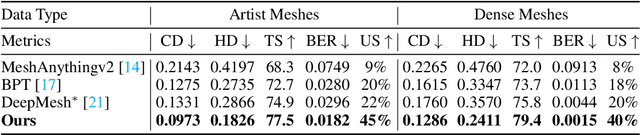
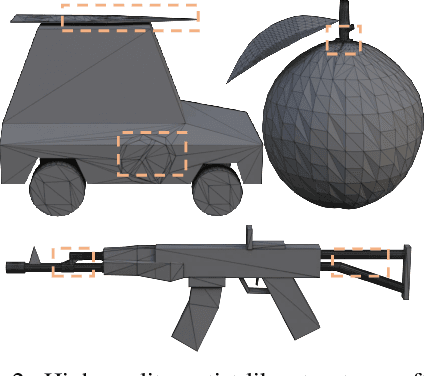
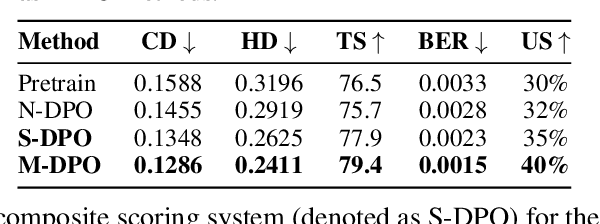
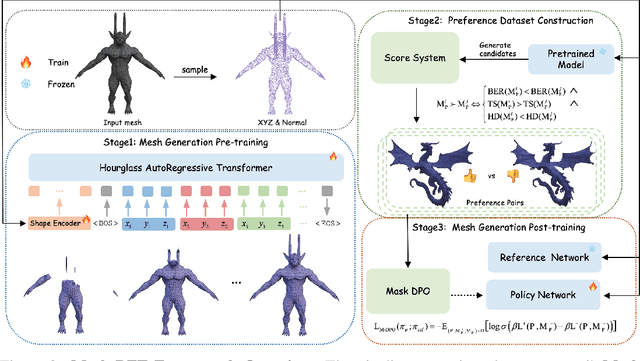
Existing pretrained models for 3D mesh generation often suffer from data biases and produce low-quality results, while global reinforcement learning (RL) methods rely on object-level rewards that struggle to capture local structure details. To address these challenges, we present \textbf{Mesh-RFT}, a novel fine-grained reinforcement fine-tuning framework that employs Masked Direct Preference Optimization (M-DPO) to enable localized refinement via quality-aware face masking. To facilitate efficient quality evaluation, we introduce an objective topology-aware scoring system to evaluate geometric integrity and topological regularity at both object and face levels through two metrics: Boundary Edge Ratio (BER) and Topology Score (TS). By integrating these metrics into a fine-grained RL strategy, Mesh-RFT becomes the first method to optimize mesh quality at the granularity of individual faces, resolving localized errors while preserving global coherence. Experiment results show that our M-DPO approach reduces Hausdorff Distance (HD) by 24.6\% and improves Topology Score (TS) by 3.8\% over pre-trained models, while outperforming global DPO methods with a 17.4\% HD reduction and 4.9\% TS gain. These results demonstrate Mesh-RFT's ability to improve geometric integrity and topological regularity, achieving new state-of-the-art performance in production-ready mesh generation. Project Page: \href{https://hitcslj.github.io/mesh-rft/}{this https URL}.
FreeMesh: Boosting Mesh Generation with Coordinates Merging
May 19, 2025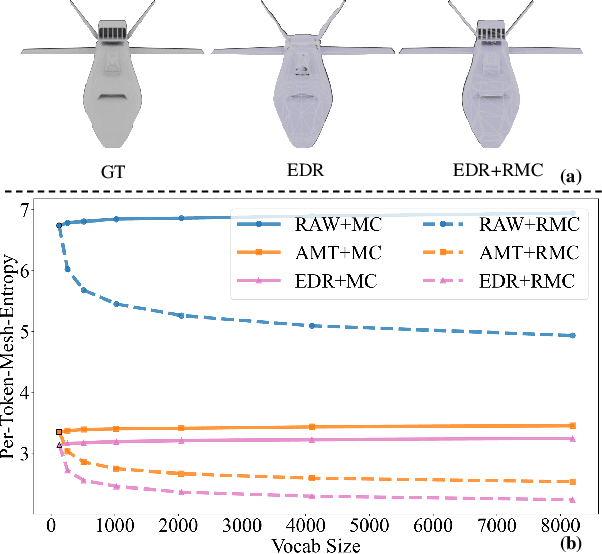
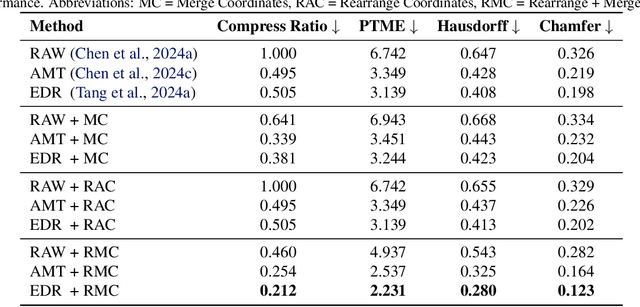
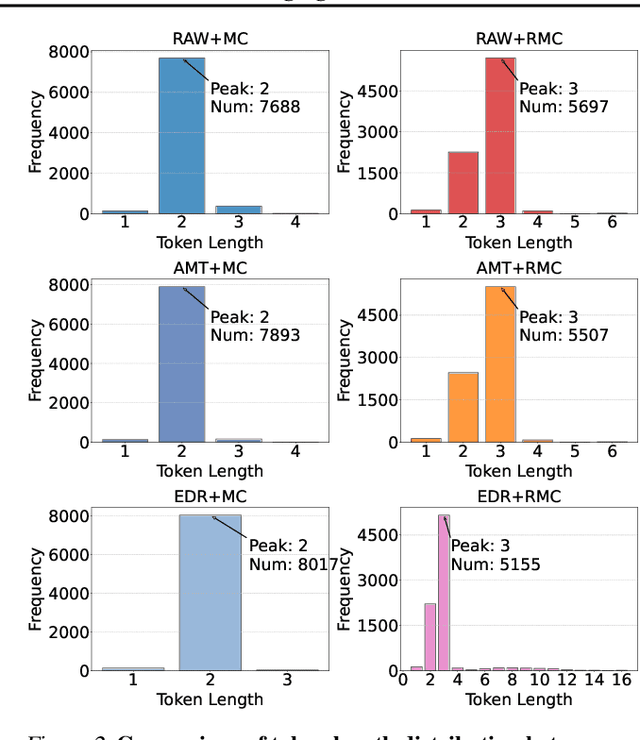
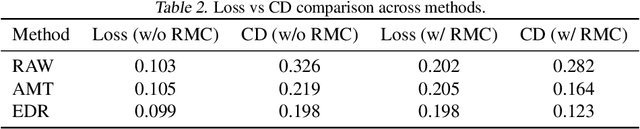
The next-coordinate prediction paradigm has emerged as the de facto standard in current auto-regressive mesh generation methods. Despite their effectiveness, there is no efficient measurement for the various tokenizers that serialize meshes into sequences. In this paper, we introduce a new metric Per-Token-Mesh-Entropy (PTME) to evaluate the existing mesh tokenizers theoretically without any training. Building upon PTME, we propose a plug-and-play tokenization technique called coordinate merging. It further improves the compression ratios of existing tokenizers by rearranging and merging the most frequent patterns of coordinates. Through experiments on various tokenization methods like MeshXL, MeshAnything V2, and Edgerunner, we further validate the performance of our method. We hope that the proposed PTME and coordinate merging can enhance the existing mesh tokenizers and guide the further development of native mesh generation.
Nautilus: Locality-aware Autoencoder for Scalable Mesh Generation
Jan 27, 2025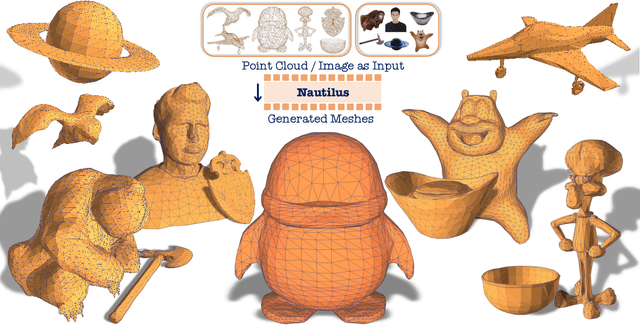


Triangle meshes are fundamental to 3D applications, enabling efficient modification and rasterization while maintaining compatibility with standard rendering pipelines. However, current automatic mesh generation methods typically rely on intermediate representations that lack the continuous surface quality inherent to meshes. Converting these representations into meshes produces dense, suboptimal outputs. Although recent autoregressive approaches demonstrate promise in directly modeling mesh vertices and faces, they are constrained by the limitation in face count, scalability, and structural fidelity. To address these challenges, we propose Nautilus, a locality-aware autoencoder for artist-like mesh generation that leverages the local properties of manifold meshes to achieve structural fidelity and efficient representation. Our approach introduces a novel tokenization algorithm that preserves face proximity relationships and compresses sequence length through locally shared vertices and edges, enabling the generation of meshes with an unprecedented scale of up to 5,000 faces. Furthermore, we develop a Dual-stream Point Conditioner that provides multi-scale geometric guidance, ensuring global consistency and local structural fidelity by capturing fine-grained geometric features. Extensive experiments demonstrate that Nautilus significantly outperforms state-of-the-art methods in both fidelity and scalability. The project page will be released to https://nautilusmeshgen.github.io.
Hunyuan3D 2.0: Scaling Diffusion Models for High Resolution Textured 3D Assets Generation
Jan 21, 2025


We present Hunyuan3D 2.0, an advanced large-scale 3D synthesis system for generating high-resolution textured 3D assets. This system includes two foundation components: a large-scale shape generation model -- Hunyuan3D-DiT, and a large-scale texture synthesis model -- Hunyuan3D-Paint. The shape generative model, built on a scalable flow-based diffusion transformer, aims to create geometry that properly aligns with a given condition image, laying a solid foundation for downstream applications. The texture synthesis model, benefiting from strong geometric and diffusion priors, produces high-resolution and vibrant texture maps for either generated or hand-crafted meshes. Furthermore, we build Hunyuan3D-Studio -- a versatile, user-friendly production platform that simplifies the re-creation process of 3D assets. It allows both professional and amateur users to manipulate or even animate their meshes efficiently. We systematically evaluate our models, showing that Hunyuan3D 2.0 outperforms previous state-of-the-art models, including the open-source models and closed-source models in geometry details, condition alignment, texture quality, and etc. Hunyuan3D 2.0 is publicly released in order to fill the gaps in the open-source 3D community for large-scale foundation generative models. The code and pre-trained weights of our models are available at: https://github.com/Tencent/Hunyuan3D-2
Scaling Mesh Generation via Compressive Tokenization
Nov 11, 2024


We propose a compressive yet effective mesh representation, Blocked and Patchified Tokenization (BPT), facilitating the generation of meshes exceeding 8k faces. BPT compresses mesh sequences by employing block-wise indexing and patch aggregation, reducing their length by approximately 75\% compared to the original sequences. This compression milestone unlocks the potential to utilize mesh data with significantly more faces, thereby enhancing detail richness and improving generation robustness. Empowered with the BPT, we have built a foundation mesh generative model training on scaled mesh data to support flexible control for point clouds and images. Our model demonstrates the capability to generate meshes with intricate details and accurate topology, achieving SoTA performance on mesh generation and reaching the level for direct product usage.