 Add to Chrome
 Add to Firefox
 Add to Edge
Beyond Binary Edits Robust Multimodal Knowledge Editing with Adversarial Subspace Alignment
May 22, 2026
Multimodal large language models (MLLMs) need efficient mechanisms to update knowledge without degrading existing capabilities. While intrinsic multimodal knowledge editing achieves strong reliability and locality, it often exhibits limited generality, failing to propagate edits across semantically equivalent visual and linguistic variations. This issue arises from the lack of explicit semantic supervision, rigid editing scopes, and biased anchoring to individual samples in high-dimensional multimodal spaces. We address robust intrinsic multimodal knowledge editing by explicitly targeting generalization. We formalize robustness through knowledge units that group semantically equivalent multimodal inputs and define generality as consistent predictions within each unit. To expose fragile semantic regions, we introduce Latent Adversarial Robustification (LAR), which generates adversarial yet semantically coherent variants in the joint latent space. We further propose Rank-Constrained Subspace Learning (RCSL), enforcing low-rank alignment of adversarial representations at the edit layer via a singular value-based objective. Extensive analysis demonstrates the effectiveness of ASAM empirically.

WorldCompass: Reinforcement Learning for Long-Horizon World Models
Feb 09, 2026This work presents WorldCompass, a novel Reinforcement Learning (RL) post-training framework for the long-horizon, interactive video-based world models, enabling them to explore the world more accurately and consistently based on interaction signals. To effectively "steer" the world model's exploration, we introduce three core innovations tailored to the autoregressive video generation paradigm: 1) Clip-level rollout Strategy: We generate and evaluate multiple samples at a single target clip, which significantly boosts rollout efficiency and provides fine-grained reward signals. 2) Complementary Reward Functions: We design reward functions for both interaction-following accuracy and visual quality, which provide direct supervision and effectively suppress reward-hacking behaviors. 3) Efficient RL Algorithm: We employ the negative-aware fine-tuning strategy coupled with various efficiency optimizations to efficiently and effectively enhance model capacity. Evaluations on the SoTA open-source world model, WorldPlay, demonstrate that WorldCompass significantly improves interaction accuracy and visual fidelity across various scenarios.
Generalizable Multimodal Large Language Model Editing via Invariant Trajectory Learning
Jan 30, 2026Knowledge editing emerges as a crucial technique for efficiently correcting incorrect or outdated knowledge in large language models (LLM). Existing editing methods rely on a rigid mapping from parameter or module modifications to output, which causes the generalization limitation in Multimodal LLM (MLLM). In this paper, we reformulate MLLM editing as an out-of-distribution (OOD) generalization problem, where the goal is to discern semantic shift with factual shift and thus achieve robust editing among diverse cross-modal prompting. The key challenge of this OOD problem lies in identifying invariant causal trajectories that generalize accurately while suppressing spurious correlations. To address it, we propose ODEdit, a plug-and-play invariant learning based framework that optimizes the tripartite OOD risk objective to simultaneously enhance editing reliability, locality, and generality.We further introduce an edit trajectory invariant learning method, which integrates a total variation penalty into the risk minimization objective to stabilize edit trajectories against environmental variations. Theoretical analysis and extensive experiments demonstrate the effectiveness of ODEdit.
TeleWorld: Towards Dynamic Multimodal Synthesis with a 4D World Model
Dec 31, 2025World models aim to endow AI systems with the ability to represent, generate, and interact with dynamic environments in a coherent and temporally consistent manner. While recent video generation models have demonstrated impressive visual quality, they remain limited in real-time interaction, long-horizon consistency, and persistent memory of dynamic scenes, hindering their evolution into practical world models. In this report, we present TeleWorld, a real-time multimodal 4D world modeling framework that unifies video generation, dynamic scene reconstruction, and long-term world memory within a closed-loop system. TeleWorld introduces a novel generation-reconstruction-guidance paradigm, where generated video streams are continuously reconstructed into a dynamic 4D spatio-temporal representation, which in turn guides subsequent generation to maintain spatial, temporal, and physical consistency. To support long-horizon generation with low latency, we employ an autoregressive diffusion-based video model enhanced with Macro-from-Micro Planning (MMPL)--a hierarchical planning method that reduces error accumulation from frame-level to segment-level-alongside efficient Distribution Matching Distillation (DMD), enabling real-time synthesis under practical computational budgets. Our approach achieves seamless integration of dynamic object modeling and static scene representation within a unified 4D framework, advancing world models toward practical, interactive, and computationally accessible systems. Extensive experiments demonstrate that TeleWorld achieves strong performance in both static and dynamic world understanding, long-term consistency, and real-time generation efficiency, positioning it as a practical step toward interactive, memory-enabled world models for multimodal generation and embodied intelligence.
WorldPlay: Towards Long-Term Geometric Consistency for Real-Time Interactive World Modeling
Dec 16, 2025This paper presents WorldPlay, a streaming video diffusion model that enables real-time, interactive world modeling with long-term geometric consistency, resolving the trade-off between speed and memory that limits current methods. WorldPlay draws power from three key innovations. 1) We use a Dual Action Representation to enable robust action control in response to the user's keyboard and mouse inputs. 2) To enforce long-term consistency, our Reconstituted Context Memory dynamically rebuilds context from past frames and uses temporal reframing to keep geometrically important but long-past frames accessible, effectively alleviating memory attenuation. 3) We also propose Context Forcing, a novel distillation method designed for memory-aware model. Aligning memory context between the teacher and student preserves the student's capacity to use long-range information, enabling real-time speeds while preventing error drift. Taken together, WorldPlay generates long-horizon streaming 720p video at 24 FPS with superior consistency, comparing favorably with existing techniques and showing strong generalization across diverse scenes. Project page and online demo can be found: https://3d-models.hunyuan.tencent.com/world/ and https://3d.hunyuan.tencent.com/sceneTo3D.
An Agentic AI System for Multi-Framework Communication Coding
Dec 09, 2025Clinical communication is central to patient outcomes, yet large-scale human annotation of patient-provider conversation remains labor-intensive, inconsistent, and difficult to scale. Existing approaches based on large language models typically rely on single-task models that lack adaptability, interpretability, and reliability, especially when applied across various communication frameworks and clinical domains. In this study, we developed a Multi-framework Structured Agentic AI system for Clinical Communication (MOSAIC), built on a LangGraph-based architecture that orchestrates four core agents, including a Plan Agent for codebook selection and workflow planning, an Update Agent for maintaining up-to-date retrieval databases, a set of Annotation Agents that applies codebook-guided retrieval-augmented generation (RAG) with dynamic few-shot prompting, and a Verification Agent that provides consistency checks and feedback. To evaluate performance, we compared MOSAIC outputs against gold-standard annotations created by trained human coders. We developed and evaluated MOSAIC using 26 gold standard annotated transcripts for training and 50 transcripts for testing, spanning rheumatology and OB/GYN domains. On the test set, MOSAIC achieved an overall F1 score of 0.928. Performance was highest in the Rheumatology subset (F1 = 0.962) and strongest for Patient Behavior (e.g., patients asking questions, expressing preferences, or showing assertiveness). Ablations revealed that MOSAIC outperforms baseline benchmarking.
MoCA: Mixture-of-Components Attention for Scalable Compositional 3D Generation
Dec 08, 2025Compositionality is critical for 3D object and scene generation, but existing part-aware 3D generation methods suffer from poor scalability due to quadratic global attention costs when increasing the number of components. In this work, we present MoCA, a compositional 3D generative model with two key designs: (1) importance-based component routing that selects top-k relevant components for sparse global attention, and (2) unimportant components compression that preserve contextual priors of unselected components while reducing computational complexity of global attention. With these designs, MoCA enables efficient, fine-grained compositional 3D asset creation with scalable number of components. Extensive experiments show MoCA outperforms baselines on both compositional object and scene generation tasks. Project page: https://lizhiqi49.github.io/MoCA
Equitable Survival Prediction: A Fairness-Aware Survival Modeling (FASM) Approach
Oct 23, 2025As machine learning models become increasingly integrated into healthcare, structural inequities and social biases embedded in clinical data can be perpetuated or even amplified by data-driven models. In survival analysis, censoring and time dynamics can further add complexity to fair model development. Additionally, algorithmic fairness approaches often overlook disparities in cross-group rankings, e.g., high-risk Black patients may be ranked below lower-risk White patients who do not experience the event of mortality. Such misranking can reinforce biological essentialism and undermine equitable care. We propose a Fairness-Aware Survival Modeling (FASM), designed to mitigate algorithmic bias regarding both intra-group and cross-group risk rankings over time. Using breast cancer prognosis as a representative case and applying FASM to SEER breast cancer data, we show that FASM substantially improves fairness while preserving discrimination performance comparable to fairness-unaware survival models. Time-stratified evaluations show that FASM maintains stable fairness over a 10-year horizon, with the greatest improvements observed during the mid-term of follow-up. Our approach enables the development of survival models that prioritize both accuracy and equity in clinical decision-making, advancing fairness as a core principle in clinical care.
StyleSculptor: Zero-Shot Style-Controllable 3D Asset Generation with Texture-Geometry Dual Guidance
Sep 16, 2025Creating 3D assets that follow the texture and geometry style of existing ones is often desirable or even inevitable in practical applications like video gaming and virtual reality. While impressive progress has been made in generating 3D objects from text or images, creating style-controllable 3D assets remains a complex and challenging problem. In this work, we propose StyleSculptor, a novel training-free approach for generating style-guided 3D assets from a content image and one or more style images. Unlike previous works, StyleSculptor achieves style-guided 3D generation in a zero-shot manner, enabling fine-grained 3D style control that captures the texture, geometry, or both styles of user-provided style images. At the core of StyleSculptor is a novel Style Disentangled Attention (SD-Attn) module, which establishes a dynamic interaction between the input content image and style image for style-guided 3D asset generation via a cross-3D attention mechanism, enabling stable feature fusion and effective style-guided generation. To alleviate semantic content leakage, we also introduce a style-disentangled feature selection strategy within the SD-Attn module, which leverages the variance of 3D feature patches to disentangle style- and content-significant channels, allowing selective feature injection within the attention framework. With SD-Attn, the network can dynamically compute texture-, geometry-, or both-guided features to steer the 3D generation process. Built upon this, we further propose the Style Guided Control (SGC) mechanism, which enables exclusive geometry- or texture-only stylization, as well as adjustable style intensity control. Extensive experiments demonstrate that StyleSculptor outperforms existing baseline methods in producing high-fidelity 3D assets.
HunyuanWorld 1.0: Generating Immersive, Explorable, and Interactive 3D Worlds from Words or Pixels
Jul 29, 2025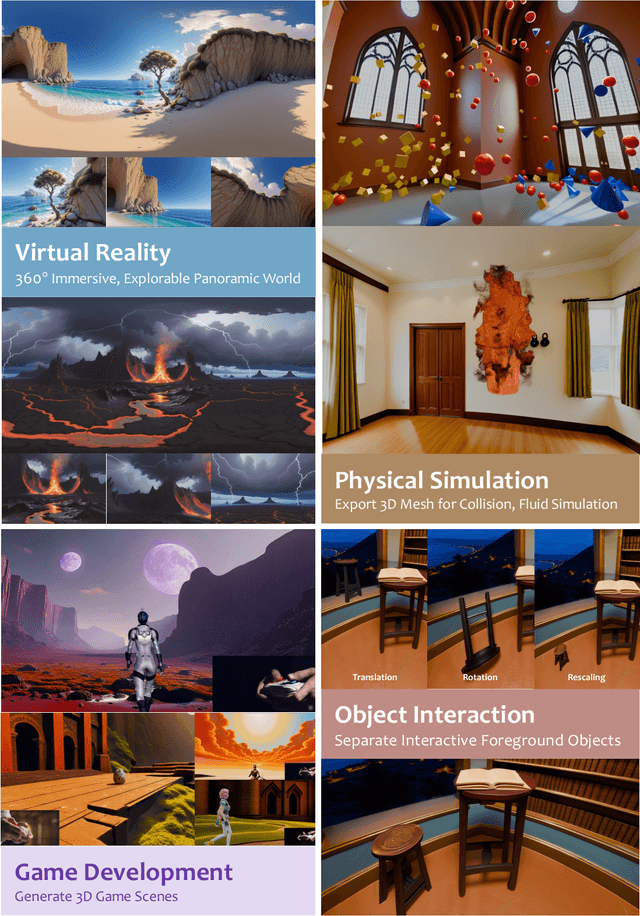

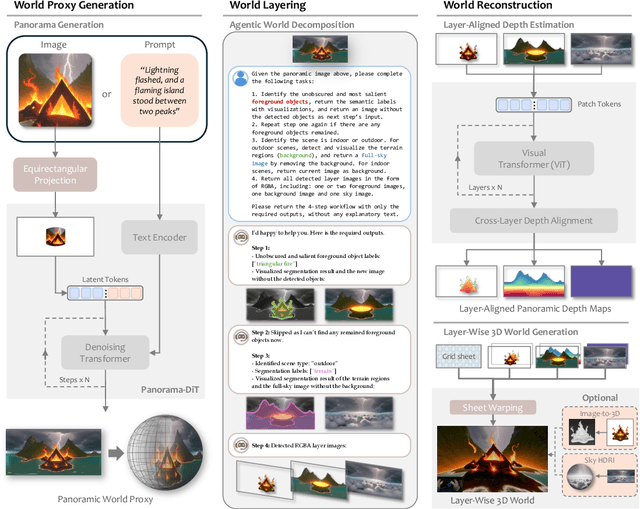
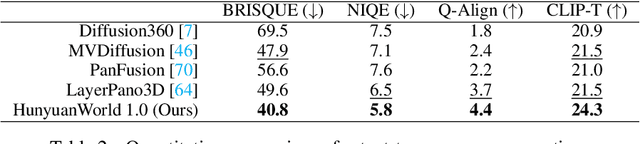
Creating immersive and playable 3D worlds from texts or images remains a fundamental challenge in computer vision and graphics. Existing world generation approaches typically fall into two categories: video-based methods that offer rich diversity but lack 3D consistency and rendering efficiency, and 3D-based methods that provide geometric consistency but struggle with limited training data and memory-inefficient representations. To address these limitations, we present HunyuanWorld 1.0, a novel framework that combines the best of both worlds for generating immersive, explorable, and interactive 3D scenes from text and image conditions. Our approach features three key advantages: 1) 360{\deg} immersive experiences via panoramic world proxies; 2) mesh export capabilities for seamless compatibility with existing computer graphics pipelines; 3) disentangled object representations for augmented interactivity. The core of our framework is a semantically layered 3D mesh representation that leverages panoramic images as 360{\deg} world proxies for semantic-aware world decomposition and reconstruction, enabling the generation of diverse 3D worlds. Extensive experiments demonstrate that our method achieves state-of-the-art performance in generating coherent, explorable, and interactive 3D worlds while enabling versatile applications in virtual reality, physical simulation, game development, and interactive content creation.