 Add to Chrome
 Add to Firefox
 Add to Edge
SIT-Graph: State Integrated Tool Graph for Multi-Turn Agents
Dec 08, 2025
Despite impressive advances in agent systems, multi-turn tool-use scenarios remain challenging. It is mainly because intent is clarified progressively and the environment evolves with each tool call. While reusing past experience is natural, current LLM agents either treat entire trajectories or pre-defined subtasks as indivisible units, or solely exploit tool-to-tool dependencies, hindering adaptation as states and information evolve across turns. In this paper, we propose a State Integrated Tool Graph (SIT-Graph), which enhances multi-turn tool use by exploiting partially overlapping experience. Inspired by human decision-making that integrates episodic and procedural memory, SIT-Graph captures both compact state representations (episodic-like fragments) and tool-to-tool dependencies (procedural-like routines) from historical trajectories. Specifically, we first build a tool graph from accumulated tool-use sequences, and then augment each edge with a compact state summary of the dialog and tool history that may shape the next action. At inference time, SIT-Graph enables a human-like balance between episodic recall and procedural execution: when the next decision requires recalling prior context, the agent retrieves the state summaries stored on relevant edges and uses them to guide its next action; when the step is routine, it follows high-confidence tool dependencies without explicit recall. Experiments across multiple stateful multi-turn tool-use benchmarks show that SIT-Graph consistently outperforms strong memory- and graph-based baselines, delivering more robust tool selection and more effective experience transfer.

MoDES: Accelerating Mixture-of-Experts Multimodal Large Language Models via Dynamic Expert Skipping
Nov 19, 2025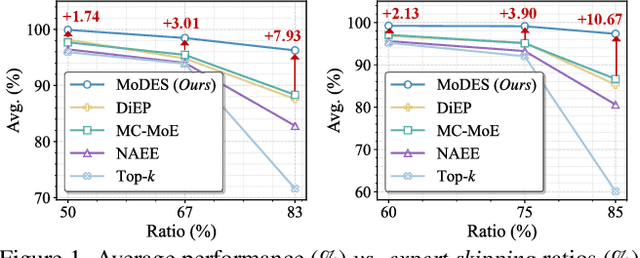
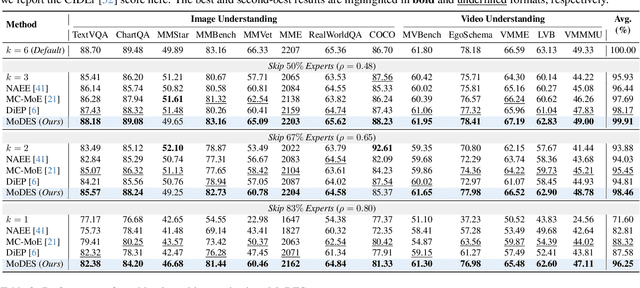
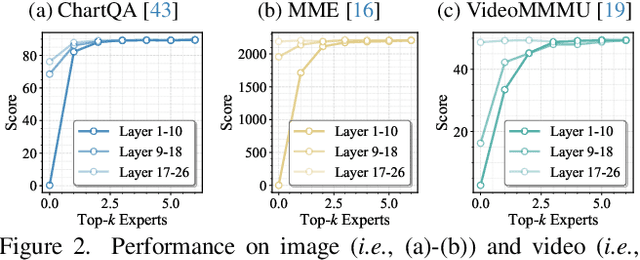
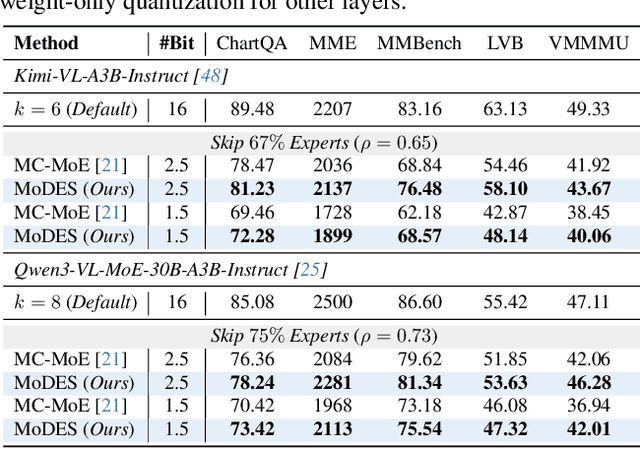
Mixture-of-Experts (MoE) Multimodal large language models (MLLMs) excel at vision-language tasks, but they suffer from high computational inefficiency. To reduce inference overhead, expert skipping methods have been proposed to deactivate redundant experts based on the current input tokens. However, we find that applying these methods-originally designed for unimodal large language models (LLMs)-to MLLMs results in considerable performance degradation. This is primarily because such methods fail to account for the heterogeneous contributions of experts across MoE layers and modality-specific behaviors of tokens within these layers. Motivated by these findings, we propose MoDES, the first training-free framework that adaptively skips experts to enable efficient and accurate MoE MLLM inference. It incorporates a globally-modulated local gating (GMLG) mechanism that integrates global layer-wise importance into local routing probabilities to accurately estimate per-token expert importance. A dual-modality thresholding (DMT) method is then applied, which processes tokens from each modality separately, to derive the skipping schedule. To set the optimal thresholds, we introduce a frontier search algorithm that exploits monotonicity properties, cutting convergence time from several days to a few hours. Extensive experiments for 3 model series across 13 benchmarks demonstrate that MoDES far outperforms previous approaches. For instance, when skipping 88% experts for Qwen3-VL-MoE-30B-A3B-Instruct, the performance boost is up to 10.67% (97.33% vs. 86.66%). Furthermore, MoDES significantly enhances inference speed, improving the prefilling time by 2.16$\times$ and the decoding time by 1.26$\times$.
GPR: Towards a Generative Pre-trained One-Model Paradigm for Large-Scale Advertising Recommendation
Nov 13, 2025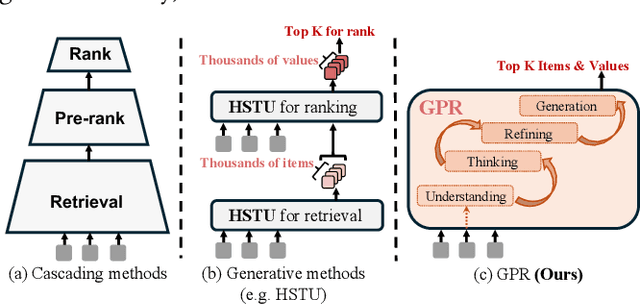
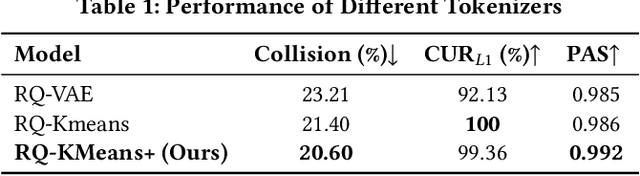
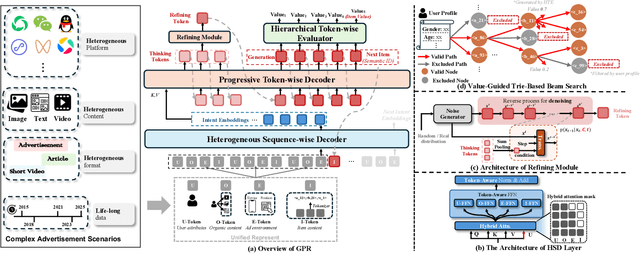
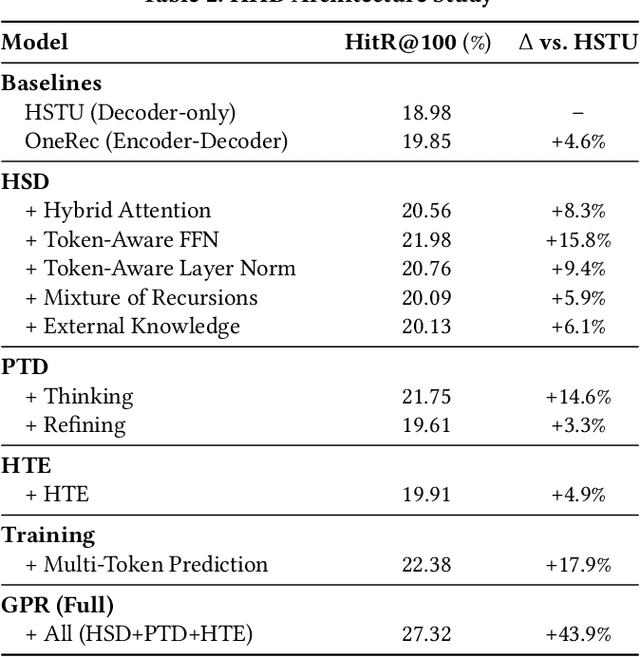
As an intelligent infrastructure connecting users with commercial content, advertising recommendation systems play a central role in information flow and value creation within the digital economy. However, existing multi-stage advertising recommendation systems suffer from objective misalignment and error propagation, making it difficult to achieve global optimality, while unified generative recommendation models still struggle to meet the demands of practical industrial applications. To address these issues, we propose GPR (Generative Pre-trained Recommender), the first one-model framework that redefines advertising recommendation as an end-to-end generative task, replacing the traditional cascading paradigm with a unified generative approach. To realize GPR, we introduce three key innovations spanning unified representation, network architecture, and training strategy. First, we design a unified input schema and tokenization method tailored to advertising scenarios, mapping both ads and organic content into a shared multi-level semantic ID space, thereby enhancing semantic alignment and modeling consistency across heterogeneous data. Second, we develop the Heterogeneous Hierarchical Decoder (HHD), a dual-decoder architecture that decouples user intent modeling from ad generation, achieving a balance between training efficiency and inference flexibility while maintaining strong modeling capacity. Finally, we propose a multi-stage joint training strategy that integrates Multi-Token Prediction (MTP), Value-Aware Fine-Tuning and the Hierarchy Enhanced Policy Optimization (HEPO) algorithm, forming a complete generative recommendation pipeline that unifies interest modeling, value alignment, and policy optimization. GPR has been fully deployed in the Tencent Weixin Channels advertising system, delivering significant improvements in key business metrics including GMV and CTCVR.
PaddleOCR-VL: Boosting Multilingual Document Parsing via a 0.9B Ultra-Compact Vision-Language Model
Oct 16, 2025In this report, we propose PaddleOCR-VL, a SOTA and resource-efficient model tailored for document parsing. Its core component is PaddleOCR-VL-0.9B, a compact yet powerful vision-language model (VLM) that integrates a NaViT-style dynamic resolution visual encoder with the ERNIE-4.5-0.3B language model to enable accurate element recognition. This innovative model efficiently supports 109 languages and excels in recognizing complex elements (e.g., text, tables, formulas, and charts), while maintaining minimal resource consumption. Through comprehensive evaluations on widely used public benchmarks and in-house benchmarks, PaddleOCR-VL achieves SOTA performance in both page-level document parsing and element-level recognition. It significantly outperforms existing solutions, exhibits strong competitiveness against top-tier VLMs, and delivers fast inference speeds. These strengths make it highly suitable for practical deployment in real-world scenarios.
WebWeaver: Structuring Web-Scale Evidence with Dynamic Outlines for Open-Ended Deep Research
Sep 16, 2025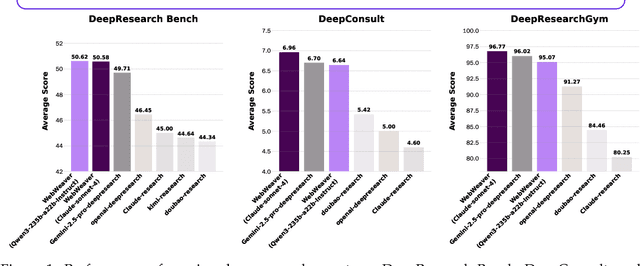
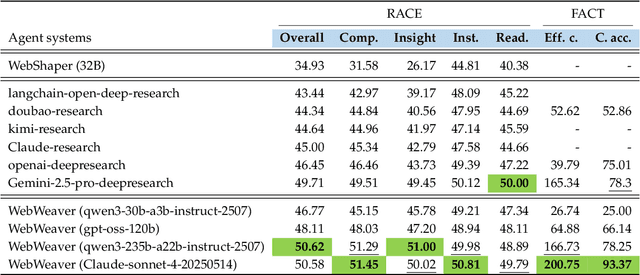
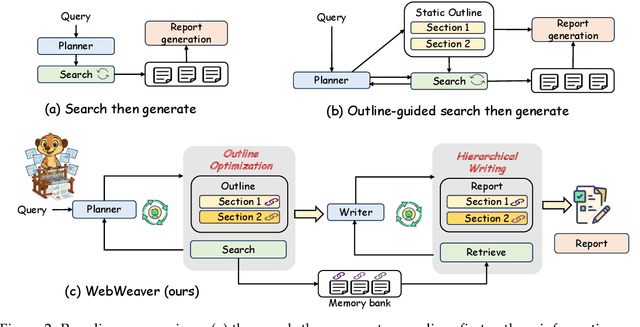
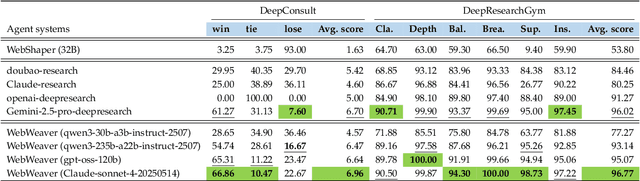
This paper tackles open-ended deep research (OEDR), a complex challenge where AI agents must synthesize vast web-scale information into insightful reports. Current approaches are plagued by dual-fold limitations: static research pipelines that decouple planning from evidence acquisition and one-shot generation paradigms that easily suffer from long-context failure issues like "loss in the middle" and hallucinations. To address these challenges, we introduce WebWeaver, a novel dual-agent framework that emulates the human research process. The planner operates in a dynamic cycle, iteratively interleaving evidence acquisition with outline optimization to produce a comprehensive, source-grounded outline linking to a memory bank of evidence. The writer then executes a hierarchical retrieval and writing process, composing the report section by section. By performing targeted retrieval of only the necessary evidence from the memory bank for each part, it effectively mitigates long-context issues. Our framework establishes a new state-of-the-art across major OEDR benchmarks, including DeepResearch Bench, DeepConsult, and DeepResearchGym. These results validate our human-centric, iterative methodology, demonstrating that adaptive planning and focused synthesis are crucial for producing high-quality, reliable, and well-structured reports.
${C}^{3}$-GS: Learning Context-aware, Cross-dimension, Cross-scale Feature for Generalizable Gaussian Splatting
Aug 28, 2025Generalizable Gaussian Splatting aims to synthesize novel views for unseen scenes without per-scene optimization. In particular, recent advancements utilize feed-forward networks to predict per-pixel Gaussian parameters, enabling high-quality synthesis from sparse input views. However, existing approaches fall short in encoding discriminative, multi-view consistent features for Gaussian predictions, which struggle to construct accurate geometry with sparse views. To address this, we propose $\mathbf{C}^{3}$-GS, a framework that enhances feature learning by incorporating context-aware, cross-dimension, and cross-scale constraints. Our architecture integrates three lightweight modules into a unified rendering pipeline, improving feature fusion and enabling photorealistic synthesis without requiring additional supervision. Extensive experiments on benchmark datasets validate that $\mathbf{C}^{3}$-GS achieves state-of-the-art rendering quality and generalization ability. Code is available at: https://github.com/YuhsiHu/C3-GS.
Attention2Probability: Attention-Driven Terminology Probability Estimation for Robust Speech-to-Text System
Aug 26, 2025Recent advances in speech large language models (SLMs) have improved speech recognition and translation in general domains, but accurately generating domain-specific terms or neologisms remains challenging. To address this, we propose Attention2Probability: attention-driven terminology probability estimation for robust speech-to-text system, which is lightweight, flexible, and accurate. Attention2Probability converts cross-attention weights between speech and terminology into presence probabilities, and it further employs curriculum learning to enhance retrieval accuracy. Furthermore, to tackle the lack of data for speech-to-text tasks with terminology intervention, we create and release a new speech dataset with terminology to support future research in this area. Experimental results show that Attention2Probability significantly outperforms the VectorDB method on our test set. Specifically, its maximum recall rates reach 92.57% for Chinese and 86.83% for English. This high recall is achieved with a latency of only 8.71ms per query. Intervening in SLMs' recognition and translation tasks using Attention2Probability-retrieved terms improves terminology accuracy by 6-17%, while revealing that the current utilization of terminology by SLMs has limitations.
DreamSwapV: Mask-guided Subject Swapping for Any Customized Video Editing
Aug 20, 2025With the rapid progress of video generation, demand for customized video editing is surging, where subject swapping constitutes a key component yet remains under-explored. Prevailing swapping approaches either specialize in narrow domains--such as human-body animation or hand-object interaction--or rely on some indirect editing paradigm or ambiguous text prompts that compromise final fidelity. In this paper, we propose DreamSwapV, a mask-guided, subject-agnostic, end-to-end framework that swaps any subject in any video for customization with a user-specified mask and reference image. To inject fine-grained guidance, we introduce multiple conditions and a dedicated condition fusion module that integrates them efficiently. In addition, an adaptive mask strategy is designed to accommodate subjects of varying scales and attributes, further improving interactions between the swapped subject and its surrounding context. Through our elaborate two-phase dataset construction and training scheme, our DreamSwapV outperforms existing methods, as validated by comprehensive experiments on VBench indicators and our first introduced DreamSwapV-Benchmark.
Yan: Foundational Interactive Video Generation
Aug 13, 2025We present Yan, a foundational framework for interactive video generation, covering the entire pipeline from simulation and generation to editing. Specifically, Yan comprises three core modules. AAA-level Simulation: We design a highly-compressed, low-latency 3D-VAE coupled with a KV-cache-based shift-window denoising inference process, achieving real-time 1080P/60FPS interactive simulation. Multi-Modal Generation: We introduce a hierarchical autoregressive caption method that injects game-specific knowledge into open-domain multi-modal video diffusion models (VDMs), then transforming the VDM into a frame-wise, action-controllable, real-time infinite interactive video generator. Notably, when the textual and visual prompts are sourced from different domains, the model demonstrates strong generalization, allowing it to blend and compose the style and mechanics across domains flexibly according to user prompts. Multi-Granularity Editing: We propose a hybrid model that explicitly disentangles interactive mechanics simulation from visual rendering, enabling multi-granularity video content editing during interaction through text. Collectively, Yan offers an integration of these modules, pushing interactive video generation beyond isolated capabilities toward a comprehensive AI-driven interactive creation paradigm, paving the way for the next generation of creative tools, media, and entertainment. The project page is: https://greatx3.github.io/Yan/.
Towards Comprehensible Recommendation with Large Language Model Fine-tuning
Aug 11, 2025Recommender systems have become increasingly ubiquitous in daily life. While traditional recommendation approaches primarily rely on ID-based representations or item-side content features, they often fall short in capturing the underlying semantics aligned with user preferences (e.g., recommendation reasons for items), leading to a semantic-collaborative gap. Recently emerged LLM-based feature extraction approaches also face a key challenge: how to ensure that LLMs possess recommendation-aligned reasoning capabilities and can generate accurate, personalized reasons to mitigate the semantic-collaborative gap. To address these issues, we propose a novel Content Understanding from a Collaborative Perspective framework (CURec), which generates collaborative-aligned content features for more comprehensive recommendations. \method first aligns the LLM with recommendation objectives through pretraining, equipping it with instruction-following and chain-of-thought reasoning capabilities. Next, we design a reward model inspired by traditional recommendation architectures to evaluate the quality of the recommendation reasons generated by the LLM. Finally, using the reward signals, CURec fine-tunes the LLM through RL and corrects the generated reasons to ensure their accuracy. The corrected reasons are then integrated into a downstream recommender model to enhance comprehensibility and recommendation performance. Extensive experiments on public benchmarks demonstrate the superiority of CURec over existing methods.