 Add to Chrome
 Add to Firefox
 Add to Edge
Statistical Properties of $k$-means Clustering for Data Missing Completely at Random
Jul 02, 2026
The classical $k$-means clustering cannot be directly used to incomplete data, and existing $k$-means-based clustering for missing data primarily focus on improving the practical accuracy of clustering, whereas most of them lack theoretical guarantees in the asymptotic sense. In this paper, we investigate the statistical properties of $k$-means clustering in the presence of missing data. We first establish the $\sqrt{n}$-excess risk bound and prove the consistency of the estimated cluster centers under general missing mechanisms. For the Missing Completely at Random (MCAR) mechanism, we further derive the $\sqrt{n}$-convergence rate and asymptotic normality of the estimated cluster centers. Moreover, we study in what cases the cluster centers estimated by incomplete data converge to the true cluster centers of original fully observed data, and give a sufficient condition about the missing probability and the separation among true clusters. These results provide a theoretical guarantee for missing-data-$k$-means. Notably, our analysis reveal that under MCAR mechanism, both achieving the $\sqrt{n}$-rate and converging to the true cluster centers require $k$ true centers to be distinct in every dimension, highlighting the significant challenges of application in high-dimensional regimes. Finally, we conduct numerical simulations on synthetic incomplete datasets to support our theoretical analysis results.

MNAR-$k$-means: A $k$-means Clustering for Data Missing Not at Random with Magnitude-Decaying Probability
Jun 30, 2026The classical $k$-means clustering, based on distances computed from all data features, cannot be directly applied to incomplete data with missing values. A natural extension of $k$-means to missing data is to involve only the observed positions in clustering, which is equivalent to imputing missing values by corresponding cluster means. However, for data missing not at random (MNAR), since missingness is related to data values, such a mean-imputation-based method may lead to the distortion of estimated cluster centers, resulting in a poor clustering result. Since MNAR mechanisms are very common in reality, it is necessary to improve the performance of $k$-means-based clustering methods for such data. In this paper, we focus on a magnitude-decaying MNAR scenario where data is more likely to be missing at positions with smaller absolute values, and we propose a novel $k$-means clustering method based on the constraint of the size of imputation values, which enjoys a good mathematical interpretation. Moreover, we establish the statistical consistency of the estimated cluster centers of the proposed method to the true cluster centers of fully observed data, and solve the optimization of the proposed loss function via an alternative minimization algorithm. Simulation experiments verify the effect of the proposed method in improving clustering results and reducing the bias of estimated cluster centers. Applications to real-world missing data further show the utility of the proposed method.
EvoRubric: Self-Evolving Rubric-Driven RL for Open-Ended Generation
May 28, 2026Reinforcement Learning (RL) has significantly advanced Large Language Models (LLMs) in verifiable domains, but aligning models for open-ended generation remains profoundly challenging due to the lack of definitive rewards. Current rubric-based RL methods mitigate this by employing explicit criteria; however, they rely heavily on static, human-annotated rubrics that inevitably cause policy lag, or expensive external proprietary models for dynamic updates. In this paper, we propose EvoRubric, a novel single-policy co-evolutionary RL framework that eliminates the reliance on static criteria and on external rubric generators. By unifying response generation and rubric generation under a single parameterized policy, EvoRubric dynamically alternates between a Reasoner and a Rubric Generator. To prevent reward hacking and ensure the reliability of generated signals, we introduce a multi-level verification pipeline featuring a meta-verifier, zero-variance pruning, and a Leave-One-Out peer consensus mechanism. Validated criteria are dynamically archived into a memory pool, yielding dense, multi-objective rewards to continuously co-optimize both roles. Extensive experiments across Medical, Writing, and Science domains demonstrate that EvoRubric consistently outperforms traditional static and external-LLM-driven alignment methods. Notably, our framework is compatible with human-expert priors. When initialized with expert-annotated rubrics, EvoRubric can further uncover novel, discriminative dimensions, achieving better performance than relying solely on static expert annotations.
NormCode Canvas: Making LLM Agentic Workflows Development Sustainable via Case-Based Reasoning
Mar 13, 2026We present NormCode Canvas (v1.1.3), a deployed system realizing Case-Based Reasoning at two levels for multi-step LLM workflows. The foundation is NormCode, a semi-formal planning language whose compiler-verified scope rule ensures every execution checkpoint is a genuinely self-contained case -- eliminating the implicit shared state that makes retrieval unreliable and failure non-localizable in standard orchestration frameworks. Level 1 treats each checkpoint as a concrete case (suspended runtime); Fork implements retrieve-and-reuse, Value Override implements revision with automatic stale-boundary propagation. Level 2 treats each compiled plan as an abstract case; the compilation pipeline is itself a NormCode plan, enabling recursive case learning. Three structural properties follow: (C1) direct checkpoint inspection; (C2) pre-execution review via compiler-generated narrative; (C3) scope-bounded selective re-execution. Four deployed plans serve as structured evidence: PPT Generation produces presentation decks at ~40s per slide on commercial APIs; Code Assistant carries out multi-step software-engineering tasks spanning up to ten reasoning cycles; NC Compilations converts natural-language specifications into executable NormCode plans; and Canvas Assistant, when connected to an external AI code editor, automates plan debugging. Together these plans form a self-sustaining ecosystem in which plans produce, debug, and refine one another -- realizing cumulative case-based learning at system scale.
Evidence-Augmented Policy Optimization with Reward Co-Evolution for Long-Context Reasoning
Jan 15, 2026While Reinforcement Learning (RL) has advanced LLM reasoning, applying it to long-context scenarios is hindered by sparsity of outcome rewards. This limitation fails to penalize ungrounded "lucky guesses," leaving the critical process of needle-in-a-haystack evidence retrieval largely unsupervised. To address this, we propose EAPO (Evidence-Augmented Policy Optimization). We first establish the Evidence-Augmented Reasoning paradigm, validating via Tree-Structured Evidence Sampling that precise evidence extraction is the decisive bottleneck for long-context reasoning. Guided by this insight, EAPO introduces a specialized RL algorithm where a reward model computes a Group-Relative Evidence Reward, providing dense process supervision to explicitly improve evidence quality. To sustain accurate supervision throughout training, we further incorporate an Adaptive Reward-Policy Co-Evolution mechanism. This mechanism iteratively refines the reward model using outcome-consistent rollouts, sharpening its discriminative capability to ensure precise process guidance. Comprehensive evaluations across eight benchmarks demonstrate that EAPO significantly enhances long-context reasoning performance compared to SOTA baselines.
LOONG: Online Time-Optimal Autonomous Flight for MAVs in Cluttered Environments
Jan 12, 2026Autonomous flight of micro air vehicles (MAVs) in unknown, cluttered environments remains challenging for time-critical missions due to conservative maneuvering strategies. This article presents an integrated planning and control framework for high-speed, time-optimal autonomous flight of MAVs in cluttered environments. In each replanning cycle (100 Hz), a time-optimal trajectory under polynomial presentation is generated as a reference, with the time-allocation process accelerated by imitation learning. Subsequently, a time-optimal model predictive contouring control (MPCC) incorporates safe flight corridor (SFC) constraints at variable horizon steps to enable aggressive yet safe maneuvering, while fully exploiting the MAV's dynamics. We validate the proposed framework extensively on a custom-built LiDAR-based MAV platform. Simulation results demonstrate superior aggressiveness compared to the state of the art, while real-world experiments achieve a peak speed of 18 m/s in a cluttered environment and succeed in 10 consecutive trials from diverse start points. The video is available at the following link: https://youtu.be/vexXXhv99oQ.
NormCode: A Semi-Formal Language for Context-Isolated AI Planning
Dec 11, 2025Multistep workflows that chain large language model (LLM) calls suffer from context pollution: as information accumulates across steps, models hallucinate, confuse intermediate outputs, and lose track of task constraints. We present NormCode, a semiformal language for constructing plans of inferences, structured decompositions where each step operates in data isolation and receives only explicitly passed inputs, which eliminates crossstep contamination by design. NormCode enforces a strict separation between semantic operations (LLMdriven reasoning, nondeterministic) and syntactic operations (deterministic data restructuring), enabling precise cost and reliability tracing. The language exists in three isomorphic formats: .ncds for human authoring, .ncd for machine execution, and .ncn for human verification, supporting progressive formalization from sketch to production. We validate NormCode through two demonstrations: (1) a base X addition algorithm achieving 100 percent accuracy on arbitrary length inputs, and (2) self hosted execution of NormCode's own five phase compiler pipeline. The working orchestrator provides dependency driven scheduling, SQLite backed checkpointing, and loop management, making AI workflows auditable by design and addressing a critical need for transparency in high stakes domains such as legal reasoning, medical decision making, and financial analysis.
Rethinking Reference Trajectories in Agile Drone Racing: A Unified Reference-Free Model-Based Controller via MPPI
Sep 18, 2025While model-based controllers have demonstrated remarkable performance in autonomous drone racing, their performance is often constrained by the reliance on pre-computed reference trajectories. Conventional approaches, such as trajectory tracking, demand a dynamically feasible, full-state reference, whereas contouring control relaxes this requirement to a geometric path but still necessitates a reference. Recent advancements in reinforcement learning (RL) have revealed that many model-based controllers optimize surrogate objectives, such as trajectory tracking, rather than the primary racing goal of directly maximizing progress through gates. Inspired by these findings, this work introduces a reference-free method for time-optimal racing by incorporating this gate progress objective, derived from RL reward shaping, directly into the Model Predictive Path Integral (MPPI) formulation. The sampling-based nature of MPPI makes it uniquely capable of optimizing the discontinuous and non-differentiable objective in real-time. We also establish a unified framework that leverages MPPI to systematically and fairly compare three distinct objective functions with a consistent dynamics model and parameter set: classical trajectory tracking, contouring control, and the proposed gate progress objective. We compare the performance of these three objectives when solved via both MPPI and a traditional gradient-based solver. Our results demonstrate that the proposed reference-free approach achieves competitive racing performance, rivaling or exceeding reference-based methods. Videos are available at https://zhaofangguo.github.io/racing_mppi/
WebWeaver: Structuring Web-Scale Evidence with Dynamic Outlines for Open-Ended Deep Research
Sep 16, 2025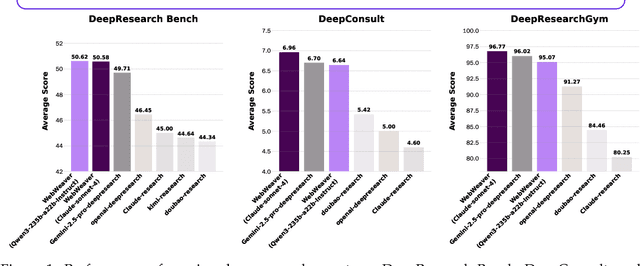
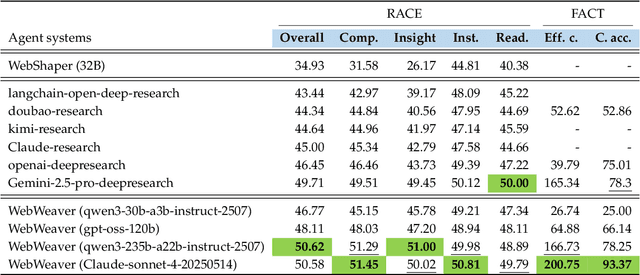
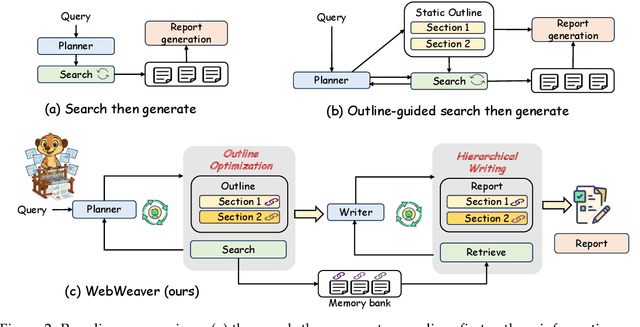
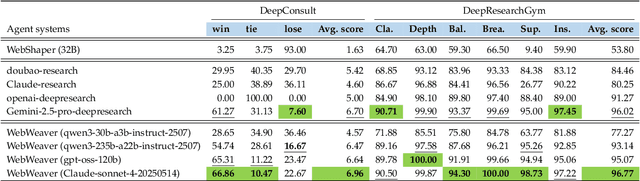
This paper tackles open-ended deep research (OEDR), a complex challenge where AI agents must synthesize vast web-scale information into insightful reports. Current approaches are plagued by dual-fold limitations: static research pipelines that decouple planning from evidence acquisition and one-shot generation paradigms that easily suffer from long-context failure issues like "loss in the middle" and hallucinations. To address these challenges, we introduce WebWeaver, a novel dual-agent framework that emulates the human research process. The planner operates in a dynamic cycle, iteratively interleaving evidence acquisition with outline optimization to produce a comprehensive, source-grounded outline linking to a memory bank of evidence. The writer then executes a hierarchical retrieval and writing process, composing the report section by section. By performing targeted retrieval of only the necessary evidence from the memory bank for each part, it effectively mitigates long-context issues. Our framework establishes a new state-of-the-art across major OEDR benchmarks, including DeepResearch Bench, DeepConsult, and DeepResearchGym. These results validate our human-centric, iterative methodology, demonstrating that adaptive planning and focused synthesis are crucial for producing high-quality, reliable, and well-structured reports.
MPF: Aligning and Debiasing Language Models post Deployment via Multi Perspective Fusion
Jul 03, 2025Multiperspective Fusion (MPF) is a novel posttraining alignment framework for large language models (LLMs) developed in response to the growing need for easy bias mitigation. Built on top of the SAGED pipeline, an automated system for constructing bias benchmarks and extracting interpretable baseline distributions, MPF leverages multiperspective generations to expose and align biases in LLM outputs with nuanced, humanlike baselines. By decomposing baseline, such as sentiment distributions from HR professionals, into interpretable perspective components, MPF guides generation through sampling and balancing of responses, weighted by the probabilities obtained in the decomposition. Empirically, we demonstrate its ability to align LLM sentiment distributions with both counterfactual baselines (absolute equality) and the HR baseline (biased for Top Univeristy), resulting in small KL divergence, reduction of calibration error and generalization to unseen questions. This shows that MPF offers a scalable and interpretable method for alignment and bias mitigation, compatible with deployed LLMs and requiring no extensive prompt engineering or finetuning.