 Add to Chrome
 Add to Firefox
 Add to Edge
RT-DocLayout: Real-Time End-to-End Document Layout Analysis with Reading Order in the Wild
Jun 22, 2026
Accurate document layout analysis remains a critical bottleneck for document parsing systems, due to the intricate coupling among heterogeneous document layout elements, geometric distortions (\eg, paper warping and bending, perspective variations), and reading order within diverse layout structures. Existing approaches typically rely on fragmented multi-stage pipelines or computationally heavy generative Transformer architectures, leading to error propagation and limited efficiency. In this paper, we present RT-DocLayout, a highly efficient end-to-end framework for document layout analysis, designed as a front-end for document parsing tasks. The proposed model unifies classification, detection, pixel-level segmentation, and reading order prediction for layout elements within a single 33M-parameter architecture. Built upon the RT-DETR, our key contribution is a unified multi-task formulation within a single query-based decoder that simultaneously classifies, regresses bounding box, generates masks, and constructs relationship to reason reading order. By jointly learning geometric and structural representations, RT-DocLayout introduces multi-task optimization that substantially improves robustness under real-world document distortions. Extensive experiments on public benchmarks demonstrate state-of-the-art performance in document layout analysis while maintaining real-time inference speed(132.1 FPS). When coupled with downstream OCR engines, RT-DocLayout significantly improves full-document reconstruction quality, providing a scalable and practical foundation for real-world document intelligence systems.

PP-OCRv6: From 1.5M to 34.5M Parameters, Surpassing Billion-Scale VLMs on OCR Tasks
Jun 11, 2026Vision-Language Models (VLMs) have achieved impressive results on general vision-language tasks, yet they suffer from hallucination, imprecise localization, and prohibitive computational cost when applied to dedicated OCR scenarios. This paper presents PP-OCRv6, a lightweight OCR system that combines architectural innovation with data-centric optimization. PP-OCRv6 redesigns the backbone, detection neck, and recognition neck around a unified MetaFormer-style building block with structural reparameterization, decoupling spatial token mixing from channel mixing and supporting both tasks through task-specific stride configurations. Three model tiers (medium, small, tiny) share the same block primitives, covering deployment scenarios from server to edge. On our in-house benchmarks, PP-OCRv6_medium achieves 83.2% recognition accuracy and 86.2% detection Hmean, outperforming PP-OCRv5_server by +5.1% and +4.6% respectively while surpassing Qwen3-VL-235B, GPT-5.5, and Gemini-3.1-Pro with orders of magnitude fewer parameters. The tiny tier achieves 3.9$\times$ faster inference than PP-OCRv5_mobile on Intel Xeon CPU while maintaining comparable accuracy.
PaddleOCR-VL-1.6: Expanding the Frontier of Document Parsing with Under-Optimized Region Refinement and Progressive Post-Training
Jun 02, 2026We introduce PaddleOCR-VL-1.6, an upgraded compact document parsing model built upon PaddleOCR-VL-1.5. Although PaddleOCR-VL-1.5 establishes a strong 0.9B baseline, its remaining errors concentrate in under-optimized regions where model behavior is unstable, data coverage is sparse, or supervision is unreliable. Rather than expanding the training corpus indiscriminately, PaddleOCR-VL-1.6 introduces a region-aware data optimization framework that identifies weak regions from the previous model, applies targeted enhancement to these regions, and improves the reliability of supervision signals. It further adopts a progressive post-training recipe based on curated data selection and reinforcement learning, pushing model performance to a higher level through staged optimization. PaddleOCR-VL-1.6 achieves a new state-of-the-art score of 96.33% on OmniDocBench v1.6, demonstrates strong competitiveness against top-tier VLMs, and provides a practical post-training recipe for the PaddleOCR-VL series.
PP-OCRv5: A Specialized 5M-Parameter Model Rivaling Billion-Parameter Vision-Language Models on OCR Tasks
Mar 25, 2026The advent of "OCR 2.0" and large-scale vision-language models (VLMs) has set new benchmarks in text recognition. However, these unified architectures often come with significant computational demands, challenges in precise text localization within complex layouts, and a propensity for textual hallucinations. Revisiting the prevailing notion that model scale is the sole path to high accuracy, this paper introduces PP-OCRv5, a meticulously optimized, lightweight OCR system with merely 5 million parameters. We demonstrate that PP-OCRv5 achieves performance competitive with many billion-parameter VLMs on standard OCR benchmarks, while offering superior localization precision and reduced hallucinations. The cornerstone of our success lies not in architectural expansion but in a data-centric investigation. We systematically dissect the role of training data by quantifying three critical dimensions: data difficulty, data accuracy, and data diversity. Our extensive experiments reveal that with a sufficient volume of high-quality, accurately labeled, and diverse data, the performance ceiling for traditional, efficient two-stage OCR pipelines is far higher than commonly assumed. This work provides compelling evidence for the viability of lightweight, specialized models in the large-model era and offers practical insights into data curation for OCR. The source code and models are publicly available at https://github.com/PaddlePaddle/PaddleOCR.
Boosting Document Parsing Efficiency and Performance with Coarse-to-Fine Visual Processing
Mar 25, 2026Document parsing is a fine-grained task where image resolution significantly impacts performance. While advanced research leveraging vision-language models benefits from high-resolution input to boost model performance, this often leads to a quadratic increase in the number of vision tokens and significantly raises computational costs. We attribute this inefficiency to substantial visual regions redundancy in document images, like background. To tackle this, we propose PaddleOCR-VL, a novel coarse-to-fine architecture that focuses on semantically relevant regions while suppressing redundant ones, thereby improving both efficiency and performance. Specifically, we introduce a lightweight Valid Region Focus Module (VRFM) which leverages localization and contextual relationship prediction capabilities to identify valid vision tokens. Subsequently, we design and train a compact yet powerful 0.9B vision-language model (PaddleOCR-VL-0.9B) to perform detailed recognition, guided by VRFM outputs to avoid direct processing of the entire large image. Extensive experiments demonstrate that PaddleOCR-VL achieves state-of-the-art performance in both page-level parsing and element-level recognition. It significantly outperforms existing solutions, exhibits strong competitiveness against top-tier VLMs, and delivers fast inference while utilizing substantially fewer vision tokens and parameters, highlighting the effectiveness of targeted coarse-to-fine parsing for accurate and efficient document understanding. The source code and models are publicly available at https://github.com/PaddlePaddle/PaddleOCR.
Real5-OmniDocBench: A Full-Scale Physical Reconstruction Benchmark for Robust Document Parsing in the Wild
Mar 04, 2026While Vision-Language Models (VLMs) achieve near-perfect scores on digital document benchmarks like OmniDocBench, their performance in the unpredictable physical world remains largely unknown due to the lack of controlled yet realistic evaluations. We introduce Real5-OmniDocBench, the first benchmark that performs a full-scale, one-to-one physical reconstruction of the entire OmniDocBench v1.5 (1,355 images) across five critical real-world scenarios: Scanning, Warping, Screen-Photography, Illumination, and Skew. Unlike prior benchmark that either lack digital correspondence or employ partial sampling, our complete ground-truth mapping enables, for the first time, rigorous factor-wise attribution of performance degradation-allowing us to pinpoint whether failures stem from geometric distortions, optical artifacts, or model limitations. Our benchmark establishes a challenging new standard for the community, demonstrating that the 'reality gap' in document parsing is far from closed, and provides a diagnostic tool to guide the development of truly resilient document intelligence.
PaddleOCR-VL-1.5: Towards a Multi-Task 0.9B VLM for Robust In-the-Wild Document Parsing
Jan 29, 2026We introduce PaddleOCR-VL-1.5, an upgraded model achieving a new state-of-the-art (SOTA) accuracy of 94.5% on OmniDocBench v1.5. To rigorously evaluate robustness against real-world physical distortions, including scanning, skew, warping, screen-photography, and illumination, we propose the Real5-OmniDocBench benchmark. Experimental results demonstrate that this enhanced model attains SOTA performance on the newly curated benchmark. Furthermore, we extend the model's capabilities by incorporating seal recognition and text spotting tasks, while remaining a 0.9B ultra-compact VLM with high efficiency. Code: https://github.com/PaddlePaddle/PaddleOCR
PaddleOCR-VL: Boosting Multilingual Document Parsing via a 0.9B Ultra-Compact Vision-Language Model
Oct 16, 2025In this report, we propose PaddleOCR-VL, a SOTA and resource-efficient model tailored for document parsing. Its core component is PaddleOCR-VL-0.9B, a compact yet powerful vision-language model (VLM) that integrates a NaViT-style dynamic resolution visual encoder with the ERNIE-4.5-0.3B language model to enable accurate element recognition. This innovative model efficiently supports 109 languages and excels in recognizing complex elements (e.g., text, tables, formulas, and charts), while maintaining minimal resource consumption. Through comprehensive evaluations on widely used public benchmarks and in-house benchmarks, PaddleOCR-VL achieves SOTA performance in both page-level document parsing and element-level recognition. It significantly outperforms existing solutions, exhibits strong competitiveness against top-tier VLMs, and delivers fast inference speeds. These strengths make it highly suitable for practical deployment in real-world scenarios.
PP-ShiTu: A Practical Lightweight Image Recognition System
Nov 01, 2021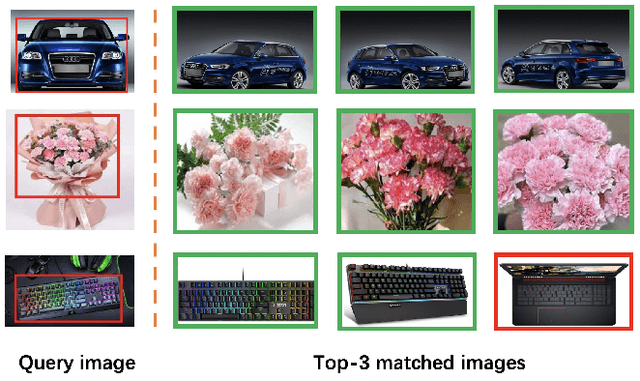
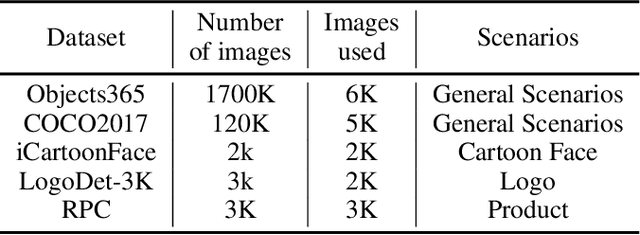
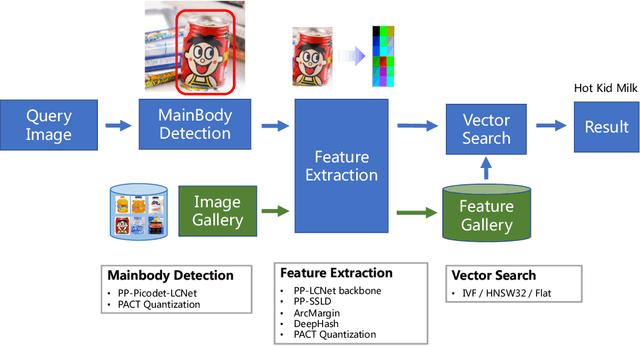
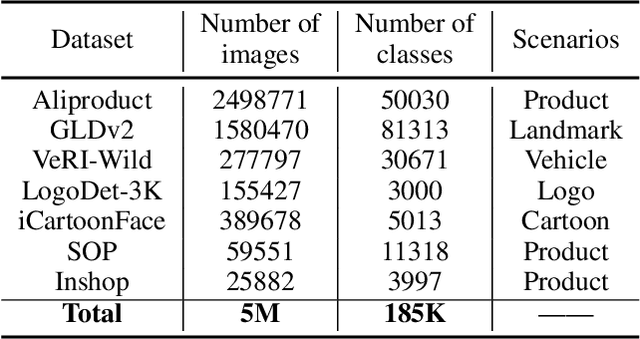
In recent years, image recognition applications have developed rapidly. A large number of studies and techniques have emerged in different fields, such as face recognition, pedestrian and vehicle re-identification, landmark retrieval, and product recognition. In this paper, we propose a practical lightweight image recognition system, named PP-ShiTu, consisting of the following 3 modules, mainbody detection, feature extraction and vector search. We introduce popular strategies including metric learning, deep hash, knowledge distillation and model quantization to improve accuracy and inference speed. With strategies above, PP-ShiTu works well in different scenarios with a set of models trained on a mixed dataset. Experiments on different datasets and benchmarks show that the system is widely effective in different domains of image recognition. All the above mentioned models are open-sourced and the code is available in the GitHub repository PaddleClas on PaddlePaddle.
PP-LCNet: A Lightweight CPU Convolutional Neural Network
Sep 17, 2021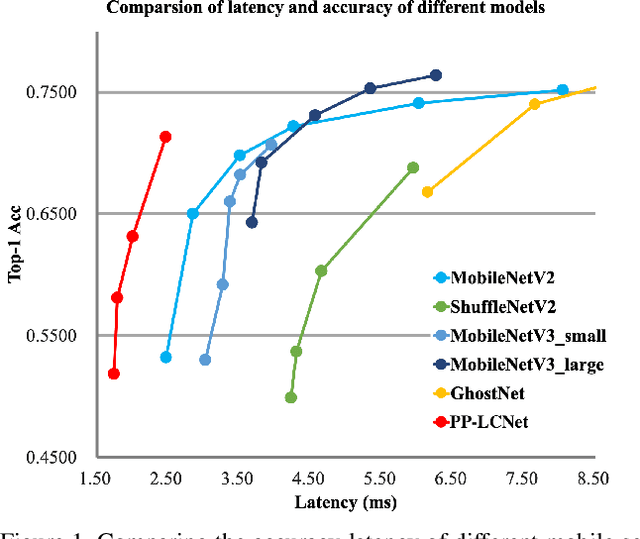
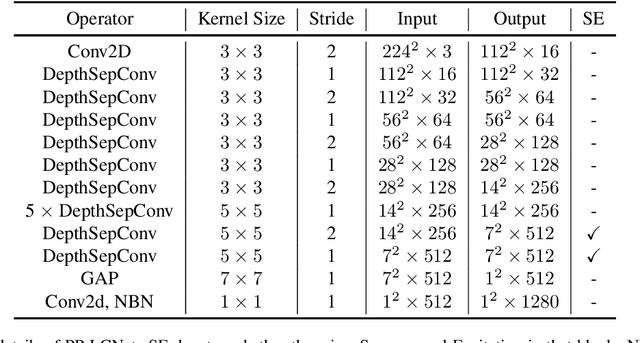
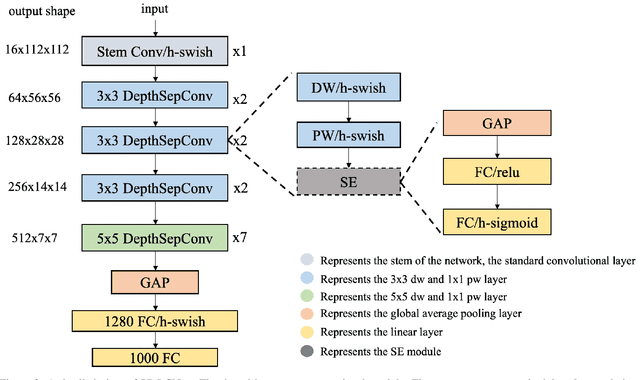
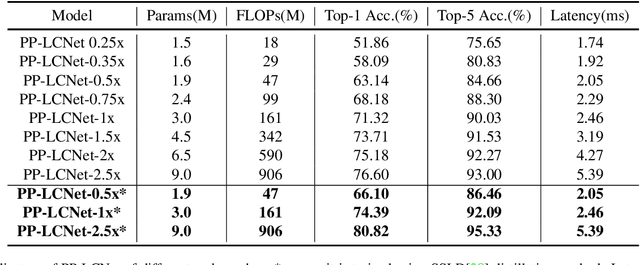
We propose a lightweight CPU network based on the MKLDNN acceleration strategy, named PP-LCNet, which improves the performance of lightweight models on multiple tasks. This paper lists technologies which can improve network accuracy while the latency is almost constant. With these improvements, the accuracy of PP-LCNet can greatly surpass the previous network structure with the same inference time for classification. As shown in Figure 1, it outperforms the most state-of-the-art models. And for downstream tasks of computer vision, it also performs very well, such as object detection, semantic segmentation, etc. All our experiments are implemented based on PaddlePaddle. Code and pretrained models are available at PaddleClas.