 Add to Chrome
 Add to Firefox
 Add to Edge
Unified Value Alignment for Generative Recommendation in Industrial Advertising
May 07, 2026
Generative Recommendation (GR) reformulates recommendation as a next-token generation problem and has shown promise in industrial applications. However, extending GR to industrial advertising is non-trivial because the system must optimize not only user interest but also commercial value. Existing GR pipelines remain largely semantics-centric, making it difficult to align value signals across tokenization, decoding, and online serving. To address this issue, we propose UniVA, a Unified Value Alignment framework for advertising recommendation. We first introduce a Commercial SID tokenizer that injects value-related attributes into SID construction, yielding value-discriminative item representations. We then develop a Generation-as-Ranking SID Decoder jointly optimized by supervised learning and eCPM-aware reinforcement learning, which fuses value scores into next-item SID generation to perform generation and ranking in one decoding process. Finally, we design a value-guided personalized beam search that reuses generation-as-ranking logits as online value guidance and applies a personalized trie tree to constrain decoding to request-valid SID paths. Experiments on the Tencent WeChat Channels advertising platform show that UniVA achieves a 37.04\% improvement in offline Hit Rate@100 over the baseline and a 1.5\% GMV lift in online A/B tests.

Spend Search Where It Pays: Value-Guided Structured Sampling and Optimization for Generative Recommendation
Feb 12, 2026Generative recommendation via autoregressive models has unified retrieval and ranking into a single conditional generation framework. However, fine-tuning these models with Reinforcement Learning (RL) often suffers from a fundamental probability-reward mismatch. Conventional likelihood-dominated decoding (e.g., beam search) exhibits a myopic bias toward locally probable prefixes, which causes two critical failures: (1) insufficient exploration, where high-reward items in low-probability branches are prematurely pruned and rarely sampled, and (2) advantage compression, where trajectories sharing high-probability prefixes receive highly correlated rewards with low within-group variance, yielding a weak comparative signal for RL. To address these challenges, we propose V-STAR, a Value-guided Sampling and Tree-structured Advantage Reinforcement framework. V-STAR forms a self-evolving loop via two synergistic components. First, a Value-Guided Efficient Decoding (VED) is developed to identify decisive nodes and selectively deepen high-potential prefixes. This improves exploration efficiency without exhaustive tree search. Second, we propose Sibling-GRPO, which exploits the induced tree topology to compute sibling-relative advantages and concentrates learning signals on decisive branching decisions. Extensive experiments on both offline and online datasets demonstrate that V-STAR outperforms state-of-the-art baselines, delivering superior accuracy and candidate-set diversity under strict latency constraints.
End-to-End Semantic ID Generation for Generative Advertisement Recommendation
Feb 12, 2026Generative Recommendation (GR) has excelled by framing recommendation as next-token prediction. This paradigm relies on Semantic IDs (SIDs) to tokenize large-scale items into discrete sequences. Existing GR approaches predominantly generate SIDs via Residual Quantization (RQ), where items are encoded into embeddings and then quantized to discrete SIDs. However, this paradigm suffers from inherent limitations: 1) Objective misalignment and semantic degradation stemming from the two-stage compression; 2) Error accumulation inherent in the structure of RQ. To address these limitations, we propose UniSID, a Unified SID generation framework for generative advertisement recommendation. Specifically, we jointly optimize embeddings and SIDs in an end-to-end manner from raw advertising data, enabling semantic information to flow directly into the SID space and thus addressing the inherent limitations of the two-stage cascading compression paradigm. To capture fine-grained semantics, a multi-granularity contrastive learning strategy is introduced to align distinct items across SID levels. Finally, a summary-based ad reconstruction mechanism is proposed to encourage SIDs to capture high-level semantic information that is not explicitly present in advertising contexts. Experiments demonstrate that UniSID consistently outperforms state-of-the-art SID generation methods, yielding up to a 4.62% improvement in Hit Rate metrics across downstream advertising scenarios compared to the strongest baseline.
DiffuReason: Bridging Latent Reasoning and Generative Refinement for Sequential Recommendation
Feb 12, 2026Latent reasoning has emerged as a promising paradigm for sequential recommendation, enabling models to capture complex user intent through multi-step deliberation. Yet existing approaches often rely on deterministic latent chains that accumulate noise and overlook the uncertainty inherent in user intent, and they are typically trained in staged pipelines that hinder joint optimization and exploration. To address these challenges, we propose DiffuReason, a unified "Think-then-Diffuse" framework for sequential recommendation. It integrates multi-step Thinking Tokens for latent reasoning, diffusion-based refinement for denoising intermediate representations, and end-to-end Group Relative Policy Optimization (GRPO) alignment to optimize for ranking performance. In the Think stage, the model generates Thinking Tokens that reason over user history to form an initial intent hypothesis. In the Diffuse stage, rather than treating this hypothesis as the final output, we refine it through a diffusion process that models user intent as a probabilistic distribution, providing iterative denoising against reasoning noise. Finally, GRPO-based reinforcement learning enables the reasoning and refinement modules to co-evolve throughout training, without the constraints of staged optimization. Extensive experiments on four benchmarks demonstrate that DiffuReason consistently improves diverse backbone architectures. Online A/B tests on a large-scale industrial platform further validate its practical effectiveness.
GPR: Towards a Generative Pre-trained One-Model Paradigm for Large-Scale Advertising Recommendation
Nov 13, 2025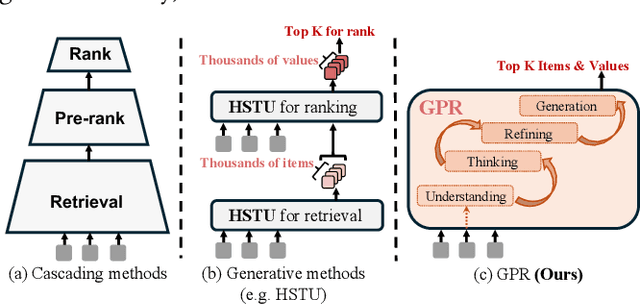
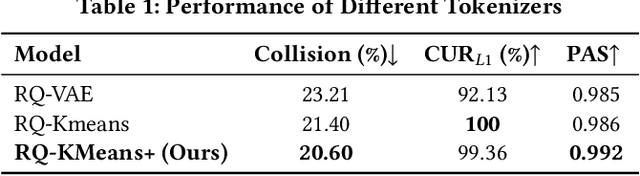
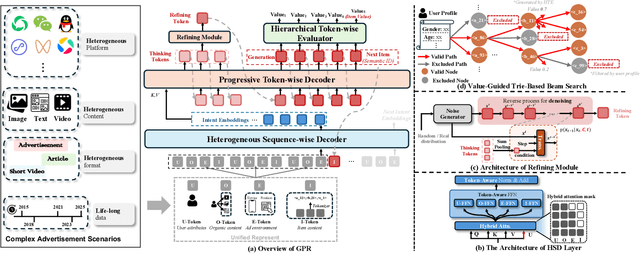
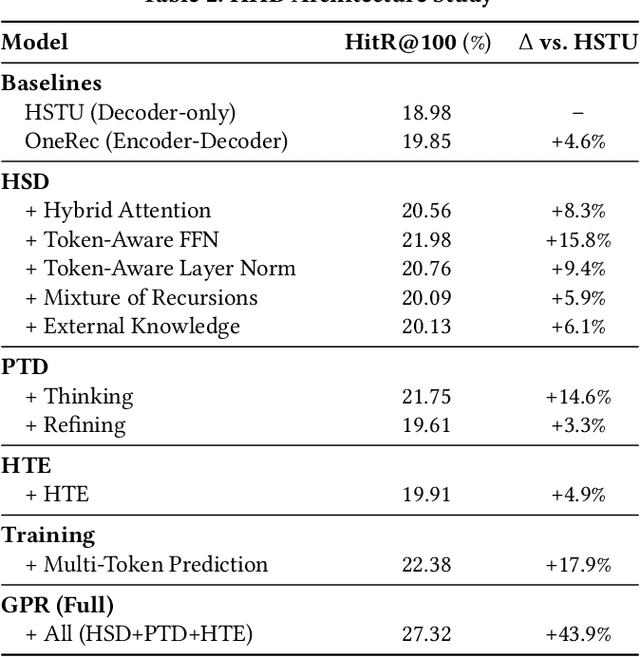
As an intelligent infrastructure connecting users with commercial content, advertising recommendation systems play a central role in information flow and value creation within the digital economy. However, existing multi-stage advertising recommendation systems suffer from objective misalignment and error propagation, making it difficult to achieve global optimality, while unified generative recommendation models still struggle to meet the demands of practical industrial applications. To address these issues, we propose GPR (Generative Pre-trained Recommender), the first one-model framework that redefines advertising recommendation as an end-to-end generative task, replacing the traditional cascading paradigm with a unified generative approach. To realize GPR, we introduce three key innovations spanning unified representation, network architecture, and training strategy. First, we design a unified input schema and tokenization method tailored to advertising scenarios, mapping both ads and organic content into a shared multi-level semantic ID space, thereby enhancing semantic alignment and modeling consistency across heterogeneous data. Second, we develop the Heterogeneous Hierarchical Decoder (HHD), a dual-decoder architecture that decouples user intent modeling from ad generation, achieving a balance between training efficiency and inference flexibility while maintaining strong modeling capacity. Finally, we propose a multi-stage joint training strategy that integrates Multi-Token Prediction (MTP), Value-Aware Fine-Tuning and the Hierarchy Enhanced Policy Optimization (HEPO) algorithm, forming a complete generative recommendation pipeline that unifies interest modeling, value alignment, and policy optimization. GPR has been fully deployed in the Tencent Weixin Channels advertising system, delivering significant improvements in key business metrics including GMV and CTCVR.