 Add to Chrome
 Add to Firefox
 Add to Edge
Boosting Document Parsing Efficiency and Performance with Coarse-to-Fine Visual Processing
Mar 25, 2026
Document parsing is a fine-grained task where image resolution significantly impacts performance. While advanced research leveraging vision-language models benefits from high-resolution input to boost model performance, this often leads to a quadratic increase in the number of vision tokens and significantly raises computational costs. We attribute this inefficiency to substantial visual regions redundancy in document images, like background. To tackle this, we propose PaddleOCR-VL, a novel coarse-to-fine architecture that focuses on semantically relevant regions while suppressing redundant ones, thereby improving both efficiency and performance. Specifically, we introduce a lightweight Valid Region Focus Module (VRFM) which leverages localization and contextual relationship prediction capabilities to identify valid vision tokens. Subsequently, we design and train a compact yet powerful 0.9B vision-language model (PaddleOCR-VL-0.9B) to perform detailed recognition, guided by VRFM outputs to avoid direct processing of the entire large image. Extensive experiments demonstrate that PaddleOCR-VL achieves state-of-the-art performance in both page-level parsing and element-level recognition. It significantly outperforms existing solutions, exhibits strong competitiveness against top-tier VLMs, and delivers fast inference while utilizing substantially fewer vision tokens and parameters, highlighting the effectiveness of targeted coarse-to-fine parsing for accurate and efficient document understanding. The source code and models are publicly available at https://github.com/PaddlePaddle/PaddleOCR.

PP-OCRv5: A Specialized 5M-Parameter Model Rivaling Billion-Parameter Vision-Language Models on OCR Tasks
Mar 25, 2026The advent of "OCR 2.0" and large-scale vision-language models (VLMs) has set new benchmarks in text recognition. However, these unified architectures often come with significant computational demands, challenges in precise text localization within complex layouts, and a propensity for textual hallucinations. Revisiting the prevailing notion that model scale is the sole path to high accuracy, this paper introduces PP-OCRv5, a meticulously optimized, lightweight OCR system with merely 5 million parameters. We demonstrate that PP-OCRv5 achieves performance competitive with many billion-parameter VLMs on standard OCR benchmarks, while offering superior localization precision and reduced hallucinations. The cornerstone of our success lies not in architectural expansion but in a data-centric investigation. We systematically dissect the role of training data by quantifying three critical dimensions: data difficulty, data accuracy, and data diversity. Our extensive experiments reveal that with a sufficient volume of high-quality, accurately labeled, and diverse data, the performance ceiling for traditional, efficient two-stage OCR pipelines is far higher than commonly assumed. This work provides compelling evidence for the viability of lightweight, specialized models in the large-model era and offers practical insights into data curation for OCR. The source code and models are publicly available at https://github.com/PaddlePaddle/PaddleOCR.
Real5-OmniDocBench: A Full-Scale Physical Reconstruction Benchmark for Robust Document Parsing in the Wild
Mar 04, 2026While Vision-Language Models (VLMs) achieve near-perfect scores on digital document benchmarks like OmniDocBench, their performance in the unpredictable physical world remains largely unknown due to the lack of controlled yet realistic evaluations. We introduce Real5-OmniDocBench, the first benchmark that performs a full-scale, one-to-one physical reconstruction of the entire OmniDocBench v1.5 (1,355 images) across five critical real-world scenarios: Scanning, Warping, Screen-Photography, Illumination, and Skew. Unlike prior benchmark that either lack digital correspondence or employ partial sampling, our complete ground-truth mapping enables, for the first time, rigorous factor-wise attribution of performance degradation-allowing us to pinpoint whether failures stem from geometric distortions, optical artifacts, or model limitations. Our benchmark establishes a challenging new standard for the community, demonstrating that the 'reality gap' in document parsing is far from closed, and provides a diagnostic tool to guide the development of truly resilient document intelligence.
ERNIE 5.0 Technical Report
Feb 04, 2026In this report, we introduce ERNIE 5.0, a natively autoregressive foundation model desinged for unified multimodal understanding and generation across text, image, video, and audio. All modalities are trained from scratch under a unified next-group-of-tokens prediction objective, based on an ultra-sparse mixture-of-experts (MoE) architecture with modality-agnostic expert routing. To address practical challenges in large-scale deployment under diverse resource constraints, ERNIE 5.0 adopts a novel elastic training paradigm. Within a single pre-training run, the model learns a family of sub-models with varying depths, expert capacities, and routing sparsity, enabling flexible trade-offs among performance, model size, and inference latency in memory- or time-constrained scenarios. Moreover, we systematically address the challenges of scaling reinforcement learning to unified foundation models, thereby guaranteeing efficient and stable post-training under ultra-sparse MoE architectures and diverse multimodal settings. Extensive experiments demonstrate that ERNIE 5.0 achieves strong and balanced performance across multiple modalities. To the best of our knowledge, among publicly disclosed models, ERNIE 5.0 represents the first production-scale realization of a trillion-parameter unified autoregressive model that supports both multimodal understanding and generation. To facilitate further research, we present detailed visualizations of modality-agnostic expert routing in the unified model, alongside comprehensive empirical analysis of elastic training, aiming to offer profound insights to the community.
PaddleOCR-VL-1.5: Towards a Multi-Task 0.9B VLM for Robust In-the-Wild Document Parsing
Jan 29, 2026We introduce PaddleOCR-VL-1.5, an upgraded model achieving a new state-of-the-art (SOTA) accuracy of 94.5% on OmniDocBench v1.5. To rigorously evaluate robustness against real-world physical distortions, including scanning, skew, warping, screen-photography, and illumination, we propose the Real5-OmniDocBench benchmark. Experimental results demonstrate that this enhanced model attains SOTA performance on the newly curated benchmark. Furthermore, we extend the model's capabilities by incorporating seal recognition and text spotting tasks, while remaining a 0.9B ultra-compact VLM with high efficiency. Code: https://github.com/PaddlePaddle/PaddleOCR
PaddleOCR-VL: Boosting Multilingual Document Parsing via a 0.9B Ultra-Compact Vision-Language Model
Oct 16, 2025In this report, we propose PaddleOCR-VL, a SOTA and resource-efficient model tailored for document parsing. Its core component is PaddleOCR-VL-0.9B, a compact yet powerful vision-language model (VLM) that integrates a NaViT-style dynamic resolution visual encoder with the ERNIE-4.5-0.3B language model to enable accurate element recognition. This innovative model efficiently supports 109 languages and excels in recognizing complex elements (e.g., text, tables, formulas, and charts), while maintaining minimal resource consumption. Through comprehensive evaluations on widely used public benchmarks and in-house benchmarks, PaddleOCR-VL achieves SOTA performance in both page-level document parsing and element-level recognition. It significantly outperforms existing solutions, exhibits strong competitiveness against top-tier VLMs, and delivers fast inference speeds. These strengths make it highly suitable for practical deployment in real-world scenarios.
PP-DocLayout: A Unified Document Layout Detection Model to Accelerate Large-Scale Data Construction
Mar 21, 2025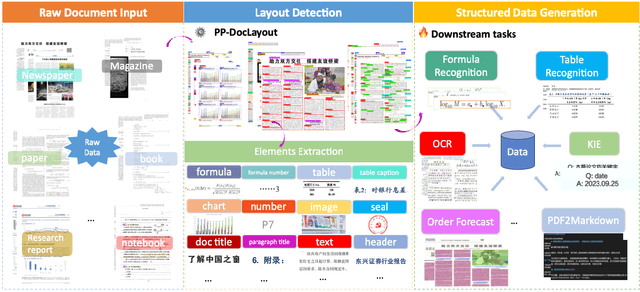
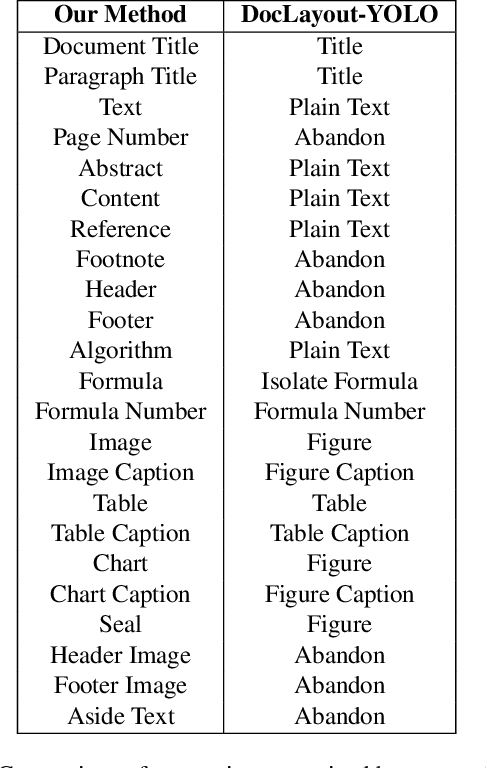
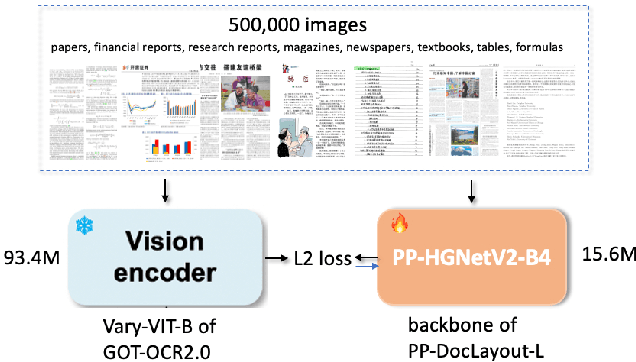

Document layout analysis is a critical preprocessing step in document intelligence, enabling the detection and localization of structural elements such as titles, text blocks, tables, and formulas. Despite its importance, existing layout detection models face significant challenges in generalizing across diverse document types, handling complex layouts, and achieving real-time performance for large-scale data processing. To address these limitations, we present PP-DocLayout, which achieves high precision and efficiency in recognizing 23 types of layout regions across diverse document formats. To meet different needs, we offer three models of varying scales. PP-DocLayout-L is a high-precision model based on the RT-DETR-L detector, achieving 90.4% mAP@0.5 and an end-to-end inference time of 13.4 ms per page on a T4 GPU. PP-DocLayout-M is a balanced model, offering 75.2% mAP@0.5 with an inference time of 12.7 ms per page on a T4 GPU. PP-DocLayout-S is a high-efficiency model designed for resource-constrained environments and real-time applications, with an inference time of 8.1 ms per page on a T4 GPU and 14.5 ms on a CPU. This work not only advances the state of the art in document layout analysis but also provides a robust solution for constructing high-quality training data, enabling advancements in document intelligence and multimodal AI systems. Code and models are available at https://github.com/PaddlePaddle/PaddleX .
WebCanvas: Benchmarking Web Agents in Online Environments
Jun 18, 2024For web agents to be practically useful, they must adapt to the continuously evolving web environment characterized by frequent updates to user interfaces and content. However, most existing benchmarks only capture the static aspects of the web. To bridge this gap, we introduce WebCanvas, an innovative online evaluation framework for web agents that effectively addresses the dynamic nature of web interactions. WebCanvas contains three main components to facilitate realistic assessments: (1) A novel evaluation metric which reliably capture critical intermediate actions or states necessary for task completions while disregarding noise caused by insignificant events or changed web-elements. (2) A benchmark dataset called Mind2Web-Live, a refined version of original Mind2Web static dataset containing 542 tasks with 2439 intermediate evaluation states; (3) Lightweight and generalizable annotation tools and testing pipelines that enables the community to collect and maintain the high-quality, up-to-date dataset. Building on WebCanvas, we open-source an agent framework with extensible modules for reasoning, providing a foundation for the community to conduct online inference and evaluations. Our best-performing agent achieves a task success rate of 23.1% and a task completion rate of 48.8% on the Mind2Web-Live test set. Additionally, we analyze the performance discrepancies across various websites, domains, and experimental environments. We encourage the community to contribute further insights on online agent evaluation, thereby advancing this field of research.
DETRs Beat YOLOs on Real-time Object Detection
Apr 17, 2023


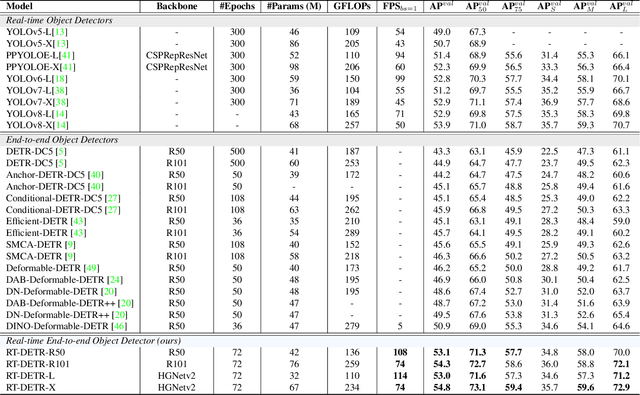
Recently, end-to-end transformer-based detectors (DETRs) have achieved remarkable performance. However, the issue of the high computational cost of DETRs has not been effectively addressed, limiting their practical application and preventing them from fully exploiting the benefits of no post-processing, such as non-maximum suppression (NMS). In this paper, we first analyze the influence of NMS in modern real-time object detectors on inference speed, and establish an end-to-end speed benchmark. To avoid the inference delay caused by NMS, we propose a Real-Time DEtection TRansformer (RT-DETR), the first real-time end-to-end object detector to our best knowledge. Specifically, we design an efficient hybrid encoder to efficiently process multi-scale features by decoupling the intra-scale interaction and cross-scale fusion, and propose IoU-aware query selection to improve the initialization of object queries. In addition, our proposed detector supports flexibly adjustment of the inference speed by using different decoder layers without the need for retraining, which facilitates the practical application of real-time object detectors. Our RT-DETR-L achieves 53.0% AP on COCO val2017 and 114 FPS on T4 GPU, while RT-DETR-X achieves 54.8% AP and 74 FPS, outperforming all YOLO detectors of the same scale in both speed and accuracy. Furthermore, our RT-DETR-R50 achieves 53.1% AP and 108 FPS, outperforming DINO-Deformable-DETR-R50 by 2.2% AP in accuracy and by about 21 times in FPS. Source code and pretrained models will be available at PaddleDetection.
GLAD: Grounded Layered Autonomous Driving for Complex Service Tasks
Oct 05, 2022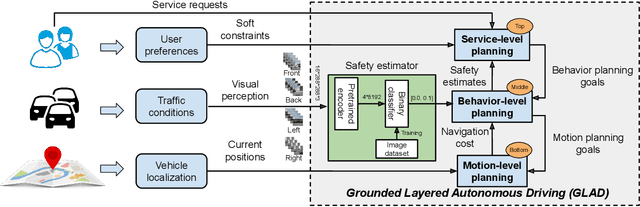
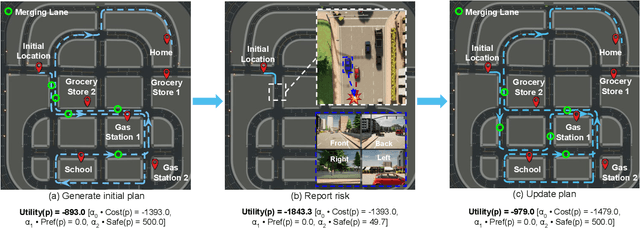
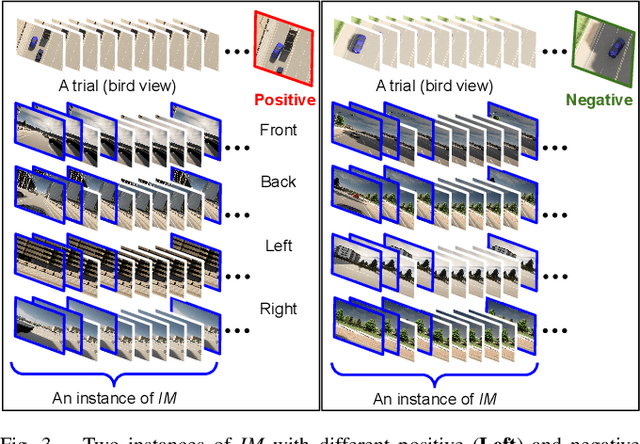
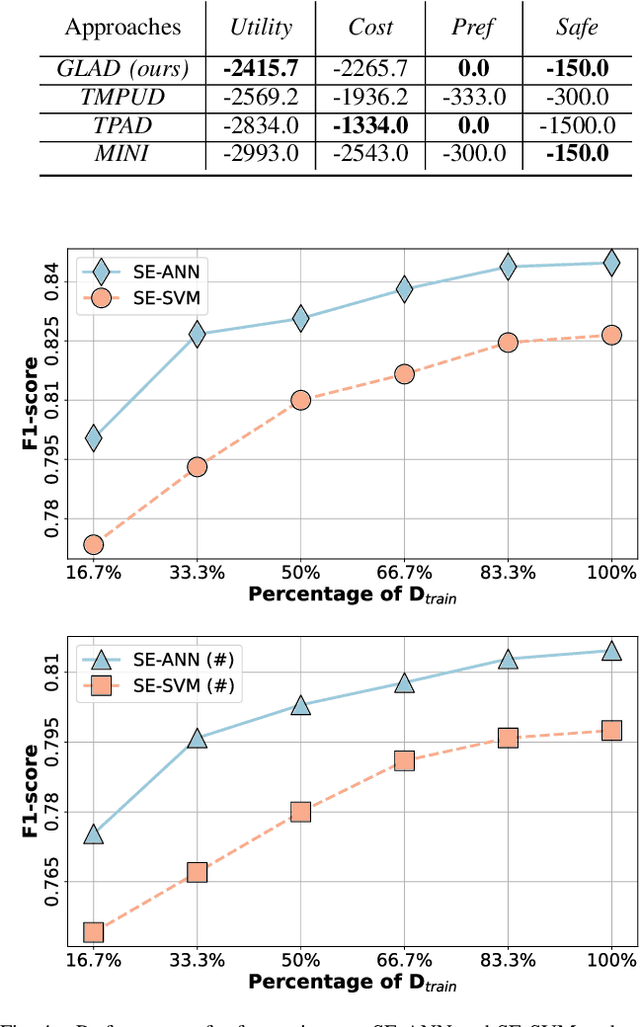
Given the current point-to-point navigation capabilities of autonomous vehicles, researchers are looking into complex service requests that require the vehicles to visit multiple points of interest. In this paper, we develop a layered planning framework, called GLAD, for complex service requests in autonomous urban driving. There are three layers for service-level, behavior-level, and motion-level planning. The layered framework is unique in its tight coupling, where the different layers communicate user preferences, safety estimates, and motion costs for system optimization. GLAD is visually grounded by perceptual learning from a dataset of 13.8k instances collected from driving behaviors. GLAD enables autonomous vehicles to efficiently and safely fulfill complex service requests. Experimental results from abstract and full simulation show that our system outperforms a few competitive baselines from the literature.